

Alexander Grabovetskiy, woodcarver, School of Woodcarving · Published 2020
What does a wood carver mean by "the extent"?
Quick answer: The extent is the word I used in Venice Room 88.2 about a volute, with the word probably in front of it. Right after it I said I would get a little deeper, and then came a cleanup and more roundness, with the final look left for later.
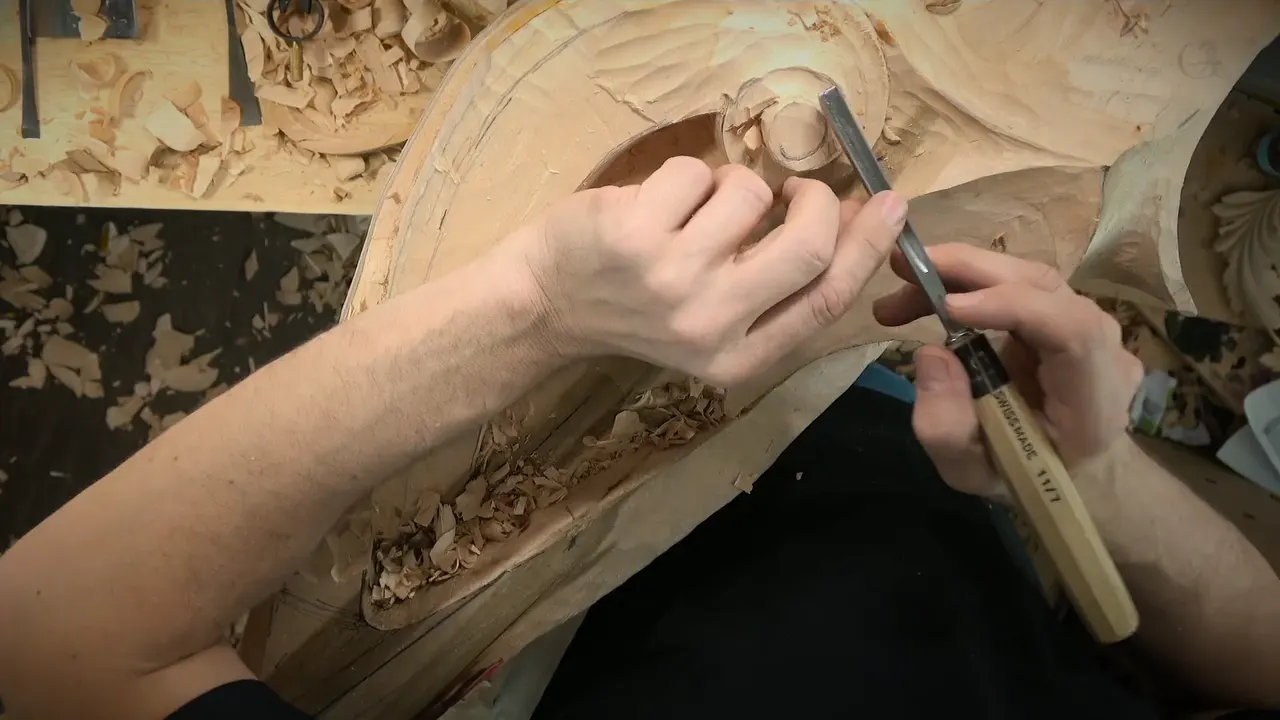

The extent, in Venice Room 88.2, is how far I wanted to take one volute for now. My next plan was a little deeper, so the stop was not the end of that spot.
Have you ever carved a curve and wondered when to set the gouge down? Did the next pass look so easy that you kept going? Then you know my spot in workshop 88. We start at the volute, and then this one word leads us through lessons from other courses.
Where the extent landed in this part
- A number 11 at seven millimeters (0.28 in) was the tool I named.
- One side was to keep an equal distance.
- A macaroni tool was for a nice vault.
- The parts had to stay separated, or it did not look right.
- A hedge came with the extent.
- Cleanup came next, then that roundness, and the final look stayed open.
What was I doing when I said the extent?
This is a short wood carving video, and it stays on one volute. Near the start I said, "start my movement somewhere right here and get this part little lower." Next I said what I was after. "Okay, so it's going to be really nice and beautiful movement. Go downhill, downhill, downhill, and go all the way this way."
I called it "exactly the same idea," and said that's what I'm going to do. The tool came next. "Number 11, and in this case, seven millimeters." Later I said I'm going to leave on a side about the same amount of the distance, and I stopped to show you that side. "So I've got the same equal distance, okay?"

Then a macaroni tool. "And again, let me use a macaroni tool." A really nice vault would come of it, I said, and a really nice transition uphill. Further on, I said maybe the macaroni tool again.
Something was not perfect yet, I said, and I will worry about it little later. Blending was next. "And let's blend that together."

All that movement goes down, down, down, down, and up right here, I said. Around here, I said, the same idea applies. It has to be separated, or, in my words, "it just doesn't look right."
I also said, "And this one needs to be sharpened." Then, "let me change the position."

What came right after I named it?
Here is the line this page hangs on, word for word. "And that is probably the extent I want to take this volute as of now." Two hedges sit in it.

My next words were a plan, "let me actually get little deeper here." Then came a need. "So now what I have to do, just clean up and create that roundness."
I left the look open. The final decision on the end result had not been made, I said, so I would leave it for now. The overall idea, I said, is going to be the same, just refined.

The last lines plan one more pass. "Let me create more rounder version of it." Then, "And for that, I use a three-quarter of an inch." That is 19 mm. The captions end there, so I cannot tell you which tool carries that size.
Did the rest of workshop 88 say the same thing?
The opening video leaves a margin. I told you I left approximately a 16th of an inch (1.6 mm) to my final line, and that I had not mentioned it. Leaving a little bit is a good idea, I said, for the cleaning operation. My flute pointed up pretty much 90 degrees, or 12 o'clock, so I would not undercut, and a number 11 did that work.
Number five fit the profile really good in that video. The number five had been dragging a little bit of the material, so I wanted the sides cleaner, and I said I could use just the number three for that.

The same words came back there, "As of now, later I will undercut," and then "But not much." Undercutting right then would be a big mistake, I said.
The plan in the third video was to leave it like that for now and clean a little later, because who knows, maybe I would change some stuff. Still, "I've got the main movement."
I said I need to clean one area first, because then it is much easier for me to see what is going on. One line was going to slope from flat to roll. For another part, I was not sure whether I'd make a fillet or a chamfer, and a chamfer would have to look good on this side. A concave would run downhill, so one part would be the highest spot.

That video gives one more number. Let's say half an inch or so, I said, then "Exactly half an inch," everywhere. That is 12.7 mm. A few calls were still open in there.
Where else did the limit come up?
Below are lines from my other lessons that sound like the one above. Each sits in its own video, and I name it so you can find it from the lesson page. Some use the word, and some use other words.
Did workshop 87 give me the same line?
Over in workshop 87, part 3, I said it almost word for word. I liked what I saw, and I said that was probably the extent I wanted to take it. More would come later, toward the final form. For now one section could lose some wood with a chop, since it just didn't look really good.

My options there were a drilled hole, or probably number nine with a plug cut. The plug cut, I said, brings exactly the same result. That way I would not lose a picture, and I would not lose the outline.
Venice Room 1, eighth video, has a cousin of it. I took number one chisel and cleaned that right away. You could go to the extent if you wish, I said, but I really don't need to, because I think it would be a waste of time.
You could make a plywood pattern first, I said, then make the rough cut about maybe 3/16 of an inch (4.8 mm) away, and use a router. It is perfect even now, and the router would make it even nicer, I said. Most of it would be gone anyway. For me, there was no reason.
How near is near enough on the volute lessons?
I was pretty close in Venice Room 153, third video, with about 16th of an inch left in the space right there. Well, a millimeter and a half, I said, which is 1.5 mm or 0.06 in. Probably the farthest I would take it right then, I said.

Venice Room 158, first video, hedges the stop the same way, in nearly the words of 88.2. I wanted no more facets or anything like that. Blending was all that remained, to make it a little more smoother and bring more softer lines. I added that a lot of cleanup needs to be done yet, and that I would show you from above.

A limit sits beside a volute once more in Venice Room 156, third video. A smaller one was needed, I said. Then, "And that's it." Not much more would come off from that point, and I was "super happy with this." The point of that acanthus, I said, would sit slightly on top of the volute.
The reason in Venice Room 44, sixth video, is a ridge. Losing it would cost the overall feel of dimension, so I held back from taking it down more. By my words, I'm using 20 millimeters, about 0.8 in. "Oops, that's not good." Then, "that's actually okay, but I should control better."

In Venice Room 37, first video, I said that was likely as much as I cared to carve there, at least for now. The feel of the whole picture mattered to me, and so did still feeling the right movements.
Who gets to set the limit?
Furniture Panel 21 has it in two of its videos, ten and eleven. In the tenth I said the detail was not final. Some of you would probably already leave it at this stage, and that's absolutely okay with me. "But I want to take it to perfection."

The eleventh video picks up one detail. "And that is probably as far as I want to go with this detail." In real life, I said, it's a really tiny detail. Cleaning was next on my list.

Hashemi Flowers 27, first video, hands the call to you. It is up to you now how far you go with the details, I said, and how nice you want to see them. For me, I do like this project left a little rougher.
I put it as a question of extremes in the seventh video of Venice Room 100. How extreme you go is absolutely up to you, I said. Just before, I had told you to blend everything and make it look even more beautiful.

What stops me before the end?
A neighbor can. In Lily Box 11, thirteenth video, I was pretty close to the leg. Going too close would lose the effect of separation on that side, and I called that important too. That was probably how far I would go there, I said.

Work still to do can. Lily Box 10, tenth video, left me no more than a couple of millimeters, a bit under a tenth of an inch, right there. It was probably the end of that pass, I said. I held off because I still have to create the detail on the inside. Nice and solid, I said, but still like a real flower. "At least that's my intention."

Business can, too. Hashemi Flowers 49, second video, has me saying this is probably, for me, the most challenging part, to decide how far a piece goes. The true artist can work on one piece nearly all his life, I said, and still see it's not done.
The business side of me just kicks in, I said, and I have to say, "That's enough. I have to feed my family." I can't go on and on. At some point I have to finish, and let it go.

How does a tool stay short of too far?
Greek Acanthus 7, third video, shows one way with a V tool. I laid it on my finger, and that finger was controlling how far the tool went, because it's a micro cut. Further on I said I have to make sure I'm not digging too deep, so it's better to take your time.
Take Venice Room 31, ninth video. I could take it even lower and go all the way, pretty much right away. That would not give me really good movement, I said. What I could do instead was move slightly in that direction, and I thought that would be better.
Why do I say too extreme?
Other lessons say it with another word. After cleaning off camera in Venice Room 108, first video, the extreme was not what I wanted. In Venice Room 107, first video, one side was done, and I did not want it too extreme. At Venice Room 140 I had done some homework off camera, and I held back there too, with maybe a little cleanup planned.

Floral and Molding for the Panel 6, second video, puts a time on it. Too extreme, I said, was not what I wanted there. More time would go later to clean everything and refine all those lines, I said. Right now I see only the overall movement. The end result is not there yet.
What did I say about the extent, line by line?
| Where I said it | What I said |
|---|---|
| The video this page starts from | the word extent, with probably in front of it |
| Taken so far | this volute |
| Next on my list for it | a little deeper, plus cleanup and more roundness |
| Still open | the final look at the end |
| In workshop 87 | the same word, and a final form a little later |
| Lesson 153 of Venice Room | a margin left, and probably the farthest I would go |
| Lesson 156, part 3 | not much more from that point, and super happy with this |
| In Lily Box 11 | close to the leg, so probably no farther |
| Hashemi 49, second video | the point where business says that's enough and I have to feed my family |
| Panel lesson 21, tenth video | a stage others might keep, and perfection for me |
Is there a spot on your own piece where you could stop and say probably? Could a small margin be enough for the cleaning? Workshop 88 waits inside one tuition plan with the rest of Part 8 of the Venice Room, and this page begins at the volute, with a number 11.
How it's done
- Name the tool and the size. In 88.2 I named a number 11 and, in this case, seven millimeters (0.28 in).
- Leave an equal distance on a side. A side was to keep about the same amount of the distance, and then I showed you that side.
- Reach for the macaroni tool. A macaroni tool, I said, would give me a really nice vault and a really nice transition uphill.
- Blend, and keep the parts separated. Blending came next, "let's blend that together," and the parts have to be separated or it just doesn't look right.
- Set the extent with a hedge. I hedged it with probably, and with a limit for now, when I said the extent.
- Plan the next pass. Next, a little deeper, plus a cleanup and that roundness.
Frequently asked questions
Does the extent mean a carving is finished?
Not in 88.2. When I named it, I planned to get a little deeper. Then I said I had to clean up and create that roundness, with the final decision still open.
How much wood did I leave for cleaning in workshop 88?
Approximately a sixteenth of an inch (1.6 mm) to my final line. I had not mentioned it, I said, and leaving a little bit is a good idea. That figure, a millimeter and a half, shows up in Venice Room 153.
Who decides how far a carving goes?
How far you go with the details was your call, I said in Hashemi 27. The extreme was yours to pick in Venice Room 100. In Furniture Panel 21 I said some of you would stop at that stage, which is absolutely okay with me.
What to carve next