
Alexander Grabovetskiy, woodcarver, School of Woodcarving · Published 2021
What does a wood carver mean by "the clock idea"?
Quick answer: In part 10 of workshop 97, the sentence about the number 11 ends on "11:30" and "the clock idea." Workshops 88 and 89, and the Furniture Panel lessons, name other hours for the flute, and some add a limit. Each hour is read here with the lines around it.
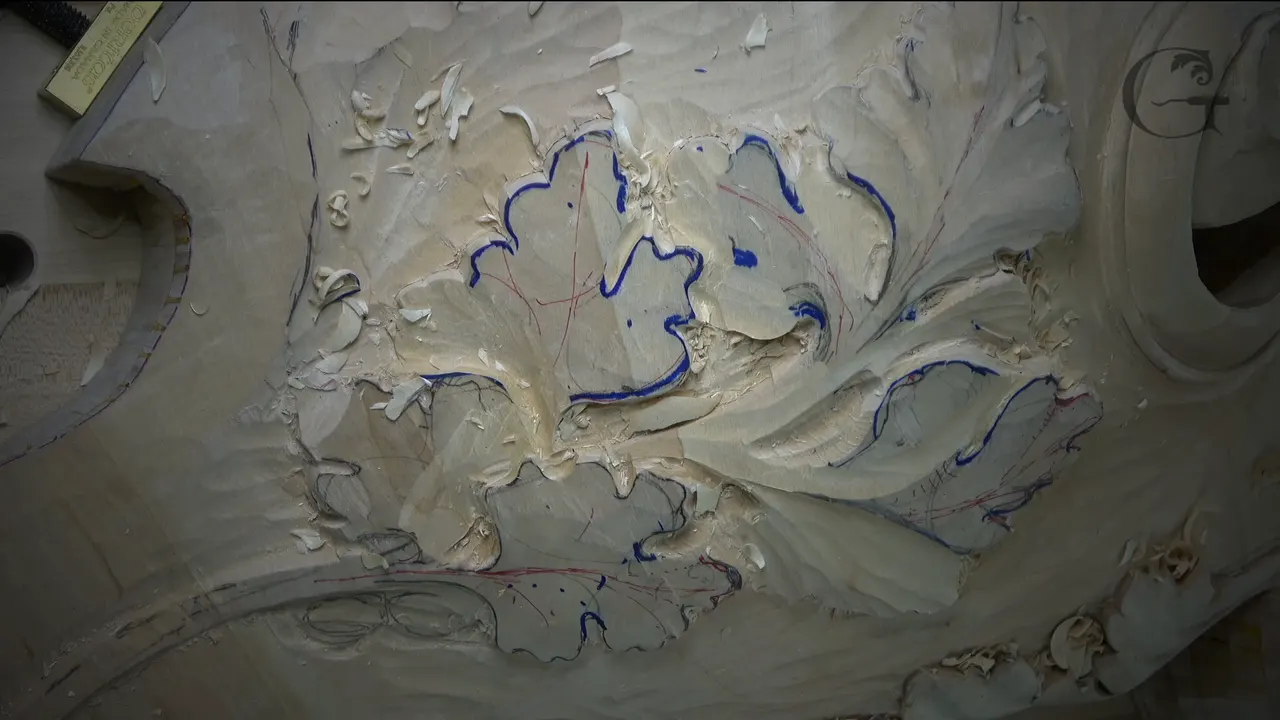

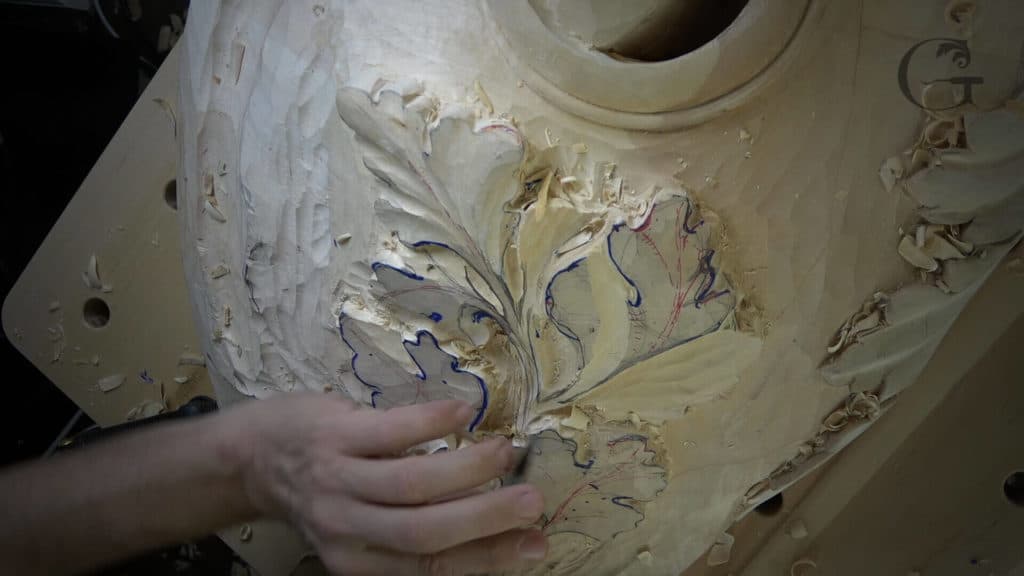
In the tenth part of workshop 97, the words "the clock idea" and "11:30" sit in one sentence with a number 11 gouge. Other wood carving lessons of mine give the flute of a tool a clock hour. Each passage here is read with the lines around it.
Ever held a gouge over a wall you want to stay straight, and wondered where to point the hollow of the tool? Workshop 97 speaks to it, and so do the lessons below, each with its own hour. Every size is in millimeters and inches, my own figure first.
What sits beside the clock idea in part 10?
The part says "I am ready to create the shapes" and the center line follows. A stem gets two limits, "too wide" and "too tiny."

Size comes next: "about six millimeters, about a quarter inch by the end." That is 0.24 in, and a quarter inch is 6.35 mm. A second figure sits close by, "I mean, quarter inch, 3/16 of an inch, that should be all right." Three-sixteenths of an inch is 4.8 mm.
One tool is named: "I'll take same number 11 and 5 millimeters" (about 0.2 in). The plan is "start excavating those areas." Two plans follow, "Attack this side also right away" and "And left side."
Then comes "What I'm after, I'm just establishing wall." Angle gets a figure of its own: "about 90 degrees at this point. Okay? So that surface versus my wall, about 90 degrees." A right angle is 90 degrees. After it, "Later on, of course, I'll just round it up. But for now, I'm just establishing boundaries."

The clock line sits in a long sentence. It starts "And the number 11 is probably one of the best tools to do that job". It goes on with "because automatically one of the wings, it actually gives me that pretty close to 90 degrees if I'm moving that to approximately maybe about 11:30, if you like the clock idea."
Right after it, "I mean, I'm talking about the flute that is inside of it." Next, "It's a flute, and I'm just twisting slightly, and I'll be able to control what happens on the side of my tool."
A limit sits beside it: "But without the undercutting." Undercutting would be "a big mistake." Then "Later on, yes, it's okay to undercut, but not right now. Not right away."

A bigger size is named next: "And I need to get little bigger number 11. Now take 10 millimeters" (0.39 in). The plan for it is "And with the side of it, I'll just take out some of the background."
The two parts beside it name the same tool. In the ninth part, the plan is "Let me use again 10 millimeters." Next, "Number 11. Again, that is a veiner." The smaller one is "the smaller number 11 veiner with five millimeters" (0.197 in). The eleventh part has the plan "Let me use 10 millimeters" (about 0.4 in), and later the words are "10 millimeters. Thinner." That part also says "It's a good habit, actually, to rotate or walk around if you don't have a setup like me, and take a look from different points of view".
Which Venice Room workshops name an hour for the flute?
Workshop 89 has the idea in its eighth video. A side gets a name first, "the left wing of the tool." Then the clock: "the idea of clock". The next words are "that would be my flute". After that, "just place like this straight down, that would be 12 o'clock". Turning reads "rotate to approximately 10 o'clock, okay? Or even to 9 o'clock." One more line reads "And if you're in Europe, it would be 21 o'clock." Last, "Or if you have been in military". See workshop 89 for the full part.

Over in workshop 88, the flute is named in the middle of a plan: "flute, which is the middle part of a tool, 12 o'clock. I'm going to rotate to the left, about 11 o'clock, I would say".

The first part of that same workshop ties the twelve to a goal: "my flute is going up 90 degrees pretty much, or 12 o'clock." Further on in that part, the words are "I'm just trying not to undercut."
Video nine of workshop 89 has hours too: "the flute about 9:00 o'clock." Beyond it, "turn opposite direction, 3:00 o'clock". Around them sits "clean right away pretty much that background."

The twelve and a turn sit in workshop 91: "if the flute is up right now, like this 12 o'clock." Next, "my cut about 2 o'clock or so carefully." What follows is "it's going to blend with this surface, but it's going to be more undercut."
In workshop 93, a small size comes with the hour: "number 11 and two millimeters" (0.08 in), then "a cut with the flute approximately, I would say, one o'clock".

A veiner and a side are named in workshop 95: "Veiner #11, and I'm positioning my tool at approximately one o'clock and using just the side of my tool."
Over in workshop 147, a size and a remark on the hour sit together: "take four millimeters" (0.16 in). Then "approximately 14 o'clock, like 2:00 PM." The remark ends with "I'm sorry to say that, 14, because it's afternoon for me."

And workshop 152 gives "put my flute to about 10 o'clock." Further along, "23 o'clock if you live anywhere else, not in the United States." A 24-hour clock has a Wikipedia page.
Which Furniture Panel lessons name an hour for the flute?
The plainest line sits in Furniture Panel 29, and it names the flute outright. Just before it, "I can probably safely can outline it." Then "12 o'clock flute." Straight after it, "the flute is the center part of the tool and 12 o'clock would be just up, okay, 12 o'clock, one o'clock toward the right, let's say 11 o'clock toward the left."

That same lesson has "get my flute straight up to 12 o'clock and I'll start outlining." About a panel that goes above another, the plan is a turn to one o'clock, with "it's just approximate, okay" and "exactly one o'clock, just approximate."
Furniture Panel 26 gives the left side a number: "In my case, I'm gonna do to about 11 o'clock." Before it, "place my tool to the left." Close behind it, "And excavate little deeper."

For a flip, see Furniture Panel 28: "flute is up to 12 o'clock. I'm gonna flip it to six o'clock".

A thought rides with the hour in Furniture Panel 30: "So approximately 11 o'clock, or maybe, actually I can go a little deeper right here."
A limit sits beside the twelve in Furniture Panel 32, "I do not wanna undercut yet." Just before it, "But I have to keep an eye."

Furniture Panel 35 has the Europe remark. Its hour is "approximately two o'clock", and for Europe, "14 o'clock."
One wing gets named in Furniture Panel 36: "the left side, like about nine o'clock."

Minutes join the hours in Furniture Panel 38: "up like 12 o'clock." Following that, "use either of the sides of the wings." Turning goes "about maybe two o'clock or all the way to three o'clock or two 30, I should say 2 45." Next, "use just a side as a chisel, as a flat chisel and remove little more." A chisel has its own Wikipedia page. For the other side, "another side of the clock to the left."
Tool and hour meet in Furniture Panel 25: "with my flute, which is the middle part of the tool". The hour there is one o'clock.
Beside a limit, Furniture Panel 37 has a flute near 12 o'clock, with "keep an eye how deep the background is." Close by, "I cannot create the cut deeper than the background." Reading Furniture Panel 34: "to the left about maybe, I dunno, 10 o'clock, I can probably see that undercut underneath of the sleeve." And Furniture Panel 27 reads "to about nine o'clock, well actually 10 o'clock in this case and kind of create undercut." In its third video, Furniture Panel 32 has "about millimeter and a half" (0.06 in). Beyond that, "I can start undercutting to undercut even better."
Which other courses carry an hour?
The Modern Acanthus course, lesson 2, has "start with my flute up twelve o'clock." Turning is "nine o'clock. Okay, nine o'clock." Next, "I'm gonna dig right underneath."

In that course, lesson 4 has "turn slightly my flute to about one o'clock." Then "start blending." Later, "you know almost to three o'clock."
Lesson 6 has "I gonna create my first preliminary cut." Beyond it, "Presenting my tools about I would say eleven o'clock." Then "Almost like undercutting. It's not real undercut." The third video of lesson 6 gives "I would not undercut right here." The flute starts "up somewhere right there", and "I turn while I'm carving to the left." The turn is "I don't know 10 o'clock", with "I'm not gonna do nine o'clock because I do have some stuff on my way."
Lesson 8 starts with "I'm gonna start with like twelve o'clock. So up." Angle gets "90 degrees pretty much to the surface". The turn is "2:30 something like that." Then comes a question, "Can you see what time I gonna create?"

The Floral and Molding course, lesson 12, gives the tool two hours: "I can rotate any direction and use just either side of the tool." Beyond that, "about 10 o'clock or so, and attack closer to this edge, which is also somewhat going to be raised up." And "rotate that to about 1 o'clock and I can blend the center part."
The flute gets a line of its own in lesson 13 of that course: "My flute is about 2:00 o'clock, so pointing pretty much in this direction." Then "repeat myself what is flute." And the groove: "the flute is a groove on the inside of the tool right there." And "Not every tool has a flute, but that's a good idea to identify the part of a tool."

The Tray of Blessing course, lesson 5, has "I'm not just excavating with the flute up." Soon after, "I position my flutes approximately 11 o'clock and I am carving slightly right underneath creating undercut pretty much right away." And "opposite direction to nine o'clock from the surface".

Another Tray lesson, lesson 3, says "Now I'm gonna present my tool not to three o'clock. So approximately one o'clock and I'm gonna start undercutting even more."

On the left-hand side, lesson 7 puts the flute at 11 o'clock. Close by, "I'm gonna get little closer." And lesson 6 gives "So approximately six o'clock versus the surface."

The Grape Leaves vase, lesson 2, holds a turn with a shadow in it: "rotate counterclockwise about maybe to 10 o'clock or 11 o'clock, and I'll create my initial undercutting cut." Right behind it comes "But not too deep. But I really need that. I really need that shadow." The other way reads "turn my flute counterwise, just a counter, whatever you call it, with the clock, about maybe 2:00 or something."

Another Grape Leaves lesson, lesson 3, says "Eleven o'clock to nine o'clock. Flute facing out." Another part of that lesson has "twist a little bit the flute counterclockwise to about 1:00. Okay? And then even to the 2:00. All right?" clockwise and counterclockwise are on Wikipedia.
The Carving Hazelnuts course has a limit: "Not exactly three o'clock because it's impossible with the stem and this angle." Next, "Later on, I'll be able to get from the side here, like so, and get it flat." Another hour in that course reads "I don't know, about five o'clock". A Hazelnut is on Wikipedia too.
Where do the frames come from?
Every picture here is a frame from the videos named on this page. Four frames come from workshop 97, part 10. Others come from workshops 88, 89, 91, 95 and 152, from Furniture Panel 26, 28, 29, 30 and 35, from Modern Acanthus 2, 4 and 6, from Tray of Blessing lessons 3, 5 and 7, and from the second Grape Leaves lesson.
Lesson by lesson, the hour and what sits beside it
| Lesson and part (Venice Room unless named) | Hour and what sits with it |
|---|---|
| 97.10 | A wall angle, and 11:30 near the clock idea |
| 89.8 | A tool straight down for 12, then 10 or 9, and Europe's 21 |
| 88.5 | Flute turned from 12 to 11 |
| 88.1 | A twelve o'clock flute, tied to not undercutting |
| 91.3 | Twelve first, then two |
| 93.4 | Two millimeters (0.08 in), near one o'clock |
| 147.3 | Four millimeters (0.16 in), near 14 o'clock |
| 152.2 | Flute at ten o'clock, and 23 o'clock for anywhere else |
| Panel 29.1 | Straight up, then one o'clock |
| Panel 35.2 | Two o'clock, and 14 for Europe |
| Modern Acanthus 6.2 | A flute at 11, almost an undercut |
| Tray 5.1 | Flutes at 11, then nine the opposite way |
| Grape Leaves 3.2 | Eleven o'clock to nine o'clock, flute out |
Is there a wall on your own bench that you want to stand at 90 degrees? Everything in this lesson sits inside one tuition plan, and more Venice Room workshops wait on the Part 8 course page. For a gentler start, try the Modern Acanthus course or the Furniture Panel course.
How it's done
- Find the line. The tenth video of workshop 97 holds "11:30" in one long sentence, and the sentence ends on "the clock idea".
- Read the sizes beside it. A number 11 at 5 mm (0.2 in) starts the work, and a bigger size follows.
- Check the wall. The part wants 90 degrees between the surface and the wall, and says "not right now" to undercutting.
- Hear workshop 89. "12 o'clock" straight down, "10 o'clock" and "9 o'clock" for the turn.
- Read the twelve o'clock line. The lesson names "12 o'clock flute" and "just up."
Frequently asked questions
Which hour does workshop 97, part 10, name?
The words are "11:30." They end a sentence about the number 11 gouge and a wall at 90 degrees. Right after them, the part says "I'm talking about the flute that is inside of it."
Which tool sizes does the tenth part name?
A number 11 at 5 millimeters (0.197 in) comes first. Later the words are "And I need to get little bigger number 11. Now take 10 millimeters." Ten millimeters is 0.39 in, and its use is "take out some of the background."
How wide is the stem in the tenth part?
The line is "about six millimeters, about a quarter inch by the end," and six millimeters is 0.24 in. A second figure sits nearby, "3/16 of an inch," which is 4.8 mm, and it comes with "that should be all right."
What to carve next