

Alexander Grabovetskiy, woodcarver, School of Woodcarving · Published 2021
What does a wood carver mean by "be smart"?
Quick answer: In part 9 of workshop 97, the word sits beside the next job, the eyes. In other lessons it appears next to a saw, and again beside a weak spot or a smaller tool. Each passage is read with its own lines around it.
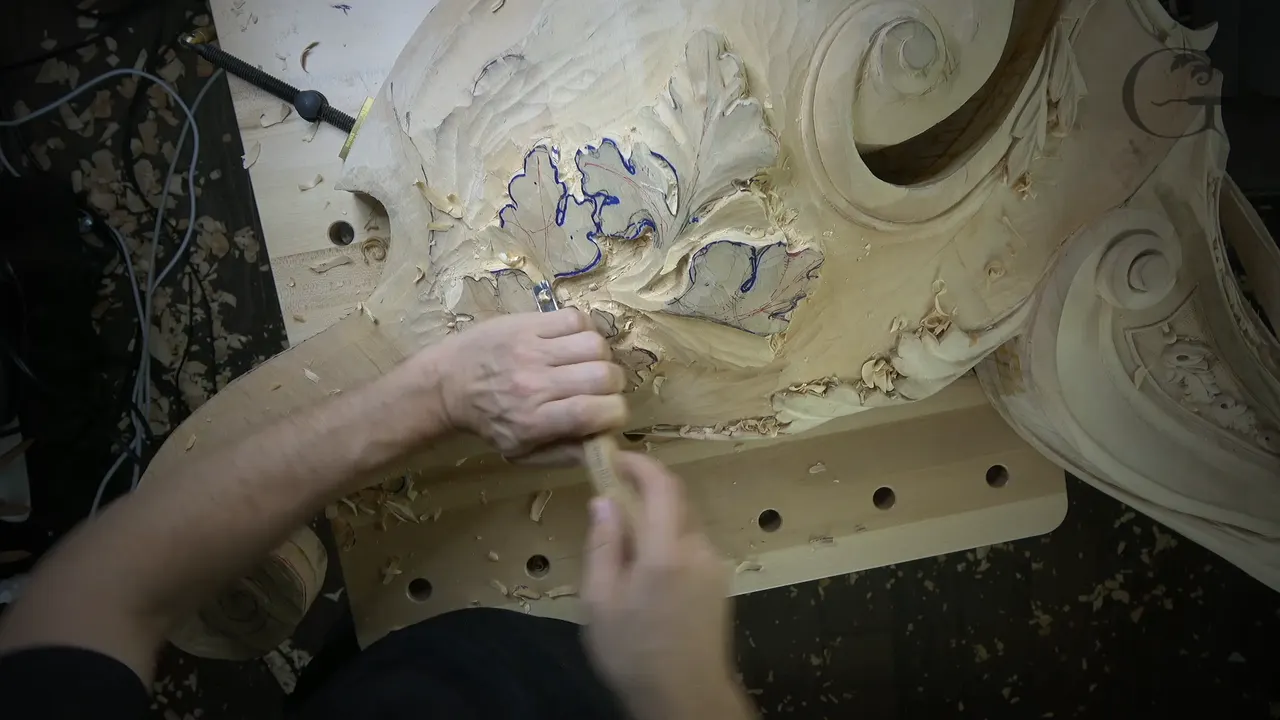

In part 9 of workshop 97 the word "smart" sits beside a plan to do some of the eyes. Other wood carving lessons of mine carry the same word. Each passage is read here with the lines around it, so every reason sits next to its word.
Ever stood over a carving and felt that one spot needed more thought than the rest? That moment is in workshop 97, and in the lessons below. Newcomers can start with the Wikipedia page on wood carving if the craft is new to them. Sizes come in millimeters and inches, my own figure first, with the conversion beside it.
What surrounds the word in this part?
One leaf plan reads "this leaf can go a little bit underneath." A tool follows. "Let me use again 10 millimeters" (0.39 in), then "Number 11." Then, "Again, that is a veiner."
Depth is left open: "And how deep do I want to go? I don't know yet." Next, "Maybe about quarter inch or so" and then "Six millimeters or so." A quarter inch is 6.35 mm, and 6 millimeters comes to 0.24 in.

How does the part treat the waste?
The waste gets one line: "First of all, I don't need to worry about this. That's all waste." The tool for it is "the smaller number 11 veiner with five millimeters" (0.2 in), and the plan reads "I can just probably excavate that." Close behind comes "That way, I'm not going to lose the idea."

A small extra is a maybe: "And maybe I can actually go a little deeper right in this section." Next, "I think it is enough." The next words are "So now, I will just blend it."

How does the wave line read?
Detail work arrives. "Now I'm ready to work on more or less detail work." A doubt follows. "I don't know if I should call it a wave or not, but it does look like a wave, okay?" The outline is "Just outline it with the number 11 veiner and five millimeters again" (about 3/16 in).
Then "Give a little more shape to it." And last, "Now take number seven again and blend that."

Where does the word itself sit?
The eyes are next: "Let me do some of the eyes. This one and that one, okay?" And then, "Because, again, that is going to be visible from this side, from this position."

Then the word itself: "I have to be really, really smart how I'm going to do it, okay?" And the line behind it is plain, "I really don't want to make mistake".

Overlap comes next: "it's going to go right underneath of that part" and then "So I'll take the left side underneath of the right side." The size follows, and it stays small: "Not much, but little bit, okay?"

Which direction lines does the part carry?
Two lines carry it. One is "And yes, I am doing it again wrong direction." Behind that sits "So that direction is going to be always better." And a tool comes ahead of both of them: "And right away, I can actually use number seven."
The last cues read "Let me do right away this one. Again, same tool. Number 11, five millimeters." That five millimeters is about 3/16 in. Final line: "That part going to go underneath little bit of this line."

What do the parts next to it say?
Part 8 of the workshop asks a question near it: "do I want to expose underneath more than I need to?"

Over in part 10 comes a line on undercutting: "But without the undercutting. If I would undercut, that would be a big mistake." A later step is allowed: "Later on, yes, it's okay to undercut, but not right now. Not right away." A stem is the topic next: "which I don't want to make too wide." The same part gives a size for it, "about six millimeters, about a quarter inch."

Which Venice Room lessons use the word?
Back in workshop 1 it sits on a plan for a saw: "But I also want to be smart how I approach it." Next comes "I glued only first board and I want to just cut outline of my design and I'm going to use just the jigsaw."
The second video of workshop 1 has a cookie: "I can place that cookie right underneath of my board". Next to it, "enough height for my blade to travel." A little later, "I think a smart idea." In the fifth video, more push pins get "I'll actually be smart and place them in the eye", followed by "but still, just in case." A page on push pins is on Wikipedia.
The old way gets a line: "Yes, they would use a Bow saw to be authentic." The limit sits right after: "if I can incorporate a jigsaw or a scroll saw, sometimes I will." The scroll saw has its own Wikipedia page.
Workshop 12 carries the word twice, and the first line is short: "And again, I got to be smart." Then, a few lines on, "a smart way to do it, okay?" Beside them sit "I really want to end this point right here" and "save some more material."

In workshop 29 pencil marks get the word: "probably smart just to get rid of those pencil marks." Then "And that way I can see much clearer what needs to be done."

A warning in workshop 31 uses the word: "And for me, it would be not so smart to create too weak spot." A limit follows: "But still, I have to keep in mind" and then "Almost all the way".

Over in workshop 60 the word sits on a plan: "Well, I think for me, probably right now would be a really smart idea to start developing of this section right here." Then, "that has to become a volute. So I have to work on this volute now." The volute has its own page on Wikipedia, for anyone who wants a picture of one.

A slope is the problem in workshop 70. First, "Although, let me think twice." Next is the word: "I have to be smart, because like I said, it's right on the slope." Another line reads "And it's not really convenient." The tool is only a maybe: "Maybe number nine".

A miss can carry it too, as in workshop 72: "Also remove that blue marker. That wasn't too smart idea to use blue marker." Beside it, "For some reason, it just penetrated so deep. Much deeper than I expected." Wikipedia covers the marker too.

The metal part gets a warning in workshop 76: "Be careful not to hit the metal part if you're going to do the same setup like me. So be wise. Be smart." Also in that part, "I do have to pay attention to the grain, how it runs." Just before the word, "I could cut that on a scroll saw or a band saw."

A protection plan for a metal part sits in workshop 77: "But there is a way to protect, maybe I could glue little pieces of wood, which is probably a smart idea". The plan stays a maybe. Before it, "And sometimes it's a good idea to change the position."

The line in workshop 78 is short, and "Let's see how easy it is" comes right before it: "I think it's a smart way to work. But again, it's my personal opinion." Before it, "holding by hand this piece and just finish up." It adds "It's actually just the finishing up touches, pretty much what's left."
A split is mentioned in workshop 129. Earlier in that part, "So have to change position and really careful remove this." The word sits in "So for me now, smart move". Then the plan, "take a number seven big one and remove all that waste first."

Extra wood is the subject of workshop 150: "Like I said, I'm happy that I left extra material. So that is sometimes smart thing to do, just to leave some extra if you're not 100% sure what you want to do." Then "And later on, you look at it, at the design, and you see exactly what you want to change."

Byzantine gilding gets the word in workshop 163. "Before the gold, they applied clay, red clay, just normal earth red clay." Ahead of that, "it's really hard, if you understand, to get right on the side of the undercut if it's too deep." Later, "I think it's really interesting that they developed that approach" and "So I think it's really, really smart what they did. It's my personal opinion." Pages on gold leaf and clay are on Wikipedia.
Which other courses use it?
Two lines sit in Furniture Panel 18. One names a tool of 1/16 of an inch (1.6 mm): "And even probably it's a good idea to change the blade to just 1/16 of an inch. That would be smart." The other gives a limit: "I need to make a micro cut with the one millimeter number 11 first, okay?" Then "Otherwise, I create a weak point right here, and that's no bueno. It would not be smart." One millimeter is 0.04 in.

Furniture Panel 19 has a line on direction: "And sometimes it's smart just to turn around and just attack that from opposite direction." The word is back later in that lesson: "smart way would be to do a relief cut with the number 11 and 1 millimeter." Right after it, "That's why I should do that before, but it's okay." Light gets the word too: "So that is a smart decision to have the light like that." Right behind it, "So it actually opens, and you can really, really see what is going on underneath." A page on relief is on Wikipedia.

A caution sits in Furniture Panel 29: "although it's maybe not really smart idea for me to do that right away." After that, "we still have to do concave, I mean convex".
In Floral and Molding for the Panel 9 the lines are "And yes, I'll go just around that." Next, "I think it's a smart idea. Okay?"

The Hashemi Flowers course, lesson 17 puts the word on prying. First, "be really careful how you make your cuts, and especially don't crank against, okay? Don't pry." Then "So you can pry against the finger, but not against the wood." The close is "not really smart."

Hashemi Flowers 27 names the weak spot first: "but be careful in area like this. This is the weak spot." There is a Wikipedia entry on wood grain as well. Then: "but for me, it would not be smart to hit that also with the grain right here, because it can break somewhere right here."

Two ways for a petal sit in Hashemi Flowers 45: "I could completely separate this petal from rest of those, or I could keep a connecting point, which is sometimes is a smart idea". Then "to create connection and just make it more solid." The warning is "Otherwise, it's going to become fragile".
Acanthus over Moldings 9 gives the word to a tool: "Maybe this tool is little too big." Next, "or be smart and use a smaller tool." Then "That's probably smarter I'll use. Maybe a number four." A number four is a plan there, not a tool taken.
In the Roman Acanthus course, lesson 16, the word goes to a knife: "That was just a normal straight back of the knife, but I grinded a little bit out, and that way, I'm actually using the backside of the knife." Next comes "I think it's just smart to use it like this." Last, "And in some areas, I don't have to use the front of the knife."

Lesson by lesson, side by side
| Lesson and part (Venice Room unless named) | Beside the word |
|---|---|
| 97.9 | A plan for the eyes |
| 1.1 | A jigsaw, and the old way with a bow saw |
| 12.12 | Material to save |
| 29.9 | Pencil marks that are probably smart to remove |
| 31.11 | A weak spot |
| 60.11 | A section that has to become a volute, so work starts on it |
| 70.9 | A concave on a slope |
| 72.3 | A blue marker that went in deeper than expected |
| 76.11 | A saw, a metal part, and a short warning |
| 77.3 | A maybe with wood |
| 129.1 | A split, and a big number 7 for the waste |
| 150.2 | Extra material that was left |
| Panel 18.11 | A blade plan near 1/16 in (1.6 mm) |
| Panel 19.7 | A relief step with a 1 mm number 11, for the smart way (0.04 in) |
| FP 29.2 | A maybe not, with the concave still ahead |
| Hashemi 17.5 | A finger to pry against, not the wood |
| Hashemi 45.4 | A connecting point on a petal |
| Acanthus Moldings 9.1 | A smaller tool, since the first is a little too big |
| Roman Acanthus 16.3 | The back of the knife |
Is there a spot on your own bench that needs a little more thought before the tool touches it? Everything in this lesson sits inside one tuition plan, and more Venice Room workshops wait on the Part 8 course page. For a gentler start, try the Acanthus Moldings course or the Furniture Panel course.
How it's done
- Find the line. Start with the middle of part 9, where the word "smart" is said.
- Read the lines before it. The plan is the eyes, with thinking first.
- Check the tools. Part 9 names five millimeters (0.2 in) and a number seven to blend.
- Look at the other lessons. Workshop 76 gives a warning about a metal part, and workshop 77 names small pieces of wood as a plan.
- Weigh the weak spots. Hashemi Flowers 45 weighs a connecting point on a petal, "to create connection and just make it more solid."
Frequently asked questions
What comes right before the word in part 9?
A plan for the eyes. After it sits "And let me think first what I want to do."
Which size does part 9 name for the first depth?
The words are "Maybe about quarter inch or so" and "Six millimeters or so." A quarter inch is 6.35 mm, and 6 millimeters is 0.24 in.
How much goes underneath in part 9?
The line says "Not much, but little bit, okay?" It follows the plan to take the left side underneath of the right side.
Which lessons use the word near a weak spot?
What to carve next