

Alexander Grabovetskiy, woodcarver, School of Woodcarving · Published 2021
What does a wood carver mean by "slightly deeper"?
Quick answer: In part 8 of workshop 97, the last line asks for "slightly deeper." In part 10 of the same workshop, the line "Not much, but little bit." sits beside it. Other lessons of mine give the words a figure, a tool or a limit.
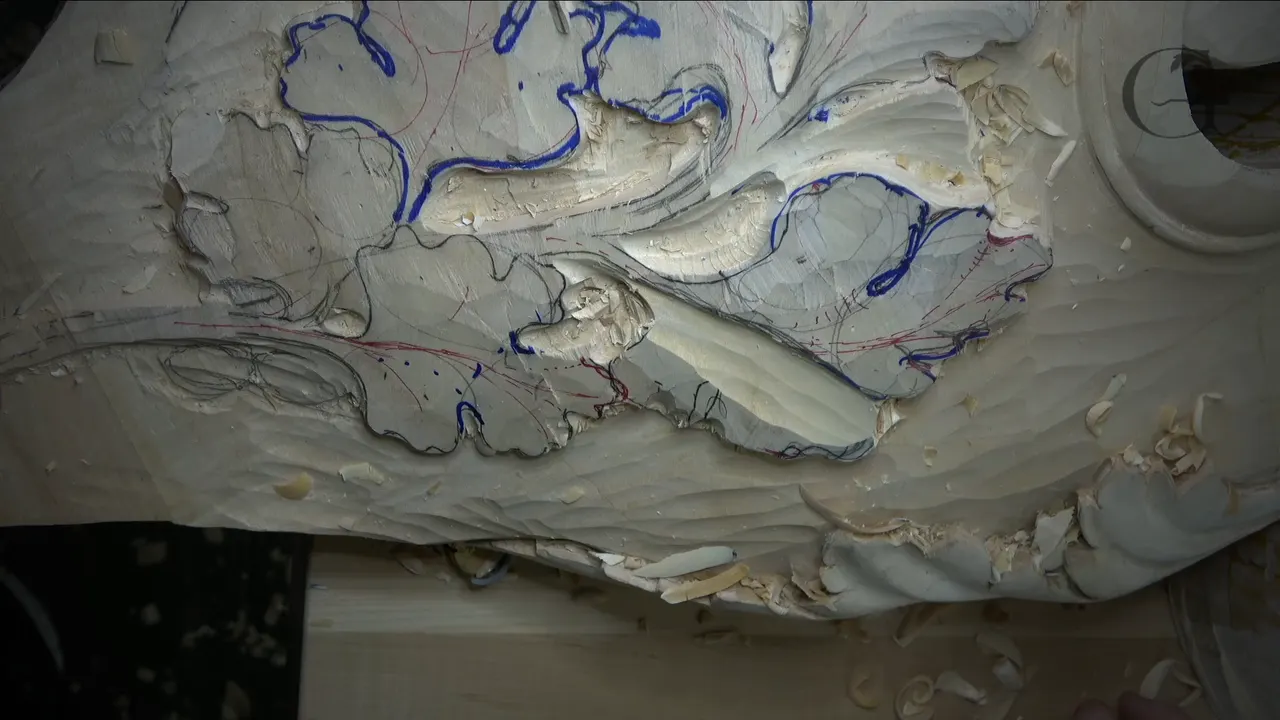

The eighth part of workshop 97 closes on "I need to go a slightly deeper." Other wood carving lessons of mine carry the same two words. Each passage is read here with the lines around it, so every reason sits next to its words.
Ever stood over a carving and felt one spot wanted a touch more depth, but only a touch? That moment is in workshop 97, and in the lessons below. Newcomers can read about wood carving on Wikipedia. Every size is in millimeters and inches, my own figure first.
What surrounds the line in this part?
The part opens on a choice: "Now, I have to make the decision about this section." A doubt follows, "do I want to expose underneath more than I need to?" The answer takes shape in pieces: "going to overlap this part" then "create much deeper cut in this area" and last "much probably more 3D."
Next comes a plain admission: "And yes, I am making changes, not changes, but decisions right on the fly."

Which depths does the part name?
A first depth is reported, "Okay, approximately 10 millimeters deep." Ten millimeters (0.39 in) sits beside "That's what I did, about 10 millimeters" and "And that is good." After that, "Now I'm ready to do shaping. I'm talking about 3D shaping."
The leaf gets a plan: "I think it's a good idea for me outline right away that leaf also." One tool is named, "the same tool, 5 millimeters, 3/16 of an inch, number 11 V-carve." Five millimeters (0.2 in) and three-sixteenths of an inch (4.8 mm) sit side by side.

Depth gets thought through aloud: "And let me think how deep I want to go, but no less than 3/8 of an inch." Three-eighths of an inch is 9.5 mm. A second thought follows, "Although, I don't want to do too much." The figure I land on is "Let me do about quarter inch, about 6 millimeters deep." A quarter inch is 6.35 mm, and 6 millimeters comes to 0.24 in. The next line is "I can always make it lower a little later" and then "At 6 millimeters, quarter of an inch, it's a good starting point."

How does the part reach a deeper shadow?
The stem has its own line: "And I need to make it lower right away, pretty much, or I would lose the idea." The next tool is a number 11 at 5 millimeters (0.197 in): "Let me outline from this position."
The shadow idea is "I think what I could do, I could create a much deeper shadow in this area." The boundary is "that is my boundary of that leaf, and I can overlap this part, and this is going to be going below." The shadow idea ends on "Again, all about shadows."

Which tool and depth come next?
A bigger size gets named: "I'll use a little bigger, 10 millimeters in this case." About 0.4 in. Next to it sits "It's going to give me a little quicker result."
The depth reads "And how deep I want to go, I can actually go a little deeper here, about 10 millimeters or so" (a little under 0.4 in). Number 7 follows, "And number 7." The part closes on "I need to go a slightly deeper."

What do the parts before and after say about depth?
The seventh part of workshop 97 has a careful line: "And I have to be careful how deep I'm going to go, because it's going to be visible." Another line reads "Although, I'm okay to create much deeper on this side."

That part ends on "Okay. About half an inch, about 12 millimeters deep. That's what I've done." Converted, 12 millimeters is 0.47 in and 1/2 in is 12.7 mm.
The ninth part has "a little deeper right in this section." Later, "I think it is enough." It also holds a plan of "Maybe about quarter inch or so," which is about 6.4 mm, or 0.25 in.

The tenth part carries the same two words. Earlier in it sits "And I need to get little bigger number 11. Now take 10 millimeters." The size is 0.394 in. A small amount is named, "Not much, but little bit." It closes on "Just a slightly deeper."

Which Venice Room lessons carry the same words?
Workshop 40 has "So I could use a little deeper concave on that side. Not too deep, but slightly deeper." A tool plan sits beside it: "And I think I should use number five or something like that and create a cut between those two lines." Then a remark on the tool, "It looks like this tool needs to be sharpened."

A spot that went deep leads into workshop 57: "And it looks like I've got a little too deep excavation on one of the spots, and I need to repeat that here." The fix reads "So I need to excavate slightly deeper that way for it to just repeat even in three-dimensional world, in 3D."

Over in workshop 62, a plan reads "And yes, I could go slightly deeper and readjust my future slopes." Further on, "more pronounced sloping."

Workshop 95 is about a hole: "And excavate a slightly deeper hole, and that's already looking better." A worry follows, "I'm not too happy how this part looks." And "So I need to remove some of that excess material from underneath,"

Tool and depth meet in workshop 96: "when I'm placing my tool straight down, so the wing is supposed to be with the same level, which means in this section, I still have to cut a little deeper" and "slightly deeper." Later in that part, "So my tool is my measuring device very much."
In workshop 98 the words are "And what I see, I could give a slightly deeper concave right here." For the tool I hear "I'll use just number 11 and 10 millimeters" (0.39 inch). Alongside it sits "Just to give a little more shape" and after that, "Though I probably should rotate and attack from opposite direction."

A check opens workshop 100: "And looks like I do have to get a little deeper cut". The measure is "So this is approximately about, the height of my tool, about six millimeters" (0.24 inch). In the tenth video of that workshop I hear "Just slightly deeper." Then "And I'll take again number five."
Another stop is workshop 101, "But I also have to excavate slightly deeper right here." Near it sits "the really tiny ones" and "no more than a couple of millimeters."

A figure goes first in workshop 105: "I think I've got approximately 20 millimeters to the lowest spot, but I'm not sure if I like it or not, if it's enough or not." Twenty millimeters comes to 0.79 in. The wish follows, "I also want to do this side slightly deeper." Then a high point: "And make the highest spot somewhere right in the middle." And "not the mid but about golden ratio."

In workshop 109 the plan is "but let me continue digging slightly deeper." Later, "And yes, I could take one millimeter now and get my shadow really pop" (0.04 in), and "of course it would be number 11."
Beside a limit, workshop 146 gives "But not too deep. I don't want to overdo it." Next, "It's already giving me beautiful shadow." A plan sits with it: "But maybe I'll use a five millimeters to create slightly deeper shadow and little more convincing folding effect" (0.2 inch). Right behind it, "And see how deep that shadow is" and "I think it's awesome."

The first Venice Room course reads, in its workshop 8, "I still kind of don't like this ridge." Next, "And this one could be a little deeper. I think I could make it slightly deeper if I need to. Maybe yes, maybe no." Then "Let me leave it for now like that,"
Which other courses carry them?
Furniture Panel 17 puts the words on a small figure: "1/32 of an inch. Maybe I'll go even slightly deeper." One thirty-second of an inch is 0.8 mm. A second figure follows: "Not quite 3 millimeters, but approximately from 2 maybe 2 and a half mills." Three millimeters is 0.12 in, and 2.5 mm is 0.1 in.
A pass is reported in Furniture Panel 19: "I actually went a little deeper, just a slightly deeper, maybe about 1/32 of an inch deeper" (0.8 mm). The plan for the final depth is 1/16 of an inch (1.6 mm).

In Furniture Panel 21 the plan is a one millimeter number 11 (0.039 in) to "remove whatever is a waste." Next, "I can go a little deeper, slightly deeper." The mark reads "I am creating just a small tool mark because I did not go all the way yet to one-eighth of an inch" (3.2 mm). The way back is "I can always make it look perfect and clean everything to that tool mark."
A limit comes first in Furniture Panel 22: "So I can't go really deep on this side. That would be a big mistake." Next, "a little deeper right here with no problem." The line is "So this section could be a slightly deeper" and the figure is "Like three millimeters deep" (0.12 in). A Wikipedia page on furniture covers the wider background.
Floral and Molding for the Panel 2 has "I can actually go even slightly deeper. Just a little bit, not much." Then "that's just maybe a little too deep." In lesson 3 of that course, "I still kind of not too happy with overall movement." Next, "slightly deeper. Okay? Just like that." Then "I lowered that slightly down just a little bit."
Over in lesson 6 of that course, I find "Even if I have to do a slightly deeper cut, I still want to make sure it feels organic."

The Lily Box course has a first layer under the tool: "That is an end grain. I have to be really careful how I'm doing it." Right after it, "And this wood is not as soft, so I just want to make sure I'm careful." And "And let me also do a little deeper on this side."

Plate with Butterflies 10 has "And it looks like I need to create slightly deeper cut." Close by, "And I do understand that this spot I need to cut a little deeper" The next move is "I'll just recreate my previous cut and go slightly deeper with that." Butterflies has a Wikipedia article.
The Butterflies course goes on with lesson 6, which has "I could just create the cut in this section slightly deeper." A line beside it reads "really don't have to but it's gonna give me a little more movement."

In Chamomile and Bow Rosette 1 the line is "number 11 and half a millimeter and make those grooves slightly deeper." Half a millimeter is 0.02 in. Earlier in that lesson, "the center of that petal is like a hill." Next, "And again, flatter tool. Number three." Readers can look up Chamomile too.

The Grinling Gibbons class in Maine, lesson 12 has "it's only about millimeter." Then "maybe slightly deeper than millimeter" and "Shadow underneath and for that I'll use number 11." One millimeter is 0.04 inch. A later lesson of that class, lesson 11, has "and I'm gonna create a little deeper excavation this section"
Grape Onlay 4 reads "slightly deeper than 10 millimeters" (nearly 0.4 inch). Then "but I've got about maybe 11 millimeters or so deep" (0.43 in). Next, "about the same depth that is important." The Grape has its own Wikipedia entry for anyone who wants the background.
Where do the frames come from?
Every picture here is a frame from one of the videos named on this page.
Lesson by lesson, side by side
| Lesson and part (Venice Room unless named) | Beside the words |
|---|---|
| 97.8 | One depth, then an outline plan near 6 mm (1/4 in) |
| 97.7 | A side that shows from below, so a careful depth near 12.7 mm (1/2 in) |
| 97.9 | A plan near a quarter inch (6.35 mm), and then enough |
| 97.10 | A little more in one area, not much |
| 40.10 | A deeper concave on one side, with number five on the plan |
| 62.10 | Slopes to readjust, and a more pronounced slope |
| 98.3 | A concave, then a 10 mm (0.394 in) tool |
| 100.9 | The height of a tool, about 6 mm (0.236 in), as the check |
| 105.2 | A lowest spot near 20 mm (0.79 in) |
| 146.1 | A deeper shadow, with a 5 mm (about 0.2 in) tool |
| Panel 19.1 | A final depth of 1/16 in (1.6 mm) |
| Panel 22.11 | About an eighth of an inch (3.18 mm), and a limit on the other side |
| Chamomile 1.2 | Grooves with a half millimeter (0.02 in) tool |
Is there a spot on your own bench that wants a touch more depth, but only a touch? Everything in this lesson sits inside one tuition plan, and more Venice Room workshops wait on the Part 8 course page. For a gentler start, try the Acanthus Moldings course or the Furniture Panel course.
How it's done
- Find the line. Start with the last line of this part.
- Read the numbers before it. A first depth near 10 mm (0.39 in) is done, and an outline plan sits near 6 mm (1/4 in).
- Check the tools. Part 8 names a number 11 for the outline, then a little bigger size for the shadow.
- Look at the other lessons. Workshop 98 gives a number 11, while 146 names a five millimeter tool (0.197 in).
- Weigh the limit. Lesson 22 of the Furniture Panel course says "So I can't go really deep on this side."
Frequently asked questions
How deep does the first area go in part 8?
Close to 10 millimeters, or about 0.4 inch. The words "That's what I did" sit right beside the figure.
Which depth is planned for the leaf outline?
A quarter inch, about 6 millimeters (0.24 in), is the starting point named for now. A number 11 at 5 millimeters (0.20 in) is the tool for the outline.
Which size is named for the shadow step?
A little bigger than the one before it, at 10 millimeters (0.394 inch). A possible depth near the same figure is named beside it.
Where does part 7 of workshop 97 end?
What to carve next