
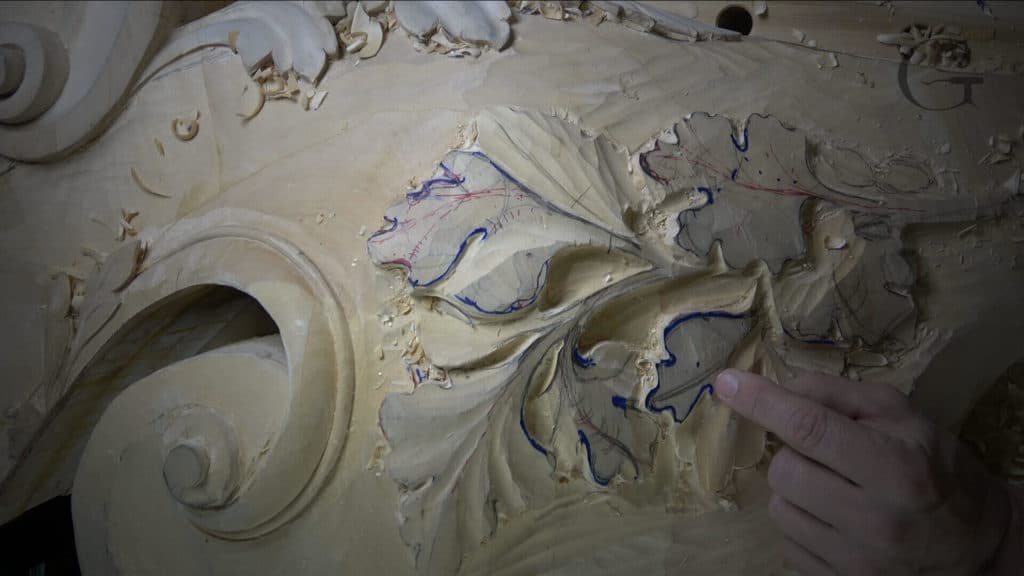
Alexander Grabovetskiy, woodcarver, School of Woodcarving · Published 2021
What does a wood carver mean by "once in a while"?
Quick answer: Walking around the piece comes first in workshop 97, part 11, and then comes a plain admission about how seldom a spot fails to add up, so the check stays short. Other lessons of mine tie the words to mistakes, design changes, checks and habits.
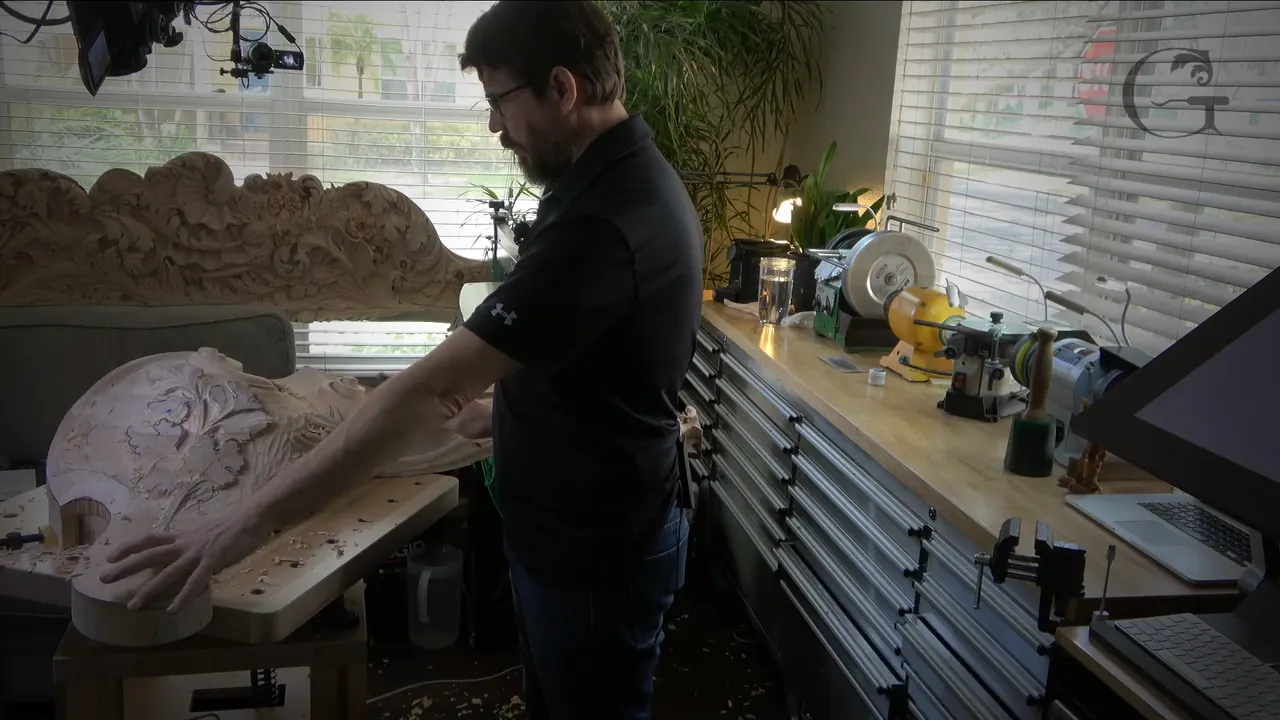

Part 11 of workshop 97 holds a plain admission: "Not a lot, but once in a while, something doesn't make sense." The same three words sit in many of my other wood carving lessons. Each passage is read here with the lines around it, so the reason stays beside the words.
Ever stepped back from a carving and found one spot that did not add up? That moment is in workshop 97, and in the lessons below. Newcomers can read about wood carving on Wikipedia. Every size is given in millimeters and in inches, with my own figure first, so you can check each pair of numbers yourself.
What does part 11 say about the phrase?
Early in the part comes a look: "I think it looks somewhat good. Let me see from different points of view." A habit follows: "It's a good habit, actually, to rotate or walk around if you don't have a setup like me, and take a look from different points of view."

Then comes the admission: "And yes, it does happen sometimes."
This time the check ends well: "So far, it does make sense, and I like it, and I'm ready to do it." The next line gives the plan: "Now, finally, I'm ready to do the 3D shape. I'm talking about concaves and convexes."

What comes after the check in this part?
The plan for the big shapes: "I'm going to concentrate on three divisions." Then "but the three waves first, and later on, I'll add smaller ones. But for now, I'll just concentrate on the big ones."
A plan for the middle of each movement sits right behind it: "So I need to create a big convex right on the side of each middle of those movements." A helper line follows: "Oh, by the way, let me put the middle line for you to understand what I'm doing."

A doubt comes next: "So let me see if I like this movement, and I don't." The cause is a shape: "if you look straight down, it creates almost like a square, which is not so good." A wish follows, "I'd rather see some taper."
Does the small change matter? In my words: "And does it matter? I think it does."

Which tools are named in part 11?
Tool one is a gouge size: "Let me use 10 millimeters. Number 11." Ten millimeters is 0.39 in. A correction is spoken later, out loud: "Use number 10. I'm sorry, number 11 and 10 millimeters. Thinner."
A care line sits beside it: "And let me attack from this side and be more careful."

A tool gets a reason of its own: "Let me use number seven because I don't want to see too sharp movement." A limit follows: "I don't worry about how it looks on outside yet." The aim is plain: "What I worry about is just how overall shape looks, overall movement."

A walk around is planned: "So I'm going to have a chance to go around and just fix all the shapes." Next, the movement is judged: "And now I can see that movement looks like it does go that direction."
One more step reads "Let me do upside-down cut, number seven." A good feeling follows soon after: "I do like it. I do like it a lot, actually."

Another movement comes near the end: "And I've got another movement going that direction." Then "And this one is going to go right here." A plan follows: "So which means I have to create concave and a concave on the sides." The last line holds one worry: "it's a little too hard in this section because it is really close to the eye here."
Where does the phrase meet a slip or a mistake?
In Hashemi Flowers lesson 5 the line sits close to the wood: "Be careful when you're doing with the grain." Then "Oh, dumb mistake. It has to go this way." In the middle of two pieces sits the phrase: "And yes, I do make some mistakes" comes first and "But in this stage, it's still forgivable" comes last. A warning for later sits beside them: "But later on, if you make a mistake, you screwed up. That's it. You're done."

A mistake in Floral and Molding for the Panel 7 has a cause: "the problem why I made that mistake, just pressing too hard." A reason for the hurry follows: "I'm trying to rush it because that is a real production piece." Then a reason to show it: "I have plenty of material left, and I think it's a good opportunity to show what you do if stuff like that happens." Just ahead of the closing words sits the phrase: "that stuff happens."
The position gets the blame in workshop 24: "And yes, the position right now I'm working from, it's not too convenient." Then "That's why I'm slipping," the phrase itself, and "Slipping with my tool, I mean, okay?"


One entry in workshop 12 is about a line that went too deep: "that was probably a mistake that I placed that line too deep."
Two more sit in Furniture Panel 38. One is about the grain: "sometimes the grain can go downhill and if you're just gonna catch it, you can create the deeper spot which you don't want to see." The second is about safety: "but be careful. Sometimes I cut myself." Soon after, the phrase turns up, and the lesson goes on with "but when you're carving all day long, you not afraid of the tools anymore, you cut yourself."

Tray of Blessing gives a short warning in lesson 8: "I'm placing the hand like that. That's too dangerous. Don't do that." Then "But I do that," the phrase, and "myself also." The warning ends on "Never place the hand at the front of the blade."

Which design changes carry it?
A part of workshop 74 ends on a design: "I really didn't want to do right away really deep excavation and clean cuts because I found out I'm changing a design" and the phrase leads on to "or right on the fly."

The cause is in workshop 75: "But like I said, I just looked at it, and it didn't make too much sense. So that's why I changed the design." Then the limit of the change: "It doesn't change overall movement. It just changes minor details." Ahead of "I have to do that because on a paper, sometimes it looks one thing, but in real life, it just doesn't look too good" stands the phrase. The aim follows: "And I really want to aim for excellency."

A fix at the wood sits in Furniture Panel 22: "It's not repeating, and I'm breaking the law right here, law of repetition." Then "stuff like that I have to fix," the phrase, and "right in the process of carving." A reason is given: "sometimes it happens, yes, you're not catching everything right away. But once you carve, you have a lot more time to look at it and justify and adjust."

The deeper spot from the grain, back in lesson 38 of that course, has a way out beside it: "just to say it was on purpose, change of the design, which happens" and the phrase ends the sentence.

A smaller change sits in workshop 10, where the thought "you could put an extra line or so" starts with the phrase.
Roses give another one. On Hashemi Flowers 47 the subject is a movement outward, and the phrase leads into "in some spots, I can do that. Not everywhere, but some spots."
A turn is named in workshop 26. It opens the clause "when you return, for example, at this side, it goes that direction."
Which checks and habits carry it?
Furniture Panel 6 gives a view from a distance. The first part reads "It is a good practice," the phrase, then "just to step away and look at your composition from just a little distance and see how overall development develops."
The Dining Table Apron course asks for a trace to be checked: "Really important, check," the phrase, then "the results, because it's easy when you are tracing to lose a spot, and that's hard to find later on."

Thickness gets a check in Grape Onlay 12: "I also," the phrase, then "check the thickness and looks like I have plenty of the material right there." A figure follows: "If you're gonna leave approximately quarter inch, about six millimeters or five millimeters, you should be okay." A quarter inch is 6.35 mm, six millimeters comes to 0.24 in, and five millimeters to 0.2 in.

A blade on a scroll saw gets a listen in the Lily Box course, just after the phrase: "I have to check the sound of my blade." Beside it sits "the metal is stretching while cutting."


A color check with a marker is the habit in workshop 60: "I'll use a blue marker, so that way I'm not going to forget what is what." Then "And yes, I do forget."

In workshop 54 a note on drying starts here: "I like my hair dryer technique actually much better than air compressor." The risk comes after a draining step: "Even if you're going to drain it," the phrase, then "there's still a possibility there's going to be some water." A hair dryer and an air compressor each have a page on Wikipedia.
On a board of MDF, Hashemi Flowers 15 gives a hit a small place: "just hit," the phrase, then "it's not going to be a problem at all."
What about clutter and moving to another spot?
Clutter gets a line in workshop 39: "If you have clutter in a house or in your shop, sometimes it just doesn't feel right and you can't even create." Those words come next, and then "it applies to carving also. You really have to just clean up all the clutter."

The same idea shows with drawing in workshop 12: "it's important," the phrase, then "clean my next area, and that way it's a lot easier to even draw, and figure out what's going on."
A move sits beside it in workshop 36: "I do that" then the phrase, then "Before I finish one area, I jump to another because if I concentrate too much on one of the areas, for some reason, I'm wasting much more time."
What changes for the camera and for you?
Camera trouble is the subject in workshop 22: "That is for me not convenient to carve." After it comes the phrase, then "I can show what is going on."
Almost the same words come from workshop 102: "My head is in the way of the camera." Next, "I'm actually using different angles for you wouldn't lose the idea."
A visitor is mentioned in workshop 77: "She is visiting me today, so it shouldn't be that noisy, but still, you're going to hear her" and the phrase closes it. On quiet, workshop 1 has "Like you're supposed to be quiet in a shop" and the phrase closes that one too.
What changes around the bench?
The shop itself is the subject in Floral and Molding for the Panel 1: "I get tired of looking at the same setup all the time." Next to the phrase sits "I change it, and I think it's good."
Another part of workshop 1 has a small helper for a jigsaw: "I don't use them every day" then "but sometimes" then the phrase. The helper is a cookie placed under the board, and the reason is "it's going to give me enough height for my blade to travel."

Color is the subject in Lily Box 13: the phrase leads into "I just dip that just to the edge of this gel and blend it darker and darker."
Roman Acanthus 6 opens with a haircut, and the phrase sits just before "Once a year or so, I do my haircut."
Looking ahead, the Plate with Butterflies final assessment has the phrase right before "that style just because it looks like people, members of the school, really like that."
Where do the frames come from?
Every picture here is a frame from one of the videos named on this page.
Lesson by lesson, side by side
| Lesson and part (Venice Room unless named) | What it sits beside |
|---|---|
| 97.11 | A walk around the piece, and a spot that fails to add up |
| 12.12 | Clean the next area now and then, so the drawing is easier |
| 24.9 | Awkward position, slipping tool |
| 36.2 | Jump to another area before the first one is finished |
| 39.5 | Clutter in the shop, and the same clutter on a carving, cleaned up before work goes on |
| 60.12 | A blue marker, so nothing is forgotten |
| 74.12 | A design that changes mid-work |
| 75.10 | A small design change, made because paper and real wood can disagree |
| 102.11 | A different angle for the camera, so the idea is not lost |
| 6, Panel | Step away from the composition and look from a distance |
| 22.8, Furniture | Repeat a curve that was missed in the design |
| 38.3, Course | A deeper spot from the grain, and a note about fingers |
| Hashemi 5.2 | Mistakes still forgivable at this stage |
| Floral 7.1 | Pressing too hard, and what to do next |
| Grape 12.2 | Thickness looked at, near 6 mm (1/4 in) |
| Apron 5 | Tracing looked at, so no spot is lost |
Is there a spot on your own bench that does not add up? Everything in this lesson sits inside one tuition plan, and more Venice Room workshops wait on the Part 8 course page. For a gentler start, try the Acanthus Moldings course or the Furniture Panel course.
How it's done
- Find the line. Start with the habit in part 11 of workshop 97, the walk.
- Read where the check ends. "So far, it does make sense, and I like it" closes it.
- Look at the tools. A number 11 at 10 mm (0.39 in) comes first, then a number three and a number seven.
- Read the other lessons. Workshop 75 and Furniture Panel 22 each give a reason for a change.
- Weigh the safety lines. Two lessons carry a warning about hands.
Frequently asked questions
Which habit is named first?
To rotate the piece, or walk around it if you have no turning setup, and look again.
Which tool size opens the 3D shaping?
A number 11 at 10 millimeters (0.394 in), with a number three and a number seven named later in the part.
Which reason does workshop 75 give for a design change?
On paper a design can look one way and in real life look worse. The overall movement stays, and only the minor details change.
Which distance check is named in Furniture Panel 6?
What to carve next