

Alexander Grabovetskiy, woodcarver, School of Woodcarving · Published 2021
What does a wood carver mean by "I'm glad"?
Quick answer: In workshop 97, part 1, a cue opens with "And I'm glad," and the cue after it reads "deep. Otherwise, I would be." The words "I'm glad" sit in lesson 19 of the Furniture Panel course beside "a really deep cut", and in Byzantine Acanthus 6 beside "stopped before it's too late".
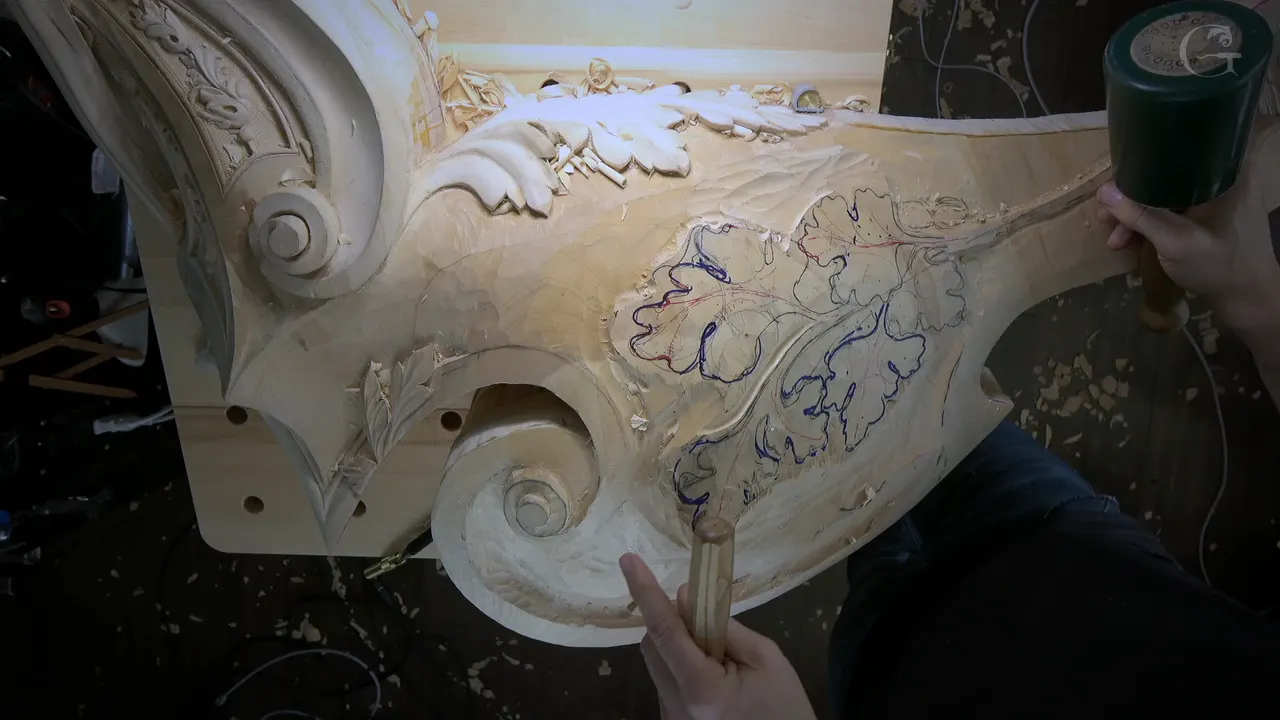

In part 1 of workshop 97 a cue opens with "And I'm glad" and the next cue ends "Otherwise, I would be." Many of my other wood carving lessons carry the same two words. This page reads each of them, with the work around it.
Ever stop mid-dig and feel a small relief that you did not go one pass further? The first video of workshop 97 has that moment. So do the lessons below. Every size is in millimeters and inches, my own figure first.
Where do the glad words sit in part 1?
A count is in the part. Its plan reads "Let me count how many of them I have." Numbers follow, "One, two, three, four, five, six" and "leaves, and that is not good." So a fix starts with "Let me actually add" and "this side" and with a leaf: "and there's going to be a leaf underneath."

The look is a topic too: "I think it's going to look much better this way." One spot is named, "the only empty spot." Then the cue "And I'm glad" arrives, the next ends on "I would be" and one more has the word "screwed."
Work goes on with "And let me" and "excavate this section." Another plan, "So let me also outline" with "right upper area," is in the same part.
What else is in part 1?
One wish is stated plainly: "So I really don't want to see everything just really super even." A gouge is next. "I'll take number seven and 14 millimeters, half an." Fourteen millimeters (0.55 in) and half an inch (12.7 mm) sit side by side. Its job is "and clean all of that stuff, whatever's left right here."

Next: "Clean little bit, but not too much because I still have to" with "work my area little later." For the outline, "And I can go around the outline" and "wherever I can fit my number seven." The gouge has a Wikipedia page.

Where does it all end up? "And get little closer to the final look," says one cue. Another adds "Not final look, but final" and "idea. Preliminary final. I don't know if I can say that." Then "It's too early to say." The straight passes get "with the straight down cuts."

The last tool is "number 11 and 5," followed by "so I can actually go inside of" and "those areas." A sibling part supplies the unit with "5 millimeters" (0.2 in), and the third part gives "3/16 of an inch" (4.8 mm).
What do parts 2 and 3 add about going too deep?
In part 2 a slip lands, and the cues run "Okay, so I made mistake. I just pushed straight" and "down. It's not big mistake, but I should be" with "more careful, I would say." Then "But it is going to be okay." The fix is a plan, "this section is just going to fold" and "down."

The third video carries the same worry. "a shell going right underneath of those" and "leaves," so "I don't want to dig too deep and create problem for" and "myself". On material: "I'm not going to have enough material for my shell movement." Another cue says "Even if it's not" with "final outline, that's going to give me pretty good" and "general idea of the main movement here."
A cue about reach says "reach the area." Also: "remove too much of the material on this side" with "to be a couple acorns" and "that would be mistake if I would do it." Elsewhere in it: "I'm happy with this side somewhat." And, "That for I would have the main framework" with "the base" and "and I can always refine from it." The last cue reads "Because like I said, I want to change some of the movements."

Part 6 of the workshop has the glad words once more. Its cue reads "glad I added this part that would make it look really" and "nice and beautiful." A plan sits next to it: "I can actually bring the main body a" and "little bit underneath of this future movement." A layer gets named, "just like a really nice layering."

Which lessons set a shallow dig next to the glad line?
Furniture Panel 19, part 4, has a spot at 00:17:47: "This section should be only 16th of an inch" (1.6 mm). Another line reads "Five millimeters right here" (0.197 in). A marker plan sits in the middle with "Let me use a different marker" and "really deep."

A warning comes before the glad line: "That would be a big mistake for me to dig deeper." Then, at 00:18:35, "I'm glad I didn't create a really deep cut."
The Floral course repeats the pairing in lesson 10, part 3, with a warning right after the glad cue. First "Not always convenient" and then "I'll deal with that." Then "And looks like I'm" and "right there" with "even without the measuring" and "I got the right spot" and "I guess that's always a good thing." The cue at 00:11:28 reads "glad I didn't excavate that deeper." And "a big mistake."

For the next pass the plan is short, "let me get that line" and "just straight." Each has a warning about a deeper dig. A mallet and a chisel each have Wikipedia pages, for anyone new to the tools.
When does a stop or a check come with the words?
In lesson 6 of the Byzantine course, an order sits just before it. "So please pay attention." Then "approximately two inches" (50.8 mm) and "from the end of the stem. Don't undercut." After it, "glad I stopped before it's too late." Elsewhere in it: "So by now, like I said, don't worry if it doesn't look" and "perfect yet."

A question follows: "Anybody made that mistake or no? Good." Then "I make all the mistakes." And "No, I mean that, untouchable, okay?" Also, "We're going to have a chance to refine the edges little later."
One more Venice Room lesson, workshop 101, has a plan in part 1: "I need to" and "run my number 11 along this line" and it is "kind of deep cut." The shape is "like a cove." After it comes "You know what" and then "I'm actually carving in the wrong side." Then, at 00:07:05, comes "glad I just thought about it" and "before too far." A repair follows in "So let me clean it" and "I still have plenty of the material."

An iPad enters workshop 126, part 3. "I'm not going to undercut yet," says one cue, and another reads "I need to establish concaves." Others read "let me double-check," "check with my iPad drawing" and "I could make a mistake." The curl gets a line, "It has to just curl this way." A wish for the viewer reads "Okay? And I want to make sure you see what I'm doing."

The verdict reads "Not a mistake, but it's a good idea to" with "double-check." Then "glad I did." One cue repeats it with a few extra words, "glad I did check that." The next tool is named, "take number seven."
In Byzantine Acanthus 9, part 2, the words follow a slip. "See, I already made a mistake." A question comes, "So what do you do if you make mistake" and an answer, "Redesign it." "I'm glad that I have a reach" is followed by "but be careful. I would use probably smaller tool next time." The order of work before it reads "do a relief cuts. And you can do it the same tool, but carefully" and "Carefully. You have to relief first."

Do any lessons pair the words with having enough wood, or the right tool?
Near a ceiling sits workshop 59, part 2. The cues run "12 millimeters" (0.47 in) and "and create my outline. So it's a half an inch" (12.7 mm). The spot gets "Again, that is a challenging area because it is" and "actually right in the transition to the ceiling" with "because really, I'm limited from both sides."

Next: "do have an eight quarter material" and then "ceiling right now. So it's two inches almost, a little less than." More figures follow: "two inches, but like one and 15/16" and "About 50 millimeters, a little less than 50" with "millimeters probably, something around that." Converted: two inches is 50.8 mm, one and 15/16 inches is 49.2 mm, and fifty millimeters is 1.97 in. Nearby sits "So I have to be mindful how deep am I going to go." The same part has "Got to work a little quicker." Also "It's a great project, by the way, for you to watch."
Lily Box 12, part 5, is small work. "Let me go with the" and "3/32 of an inch or 2 millimeters" (2.4 mm and 0.08 in). Then "Oops, that's not good." Next, "have enough material" and the one after that is "But I need to make that relief cut." A relief page is on Wikipedia. Near them sit "It is a tough spot" and "And yes, I will blend it, okay?"

Next comes a spot, "I really need to go around this middle part" and "and get that relief cut done." Also "And yes, I am wiggling." And "I need to change the direction of the cut."
In workshop 64, part 11, the words sit beside a pencil. Before it comes "fun stuff." Then "my pencil broke." Then "After a few attempts of sharpening my pencil, I've" and "beautiful and not cheap pencil, 8B, really" with "short." Then "glad I have a lot of them, okay?"

Grinling Gibbons, Maine class 10, part 3, has the words in a glue step. "small amount of glue, but I'm actually glad" is one cue. Two more read "some filler flowers you can see" and "and that's a good area." Earlier in it: "I still have to be kind of careful."

Where does a choice I liked sit next to those words in other lessons?
In Venice Room 42, part 9, a choice is set up. "Now I can give a final form" and "semi-final form. Okay. If I've got separation." A doubt is aloud, "which I'm not sure if I should do that point, see, look or not" and then "but I kind of love it." The decision is "leave it like that."

Next, "glad I went with this" and "detail." Then, "like it. I really love it. Okay. I should say I love it" and "because it's something different because." A comparison comes: "I could do simple" with "acanthus, and it probably would fly" and "but it wouldn't give me" and "the feel of satisfaction." The acanthus word has a Wikipedia page.
Lesson 5 of the Floral course, part 1, opens with a look for slopes. "I need to check also" and "if I have any sloping going on on the" and "original piece," are followed by "And looks like, no, I don't have any slopes." Then "Slopes sometimes, they do create a problem, and." At 00:01:58 comes "I'm glad there is no slope" with "I love slopes" beside it, and then "Don't get me wrong, okay?"

A reason sits right there: "But sometimes it just creates some kind of" and "confusion." The plan for the pass is "repeat my operation, and I'll just go all the way" with "down."
What do the frames from workshop 97 show beside those lines?
The frame from the third video sits beside "a shell going right underneath of those." The second video's frame sits beside "this section is just going to fold" and "down."

Each lesson here names its own tool: a number seven in workshop 97, a number 11 in workshop 101, and 2 millimeters (0.08 in) in the Lily Box lesson. The corbel and oak words have Wikipedia pages.

Lesson by lesson, what follows the glad words?
| Lesson | What follows the glad words |
|---|---|
| Workshop 97, first video | A dig that stayed shallow, and a leaf added underneath |
| Sixth video, same workshop | A part added, and a nice layering |
| Furniture Panel 19, part 4 | A deep spot of 5 millimeters (0.197 in), and no deeper dig |
| Floral and Molding 10 | A spot found without measuring, and no deeper dig |
| Byzantine lesson 6 | An untouchable end of the stem |
| Byzantine lesson 9, second video | A slip, a reach, and a smaller tool next time |
| Lesson 101 | A carve on the wrong side, caught before it went far |
| The iPad check in 126 | A drawing checked, and a curl that has to curl this way |
| The ceiling in lesson 59 | Eight quarter material, 1 15/16 inches (49.2 mm) |
| Lily Box 12, part 5 | Enough material, and a tough spot to carve |
| 8B pencil, lesson 64 | A lot of them, and a pencil that broke |
| Floral and Molding 5 | No slope in the original piece, plus a love of slopes |
| Venice Room 42, part 9 | A detail kept in, and a form that is semi-final |
Is there a spot on your own bench where one more pass could go too far? Everything in this lesson sits inside one tuition plan, and more Venice Room workshops wait on the Part 8 course page. For a smaller start, try the Lily Box course. Wikipedia has a page on furniture too.
How it's done
- Find the line. The opening video of the workshop has the cue "And I'm glad."
- Read the next cue. "deep. Otherwise" is in the next cue.
- Check the tool. A number seven gouge goes with "14 millimeters" (about 0.55 inch).
- Look at the plan. "And let me" starts the next plan.
- Compare other lessons. Each lesson in the table adds its own words after the line.
Frequently asked questions
Which lines follow "I'm glad" at the start of workshop 97?
The next cue ends "I would be," and then comes "And let me" with "excavate this section."
Which tool does that first video name?
"number seven and 14 millimeters" (0.55 in). Later it names "number 11 and 5," and the sibling part adds "5 millimeters," which is 0.2 in.
What sits beside the words in Workshop 101, part 1?
"You know what? I'm actually carving in the wrong side." Right behind it sit "and I'm glad I just thought about it" and "before too far."
What are the sizes in Workshop 59, part 2?
What to carve next