

Alexander Grabovetskiy, woodcarver, School of Woodcarving · Published 2021
What does a wood carver mean by "spend a lot longer"?
Quick answer: In workshop 97, part 4, the line in the title above is followed by "So I guess my first leaf I want to concentrate on." In workshop 139, part 3, the same words carry a reason: "Reason why, because I also want to texture it, okay, inside of here."
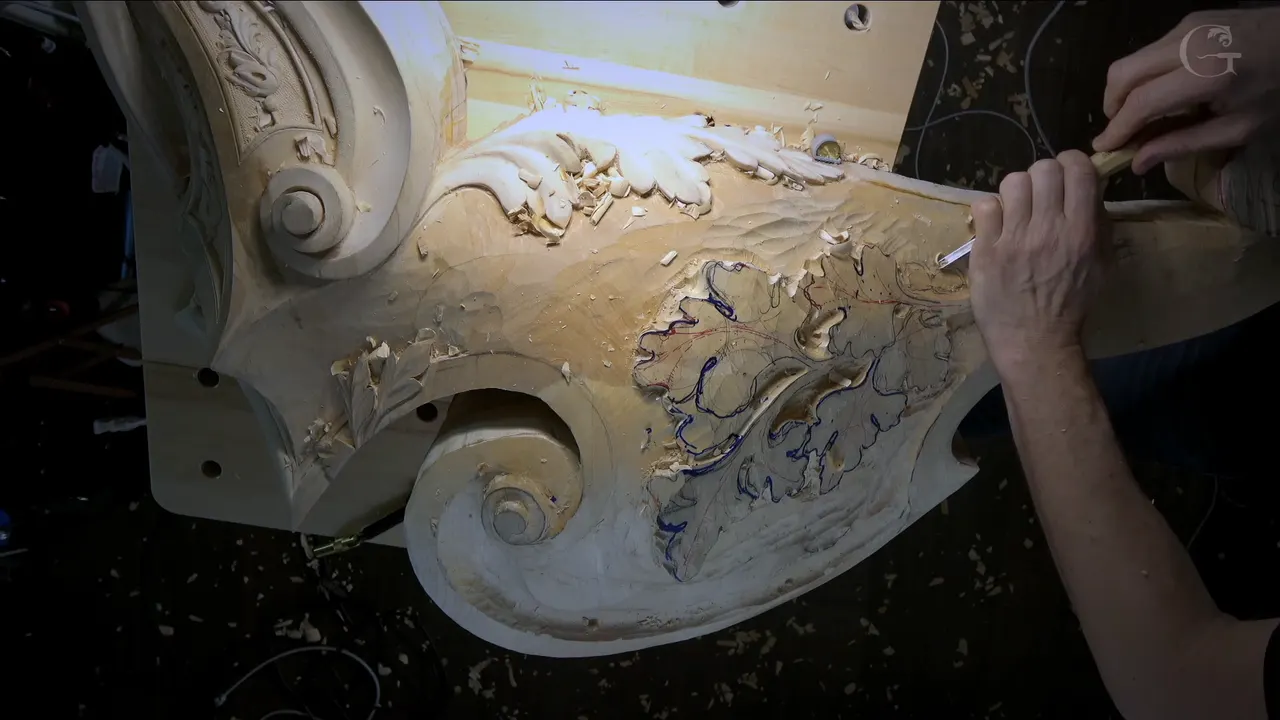

Part 4 of workshop 97 holds a line about a stage that has more in it, and a reason to leave it. Other wood carving lessons carry the same two halves. Each one is read here, together with the lines around it, so every reason sits beside its words.
Ever stop a pass while you can see more work in it? That moment shows up in workshop 97, and in the lessons below. Newcomers can read about wood carving on Wikipedia. Every size is in millimeters and inches, my own figure first.
What sits around the line in workshop 97, part 4?
The part opens with a plan for the next shapes: "Okay, let me also outline those future acorns." A worry about wood follows, "I want them, but I don't know if we're going to have enough material in this section." Next to it sits "Maybe I just removed a little too much. Maybe yes, maybe no." acorns have a Wikipedia page of their own, in case the word is new to you. The next plan is short: "Outline this side."

The light gets a line too: "And I guess I need a little more lights." Right after it comes the narrowing, "I mean, closer to me. I don't need more lights, but just get the light closer to me. That's what I need."

Mood and plan sit side by side. "All right, so I'm happy with this. Although I can probably remove some of that material right here." The blend has its own plan, "And yes, I need to blend that to my acanthus." Its measure is "So it has to be somewhat gradual." Elsewhere in the part, a leaf gets this plan: "part of a leaf going to go underneath of that line, and I can probably right away outline it."

How deep is the movement, in numbers?
The numbers arrive in the same stretch: "So pretty much my goal is to create about, I would say, about 10 millimeters or 12 millimeters, 10 to 12 millimeters from the upper part of this movement to my background area." That range is 0.39 to 0.47 in. My own inch figures sound like "About half an inch, three-eighths of an inch, half an inch, something like that." The two inch figures work out to 9.5 mm and 12.7 mm.

The reason is stated next to that aim: "Because I want to create lots of shapes in those leaves, and that way it's going to look much better, nicer." The depth at that moment is "I'm approximately right now six to eight millimeters deep." Those are 0.24 to 0.31 in. Close by sit "Pretty close" and "Later on, I'll get a little deeper, but for now it's good."

Where does the line itself sit?
Right here: "Okay. I guess that gives me a good idea what is going on." Then the sentence, "And I could, of course, spend a lot longer on this stage, but I really don't need to." A choice of leaf comes after it, "So I guess my first leaf I want to concentrate on. It's going to be upper one, of course."

What follows the line?
Next comes a plan for the movements: "Now I can probably just start the refinement of my movements." Also "Let me get some kind of different color." The count is "I'm going to divide in fives."
The outline gets its tool: "And outline it I'll take the same 5 millimeters. 5 millimeters, number 11. And I'll just create a cut around." Five millimeters is 0.2 in. A limit comes with it, "It would be too early because we still didn't establish the main form yet." And a depth, "maybe about 1/16 of an inch deep as of now, okay? It's not the end yet." One sixteenth of an inch is 1.6 mm.

The old carvers are the model: "And I'll follow probably the logic of those people who used to live in the beginning of 16th century, end of 15th century." Beside it, "I'm going to do exactly the same idea what they've done." Their shape, "The main convex right in the middle of those three main divisions."

Eyes come with a warning. "I don't want to set those eyes too deep. It's not going to look like oak" and "But they've done it actually. They've done it." One more line gives a guess at why, "because they carved all the time just acanthuses, and even oak leaf look like acanthus." Wikipedia covers oak and acanthus.

What do the other two videos of workshop 97 add?
Part 3 holds a plan and a worry: "a shell going right underneath of those leaves, so I don't want to dig too deep and create problem for myself later on." The worry ends on "enough material for my shell movement."

Also in part 3 sits "and that would be mistake if I would do it." It follows a thought about acorns. Earlier in that part, "I'm happy with this side somewhat" and "Not as deep."

Part 5 puts depth in the foreground, the depth of each concave and convex: "So it's more subtle but still readable." Close to it, "Again, that is just a main form." The same part has "but I'll try little by little, okay, the movement" and a note on the marker, "Man, I shouldn't use the blue permanent marker. It's really deep."
Where else does the same thought sit?
Extra detail meets a delivery date in workshop 77, part 10: "just creating beautiful detail on it." Then "But I also have to be mindful that is a real project, and I need to deliver that project by a certain date." Last, "just be really mindful how much time I'm spending in one area."

In part 3 of workshop 139 the thought runs on: "So I've pretty much done both directions my cut" and "just to get that to the perfection". Its reason follows, "Reason why, because I also want to texture it, okay, inside of here, same like what I did right here, by using my punch."

A second reason sits further on: "more realistic, I would say." The result is voiced as "the texture what I've done, it just blends those designs together." There are Wikipedia pages on texture and the punch.
In Chamomile and Bow Rosette 1, part 2, a chisel is on the plan: "I could take a number one, like a small chisel, 1/16 of an inch, and refine and kind of round somewhat some of those cuts." That size is 1.59 mm. A comment sits in front of it, "and maybe I should." After it come "And also attack that middle part, clean it" and "I think it's a good idea to use that small, tiny tool." The warning is "I could break it really easily." Chamomile has a Wikipedia page too.

Vase with grape leaves, lesson 4, part 5, starts the other way round: "I think it is enough." Then "make it to the perfection." A scraper plan sits in the middle, "I could take a small scraper and scrape some high spots." The vase and the scraper both have Wikipedia pages.
In the Grinling Gibbons class in Maine, lesson 12, part 2, cleaning is put off. Before it come "And blend that thing" and "Give that shape." After it, "clean everything later, but still, you know, try to be as close as possible. But if it's not as clean, don't worry about it, okay?"

Plate with Butterflies, lesson 10, part 3, holds "Maybe I will do it also a little later." What is left is "those cuts, which is really easy actually." The depth is "And the cut is not that deep, like even, I don't know, half a millimeter or so." Half a millimeter is 0.02 in.

In Furniture Panel 18, part 3, the details wait for another day: "because it is a later project." A tip sits beside it, "But still, get as close as possible." Also "so you'll have a chance to work on it". The tool is named in "We're going to take number 11 veiner and outline it." Readers can look up furniture on Wikipedia.
Time goes to the end in Furniture Panel 19, part 11: "If you look really close to it, you will see some imperfections yet," followed by "because I'm still going to spend more time and clean it." Then "I usually leave it to the last point."
Which Venice Room lessons carry the same thought?
The workshop 100 video, part 7, has these words: "Yes, of course, there's no end what you can do" and "You can take to the extreme". A closing line is "to what extreme you want to take it." The finish sounds like "just clean it even nicer. Just blend everything and make it look even more beautiful."

An eye is the spot in part 10 of workshop 22: "I can always clean little better inside of the eye" plus "But not now because I can't concentrate right now just on the cleaning." Its reason is "Because you never know, maybe later on, I will change some stuff."

Details wait until the last point in workshop 21, part 1: "how I can create my separations on this one." Then "Probably now you know why I don't work on the details until the last point when I am actually ready for the details."
Part 3 of workshop 7 puts the cleaning later: "which I can always get done a little later because I'm still working on development of the main idea."

Movement is the topic in part 12 of workshop 20: "but you can see it just created beautiful movement." A plan follows, "And I can actually create an extra separation right here, and that's going to give me even more beautiful movement." The tool is on the plan too, "I probably should use just a small number three tiny tool, just like that."
Part 10 of workshop 34 has a reason behind it: "And now I can probably just get more definition, I would say, to those areas" then "and undercut even more" and "which I don't have to do right away". It ends with "and I will probably just off-camera spend some time on details."

Which other courses say it?
In Acanthus over Moldings 7, part 2, blending is the subject: "Of course more blending." Later in that part, "I gonna spend a little more time little later on that but for now, I'm happy."

Floral and Molding for the Panel 2, part 2, ties extra time to a drawing: "I do an original drawing, but when I transfer that design to the wood" and "than what I need to."
Workshop 119, part 1, names a side nobody sees: "anything on this side because it's never going to be visible" and "than what I have to."

The other way round sits in Lily Box 6, part 5: "I know it's slow. I know." And "I'd rather spend more time on developing." Also "Little by little, almost like a turtle" and "Really slow." A closing reason is "to make any mistakes right here."
In Hazelnuts, lesson 7, part 3, a result is in view: "make it even better." Then "don't worry about making it perfect because you're going to have a chance to clean up a little later." Also "Once you're happy with all in the motion right here, you can always make everything cleaner and nicer." The Hazelnuts have a Wikipedia page of their own.
And in the beginner course, workshop 2, part 6, a knife lesson has "do a lot more details, and you could do that actually, just to make it more beautiful if you wish." Next, "But there's no limit."
Where do the frames come from?
Each picture here is a frame from the video of the lesson named beside it. Two more come from parts 3 and 5 of workshop 97.
Lesson by lesson, side by side
| Lesson and part (Venice Room unless named) | Beside the words |
|---|---|
| 97.4 | A depth that is still shallow, and then the first leaf to concentrate on |
| 77.10 | Beautiful detail and a delivery date |
| 139.3 | Both directions done, with texture planned for the inside of the shape |
| Chamomile 1.2 | A small chisel on the plan |
| Grape vase 4.5 | Enough, plus a scraper on the plan, with the oil still to come |
| Gibbons Maine 12.2 | No second pass, cleaning later |
| Butterflies 10.3 | Later, then a very shallow depth |
| Panel course 18.3 | Details saved for a later project |
| Panel course 19.11 | Imperfections left |
| 100.7 | No end to the options, and a free choice of extreme |
| 22.10 | An eye |
| 21.1 | Details held back for the last point, when they are ready |
| 7.3 | Cleaning waits |
| 20.12 | Beautiful movement, then a tool on the plan, and one more separation to add |
| 34.10 | More definition |
| Acanthus Moldings 7.2 | More blending, then a little more time later on |
| Floral and Molding 2.2 | An idea of where the flower goes, with no extra time on the transfer to the wood |
| 119.1 | A side out of view |
| Lily Box 6.5 | A slow pace, and a wish to avoid mistakes |
| Hazelnuts 7.3 | A result, and better later |
| Beginner course 2.6 | A quick design, and room for a lot more details |
Is there a stage on your own bench that still has more in it? Everything in this lesson sits inside one tuition plan, and more Venice Room workshops wait on the Part 8 course page. For a gentler start, try the Acanthus Moldings course or the Furniture Panel course.
How it's done
- Find the line. Start with the line in the title of this page.
- Read what follows. Then the choice of leaf gets named.
- Check the numbers. The first outline is about 1.6 mm deep (1/16 in).
- Look at the other lessons. Each lesson in the table adds its own reason beside the words.
- Compare the reasons. Each lesson gives its own reason. One names a delivery date, another texture, and others a later project or a side out of view.
Frequently asked questions
How deep does the movement go in this part of the lesson?
"10 to 12 millimeters" (0.39 to 0.47 in).
Which tool outlines the leaf?
"5 millimeters, number 11" (0.2 in), and the plan is to "create a cut around."
Why texture the inside in workshop 139?
"same like what I did right here, by using my punch," and "more realistic, I would say."
Which chisel is on the plan in Chamomile 1?
What to carve next