
Alexander Grabovetskiy, woodcarver, School of Woodcarving · Published 2021
What does a wood carver mean by "close enough"?
Quick answer: Close enough is a word I use when a figure lands near the one I want and I go on with the work. In part 12 of workshop 97 I guess "12 millimeters or so," then end on the half inch. Other lessons of mine use the words for a tool size, a gap and a drawing.
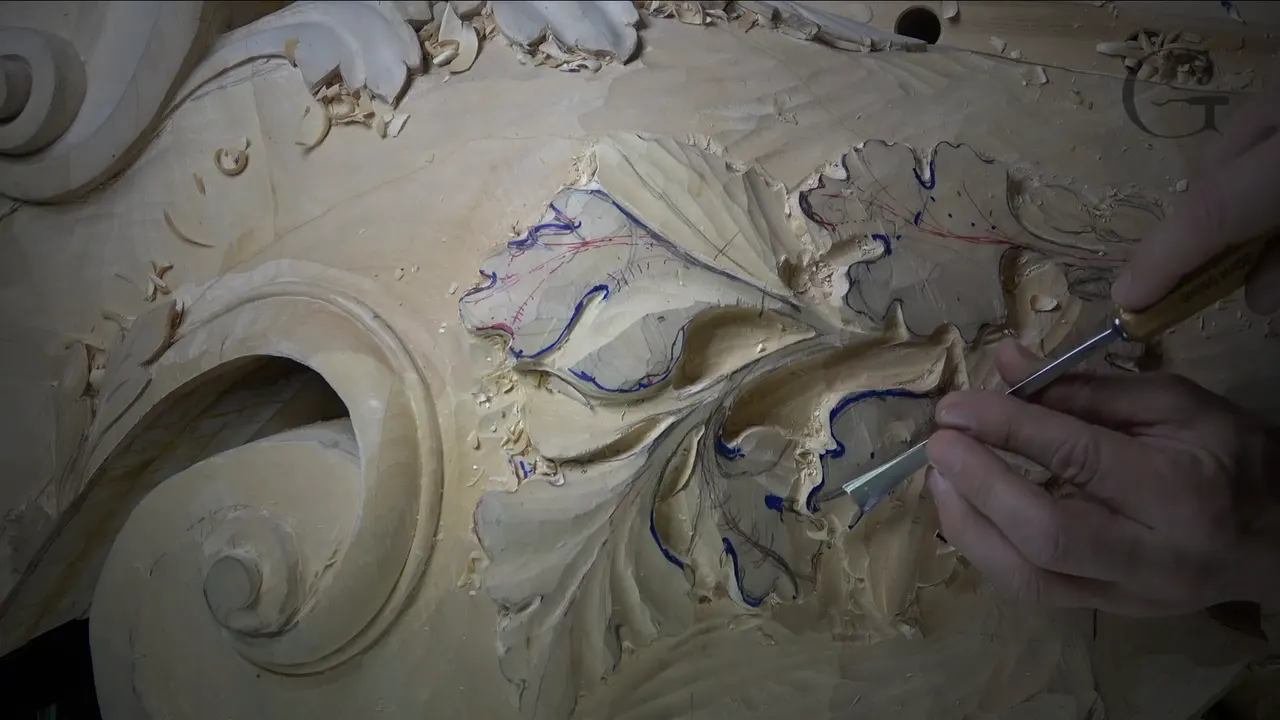

Close enough is my phrase for a figure that lands near the one I want, and I let it stand. In part 12 of workshop 97 I guess at a size twice, then settle. The same two words sit beside a tool size, a gap and a drawing in my other wood carving lessons.
Ever held a gouge against a drawn line and found it a bit wider than the line? Or checked a gap and found it slightly off? Those moments are in this part and in the lessons below. Every size is in millimeters and inches, my own figure first, and I checked each conversion by arithmetic.
What does part 12 name before the line?
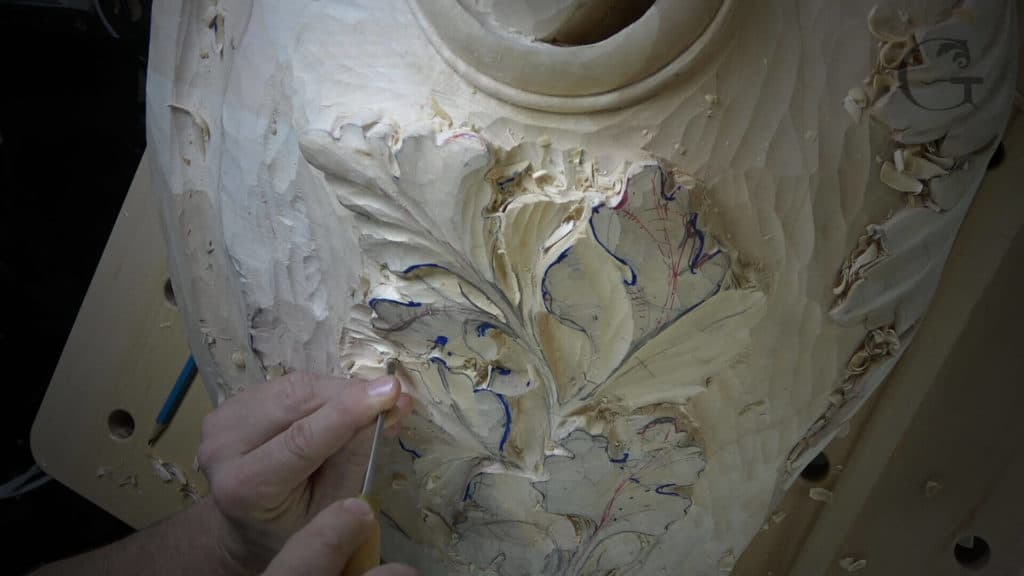
The part opens on a tool: "Try the number seven first." A wish comes next, "And I don't want to lose the sense of an eye and the sense of the movement." Then comes my plan, "And I'll use my number seven upside down and maybe give a somewhat final outline to this region."

A need follows: "I'm going to need little smaller tools to finalize that movement." The choice is "Let me think if I'll be able to use somewhat like a number six or number five." The pick is "I'll use quarter-inch number five." The figure beside it is "That's six millimeters." A quarter inch is 6.35 mm, and six millimeters comes to 0.24 in.
I give my verdict on that outline in plain words: "Okay, and that is the outline I'm after. And I think I like it. I think I like it." A little later come "Number seven again" and "I can go a little deeper in this section." One more plan sits there: "And what I'll do, I'll create secondary concave going all the way to this point."

Two videos earlier, in part 10 of the same workshop, a stem gets its figure in two systems: "overall, it's going to be about six millimeters, about a quarter inch by the end". That line is a plan, so the stem stays a plan on this page too.
What leads up to "close enough" in part 12?
A small count comes first: "Maybe I've got too many divisions already." Next, "And I'll just do it this way because I don't want to overdo it. One, two, three, four, five." My size plan is "Let me use number 11, 10 millimeters" (0.39 in), and the verdict on it is "I think that looks much better."

A smaller size follows, "And I'll use five millimeters to outline it slightly better" (0.197 in). I name the next tool and guess at its size: "Number three upside down, about half an inch, about maybe 12 millimeters or so. Maybe about 13 millimeters. Who knows?" The verdict lands next: "Close enough, right? Half an inch."
A half inch comes to 12.7 mm. My first guess of 12 mm (0.47 in) sits 0.7 mm under it, and my second guess of 13 mm (0.51 in) sits 0.3 mm over. Both land within a millimeter. Anyone who lets a guess stand like that is working to a tolerance, even if nobody says the word.

What follows the line?
The work goes on: "And cut it like this." Next I give a tool, "Let me use two millimeters. Number 11." Two millimeters fits in 0.08 in. Close by sit "Make it a little nicer, cleaner look" and "Go a little deeper right in this section."
The part ends on a need for the whole leaf: "And here you go. That is the middle line, which means I need to fix overall movement like this." A need stays a need here.

How does part 12 talk about the leaf itself?
A different kind of nearness sits in the middle of the part. The leaf is a shape, and I tell you how near it is to a real one: "That leaf is not true like a leaf you see in life. Okay? It's more or less stylized, I should say." A doubt follows, "I don't know. Maybe you saw a leaf like this in life." My own answer is "So I never saw anything like that."
The reason I give for the shape is "But like I said, I researched, and that's what they did." Next, "And that actually blends nicely with acanthus." The longer thought is "So it doesn't make sense in a sense of nature, but it does make sense in a sense of design and that style. It just blends together with the rest of the design."

Where else do I say "close enough" about a tool size?
In Hashemi Flowers 10 I name a tool: "Again, this is a #7, that's what I'm using. One inch, 25 millimeters. Little bigger than 25, but close enough." One inch is 25.4 mm, which is a little over the 25 I give, so the words fit. A bigger tool is fine too: "Any bigger tool will do." The example is "If you have 3/4 inch, it's still going to work, or 20 millimeters." Three-quarters of an inch is 19.05 mm. A 20 mm tool measures 0.79 in. The gap is "It's only five millimeters difference, or 3/16 of an inch difference." Five millimeters comes to 0.2 in, and 3/16 in is 4.76 mm.

Later in that lesson another size gets the word "about": "And this one is about 3/8 of an inch." Next comes "All they mark is just the number of the sweep." Three-eighths of an inch is 9.5 mm. The way around it reads "So this case is just the number eight, and you have to just kind of guesstimate all your measurements." The rule I give is "if it's close enough" and then "to the task what you need to achieve, then that should be fine."

The first Venice Room course has the words again, this time with a number 9. The line is "You can see it right here, number nine, 14 millimeters" and then "it's 5/8. It's about 16 millimeters." Fourteen millimeters works out to 0.55 in, and 5/8 in is 15.9 mm. My verdict is "But it's okay. It's close enough." See Venice Room workshop 1 for the whole stretch.

The Lily Box course puts the words beside a drawing, and the plan is to stay near that design without getting too crazy about it. The tool plan is "I'll use a same number seven, which is marked as a six millimeters, but whatever the tool you can fit." That marking is 0.24 in.
The Furniture Panel course, lesson 18 has "Okay. That is close enough." Right after the verdict comes "What I want to do, I can probably just tap with the number one this section" and then "and I want to make sure this corner is really nice and sharp." The size is "this is a number one and 8 millimeters" (0.31 in). A plan sits beside it: "I could probably get a little bigger number one, like five-eighth of an inch" (15.9 mm).

Do I use the words on a measurement too?
Floral and Molding for the Panel 4 has a gap check. Before it comes "how you determine, you look at the gap, whatever the gap is". A figure follows, "maybe about half a millimeter, maybe even less." Half a millimeter is 0.02 in, for the record. Then "Let me get a piece of paper and just try to place it right there." The result is "the gap is just about paper." My own call on it is "close enough for me. I still have to shave it."

Venetian Flowers Rosette 5 ties the words to a distance. I measure it first: "So what I've got, I've got about an inch and a quarter between those two spots." An inch and a quarter is 31.75 mm. Then "And let me check my original drawing, and I can see if I've got close enough or not." The finding is "It does look like I'm pretty close."

In the first Butterflies lesson a board gets a figure it treats as approximate: "the board itself. It's about 254 millimeters." Then "that's gonna be my approximate diameter." Ten inches is 254 mm, so the two figures agree to the millimeter.
That lesson comes back to a smaller figure: "And I would say it's about five millimeters in this space, 3/16 of an inch, maybe little less than it, like four and a half. Doesn't really matter." In inches, five millimeters is about 0.2, 3/16 in is 4.8 mm, and 4.5 mm is 0.18 in. An approximately measured figure is enough for that spot, and my own words say so.
Does a drawing or a line have to match?
In Roman Acanthus 1 I talk to you about your own sketch. "Even if it's not going to look exactly the same like mine, that's absolutely no problem." The standard is "But if you can get a close enough drawing, if you can get the main idea, that would be sufficient."

The Lily Box course, lesson 11 has a redrawn layout. "I really don't need to be too accurate to my drawing." Then "Like I said, I just lost one of the parts, but if I'm pretty close or close enough, I should say, I should be okay." The cause shows up further on, "this part, just because I drilled too big of a hole." And "I essentially just created a problem for myself."

Plate with Butterflies 11 puts the idea on a line you draw. "But if you don't feel comfortable just eyeballing, you can always recreate approximately." The method is "just place your finger against the end of the plate, get approximately to the line you want to create and just follow that." The verdict reads "It doesn't have to be perfect, but close enough." Then "Do not rush it."

Furniture Panel 38 moves the same idea to a sweep. I ask you to find the right sweep "where you can just get, uh, to the line." Then "I mean put it close to the line." The words after it are "Doesn't have to be uh, perfect" and then "get close enough to the line, it should be good."

Furniture Panel 21 puts a limit on it. The subject there is "that first cut." I describe how "Lots wood carvers, they would just grab close enough to the profile gouge and start digging just like that." Then "which I think that's still possible, and that creates a really nice and smooth line." My problem with it is "my fibers go back." The cost I name is "And yes, the cut looks clean at the beginning, but next morning when you come" and then "somewhat rugged, so it's not really good." My verdict is "Okay? I think it's doable, but it's not my preference, how I would do it."

In Venice Room 25 the words are "But I also want to make sure I am doing the right thing close enough." The words "I think I should move this movement" come right after them.

Where do I stop when I say it?
Venice Room 150 gives a first step and then a limit: "I'm going to excavate around first." Then "the space right here on this side is going to be about no more than quarter inch." A quarter inch is 6.35 mm. My plan is "And I'll take it all the way to the quarter inch." Further on sit the words "And I think that's close enough."
Venice Room 159 sets the words beside a profile. A check opens it, "Right now, I can probably just check which number 11". Then comes "If I can just get that profile close enough, and yes, I've got a really close profile." For the dig the tool plan is "just the 12 millimeters, number 11, but 12 millimeters to excavate a little deeper." Twelve millimeters equals 0.47 in. The last words of the plan are "It's going to give me perfect almost."

Lesson by lesson, side by side
Across these lessons the words sit beside a tool size (Hashemi 10, Venice Room 1, Lily Box 2) and a distance (Floral and Molding 4, Rosette 5). A drawing or a line (Roman Acanthus 1, Lily Box 11, Butterflies 11, Furniture Panel 38) carries them too, and so does a limit (workshop 150). Each figure above comes in metric and imperial units, my own figure first.
| Lesson and part (Venice Room unless named) | Beside the words |
|---|---|
| 97.12 | Two guesses at a size, then the words that end them |
| 97.10 | A stem that gets one figure in two systems |
| Hashemi 10.2 | A number 7 just over the size I name |
| Hashemi 10.9 | A tool marked only by its sweep number |
| 1.14 | Marked one way and, in my words, really another |
| Lily Box 2.8 | A drawing I want to stay near |
| Panel 18.1 | A short verdict, then a plan for a number 1 |
| Floral 4.1 | A gap checked against a sheet of paper |
| Rosette 5.3 | A distance checked against my first drawing |
| Rosette, later | A figure that does not really matter |
| Roman 1.3 | Your own sketch, with the main idea in it |
| Butterflies 11.2 | A line you draw yourself, with a finger as the guide |
| 150.3 | A space with a limit |
| 159.3 | A profile that is checked before the tool gets picked |
| 25.11 | The right thing, done near enough |
Is there a spot on your own bench where a shape sits near the mark and you have to decide whether to let it be? Everything in this lesson sits inside one tuition plan, and more of this room waits on the Part 8 course page. For a gentler start, try the Acanthus Moldings course or the Furniture Panel course.
How it's done
- Find the line. Start with the verdict near the end of part 12, after the guesses.
- Read the guesses before it. Two guesses sit before it, 12 mm and 13 mm, against 12.7 mm for the half inch.
- Check the tools around it. Part 12 names a number 7, a quarter inch number 5, a number 11 and an upside down number 3.
- Look at the other lessons. Hashemi 10 sets a number 7 beside a size, and Venice Room 1 sets a number 9 beside a mark.
- Weigh the limit. Workshop 150 sets a space of no more than a quarter inch before the verdict.
Frequently asked questions
How close are the two guesses in part 12?
Within a millimeter (0.04 in) of 12.7 millimeters, which is a half inch. The first guess is 12 mm, and the second is "Maybe about 13 millimeters." After them comes the verdict.
Which tool follows the verdict in part 12?
A number 11, set at two millimeters (0.08 in), is the tool I name next. In the part it is just "Number 11." The size comes right before it, and the part gives nothing more.
How big a tool does the Hashemi lesson allow?
Any bigger tool will do, in my words, and a 3/4 inch tool of 19 mm, or 20 millimeters (0.79 in), still works. The line before it is "Little bigger than 25" for my one inch (25.4 mm) number 7.
What to carve next
- Workshop 97
- Hashemi Flowers 10
- Venice Room workshop 1
- Lily Box 2
- Furniture Panel 18
- Floral and Molding for the Panel 1
- Floral and Molding for the Panel 4
- Venetian Flowers Rosette 5
- Roman Acanthus 1
- Lily Box 11
- Plate with Butterflies 11
- Furniture Panel 38
- Furniture Panel 21
- Venice Room 25
- Venice Room 150
- Venice Room 159
- Part 8 course page