

Alexander Grabovetskiy, woodcarver, School of Woodcarving · Published 2021
What does a wood carver mean by "every little bit"?
Quick answer: In workshop 97, part 7, the line sits right after a talk about daylight from the windows. A plan to go deeper follows it. The same words show in Hashemi, Furniture Panel and other Venice Room lessons, each read with the lines around it.
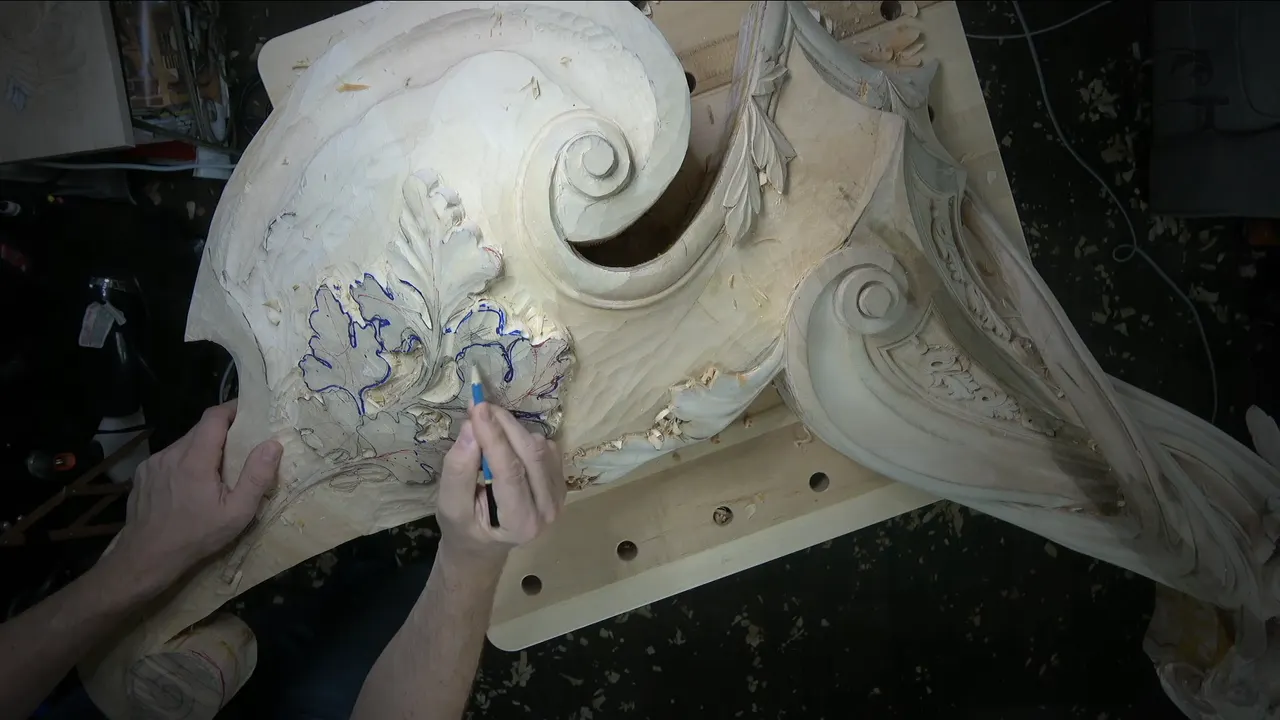

In the seventh part of workshop 97, a talk about daylight and a deeper dig on the second side ends on a short question, "Does it matter?" Its answer is the line this page is named for. Other wood carving lessons carry the same words, and each passage below is read with the lines around it, so every reason sits beside its words.
Ever pushed a gouge a little farther just to see what the light would do? That is the spot this lesson sits in, and the lessons below hold the same kind of choice. Newcomers can read about wood carving on Wikipedia. Every size is in millimeters and inches, my own figure first.
What comes before the line in part 7 of workshop 97?
The part opens on a change of plan: "It's time actually to work on more details." A reason for the change sits near it: "I decided to get an extra movement underneath of this leaf." The change itself was made "off camera." It "has to do with this leaf."
The aim is spoken as "I want to separate and make this one as separate from that part." The leaf has a place on the carving, "right underneath pretty much of this line" and the count stays at "three divisions."

Why does the shadow decide the first dig?
Light is behind the dig: "especially the light source is going to strike from this side, from above, and it's going to cast a shadow." The shadow shows from below, so a warning rides along: "And I have to be careful how deep."
Number 11 comes first, as a plan: "So I'll take number 11 again and 5 millimeters, 3/16 of an inch and start." Five millimeters (0.2 in) and three-sixteenths of an inch (4.8 mm) sit side by side. Next comes "I will start just outlining."

A limit travels with it: "And I don't want to go too deep." The reason for the limit is "It's going to be hard for me to create nice look underneath." Looking at the result, the verdict is "But you already see how deep shadow it casts. It's just perfect."
How does the second side get its turn?
The other side gets this line: "exactly the same on the other side." Next a move for the body: "Let me change the position." A thought follows, "Maybe I can just attack from here" and that spot goes "underneath of the bigger leaf."

A change of tool follows: "So next, I'll just take number 7, 14 millimeters. I'll blend that in." Fourteen millimeters (0.55 in) is the size. A grain note sits in the middle of the pass: "Yes, I'm doing a wrong way across the grain." Then "So that's the right way."

How deep did the first side go?
A figure arrives after the grain note: "approximately maybe about a 3/16 of an inch deep cut." Three-sixteenths of an inch is 4.8 mm. One word follows, "plenty." Then a turn: "I'm okay to create much deeper on this side."
Light explains it: "the light's going to hit from this point." A second reason is the view from the bottom, and the spot does not show from there. The line that follows is "I really could exaggerate this movement right here" with "actually create some kind of nice movement" after it.

Why does daylight change the dig?
Daylight comes in with the windows. The talk is about the viewer: "if they're going to look during the day, the light source is going to be from the windows, okay?" On that side the light is said to "travel on inside" and the shadow there is not as deep. The picture is "the light actually shoots straight to it, it's not from above."
A line to the viewer follows: "I hope it makes sense. It's still going to create some shadow, but during the day, not at night." Wikipedia has pages on daylight and sunlight.

The question that names this page comes next: "Does it matter? I think every little bit matters." After it sits a choice, "So I can actually go and create much deeper area." The size is a plan, "So maybe all the way, half an inch or so" (12.7 mm). The payoff named is "give me a lot more movement."
How does part 7 end?
The part ends on a swap and a tool: "All right. Okay, let me take number 7 again. No, I'll just blend that." The last lines give the depth: "About half an inch, about 12 millimeters deep." Then comes "That's what I've done." Twelve millimeters (0.47 in) is the figure.

What do parts 6 and 8 say about the same spot?
Part 6 gives the stem a figure: "I'll make it about six millimeters, about a quarter inch." Six millimeters is 0.24 in, and a quarter inch is 6.35 mm. The added part draws praise: "And I'm glad I added this part that would make it look really nice and beautiful." An option sits next to it: "I can actually bring the main body a little bit underneath of this future movement." The picture is "just like a really nice layering."

The five divisions in part 6 get this limit: "They don't have to be deep, by the way. Really don't." Near the end of that part sits "it still gives me some shadows and lights, and it looks really good."
Part 8 has an early worry about the underneath: "do I want to expose underneath more than I need to?" The way out is an overlap: "overlap this part" gives room for "much deeper cut in this area," which is "much probably more 3D." Along the way sit "I am making changes, not changes, but decisions right on the fly" and "I'm talking about 3D shaping."

Figures follow. One section gets "approximately 10 millimeters deep" (0.39 in). A second leaf gets "no less than 3/8 of an inch" (9.5 mm), and a limit goes with it: "I don't want to do too much." The plan for now is "about quarter inch, about 6 millimeters deep" (6.35 mm and 0.24 in).
Another line in that part is "Again, all about shadows." A tool size follows, "10 millimeters in this case" (0.39 in), with a reason, "a little quicker result." The gouge and the mallet each have a Wikipedia page.
Which Hashemi lessons carry the same words?
Hashemi Flowers 9, part 1, answers a question about small details: "Why I do those small details, if you would ask me." The answer is "every little shadow will help." A smaller tool follows, "maybe even number 11 and only one millimeter" (0.04 in). The next move is "I'll just undercut this way, and look what I'm doing with my finger."

Hashemi Flowers 26 gives an undercut first, in part 3: "and make a small, not too big, but small undercut." Next come the lines: "Not much, a little bit, but still, every little helps. For the shadows, of course. That's what I mean." A reassurance follows: "don't worry about it doesn't look as perfect as far as the lines and so on. So we are still able to fix it."

A figure comes first in Hashemi Flowers 7, part 1: "I still have to take about eighth of an inch right here." An eighth of an inch is 3.2 mm. Any gouge may do: "I could use just probably number one, or any other gouge will work also." Just after "Take this out also" sit the words, opening with "And like I said,".

Over in part 2 of Hashemi Flowers 41, a twist gets them: "I think it just look much better with that small, tiny detail. I know it's almost impossible to see that." The end of the thought is "makes it look unique."

Which Furniture Panel lessons carry them?
The words sit in part 10, part 15 and part 8 of Furniture Panel 19. In part 10 a hand placed near the area shows a shadow: "See, it just gives me that extra shadow." Next, "See how it creates that beautiful shadow casting?" The sentence that holds the words ends "just like a black line, actually, is what it is, creates that shadow. Really important."

Talk of shadows goes on in part 10: "I know there's a lot of wood carvers, they really don't stress about the shadows, but I really like the shadow idea, okay? I really love it. And that all depends how you cast the light." A plan follows: "Let me use number 11 and half a millimeter" (0.02 in).
Space is short in part 15: "So I really don't have any space for undercutting because it's a really tiny detail." A knife is next: "Let me use a knife. A small knife." A knife has a Wikipedia page. Further on sits "Almost no pressure whatsoever."

Number three is named in part 8: "It's a number three. And I'm just creating that shadow." Then "It's really important." The depth is reported: "And that's kind of deep, what I undercut. So I've got in, I would say, good couple millimeters."

Almost no material is left in Furniture Panel 20, part 4: "I really don't have too much material to undercut because like I said, it's only 1.0 millimeter wide detail" (about 1/25 in). Just after sits "every little cut helps."
A thought about time follows, on doing it for furniture: "yep, that's true, and that's exactly what previous generations, when they worked on furniture, would take." Further in that part sits "I still want to undercut somewhat, okay? See? It's almost invisible, but still" and the words follow.

A profile sits beside the line in Furniture Panel 21, part 8: "Whatever fits the profile to create a really nice, smooth transition." Then "Everything counts."

A shadow on one side leads to a plan for the opposite side in Furniture Panel 23, part 11: "See how nicely it casts its shadow?" Then "And I can do exactly the same on the opposite side also" and "Go a little bit in, right to half a millimeter" (about 1/50 in). After it sits "It's not really undercut, but still,"

Which other Venice Room workshops carry them?
A tiny tool is planned for more shadow in part 2 of workshop 110: "And let me take 1 millimeter. 1 millimeter, and yes, it's still number 11" (0.039 in). Then "And carefully, I'm going to get an even deeper shadow" and a question sits beside it, "Do I need it? Not really, but"

A slope gives room in part 1 of workshop 120: "I could go even deeper because I do have a slope downhill this way." Then "I'm okay, actually, if I can dig a little deeper and create even deeper shadow." After the words comes "It is enough."

The viewer is the subject in part 1 of workshop 7: "especially it has to be clean on this side." Then comes "from a distance, but still."

Which other courses carry them?
Carving Grape Onlay 10, part 1, has a small opening as its subject: "I've got my opening, I've got my opening." The thought is "I know it's not a big opening," Then "Again, not necessary detail in all. People probably won't even notice that."

A stem sits beside a leaf in part 3 of Chamomile and Bow Rosette 2: "or this leaf could hide underneath of the stem. It doesn't really matter." The choice is "Maybe I'm going to hide this stem" and the reason sits right after, "a little easier to do." The line leads in with "Doesn't really matter, but" Then a tool: "I'll use a small back bend." Chamomile has a Wikipedia page, and so does a chisel.

Do the same words ever mean something outside the bench?
The Dining Table Apron lesson, workshop 9, takes the line off the wood: "And also comment. Don't forget to comment." Then "it helps website to grow and rank even in Google higher" and the plea ends "So comment as much as you can." Readers can look up an apron on Wikipedia.
Where do the frames come from?
Each picture here is a frame from the video of the lesson named beside it. One comes from part 6 of workshop 97, and the rest follow the passages above, one lesson at a time. Hazelnuts have a page on Wikipedia, and so do oak and wood, while a relief has its own entry as well.
Lesson by lesson, side by side
| Lesson and part (Venice Room unless named) | Beside the words |
|---|---|
| 97.7 | Daylight on the leaf, then a deeper second side planned |
| 97.8 | A leaf overlap that lets the dig go about 10 mm (0.4 in) deep |
| Hashemi 9.1 | Why small details matter, then a smaller tool |
| Hashemi 26.3 | A small undercut, and a reassurance |
| Chamomile 2.3 | A stem that could hide under a leaf, or the other way |
| Furniture Panel 19.10 | Placing a hand to show how a shadow is cast |
| Furniture Panel 20.4 | A detail with almost no material to undercut |
| Venice Room 110.2 | More shadow from a tiny tool, and a question |
| Venice Room 120.1 | Downhill ground, and a dig that stops at enough |
| Grape Onlay 10.1 | An opening that is not big, and a detail few will notice |
| Dining Table Apron 9 | A plea to comment, said with the same words |
Is there a carving on your own bench where a small step could still pay? Everything in this lesson sits inside one tuition plan, and more Venice Room workshops wait on the Part 8 course page. For a gentler start, try the Furniture Panel course or the Hashemi Flowers course.
How it's done
- Find the line. Start at the short question this page is named for, in the seventh part of workshop 97.
- Read the talk before it. Light from above and the view from the bottom set the first dig.
- Check the depths. About 12 mm (0.47 in) is the figure at the end of part 7, after a plan for a deeper side.
- Compare the other lessons. Lesson 9 of Hashemi Flowers has a reason, "every little shadow will help."
- Match each line to its spot. A thin detail sits in the Furniture Panel course, and a slope sits in Venice Room 120.
Frequently asked questions
Which tool outlines the first leaf in part 7?
Number 11 at 5 millimeters (3/16 in) is the plan, and the first job on the list is an outline. A deep dig there would make the look underneath hard to create.
How deep does the second side go in part 7?
The plan is to go deeper on that side, and the last figure is about 12 millimeters (15/32 in).
Where does daylight enter the talk in part 7?
A viewer might look by day as well as at night, and window light hits the leaf straight on, not from above. A shadow still forms, and more movement is the payoff named for the deeper dig.
What to carve next
- Workshop 97
- Hashemi Flowers 9
- Hashemi Flowers 26
- Hashemi Flowers 7
- Hashemi Flowers 41
- Furniture Panel 19
- Furniture Panel 20
- Furniture Panel 21
- Furniture Panel 23
- Venice Room workshop 110
- Venice Room workshop 120
- Venice Room workshop 7
- Carving Grape Onlay 10
- Chamomile and Bow Rosette 2
- Dining Table Apron
- Part 8 course page
- Furniture Panel course
- Hashemi Flowers course