
Alexander Grabovetskiy, woodcarver, School of Woodcarving · Published 2021
What does a wood carver mean by "enough material"?
Quick answer: In workshop 97, part 3, the words sit inside a plan to quit digging early: a shell is still to come under the leaves, and a dig that goes too deep leaves no wood for it. Hazelnuts 7 asks to keep the wood thick for later work.

In workshop 97, part 3, one cue ends on "enough material for my shell movement." It sits inside a plan to quit digging early. My other wood carving lessons carry the words "enough material" too, and this page reads each of them with the lines around it.
Ever halt an excavation because the wood beneath it is needed later? This video has that moment. So do the lessons below. Newcomers can read about the gouge and the millimeters unit on Wikipedia, and every size here comes in millimeters and inches, my own figure first.
What does this part say before the line?
A walk around the piece is voiced in "And I'll go around." Then "Same operation." Further on sits "And yes, I have to attack that from the right" and "position." One remark follows: "I'm happy with this side somewhat."

A first dig is planned in "preliminary excavate" and "little section right here." The tool talk adds "number 11 and 5 millimeters," a size of 0.2 in, and "3/16 of an inch," or 4.8 mm, with "excavate a little" and "bit." Depth comes next: "Not as deep."
Why stay shallow? Look at "So it's not like I said, final form." Beside it sits "That for I would have the main framework" then "the base" and "and I can always refine from it."

A tool change is voiced as "Number seven again." A hedge sits beside it, "And maybe" and "mallet will help me." The mallet has a Wikipedia entry for anyone new to it. Then comes "There you go."
So what is the shell under the leaves in this lesson?
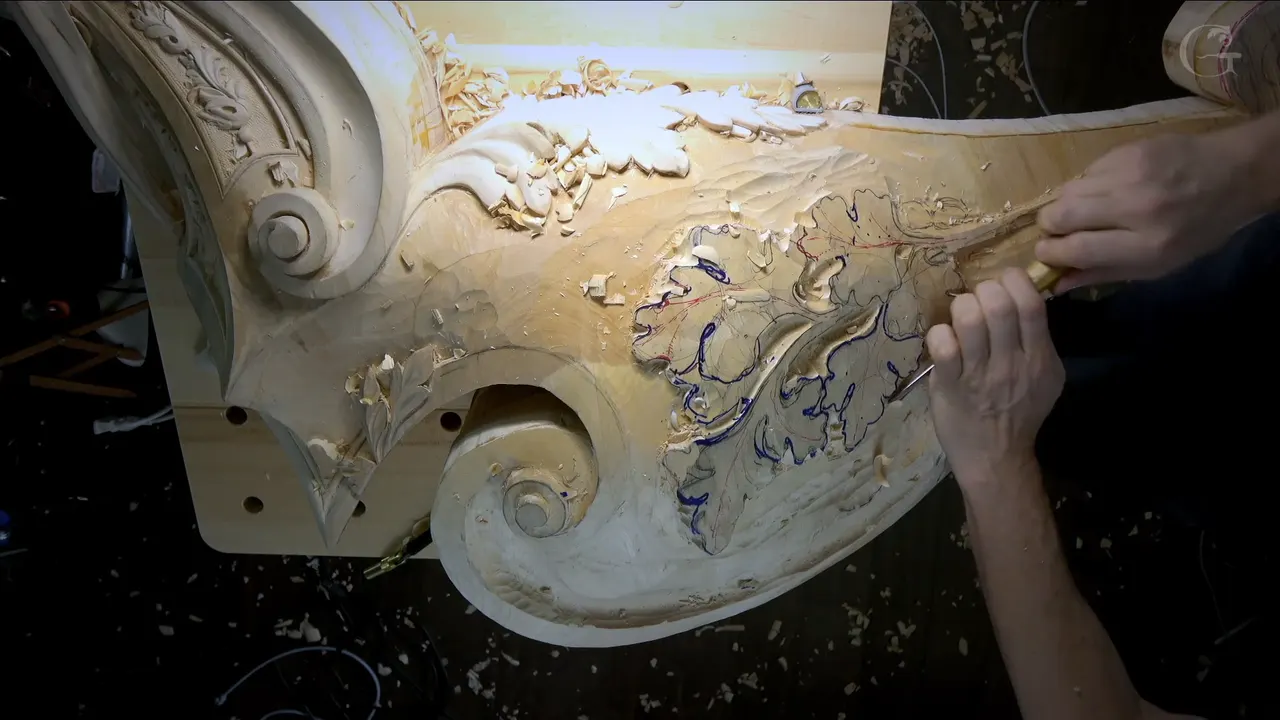
The line sits inside a longer answer. "Later on, there's going to be a shell going right underneath of those" and "leaves" and the worry is "so I don't want to dig too deep and create problem for" "myself" and "later on."

Two reasons follow. One is "If I'm going to create too deep of a cut," which ends in the title cue. The other is "then it's going to be hard for me to" and "reach the area." A short remark closes the thought: "So that is" and "good."
A shell gets a Wikipedia page. In this lesson the shell is a movement still ahead, and the wood below the leaves has to carry it.

Which tools and sizes does the video name?
Short lines carry the numbers. "Number 11" then "5 millimeters clean up" and "And I'm using just number three." Another reads "Let me use again number 11 and" with "5 millimeters." Five millimeters is about 0.2 inch. A further plan is "little deeper cut on inside of here" plus "Somewhat closer to the outline."

A stem is named once, in "like a stem side." Another side gets a plan in "And I'm ready to jump on another side." Then "Let me rotate that" and "Or maybe I'll just place it back and just work from opposite" with "side."

What about the opposite side and the acorns?
A walk is planned in "So I'll just walk around and work from the opposite side." After it, "Number seven again," followed by "And whenever I can" and "see the open area like this" and "I'll just outline it with that."
The second use of the phrase names a future part. "I don't want to remove too much of the material on this side because there's going" and "to be a couple acorns" and then "that would be mistake if I would do it." Wikipedia has entries on acorns and on oak.

Another dig is planned in "Let me excavate" and "millimeters." Doubt follows with "Still don't" and then "I want to change some of the movements."

What do the other parts of workshop 97 add?
Part 4 starts with the acorns. "Okay, let me also outline those future acorns." The doubt itself reads "I want them, but I don't know if we're going to have enough" and "material in this section." Next, "Maybe I just removed a" and "little too much. Maybe yes, maybe no."

The same part counts the wood. "I still have some of the material, but I don't know" and then "plenty" with "enough." A goal comes with numbers, "about 10 millimeters or 12 millimeters, 10 to 12," or 0.39 to 0.47 in, followed by "About half an inch, three-eighths of an inch." Half an inch is 12.7 mm. Three-eighths of an inch is 9.5 mm.
A current depth follows: "I'm approximately right now six to eight millimeters" and "deep," or 0.24 to 0.31 in. Then "Later on, I'll get a little deeper" and "but for now it's good." The reason for the depth is "Because I want to create lots of shapes in those leaves" with "and that way it's going to look much better, nicer."

Part 2 holds a small slip that sits near this theme. "Okay, so I made mistake. I just pushed straight" with "down." The summing up is "It's not big mistake, but I should be" and "more careful, I would say." Right after it, "But I really have to be careful."
Which lessons ask whether the wood will last?
Over in workshop 78, part 9, the words close a plan for a small leaf. "create a small leaf right on the" and "inside. Hope I have enough" with "material right there." Next, "So let me create the first cut" and "use 2 millimeters," or 0.08 in, and "2 millimeters, number 11, of course."

A reason for the plan sits in "really good idea to hide that, and I don't have to excavate" and "all the way deep in this area." One more remark: "And yes, I glued that piece, so now it's somewhat solid." The wrap-up is "It's a little trick to hide" and "those cuts like this" with "and still keep it really strong."
Floral and Molding 11, part 2, brings the words as a result. First "on the opposite side, but not as deep." Here "So now I do have" and "enough" beside "material for establishing convex" plus "my pipe." Another tool is named: "I'll use" and "flatter tool."

The same lesson names a knife as an option. "If you have a knife, you can do exactly the same" and "operation with just a knife." The method is "just pretty much just little by little creating chamfer" and "cuts and create the overall shape." Wikipedia covers the knife.
Floral and Molding 12, part 1, has a shorter line: "Okay. So now I've got" and "enough material to create some kind of movement with" then "this piece, or that acanthus, I should say." Also "I could probably go around the volute" and "itself."

Workshop 50, part 2, outlines a future movement first, and the quote below shows the check. "Now I need to outline my future movement right here." The check is "But I need to make sure I do have enough" paired with "material left" and "for this development." Its tool is "the same tool" and "and outline it."
A decision sits in the same part. "next development, or this is" and "above that development." The answer: "looks like the logical approach would be this would be" and "higher than that."

Lily Box lesson 11, part 6, brings a relief step. "Carefully, I'll just" and "make a relief cut around." Then "And yes, I do have enough" beside "material" followed by "to cut a little deeper." A relief page lives on Wikipedia. Next sits "from this side" and "attack carefully."
The grain gets a mention in the very same part, right after the relief step. "Also, please feel" and "what the grain of the wood does. Okay?" A warning: "If it's catching, if you're creating too much pressure" and "so you'll break it." The grain is covered on Wikipedia too. One more line is "better to be on a safer side" and "than rush it and push it too hard."

Over in workshop 25, part 3, the wood is needed for a leaf point. "visible from the bottom, and I want to make sure" plus "that point is visible." Then "So I need to get enough" before "material for myself."
Tools follow. "I'm using" and "number three and 20 millimeters," about 0.79 in. "I could use, actually, number seven" then "25 millimeters, about one inch."

Where does the wood run out?
Grape Onlay 4, part 2, says "But I hope I have enough material." Just before it, "So, which means this part gonna go right underneath." Right behind it, "I can either go on top" then "which is not gonna give me a good knot."

Hashemi 41, part 2, drops a twist. "For that twist" and "I'll make a small-- Well" and "almost impossible, but" and "let me try." Then "Maybe I shouldn't even try." The cause named is "not enough material left."
Next, the tool changes. "I need the small gouge" and "I've got about" with "1/8 of an inch. Actually, less. Maybe 3/32 of an" and "inch gouge." One eighth of an inch is 3.2 mm. Three thirty-seconds is 2.4 mm. Last, "I think it just look much better with that small, tiny" and "detail."

Greek Acanthus 9, part 4, puts the warning near a weak point. "The weak point right here, because the grain goes this" and "direction" and "can break that," The advice: "So just make sure you don't remove too much material" and "right here."

In Venice 99, part 6, the doubt follows the dig. "Maybe use number 11," "excavate around them." Next comes "I don't know why I didn't leave enough" plus "material." And right behind it, "But again, maybe there is enough. Just about."
More tools: "Let me use number seven" and "or number five will work" and "take care of" with "this surrounding area." The last line is "Got to attack that from the right position."

What do the keep-the-wood lessons say?
The Hazelnuts course, lesson 7, part 2, gives a request. "ahead and preliminary undercut." Then "But keep a thick enough material" with "because later on, we're going to work on that bunch" plus "and you don't want" and "to lose all that material." The tool is "5 millimeters, number 11 veiner," about 0.20 inch, with "Don't go too deep."

Later in that part: "Later on, I still leave enough" then "material for myself." Same lesson, same part. Another idea is "Maybe I can introduce some kind of a curl." Near the end sits "Keep enough material. Okay? Please keep enough material." And the reason, "You can always take it later and make it thinner."
In Hazelnuts lesson 2, part 1, the wood is checked from the side. "do have to look from the side a lot." The reason is "I have to make sure I have enough" then "material." Next, "The first thing that I have to do, I have to protect" and "this high spot." Beyond that, "outline my future leaf." The Hazelnuts are on Wikipedia as well.

For that outline the tool is "a really tiny, small number 11. In this case, it's a two" and "millimeters," roughly 0.079 inch. Look closer. The cue says why: "That way I'm not going to lose that line." And "I'm going to protect that leaf."
Grape Onlay 5, part 1, treats the question as an if. "Maybe I'll go all the way and make it airborne." Then "Why not? If I have enough" next to "material" and "then that's a problem." A warning follows: "Carefully, carefully. Gonna hook this out."

Its third part sets the reason for a downhill dig. "I'm getting about quarter inch downhill cut" and "'cause I need to expose the side" and "otherwise it's not gonna be, uh, enough material." A size follows, "Number 11, four millimeters," which equals 0.16 inch. Then "We've got good, good material."

Next, Grape Onlay 7, part 3, goes at the side. "excavate some more" "perpendicular to the crane until I have" and "enough material on the side." Another line reads "I need to create the wall approximately quarter" and "of an inch," about 6.4 mm. A grape gets its Wikipedia page too.

Last, Lily Box 12, part 5, puts the wood after a slip. "Let me go with the" and "3/32 of an inch or 2 millimeters." Then "Oops, that's not good." The summing up: "I'm glad that I have enough" before "material." And the task, "But I need to make that relief cut."

Where is the wood plentiful?
The neighbor phrase is "plenty of material." In Venice 76, part 6, it ties to a size, and you can open that lesson to see it for yourself. "And I can actually, I do have plenty of the material, about maybe" and "about a quarter inch, about 6 millimeters at" and "this point to the ceiling." That is 6.35 mm and 0.24 in. Then "I think I'll be able to create something nice."
Where is little wood left?
The reverse is the plain "not too much." Lesson 74, part 3, reads "really mindful how deep I'm going." Then "There's not too much material left."
Workshop 78, part 10, has a short run of lines. Next to "Don't have too much" and "material left," sits "Have to be really careful now." The plan is "just to clean around this section with the half a" and "millimeter," about 0.02 in.
Where do the frames come from?
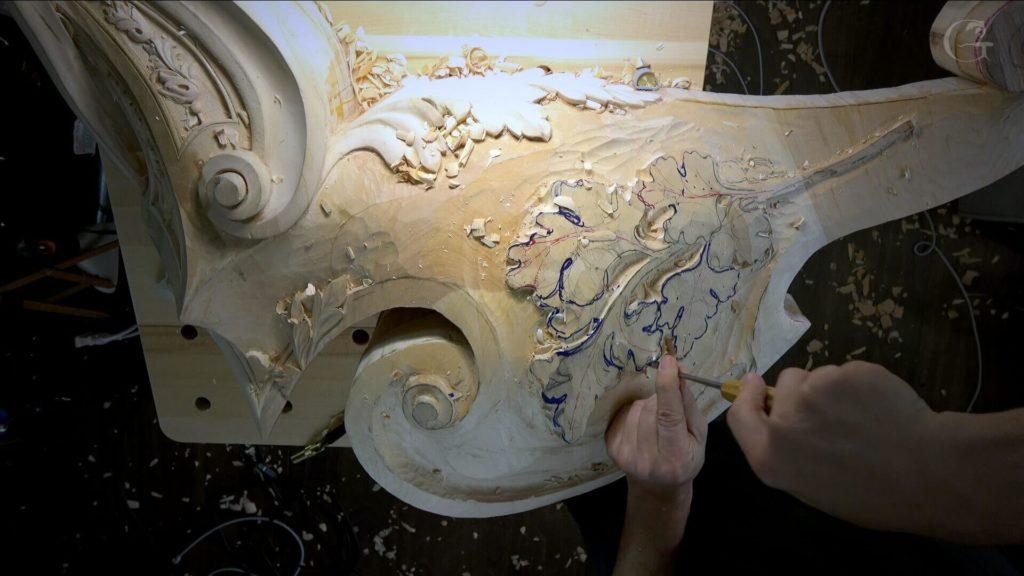
Each picture is a frame from the lesson video named beside it. Nine frames come from the 97-3 video. Parts 2 and 4 give one each. In the table, a plain number means a Venice Room lesson and part.
Every passage side by side
| Part | What sits beside the wood |
|---|---|
| 97-3 | Shell planned beneath the leaves, so the dig stops early and stays shallow while the base is still being set |
| 97-4 | Future acorns, and doubt about the wood in that section |
| 78-9 | Small leaf on the inside, using 2 millimeters (0.08 in) with a number 11 |
| 11-2 (Floral Panel) | Enough wood to set a convex that later becomes a pipe |
| 12-1 (Floral Panel) | Enough wood for a movement on an acanthus piece, plus a plan to go around the volute |
| 50-2 | A future movement outlined, with the wood checked first |
| 11-6 (Lily Box) | Relief step around, then a little deeper |
| 25-3 | The point of a leaf that has to show from below, and a hunt for enough wood to round it |
| 4-2 (Grape Onlay) | A twist under a part, and a hope |
| 41-2 (Hashemi) | A twist given up for lack of wood |
| 9-4 (Greek Acanthus) | A weak point where the grain runs across, with a warning about the knife going through |
| 99-6 | Doubt after the dig, then a hopeful just about |
| 7-2 (Hazelnuts) | A request to keep the wood thick for later work on a bunch |
| 2-1 (Hazelnuts) | Checking the piece sideways before the outline of a future leaf |
| 5-1, 5-3, 7-3 (Grape Onlay) | Airborne piece, exposed side, and a wall of about a quarter inch (6.35 mm) |
| 12-5 (Lily Box) | A slip with a 2 millimeter tool (0.08 inch), and the relief step still to do |
| 76-6 | Wood in plenty, and a hope to make something nice |
| 74-3 and 78-10 | Little wood left, so every dig slows down |
Is there a spot on your own bench where the wood beneath is needed for later? Everything in this lesson sits inside one tuition plan, and more Venice Room workshops wait on the Part 8 course page. For a smaller start, try the Hazelnuts course or the Grape Onlay course.
How it's done
- Find the cue. Start with the cue named in the title and read the lines on both sides of it.
- Read the reason. A shell is still to come beneath the leaves.
- Check the tools. A number 11 of 5 millimeters (0.197 in) goes with the early dig.
- Look at the other lessons. Each lesson in the table adds its own words beside the phrase.
- Compare the doubts and the plenty. Hope, a dropped twist, a request to keep wood and wood to spare each go with the words in a different lesson.
Frequently asked questions
Which sizes does the 97-3 video give for the first dig?
"5 millimeters" (about 0.2 inch) and "3/16 of an inch" (4.8 mm), with a shallow depth.
What reason does Hazelnuts 7, part 2, give for keeping wood?
"You can always take it later and make it thinner."
Hashemi 41-2: which twist is dropped?
"Maybe I shouldn't even try," for "not enough material left," right after "I'll make a small-- Well," and "almost impossible, but" and "let me try."
How does Greek Acanthus 9-4 treat the grain?
What to carve next