
August 30, 2024 · Updated August 19, 2026
By Alexander Grabovetskiy — Master Woodcarver · Founder, School of Wood Carving · 17 min read
What does low density wood mean?
Low density wood is wood that holds less solid material in the same space, so it weighs less and gives way sooner under a blade. The USDA Forest Products Laboratory prints American basswood at a specific gravity of 0.37. Water sits at 1.00. I carve that wood almost every day, and light is not the same thing as weak.

Every line here went on before a single chip came off.
You pushed a gouge into a board and it went soft on you, like cheese. Then somebody told you to buy harder wood.
Wrong shelf. The weight of a board and the way that board behaves under steel are two different questions, and the second one is what ruined your leaf tip. I have been carving for over forty years and I still reach for the light stuff on purpose.
My grandfather handed me my first chisel when I was six years old. I took it straight to a brick and tried to carve a face in it. The tool was finished. The passion started right there, and learning to match the material to the steel took me a great deal longer.
Here you get the real numbers, the reason two respected books print different ones for the same tree, and one honest puzzle off my own bench that I have never been able to explain.
- Density is weight over volume, written in the books as specific gravity.
- Basswood reads 0.37 in the federal tables. Water reads 1.00.
- Weight and softness are separate ideas, and the softest board in my own shop is a hardwood.
- Soft enough, still stable. That pairing is why the stuff carves so well.
- A construction 2x4 will punish your tools and your patience, so walk straight past that pile.
How do you actually measure the density of a board?
A lab dries the wood, weighs it, measures how much space it takes up, and divides one by the other. That ratio then gets compared against water.
Chapter 4 of the Wood Handbook defines specific gravity as the density of a substance over the density of water at 4 degrees Celsius, where water weighs 1.000 gram per cubic centimeter. So 0.37 means the solid part of a basswood board weighs a bit over a third of what the same space of water would. That is why the board floats so high.

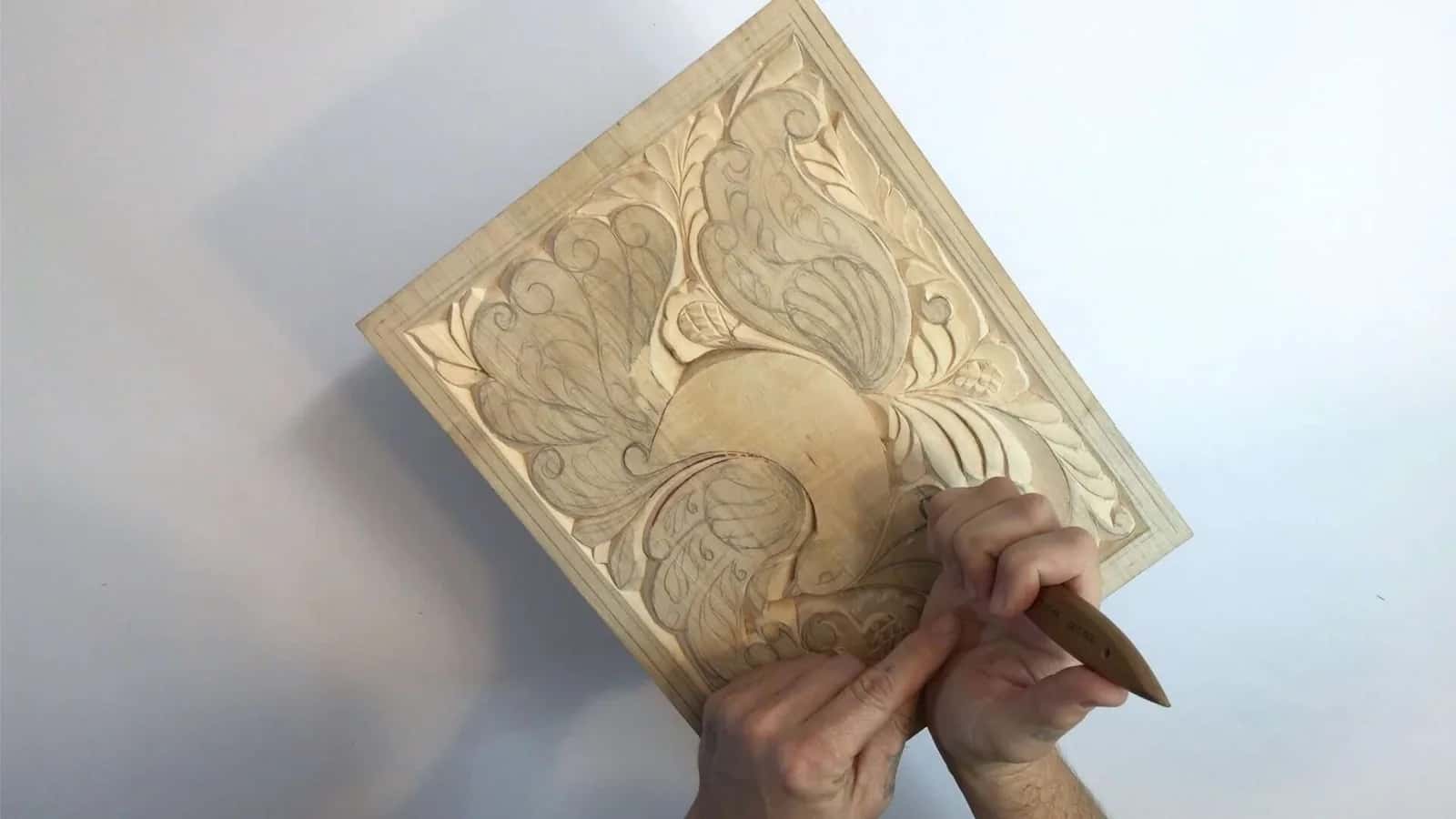
Mostly drawing so far, with just the middle shell opened up.
You will never run this test at a lumberyard. No need. The number is there for comparing, and comparing is what saves you money.

On a board this light my hand supplies all the force there is.
Why do two good books print different numbers for basswood?
Wood has more than one honest specific gravity, and those two books picked different ones. Neither is a typo.
The federal tables put basswood at 0.37. The Wood Database basswood profile prints 0.42 for a figure it also labels 12 percent. Both are right inside their own convention. The handbook always weighs the board bone dry. That 0.42 from the Wood Database weighs the board at 12 percent, water included, and that is the whole difference, because 0.37 times 1.12 comes out at 0.41. The same site calls specific gravity the most abused term in woodworking and counts at least five ways to write it. One of those pairs oven dry weight with green volume, which no real board ever has at one moment.

Blue pencil again, straight over carving already down to depth.
Compare two numbers only when both name their method. That one habit keeps you from buying the wrong plank just because some chart flattered it.

Pencil in one hand, gouge in the other, the design still moving.
Is low density wood the same thing as softwood?
No. Hardwood and softwood are family names for trees, and they say nothing about weight or hardness. The handbook is blunt about that.
Chapter 3 states that not all softwoods are soft and light, and not all hardwoods are hard and heavy. Softwoods come from conifers. Hardwoods come from flowering trees, and they carry a cell called a vessel, which is the open pore you can see on any oak plank. Basswood flowers, so basswood is a hardwood, and it is also one of the softest woods sold anywhere on earth. White cedar is a softwood, and it weighs less than basswood does.

I lift it to the light to see if the leaves read from across a room.
Old Europe had this sorted out long before anybody printed a table. Lime was treated as a hardwood there, and pine was the soft wood. In England the cheap carvings came out of pine. The costly work started in oak, and after the 17th century the best of it moved to limewood. The modern shopping version of that argument lives on the page about the best wood for carving.

One hand is enough on wood this soft.
What makes basswood the first choice for carving?
Grain, not softness. Basswood has a grain you cannot see, and that invisible grain is what puts it first.
Whenever I can, I use lime wood. One tree wears five names: Europeans call it lime wood, Americans say basswood, Germans say linden, Russians say lipa, and the label at a serious yard reads Tilia. That is one of the best woods for carving, and softness is not why. Sure, it is kind of soft. Plenty of other woods are soft too. Look hard at any basswood board and the real reason shows itself. It does not have a grain. It does have a grain. You simply cannot see it, and that is exactly what you want, because you can run any curve you like across the face and it still looks right.

Both hands drive one small blade.
Beautiful and white. Not really white, but you get the point. A loud board fights the picture you are building, and on some woods you lose the whole shape inside the figure. Basswood hands you a clean canvas instead.

An hour of light wood leaves this much around the bench.
In The Lost Carving, David Esterly says it plainly. He recarved a lost Gibbons overmantel at Hampton Court, so he had reason to know the wood.
The queen of carving woods, in all its pale glory.
Grinling Gibbons called it the queen of all woods too, and the old church carvings of Europe were done in limewood. Two carvers, generations apart, same verdict.

That sharpened pencil never travels far from my knife.
There is almost no limit to what you can do with limewood. Of course there is a limit. The material is soft enough and still stable, and it still holds the detail, and that last part is the answer to the question every beginner asks me first. The government description agrees: soft, light, fine and even in texture, straight grained, easy to work with tools.
I love carving walnut. Cherry too, and English brown oak is beautiful wood. Given a free choice on a project, though, I take basswood, because it is easy to manipulate and it never pulls my eye off the design. Beginners get pointed at the softer woods worth practicing on for the same reason, and forty years of work has not changed my own answer.

My palm holds the panel down while the blade works a leaf tip.
What do the real density numbers look like?
Five rows cover nearly everything a carver picks up, and the heaviest of them weighs more than twice the lightest. Every figure sits at 12 percent moisture except the green row, and all of them come out of the 2021 Wood Handbook tables.
| The wood on the bench | Specific gravity, straight from the handbook table | Side hardness, in pounds | What that pairing means once you pick up a gouge |
|---|---|---|---|
| Northern white cedar, a softwood | Only 0.31, the lightest row on this list | A mere 320 pounds | Light and rot resistant at the same time, which honestly surprises most people. |
| American basswood, green off the log | Down at 0.32 while the water is still in the fibers | Around 250 pounds | Wet stock dents long before dry does. |
| The same basswood, dried | Up to 0.37 once the board dries down to 12 percent | Only 410 pounds of force | My reference point, and the number I carry around in my head. |
| White oak, Quercus alba, the wood of old furniture | Nearly double basswood at 0.68 | Fully 1,360 pounds | Beautiful stuff, and those open pores fight every fine cut you try. |
| Black locust, from fence posts | The top of this table at 0.69, barely above oak | A heavy 1,700 pounds of force | Fence post wood outdoors, and never once a carved leaf tip. |
Read the third row against the fourth. White oak weighs less than twice what dried basswood weighs, and yet it takes more than three times the load to dent, because weight and hardness are read off different machines and they do not track each other. The Janka test drives a steel ball 11.28 millimeters across into the side of a board until half the ball is buried, and the force it took is the number. Lignum vitae needs 4,390 pounds. Basswood needs 410. So the whole commercial spread runs a factor of ten, and my gouge feels every bit of it. If you want the other end of that shelf, we keep a page on high density wood and one asking whether denser wood is stronger.

Flat to the surface, the blade takes a shaving and leaves a wall.
One more thing about that table. Every row in it was measured on small clear sticks that were sawn on purpose. Your plank is not that.

Here is what a sharp edge does in soft wood.
Do my tools stay sharp longer in soft wood?
No. Mine go dull faster in basswood than in oak, and I have never worked out why. That one still bothers me.
You probably noticed that I do not walk to my sharpening station as often when I am carving oak. Kind of a paradox. That softer wood is basswood, or limewood, the same tree either way, and my edges still die on it quicker. My teacher tried to explain it to me. I still didn't get it.

Shavings, not crumbs. I trust that test more than any chart.
Some woods really are abrasive. Teak carries as much as 1.4 percent silica, and that grit blunts steel fast. Black locust dulls a blade too, and that one is heavy. Basswood is neither. It runs smooth and clean under the blade with no grit inside the fibers, so both explanations that work everywhere else fall apart right here. Sharpening is the skill that takes years anyway, which is why it sits second of the three things I teach.
The title is my honest opinion of the wood, and it runs about 16 minutes.

A long handle held almost flat gives me control I cannot get any other way.
The fix is dull and it works. Keep a strop on the bench and touch the edge before it starts tearing. A blunt tool in soft wood is the fastest road to the mistakes I see most often.

Down inside a leaf, where a heavier wood would have chipped out on me.
When is light wood the wrong choice?
Outdoors, and anywhere the finished piece has to take a knock. Basswood is rated non-durable against heartwood decay, which makes it a shop wood and a wall wood, nothing more.
Northern white cedar makes the point from the other side. It comes in lighter than basswood at 350 kilograms per cubic meter, counts among the very lightest and softest woods sold in America, and still rates durable to very durable against rot. Low weight and rot resistance are separate questions. A chart that treats them as one thing is lying to you. Cedar carries its own bill: the wood holds plicatic acid, and long exposure to that dust has caused occupational asthma, so run the extractor and read the real dangers at a carving bench.

The pale patch on that scooped face is dust and fuzz, not a torn cut.
Then there is the lumber aisle. Carve a 2x4 and you are going to get so frustrated and kill your tools. I would not put a beginner on poplar either, or on maple. Both are carvable. You can carve almost any wood if you insist on it, and it is going to be difficult. Butternut is good, though. Really excellent, if I am honest about it.
Soft patches come with the territory, and you can read them coming. A dark spot on the surface means the material under it is a little mushy. Which is absolutely okay. Work around it, take smaller bites, and stop pressing, because that wood holds fine detail as long as you do not crush it. Walnut and cherry hold detail beautifully. Basswood matches them when your hand is honest, and there is a separate page on how to soften wood before carving if you bought something too hard.

One flat hand, one small spiral, and a blade I keep resharpening.

The red line is my depth mark, and I follow it rather than my optimism.
How do I check a board before I pay for it?
Pick it up first, press it second, take one cut, and read the color last. None of that needs a laboratory, and four of the five steps happen right at the rack.
Step 1, weigh two boards against each other in your own hands
Take both candidates off the rack and hold one in each hand. Your hands are a comparator, not a scale, and a comparator is all this job needs. The lighter board is the lower density board, and you will feel the gap between 0.37 and 0.68 before you find a label.

The heaviest scatter I have on file, all from one panel.
Step 2, press a thumbnail into the end grain in two places
A laboratory presses an 11.28 millimeter steel ball to half its depth and records the pounds. Your thumbnail is a far worse instrument. It still tells you which of two boards gives way first, and whether one end of a plank is softer than the other.
Step 3, take one slicing cut across the grain with a sharp gouge
Cross grain is where a light board either slices clean or tears out fuzzy. Do it in a corner nobody will ever look at. Sharp tool only, because a dull edge makes every wood look bad and teaches you nothing about the board in front of you. The full set of hand tests for a carving board goes further.

One thumb hooks the edge.
Step 4, read the color of the face before you draw anything
Dark patches mean mushy wood underneath. Sometimes you design around them. Other times you carve straight through and accept a softer surface there, which is what I do most of the time, and the finished panel never tells on you.

Both thumbs get involved when the cut has to stop exactly where I say.
Step 5, buy the board a year before you need it
I get basswood years ahead of a project. Two kinds of dryness exist: air dry, and kiln dry. A lumberyard sells you kiln dried stock, cooked out in a big stove, and I have found that it moves a lot more afterward. So my wood goes into the shop and I leave it alone. Some of it has sat there over 10 years, and a few boards have waited 20 without me touching them. Air dried wood has done its moving already.

That spiral is smaller than a fingernail.
Does the number on the chart describe the board on your bench?
Those figures are species averages, and your plank came off one tree in one place. The scatter is far bigger than most carvers expect.
One study of 14 Central African species measured wood specific gravity from 0.28 all the way up to 0.95, and species identity by itself explained only 45 percent of the variation. Density from the pith outward climbed in some of those trees and dropped in others. So the species name on your invoice is a hint, and it is not a measurement of the board in your hands.
The old rule of thumb says slow growth means dense wood. A 2023 paper tested that across 57 conifers and found the opposite: the more shade tolerant the conifer, the lower its basic specific gravity, at p equal to 0.001. Among flowering trees there was no link at all. Trees do not read our rules of thumb, and neither does whatever makes one board lighter than another.

Seen from above, working the top corner, forearm steadying the panel.
Drying moves the number too. The federal write-up rates basswood shrinkage in width and thickness as high, then adds that the wood seldom warps in use, which is a strange and welcome pair of sentences to meet in a government table. Wood parks itself at whatever moisture the air around it allows, and the handbook has been printing those equilibrium figures since before 1920.
Even the name covers more than one thing. Eastern basswood and western basswood come out a little different, with different properties and sometimes different colors, and Tilia americana is only the most important of the native ones. A federal silvics volume calls it an important timber tree, especially through the Great Lakes States.
The 2021 handbook is the current edition. The 2010 edition prints the identical basswood row, right down to the 4,730 pounds per square inch of crushing strength that the current mechanical properties chapter still carries. Nobody re-measured it. That tells you how settled the figure is, and also how old it is.
None of this makes the number useless. It makes it a starting point, the same way a single species page on boxwood is a start and never a promise. Beginners who want the short list should read what a beginner actually needs.
Have you pressed a gouge into a board and felt it collapse? Do you want the wood to hold the edge of a leaf instead of folding under it? Would you rather know which plank to buy before you pay? Then start light, get someone to show you the first cuts, and walk the whole path from a flat blank to a carved panel inside the course library.
Frequently asked questions
Where is the line between light wood and heavy wood?
In my shop that line sits at basswood, which the handbook prints at 0.37. White cedar comes in lighter, at 0.31. Anything up near white oak at 0.68 is a different animal, and it wants a different bevel and a heavier hand than a beginner has.
Is basswood a hardwood or a softwood?
Botanically it is a hardwood, because the tree flowers and the wood carries pores. Hardness has nothing to do with that label. Basswood sits among the softest woods on the market, while white cedar is a softwood that weighs even less than basswood. The words only describe which family the tree came from.
Does soft wood hold fine detail?
Yes, with one condition attached. Basswood holds detail with no problem as long as you do not press it too hard and do not make cuts the design never needed. Walnut and cherry forgive more pressure. On basswood the discipline lives in your hand, and that is a good thing to learn early.
Why do my tools go dull faster in basswood?
Mine do the same thing, and I cannot explain it to you. My teacher tried, and I still did not get it. Basswood runs smooth, with no grit in the fibers the way teak carries silica. The best advice I have is to keep a strop at the bench and stop guessing about it.
Can I carve a 2x4 from the hardware store?
You can, and you will hate every minute. Construction lumber is knotty and it moves, and it will kill your tools while it teaches you the wrong lessons about how wood behaves under an edge. Buy one small piece of real carving stock instead. A board the size of a paperback is enough.
How long should wood sit in the shop before I carve it?
Mine sits for years. I buy basswood well ahead of the project, stack it, and leave it alone, because kiln dried stock keeps moving once it comes out of the stove. Some of my boards have waited more than 10 years. Air dried wood has done its moving already, and it stays put.
Filed under
- advantages of carving with low density wood
- benefits of low density wood
- best wood for carving
- carving wood best practices
- carving wood types
- hardwoods compared to low density wood
- industries using low density wood
- low density vs high density wood
- low density wood examples
- low density wood explanation
- low density wood in construction
- popular low density wood species
- softwoods for carving
- types of wood for carving
- Understanding Wood for Carving
- uses of low density wood
- wood carving blocks
- wood carving techniques
- wood density measurement
- wooden carving blanks
- wood for crafting