
August 30, 2024 · Updated August 19, 2026
By Alexander Grabovetskiy — Master Woodcarver · Founder, School of Wood Carving · 19 min read
What is high density wood?
High density wood is wood that packs far more solid material into the same space than a carving board usually does, above about 50 pounds per cubic foot against 26 for basswood. A few of them sink in water, which sits at 1.00. Most days I carve the light stuff.
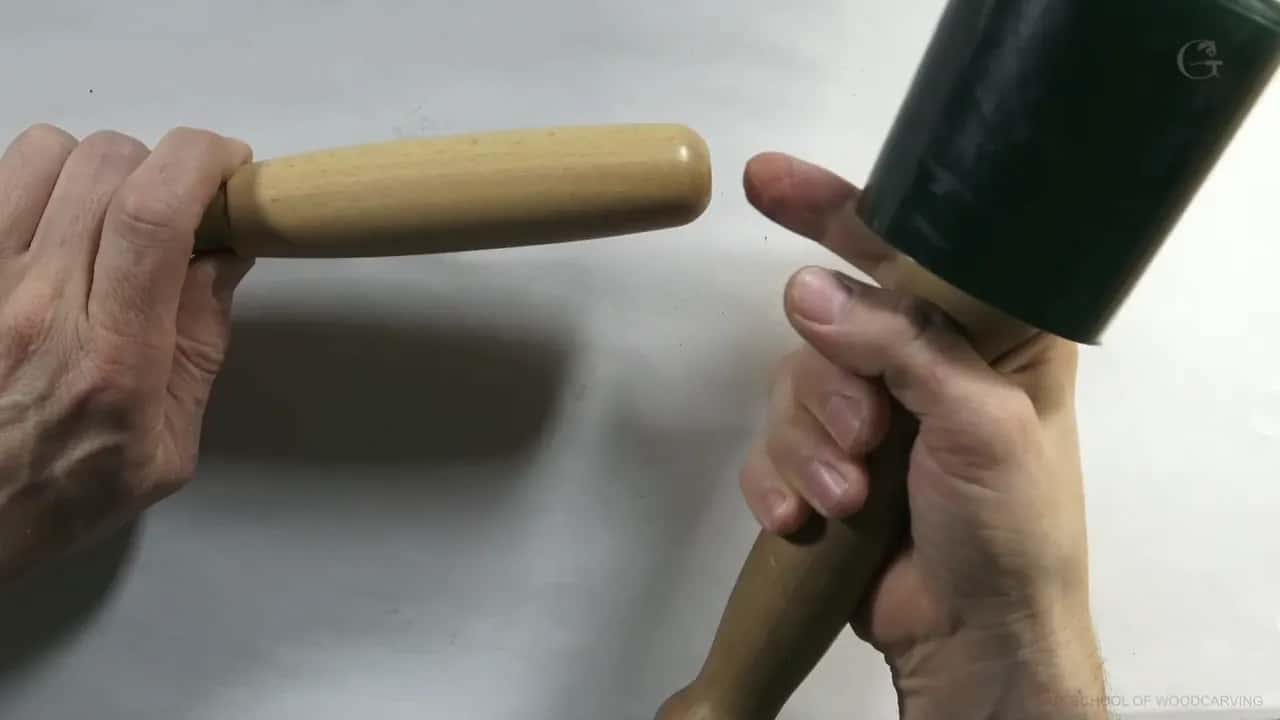
My whole fist is wrapped around that handle, because the dark coarse stuff under it does not move for finger pressure.
You picked up a board and it felt like a brick. Somebody at the yard told you heavy means good.
Heavy means slow. The weight of a plank decides how many hours you spend on it and how often you stop to sharpen, and it decides almost nothing about whether your carving survives a pair of hands touching it. I have been carving for over forty years, and the wood I reach for most is one of the lightest on my bench.

That is my bench, and the row of handles behind me is where the heavy woods actually end up.
In prison I carved furniture with a 10mm knife I made myself and a tiny gouge made from a nail. One boiled potato a day was the pay.
So here you get the real numbers, which trees actually sit at the heavy end of the pile, and the honest price of every extra pound.
- Nobody governs the cutoff. The band called high opens at 960 kg for every cubic meter.
- Heaviest, hardest and strongest sit on three separate trees.
- Twice the specific gravity buys roughly four and a third times the hardness, and barely double the strength.
- Ebony shifts more than oak in humid weather, so weight predicts nothing about stability.
- A heavy board earns its keep in mallets, handles, and rails that a thousand hands will grab.
Which woods actually count as high density wood?
Nobody owns that line, so the honest answer is a set of weight bands rather than one magic number. Anyone quoting a single cutoff invented it.
The Wood Database heaviest-woods list publishes bands and prints where they came from. Low begins at 520 kilograms a cubic meter, medium at 730, high at 960, and the extreme band at 1,200. Those bands trace back to CSIRO provisional strength groupings, SD1 through SD8. A chart with a source on it beats a chart without one.
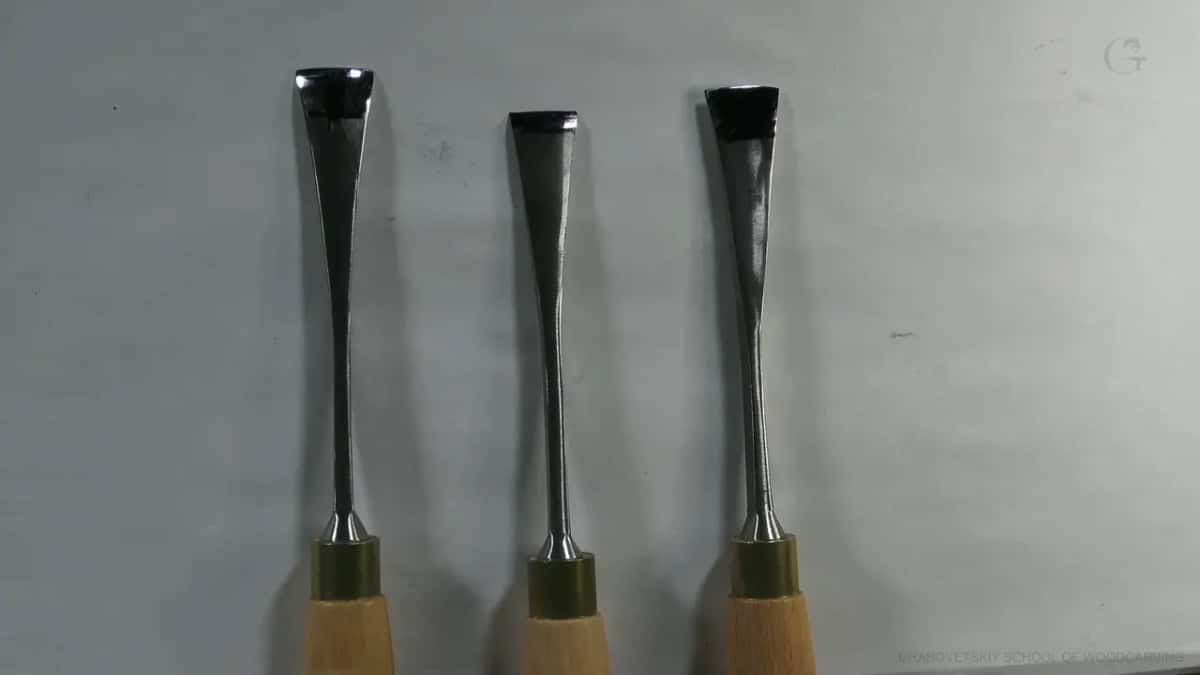
Three widths standing in a row, and the board decides which one I pick up.
Here is the short version for a bench. Anything past about 50 pounds in a cubic foot is a completely different job from basswood at 26. Walnut, oak and hard maple sit comfortably in the middle of the range. The tropical monsters live somewhere else, and one or two of them will not float at all.
| The species, by name | Weight, in pounds a cubic foot | Janka side hardness | The job I would hand that board at my own bench. |
|---|---|---|---|
| American basswood, my reference | Just 26.0, the floor of this table | A soft 410 lbf | Relief panels, leaves, and any thin edge that has to stay put. |
| American black walnut | 38 pounds, roughly half again over basswood | Reads 1,010 lbf | Furniture ornament that has to match a dark room already built. |
| White oak, the old furniture wood | Heavier still at 47.0 | 1,350 lbf on the Wood Database figure | Church work, stair rails, and repairs to old oak furniture. |
| The famous gaboon ebony | A serious 60 pounds, more than double basswood | 3,080 lbf, over seven times basswood | Small dark accents, and a wallet you do not mind emptying. |
| Hardest of all, lignum vitae | 78.5, and this one drops straight to the bottom of a bucket | The peak of the scale, 4,390 | Mallet heads, and handles that take a beating for years. |
| Dalbergia melanoxylon, blackwood | 79 pounds, denser than water itself | 3,670 lbf, below lignum vitae | Holds more bending load than anything above it before breaking. |
| Krugiodendron ferreum, black ironwood | The heaviest of them all at 84.5 | Around 3,660 lbf | Almost nothing, since the tree grows too small to saw into boards. |

Bar clamps left and right, chips filling the hollow.
Every figure there comes from the Wood Database at 12 percent moisture. The federal handbook prints white oak a little differently, at 1,360 pounds of force, and I have left the two apart on purpose. Averaging two good sources gives you a number that neither one measured.

Same leaf over and over, finished at one end and still blank at the other.
Is the heaviest wood also the hardest one?
Three different trees win those three contests, and that is the whole reason this page exists. Weight, hardness and bending strength are separate measurements.
Black ironwood is the heaviest at 84.5 pounds for a cubic foot. On hardness it lands around sixth, at 3,660 lbf. Lignum vitae takes the hardness crown at 4,390 lbf, more than ten times basswood. Now bend it. The hardness champion snaps at 17,970 pounds per square inch, while African blackwood carries 30,970 and even gaboon ebony reaches 22,930. The hardest wood on earth is nowhere near the strongest.
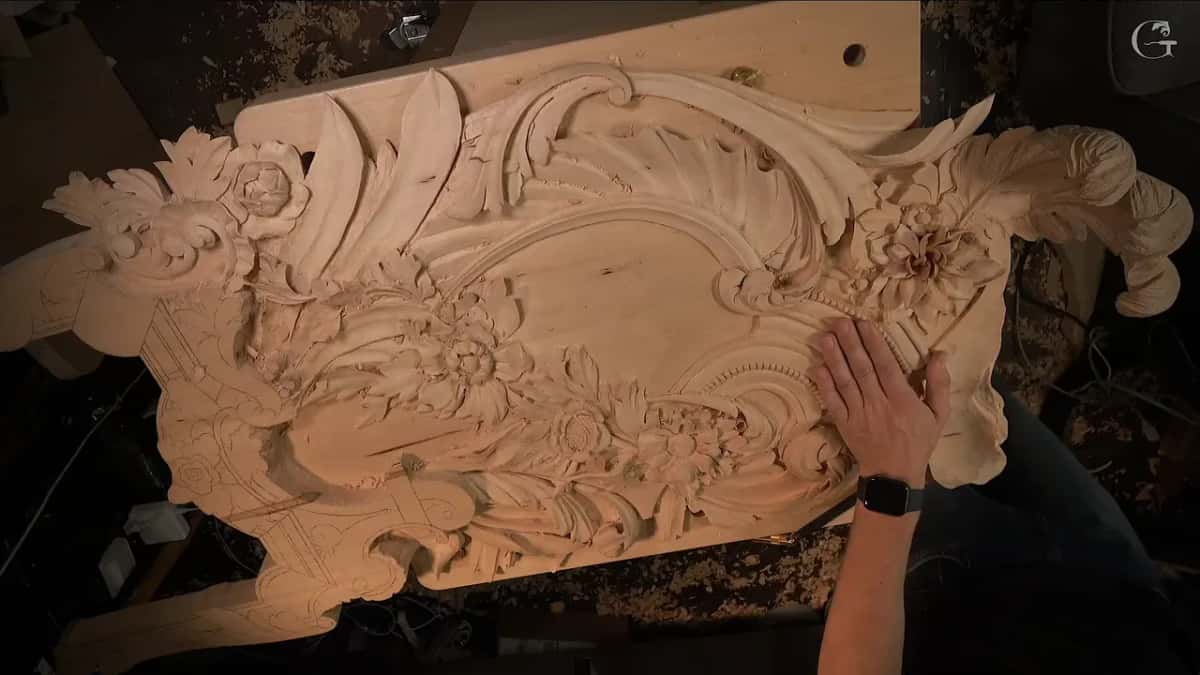
A panel this wide is why a cubic foot is not just a number to me, and the bottom corner is still pencil.
So ask yourself which question you were really asking. Dents and wear are hardness. Snapping is bending strength, the modulus of rupture, and that has a page of its own. Shipping weight is density, which the hub page on density handles properly.
The runners-up make the same point without any help from me. Behind black ironwood come itin at 79.6 and quebracho at 77.1, then leadwood, snakewood, desert ironwood, kingwood and verawood, all bunched between 74 and 76. Now look at the hardness order. Gidgee comes second at 4,270 lbf, snakewood third at 3,800, verawood fourth at 3,710, camelthorn fifth at 3,680. Only one name holds a top-five seat on both lists.

Small enough to pinch between two fingers, with the stripes running across it.
One more thing before you memorize a league table. Eric Meier, who compiled it, warns that wood density can swing by plus or minus 10 percent between samples, so a piece of the tenth wood could easily outweigh a piece of the first. The rankings sit inside the noise. If you want the argument about the densest wood ever recorded, there is a whole article on it, and it lands in the same place.
What does all that weight cost you at the bench?
Density charges you far more in hours and steel than it pays back in strength, and the arithmetic is public. Two exponents settle the argument.
Table 5-11b in the Wood Handbook fits hardwood bending strength as 24,850 times specific gravity raised to the power 1.13. The same table puts side hardness at 3,440 times specific gravity raised to 2.09. Double the specific gravity and bending strength climbs about 2.2 times. Hardness climbs about 4.3 times. You pay roughly quadruple in resistance under your hands to buy a little over double in strength, which is the plainest argument against carving ebony that I know.

The little one in the middle is the one that breaks, not the two beside it.
You feel that trade in your shoulder before you ever see it on paper. A while back I posted a video of myself carving a really dense area, and one smart guy on Instagram commented, have you ever tried sharpening your tools, it would make it a lot easier to carve. Right. I know. Let me try it. My tools are sharp, really sharp, and with dull tools you would not be able to carve a wood like that at all.
Then comes the tool bill. I broke my number 11, the half millimeter, on a hard piece. I was careful with it and I did not force it. That piece was simply hard, and hard wood does not help a thin blade.
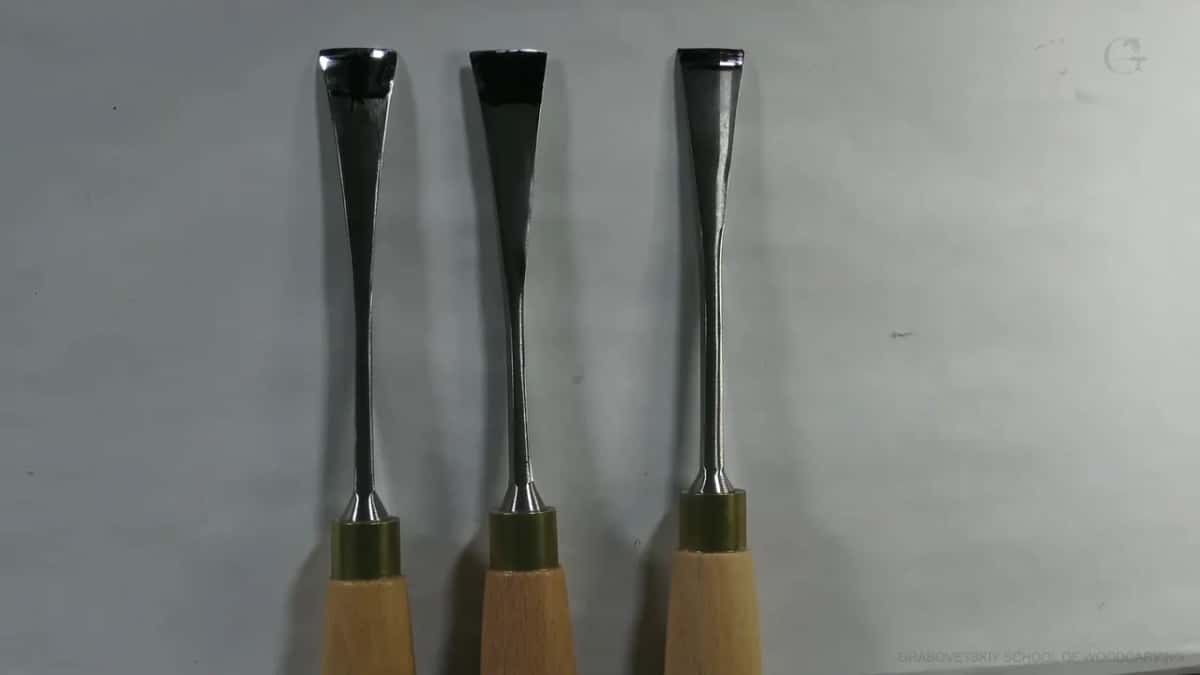
See how thin the steel gets in the neck, since a tool always lets go there.
Density even decides which tools you may own. I love the Henry Taylor line because the tool is light and the walls of the tool are really thin. That makes it very good for a soft wood such as limewood. On a hard wood a thin tool like that breaks easily, so the tool course spends real time on which steel belongs where.
Splinters are the small tax nobody warns you about. I never once got a splinter from basswood. From crunchy wood like oak, white oak, you can get them, and some woods are more crunchy than oak. I am not sure I am supposed to say it that way. Crunchy is the best word I can find.
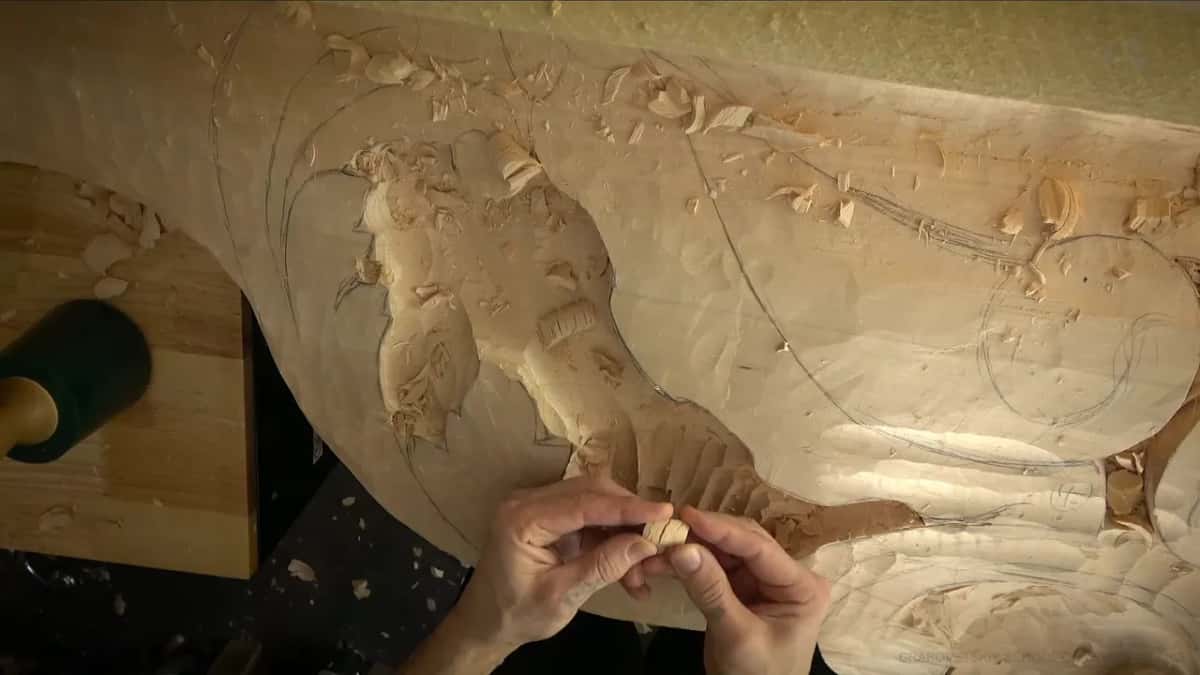
Green mallet lying at the left edge, and the leaves are only roughed in.
Price belongs in the same column. The heavy tropical woods are sold in small pieces at small-piece prices, and you feel that long before the hardness ever reaches your hands. Basswood you buy by the plank.
Then the mallet comes out. Oak is a harder wood, and to carve oak you most likely have to use one, which changes your whole day at the bench. There is a page on whether a beginner needs a mallet at all, and another on what a carving mallet actually is.
Do you sharpen a different bevel for hard wood?
Shorter bevel for harder wood is the rule I teach, and I break it myself most days. Both halves of that sentence are on camera.
Take the rule first. When you make a really long bevel, the metal becomes weak at the point, and on hard woods such as oak or cherry that is dangerous. Not all oaks are the same either. Brown oak is a little softer than white American oak, and red oak is also really hard. For any of those I use a short bevel most of the time.
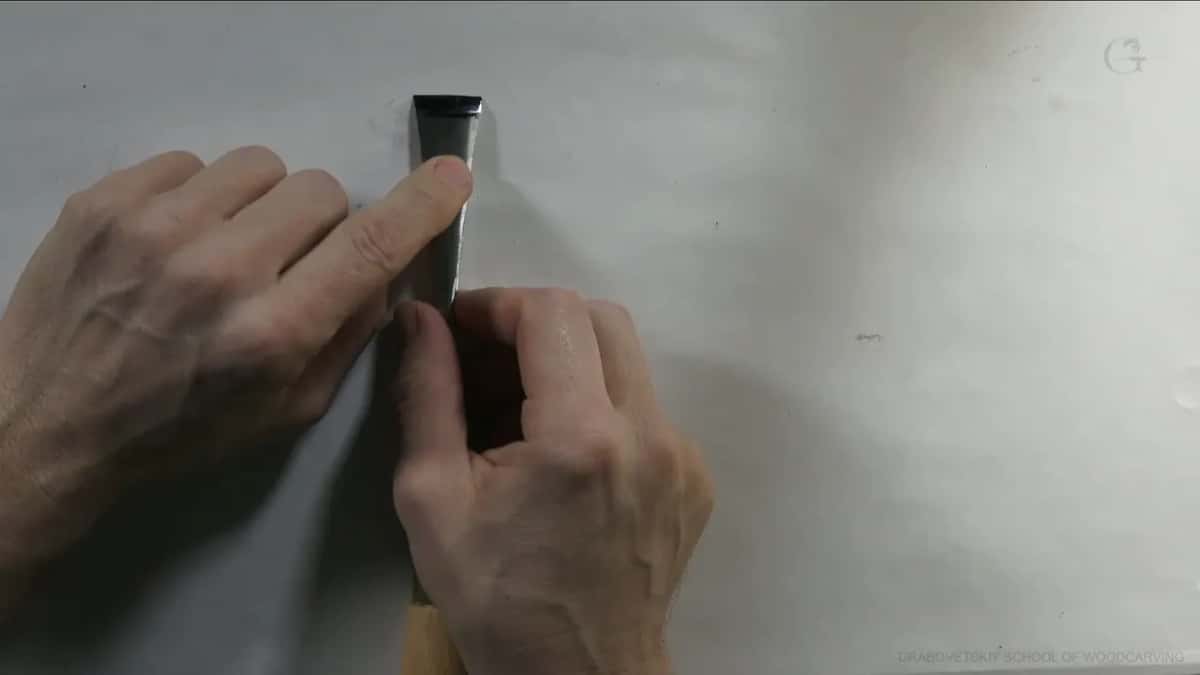
One gouge, and my finger is on the bevel.
Now the honest part. In my spoon gouge sharpening lesson I say that same rule out loud, and then I say that I am staying on the longer bevel even for the hardwood. Both statements are mine. I have never fully squared them, and I am not going to pretend otherwise on a web page.
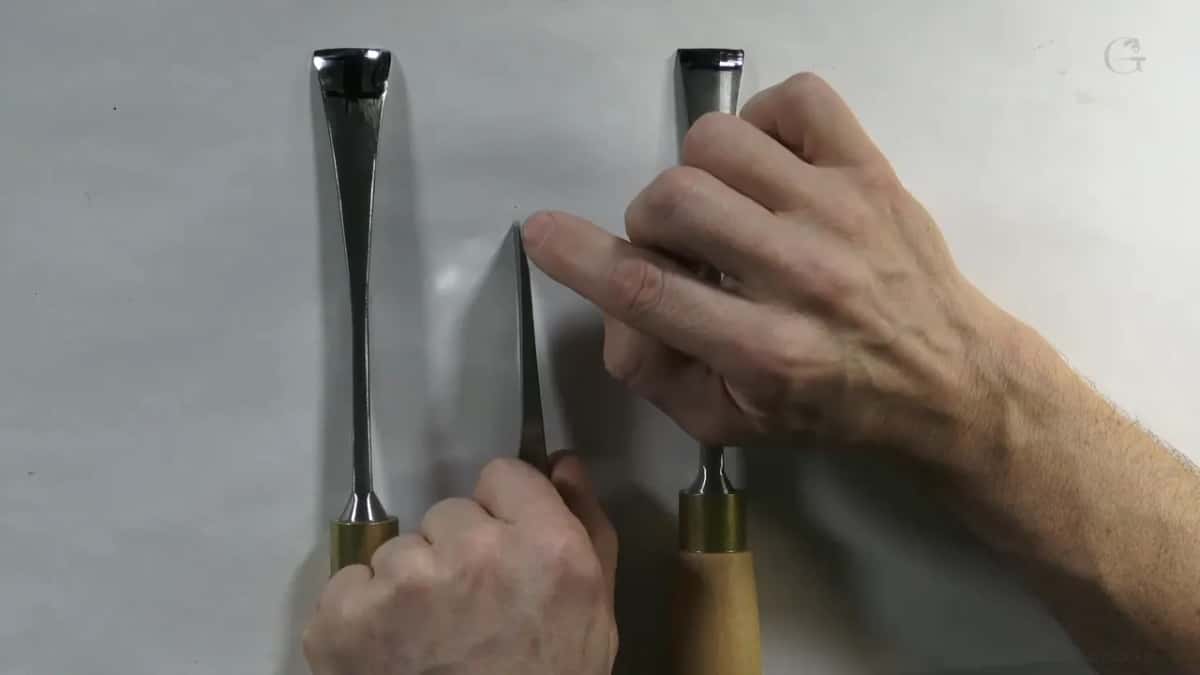
Finger on the tip, and the two big ones are waiting their turn.
What about the angle? I do not measure. I put my hand under the handle, and my knuckle should almost touch the wood. That lands somewhere between eighteen and twenty-two degrees if you want to be technical about it. But I do not measure. The whole subject sits inside the sharpening course, because sharpening is the second of the three things I teach and the one that takes years.

Dark stone within reach of the block, and the flower on top is still mostly pencil.
Sharp is not optional here anyway. On the harder woods that catch the fibers, an edge that would carve basswood all afternoon starts tearing inside twenty minutes.
Does the word hardwood tell you anything about hardness?
Almost nothing, and a university extension service says so in plain words. Hardwood is a botanical label about the tree, not a measurement of your board.
Ohio State University Extension states it flatly: the term hardwood is not an indication of the hardness of the wood. Eastern white pine measures 380 pounds of force on the Janka scale, and it is a softwood. Basswood measures 410, and it is a hardwood. The softer board of the two carries the harder name.
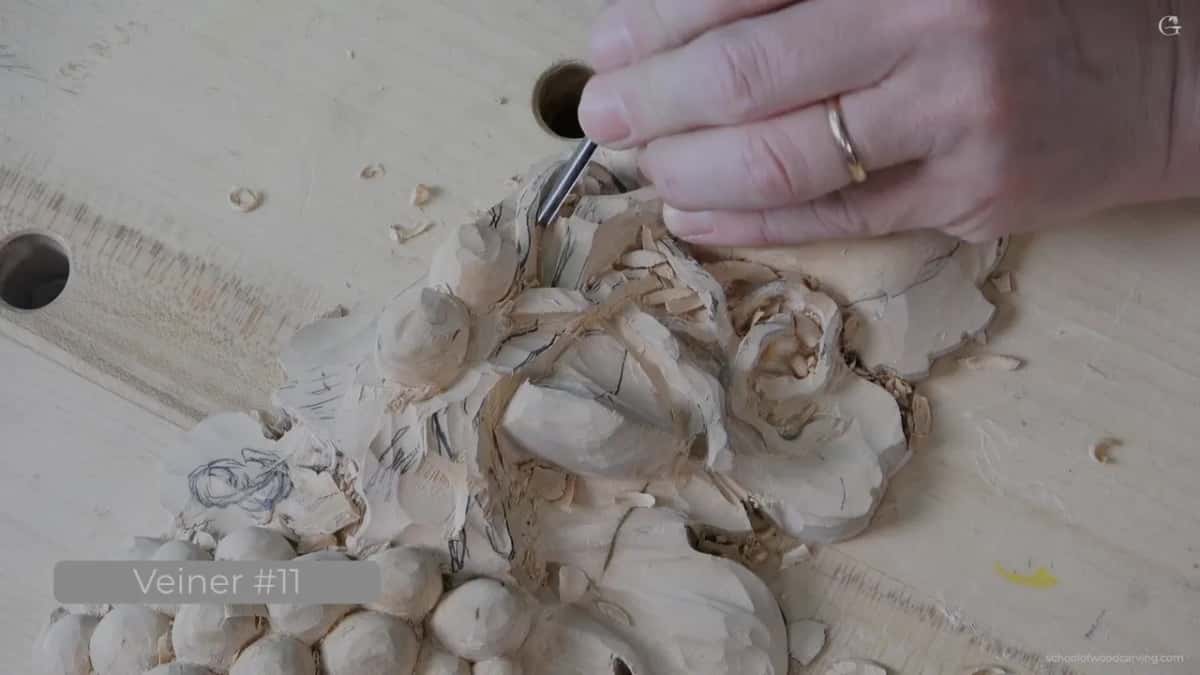
Pale wood, a veiner, and every one of those lines has to stay crisp.
Old Europe read it backwards. Limewood, which is basswood, was not considered a soft wood at all over there. A soft wood was pine. In England the cheaper carvings were done in pine, the more expensive ones in oak at first, and after the seventeenth century in limewood. Grinling Gibbons called limewood the queen of all woods. David Esterly, in his book The Lost Carving, called limewood a patrician medium which, treated correctly, really will be an obedient servant.
The Janka test itself is simple enough to picture in your head. A steel ball 0.444 inches across is pressed in until half its diameter is buried, and the force that took is the number. It measures denting. Nothing else. The page on Janka hardness goes deeper into it, and the list of woods that fight back is a more useful read for a beginner.
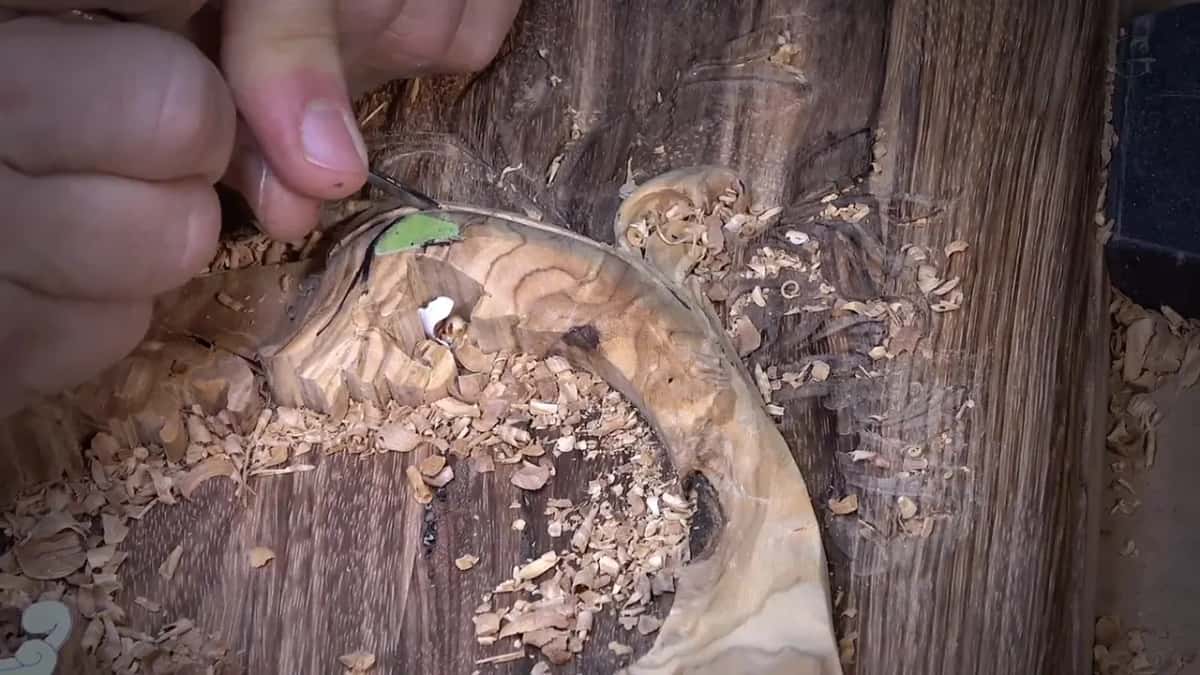
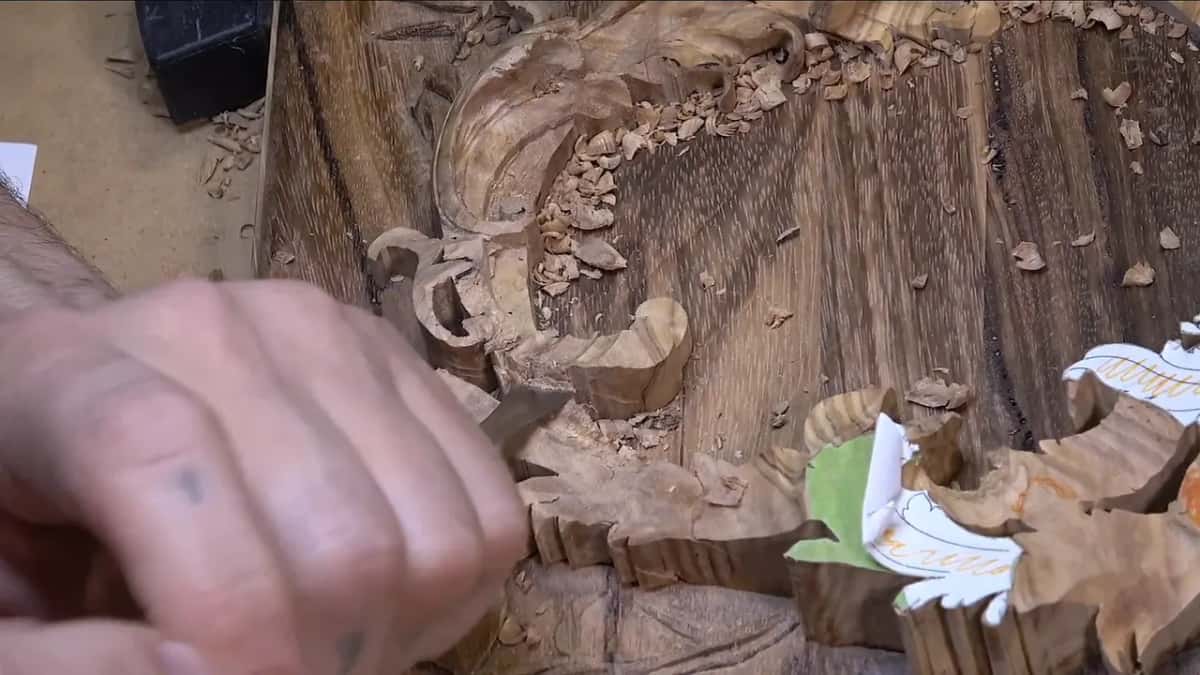
Swirling grain like this crosses the line my tool wants to travel, so I am working it with the small one.
Color fools people too, and I have said opposite things about it. On olive wood I found the darker areas harder to carve. On a piece of limewood I found the darker color a little softer under the tool. Different trees, opposite readings, and I have not tried to force them into one rule.
The same extension sheet spells out how the Janka figure is produced, which is worth five minutes if you have only ever seen the chart. Numbers with a method behind them are worth trusting. Numbers on a poster are not.
When is a heavy board the right board?
Four jobs earn it: a mallet head, a tool handle, outdoor work, and furniture that must match wood already standing in the room. Everything else is negotiable.
Furniture is the honest case. When a client has a walnut dining room, the new carving has to be walnut, and no chart is going to talk anybody out of that. Walnut carves well, at 38 pounds and 1,010 lbf, and it is one of my favorite woods. Lipa, which is limewood, is still preference number one. Walnut is second.
The whole wood question, argued out loud on my own channel.
Mallets and handles are the second case, and there the weight is the point. Hard maple runs 44.0 pounds and 1,450 lbf, just past oak on hardness while staying tame under a gouge. European beech does the same work. Nothing beats lignum vitae on paper here, and its own species page carries the full set of figures. It leads the hardest-woods ranking outright.
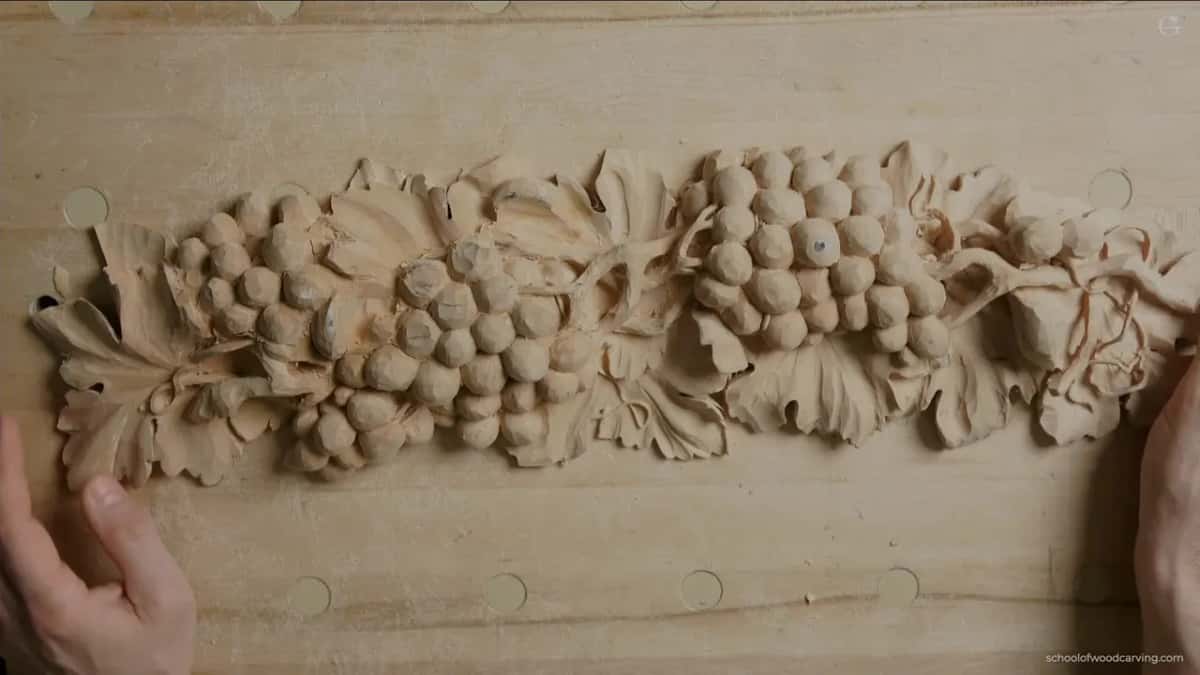
Grapes and leaves, finished.
Outdoor work is the third case, and there density and durability often travel together without being the same property. Rot resistance is measured separately and deserves its own page. How long a carving survives depends on where it hangs far more than on what it weighs.

Both hands on one gouge, which is how the deep leaves get their shape.
Now the case people expect me to make, and I will not make it. Hardness is not how I pick wood. I strongly suggest you do not use poplar. It is workable, but it does not feel good under the tool, and cherry or even oak is better in my opinion. That is me choosing by feel, and a hardness chart had no vote in it at all.
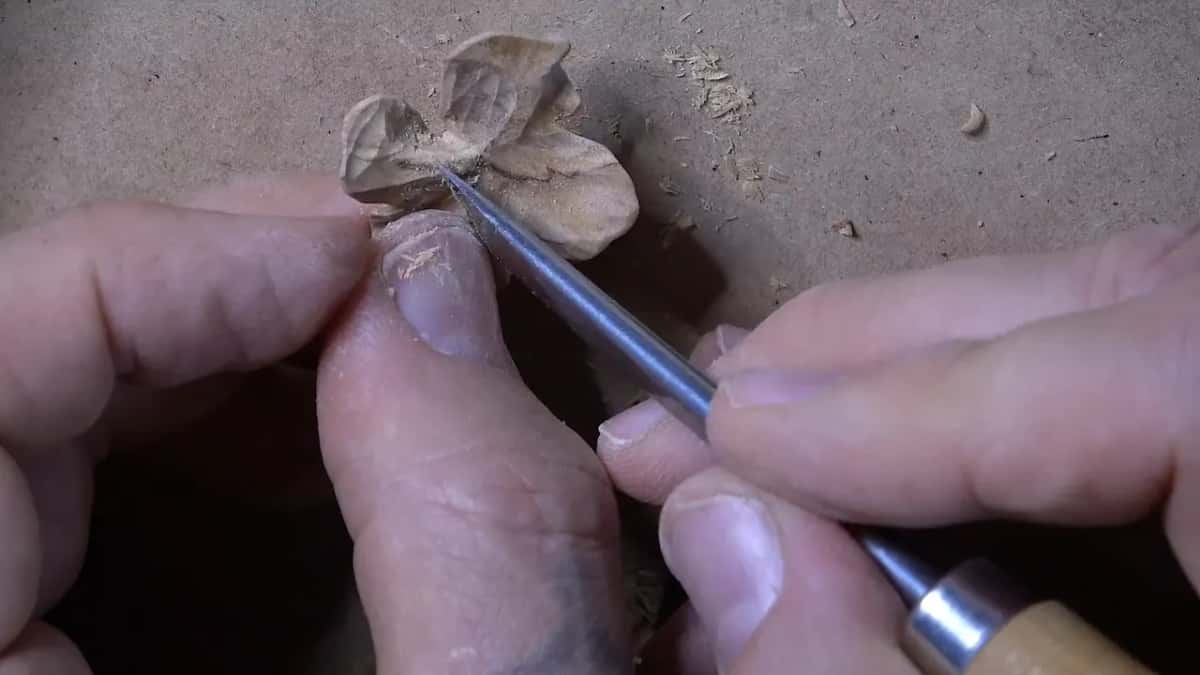
Left hand steadies, right hand carves, and that flower is about as wide as the thumb beside it.
For most people reading this, the heavy board is the wrong answer. The wood is fine. The trouble is that you spend a first year fighting the material instead of learning design, and design is the first of the three things I teach. Learn on something that forgives you.
When I chose olive and acacia for a lily box, performance never entered into it. I could have used ordinary limewood for that project. Olive is not harder or easier than walnut or oak, it is a completely different feel, especially in curly grain. You can watch that whole build inside the olive wood lily box course.
One warning about the very top of the table. Several of those woods are not carving stock in any real sense. Neither black ironwood nor desert ironwood grows into a viable timber tree, so what reaches the market is offcuts and turning blanks. A wood you cannot buy as a panel is a wood you cannot carve a panel from.
Does dense wood sink, and does dense mean stable?
A handful of species really do sink, and stability turns out to be a separate axis that weight cannot predict. The float test is the only measurement on this page you can run in a bucket.
Water sits at a specific gravity of 1.00. At 1.26 and 1.27, lignum vitae and African blackwood both go straight to the bottom. At 0.96, gaboon ebony floats with almost nothing showing. The floating question has its own article, and so does the strength question.
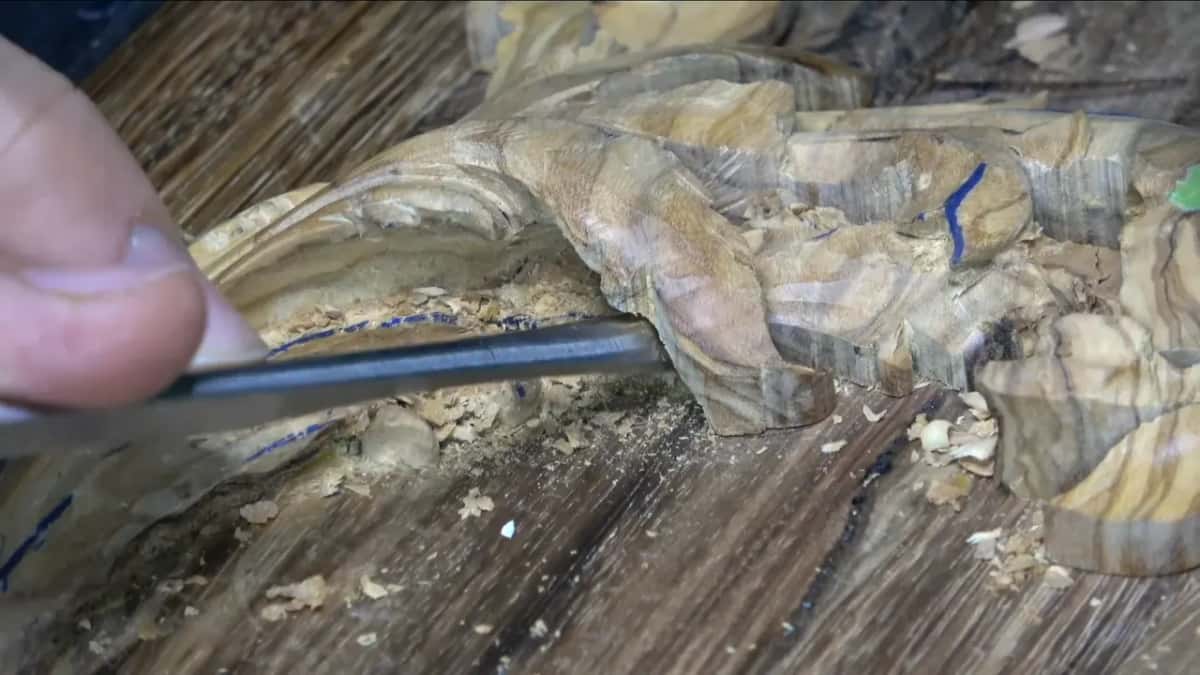
Streaks that fight the blade, and blue lines to follow.
Stability is where the assumption really falls apart. Shrinkage on gaboon ebony runs 19.6 percent by volume and 8.3 percent on the radial face, worse movement than white oak. The blackwood beside it, at almost identical weight, sits at 7.7 percent. Two woods, nearly the same density, and one of them moves two and a half times as much as the other. If your panel is going to move with the seasons, weight will not warn you.
Ebony carries other baggage as well. Conservation status and trade paperwork are printed right on the gaboon ebony species page, which is worth reading before you spend money. Blackwood carries the same kind of note, and the species page here covers what it is like under a gouge.
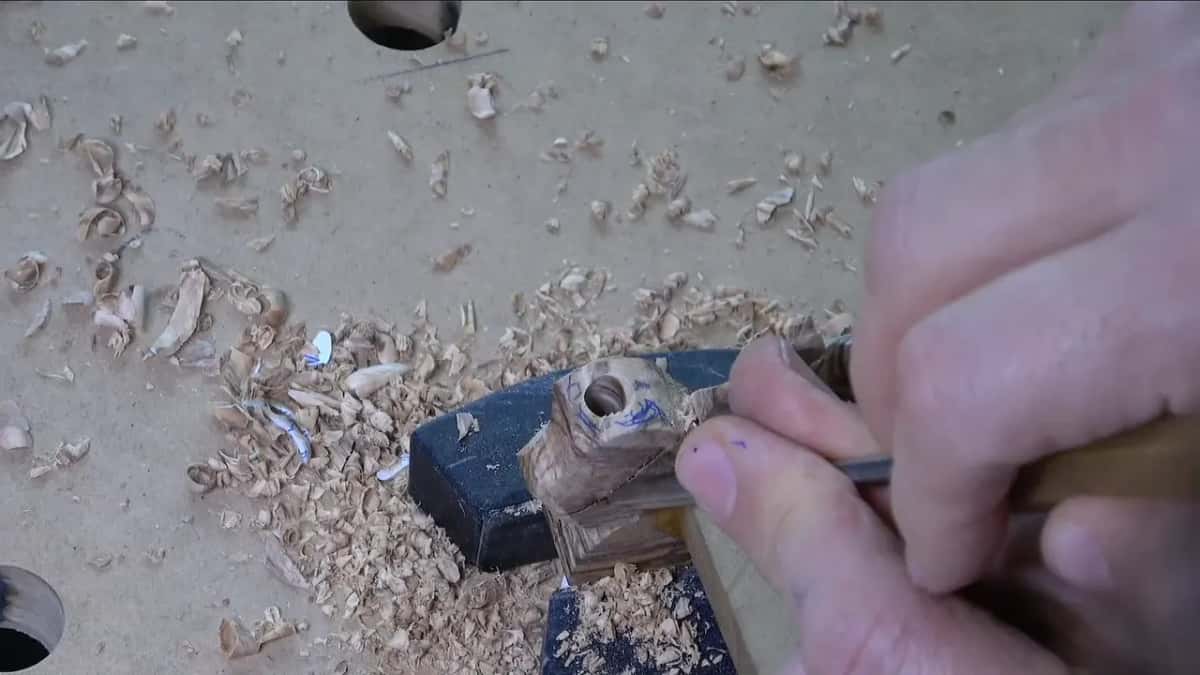
Blue pencil marks and a drilled hole, on a piece small enough to hold in one hand.
How do you choose a dense board at the rack?
Name the job first, then let two boards of the same size argue it out in your hands. Five minutes at the rack saves a ruined weekend.
Step 1, decide what the carving has to survive
A wall panel behind glass and a stair newel that fifty people grab every day are not the same commission. Write down whether hands will touch the finished piece. That single line decides more than any chart, and it is the question I ask a client before I ask about the budget.
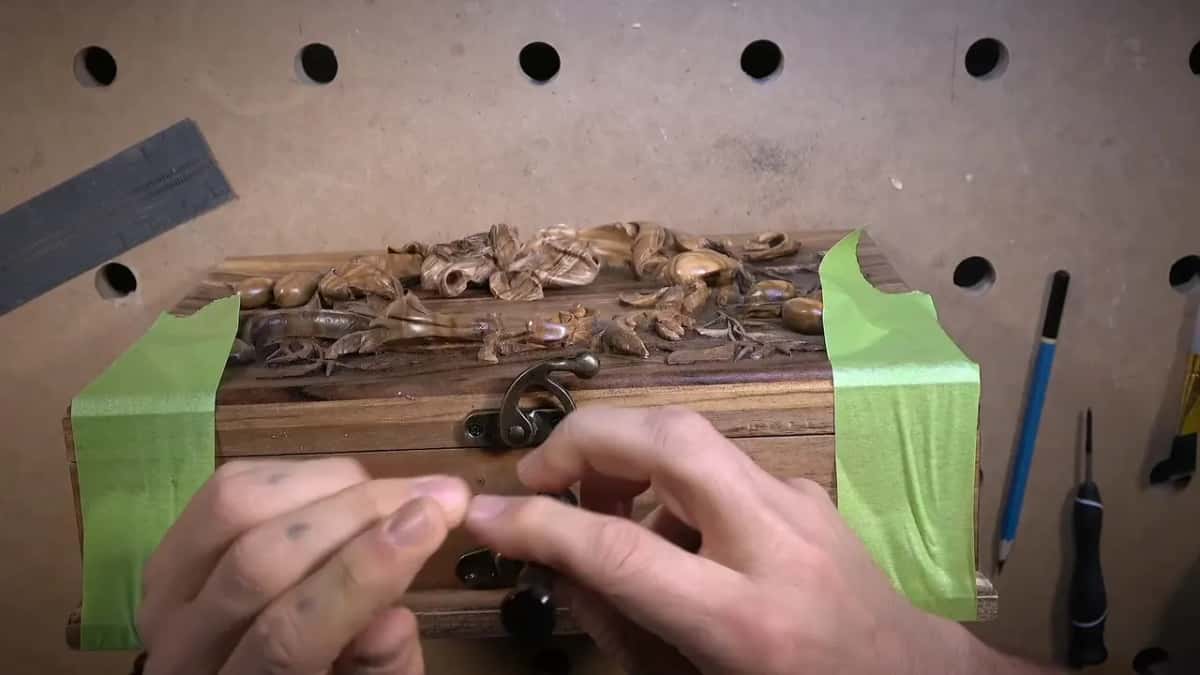
Somebody opens and closes this box a thousand times, and the tape stays on until the clasp is set.
Step 2, weigh two boards of the same size against each other
Pick up both. Your hands are a comparison instrument, and they are good at it, even though they are useless at absolute numbers. The heavier of two identical planks will dull you faster and hold a sharper undercut. Neither fact is worth anything until you know which one you needed.
Step 3, take one slice with a freshly stropped gouge
Ask the yard for a corner, or buy the smallest piece they will sell you. Listen while you carve. Shavings mean the fibers are slicing. A crunch means they are breaking ahead of the edge, and that sound tells you more about your afternoon than the species name ever will.
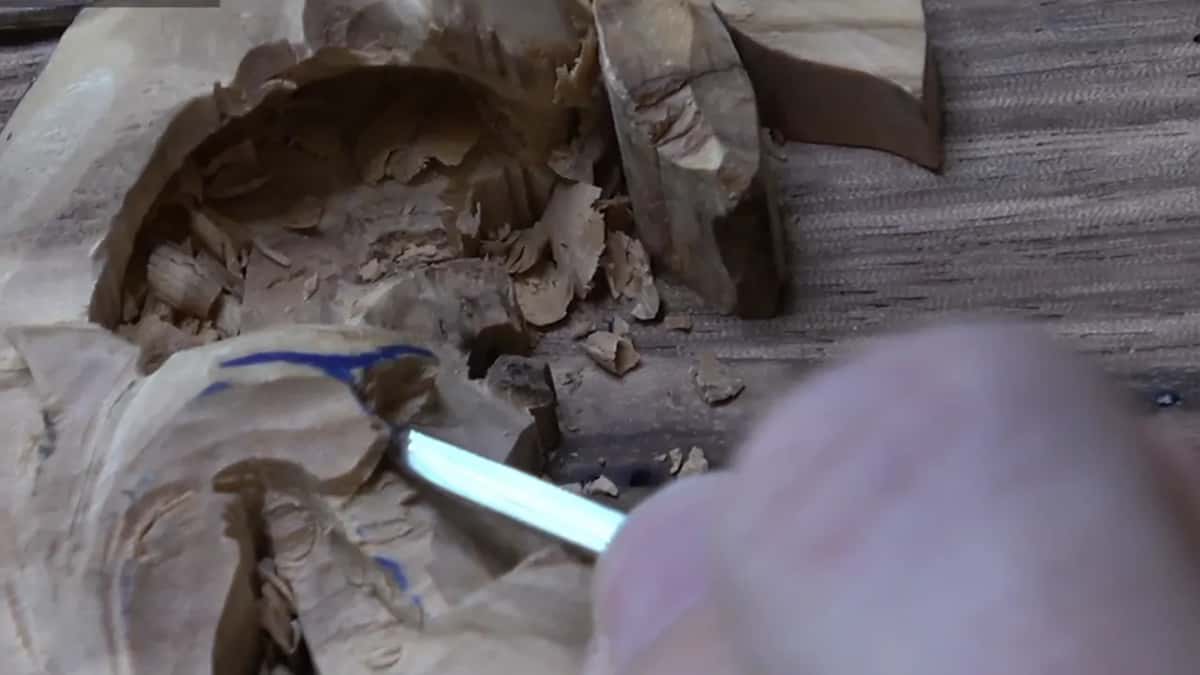
Those are curls in the hollow, not crumbs, and my ear knows the difference before my eyes do.
Step 4, carve one small detail before you buy the whole plank
Take the offcut home and carve the hardest shape in your design at full size. An undercut leaf tip, a bead, a small scroll. If the wood chips out there, it will chip out on the real panel, and finding that out on a piece the size of your palm is cheap.
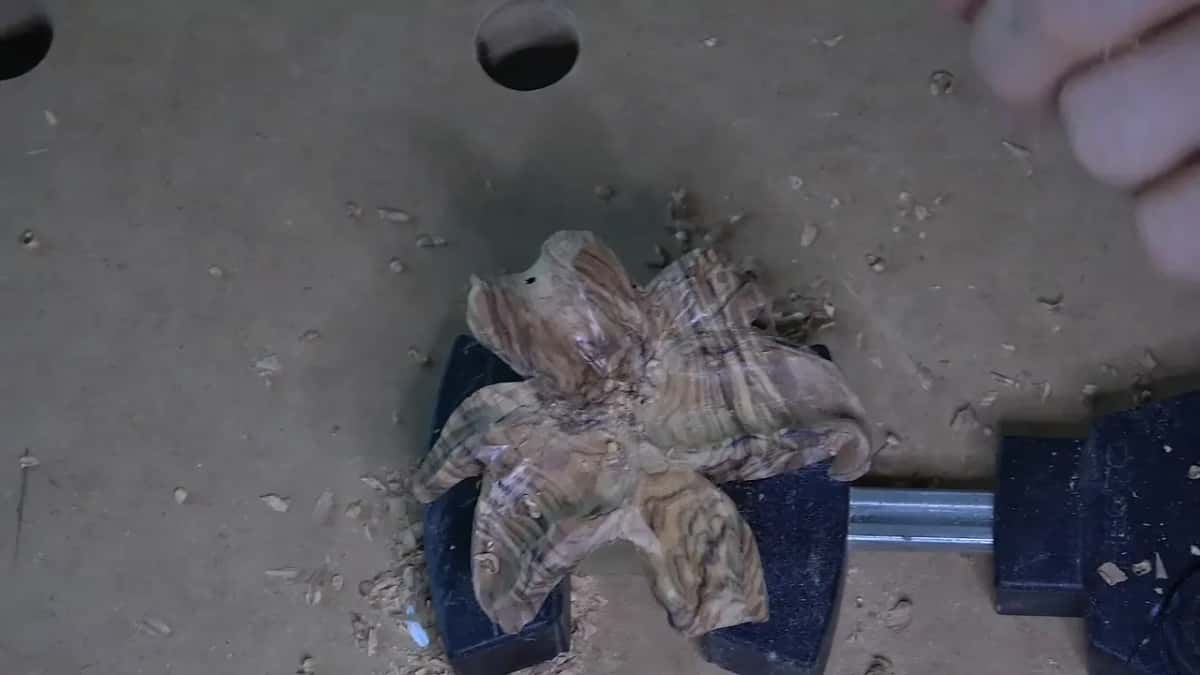
Tight striped grain, a small flower, and two jaws holding it, which is the size of test I want before I buy a plank.
Step 5, price the sharpening along with the board
A dense plank costs you money twice, once at the till and again in stones and hours. I count roughly one extra sharpening stop for every hour of carving in something like oak, and more in the tropical woods. Add that to the invoice, or add it to your evening. It gets paid either way.
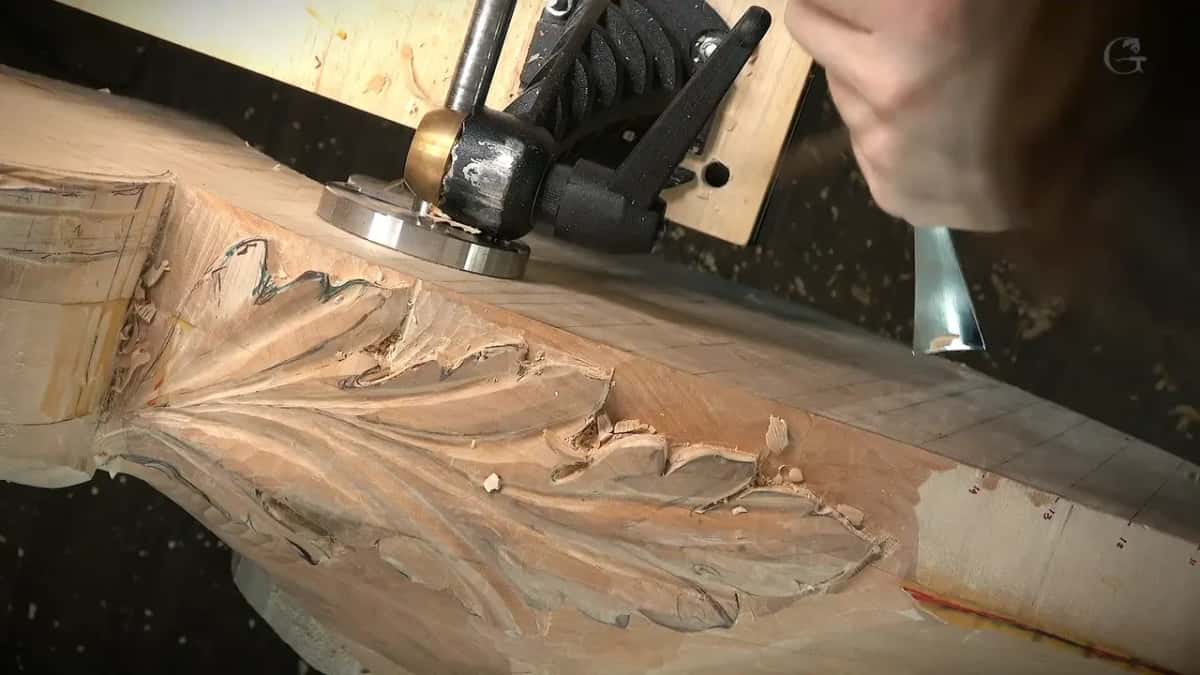
Half the leaf has its shape, and the wide chisel is lying where I set it down.
None of this makes the heavy board a bad board. It makes it a specific tool for a specific job, the same way black locust earns a fence post and never a leaf tip. Beginners who want the short list should read the plain answer on the best wood for carving first, then what kind of wood to use after that.
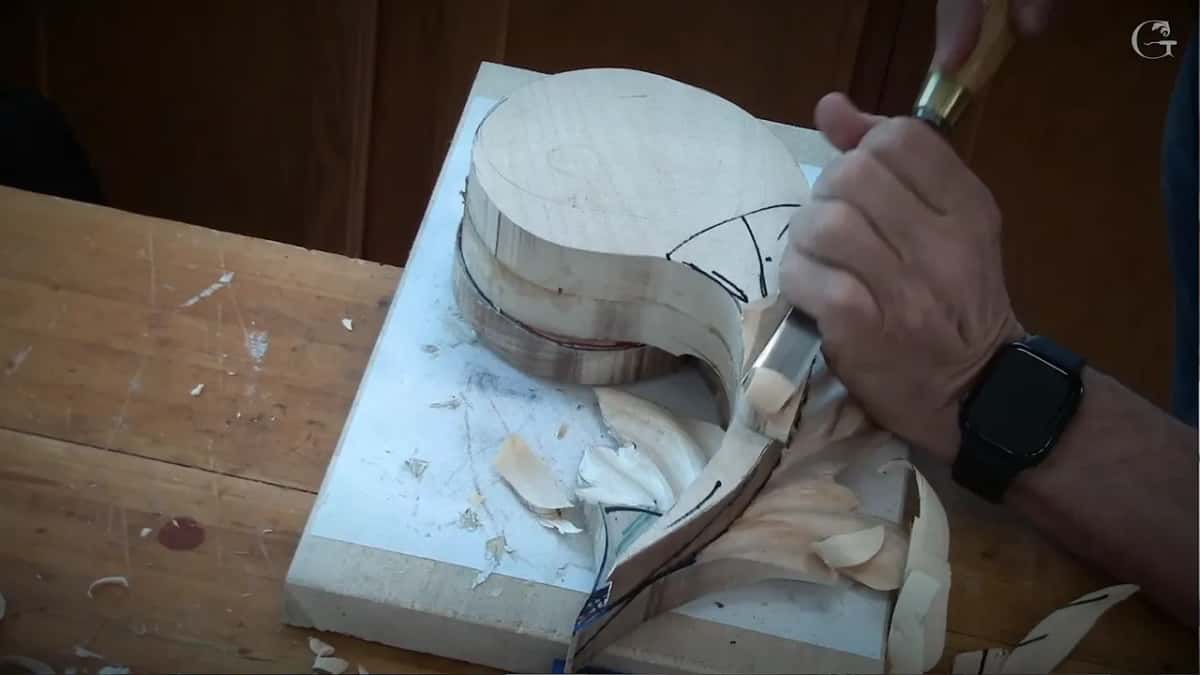
Saw marks still showing, and the shaving came off whole.
Have you ever pushed a gouge into a board and felt the fibers break instead of slice? Do you want to know that about a plank before you pay for it? Would you rather spend the evening carving than grinding a chipped edge back? Then start with wood that lets you learn, get somebody to show you the sharpening, and walk the whole path inside the course library. Tuition keeps this school and its charity work going.
Frequently asked questions
What is the heaviest wood in the world?
Black ironwood, Krugiodendron ferreum, weighs 84.5 pounds in one cubic foot on the Wood Database list. Itin and lignum vitae follow close behind it. Samples of any species vary by roughly ten percent either way, so the head of that list is a photo finish rather than a settled ranking.
Is lignum vitae good for carving?
Lignum vitae is the hardest wood measured, at 4,390 lbf, and that hardness is exactly why nobody carves ornament in it. Mallet heads, bearings and tool handles suit it. Its bending strength of 17,970 psi also sits well under African blackwood, so all that hardness bought less than you would think.
Does ebony sink in water?
Gaboon ebony sits at a specific gravity of 0.96, just under water at 1.00, so a dry piece floats with almost nothing showing. Blackwood at 1.27 and lignum vitae at 1.26 both sink outright. Green or wet stock behaves differently, which is why every table names a moisture content.
How hard is white oak next to basswood?
White oak reads 1,350 lbf on the Wood Database, against 410 for American basswood. Roughly triple. You will feel that as a mallet in your hand instead of palm pressure, plus open pores that fight small detail, and a sharpening stop every time the edge begins to tear.
Will a dense board hold a fine undercut better?
Denser wood does resist a fingernail and a knock better, which helps on parts that get handled. Snapping is a different measurement though, and doubling the density buys only about 2.2 times the bending strength. Thickness and grain direction protect a thin part far more than any species name will.
Do I need a mallet for hard woods?
Oak and the woods above it usually require one, yes. Palm pressure runs out somewhere around walnut for most people, and pushing harder is how beginners chip an edge or slip. A mallet is not extra effort. It moves the work off your wrist and onto a controlled tap.
Filed under
- advantages of high-density wood
- benefits of using high-density wood
- best high-density wood
- best wood for carving
- carving blocks comparison
- carving wood options
- high-density vs hardwood
- high-density wood characteristics
- high-density wood examples
- high-density wood meaning
- high-density wood reviews
- how to identify high-density wood
- identifying high-density wood
- trees that produce high-density wood
- types of high-density wood
- Understanding Wood for Carving
- uses of high-density wood
- where to find high-density wood
- wood for carving projects
- wood types for carving
- woodworking with high-density wood