
August 28, 2024 · Updated August 17, 2026
By Alexander Grabovetskiy — Master Woodcarver · Founder, School of Wood Carving · 15 min read
What does the elastic modulus of wood mean?
The elastic modulus of wood is its stiffness. It tells you how hard you have to push to bend a piece a given amount, and nothing more than that. American basswood lands at 10.1 gigapascals, white oak at 12.3. At the bench it predicts one thing, whether a thin part springs back or snaps.
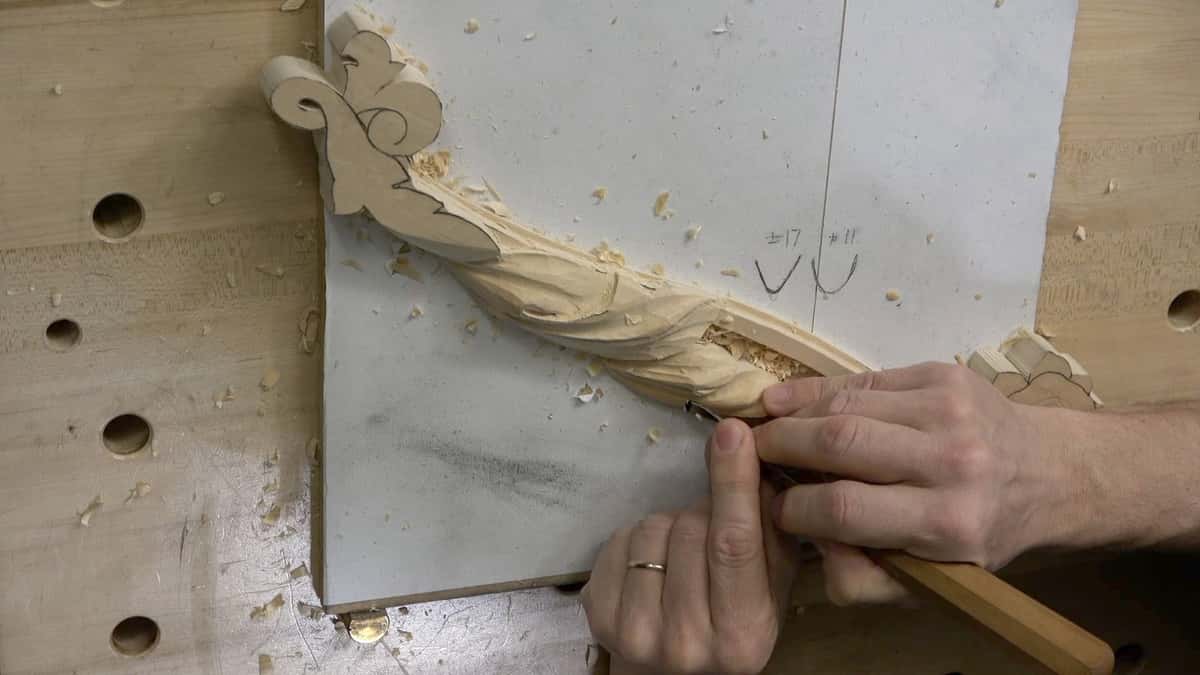
A carved molding this narrow has almost no material left to resist a sideways push, so my palm does the work a thicker blank would have done by itself.
You carved a leaf tip thin, then thinner, and it let go. I know that sound.
Most carvers open a hardness chart after that happens. Wrong chart. What decided the outcome was stiffness, and wood scientists call it the modulus of elasticity, or MOE. Over forty years I have lost tendrils, petal edges and one olive stem to it, and I never once fixed the problem by buying a harder wood. Here is the physics, in real numbers, written for somebody who hated physics.
- MOE is stiffness. Push, and a stiffer piece moves less.
- Hardness is a dent test, so it says nothing about springback. Basswood and mahogany prove the two come apart.
- The woods on a carving bench run roughly 8 to 12 GPa when they are dry.
- Turn a basswood board sideways and it keeps 2.7 percent of the stiffness it had along the grain.
- Thickness beats species every time. Halve the thickness of a panel and it becomes eight times floppier.
Is stiffness the same thing as hardness?
Stiffness and hardness answer two different questions, and one carving wood can score high on one while it sits low on the other. Hardness comes from a dent test.
A steel ball 0.444 inches across, or 11.28 mm, is pressed into the surface until it is buried to half its diameter, and the force it took is the Janka hardness number. That tells you about tool edges, dings and floors.
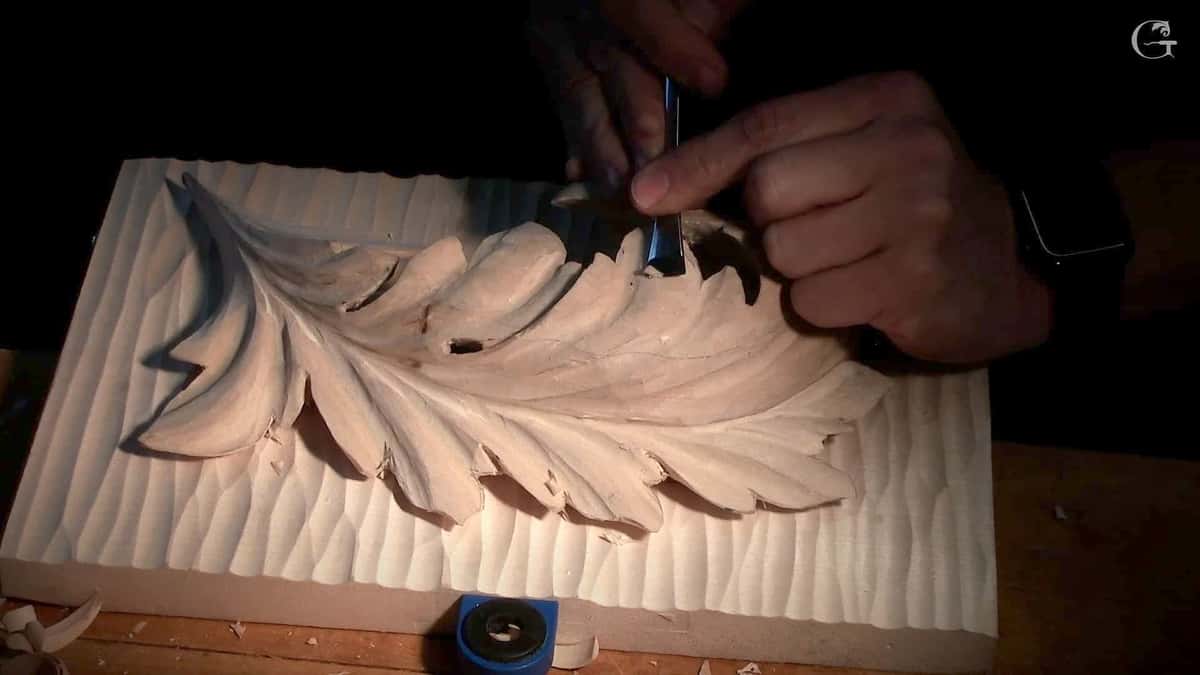
The lobes along the left edge are already too slender to take a mallet blow.
Stiffness is a different experiment entirely. You support a stick at both ends, press in the middle, and watch how far it sags. Strength is yet a third number, called modulus of rupture, and that one is the load where the stick finally gives up. So a board can be soft to your gouge and still refuse to bend, and it can be hard as a rock and still whip like a ruler. If you have been treating density as a stand-in for strength, that is the habit to break first.

Walnut asks more of my shoulder than basswood does. Its stiffness figure is only 15 percent higher.
How does anybody measure the stiffness of a piece of wood?
A laboratory rests a small clear stick of wood on two supports, presses down in the middle, and records how far it sags for every pound of load. Divide load by deflection, run it through the beam formula, and out comes the modulus.
The USDA Forest Products Laboratory Wood Handbook spells out the setup: a simply supported beam, loaded at the center, on a span to depth ratio of 14 to 1, following ASTM D143.
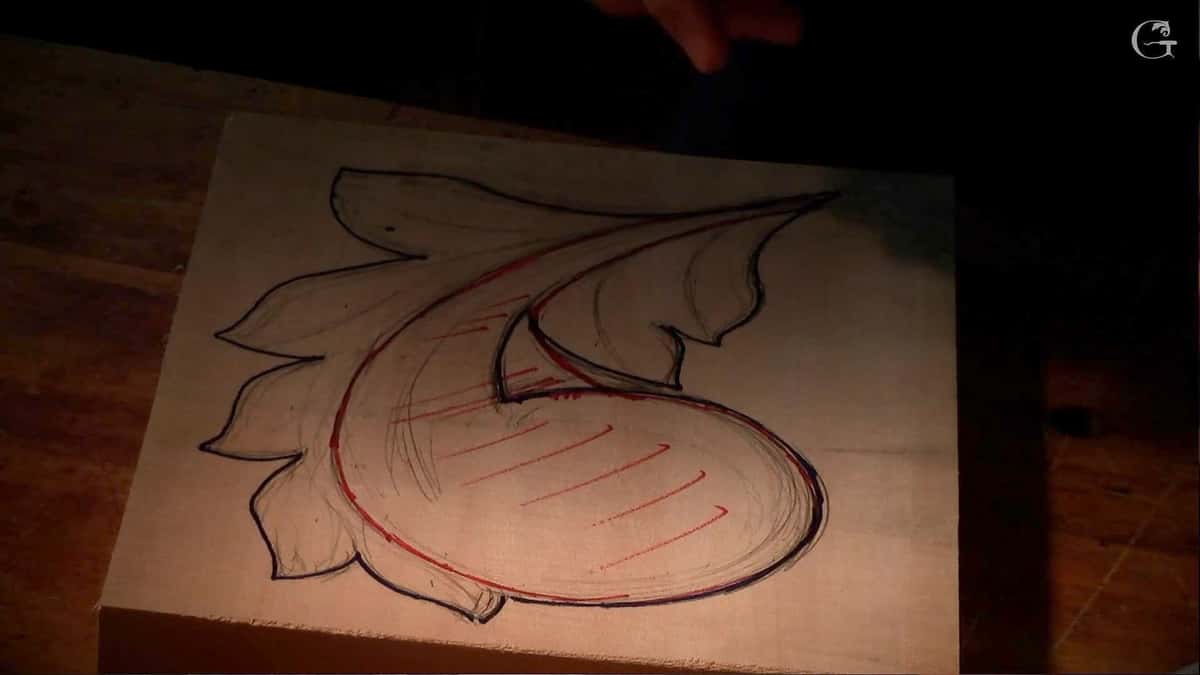
Nothing here has been carved yet. The block still holds every bit of stiffness it will ever have.
Two details in that handbook are worth knowing, because nobody quotes them. First, the tabulated figure includes a little shear sag mixed in with the bending, and the handbook says you can raise it by 10 percent to strip that out. Second, the sticks are clear and straight grained, sawn small on purpose. The number belongs to perfect wood.
Engineers write it as Young's modulus, in gigapascals, or in millions of pounds per square inch if the shop is American. Basswood reads 10,100 MPa in the metric table and 1.46 million psi in the other one. Same wood, same test, two languages.

Each surviving strand now carries its own load, and the board stops behaving like a board.
What is the elastic modulus of the woods on a carving bench?
Six woods a carver actually touches cover barely half again in stiffness, bottom to top, while their hardness numbers spread more than threefold. Every figure below is measured at 12 percent moisture, and all of them come out of the Wood Handbook tables.
| The carving wood | Stiffness, written out here as MOE in gigapascals | Side hardness, given in newtons | What that pairing actually tells a carver back at the bench |
|---|---|---|---|
| Butternut, the white walnut | 8.1 GPa, springiest board on this list | Just 2,200 newtons | Harder than basswood, and much floppier |
| American basswood, sometimes called limewood | 10.1 GPa, the reference point most carvers already carry in their head | A mere 1,800 newtons | Softest wood here, and yet only middling for stiffness |
| True Honduran mahogany | 10.3 GPa, a hair above basswood, nothing more | A solid 3,600 newtons | Twice the dent resistance and the same springback |
| American black walnut, Juglans nigra | 11.6 GPa, measured the same way on clear and straight stock | Roughly 4,500 newtons of side hardness | Holds a fine undercut edge cleanly, though it wants sharper tools |
| The American beech | 11.9 GPa, stiff and heavy in hand | Around 5,800 newtons | Tool handles and mallets, rarely panels |
| White oak, Quercus alba | 12.3 GPa, the stiffest of everything a carver keeps around | Fully 6,000 newtons | Those open pores fight against any fine detail work |
Read the last two rows against the first two and the whole spread is about half again. Smaller than most carvers expect. Walnut and oak, which the wood database covers at the black walnut entry and the white oak entry, do sit above basswood. They also take between two and a half and three and a third times the force to dent, which is a poor trade unless the design demands it. Beech goes further still, and the European beech entry puts that species at 14.3 GPa, well past anything in my table. There is a separate page on whether walnut works for carving at all. The panel in my furniture course came out of a job where the whole house was walnut, and it was not black walnut and not European walnut. It was a purple one. I had leftovers I could not use anywhere.
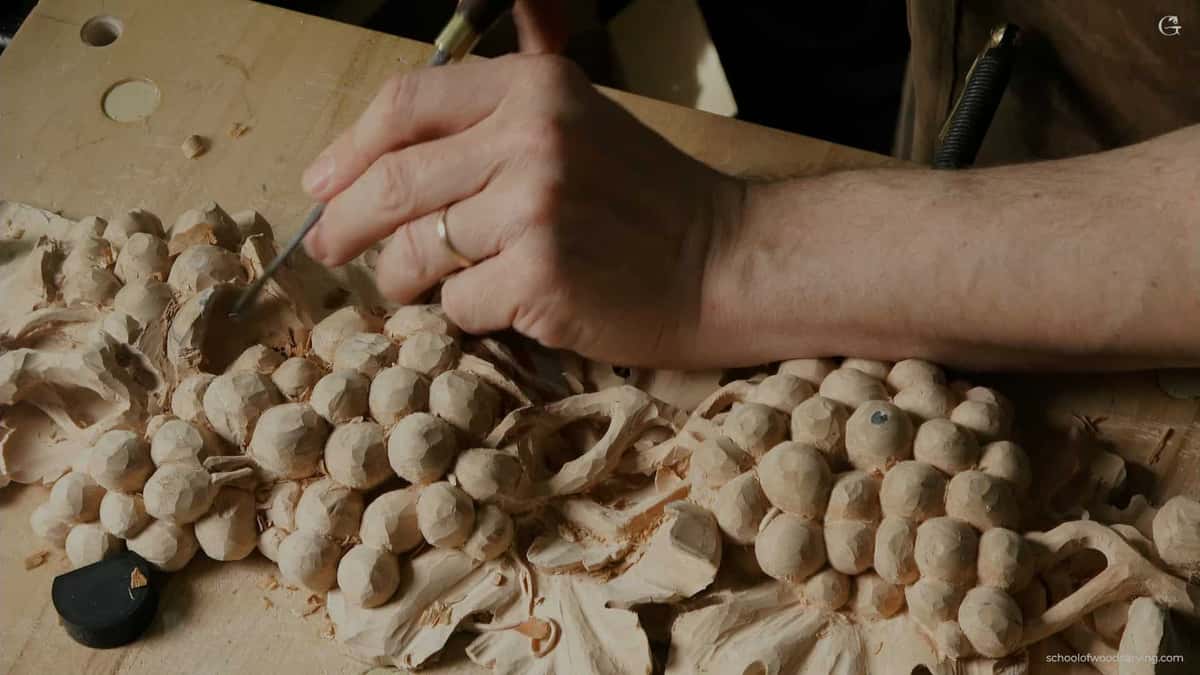
Grapes carved in the round leave stems as thin as a pencil lead. Those stems are where a stiffness figure stops being trivia.
Why do basswood and mahogany bend the same amount?
They sit 0.2 GPa apart in stiffness while mahogany takes twice the force to dent, which is the plainest proof that one of them cannot predict the other. Look at the pair again. Basswood measures 10.1 GPa with a side hardness of 1,800 newtons.
True mahogany, profiled at the Honduran mahogany entry, sits a fraction above basswood at 10.3 GPa in the same handbook table, and dents at 3,600.

A walnut panel this size barely flexes at all, and the whole risk moves later, out to the small parts that stand proud of the ground.
Butternut runs the trick in reverse. It dents at 2,200 newtons, so it beats basswood on hardness, and then it turns out to be a fifth less stiff than basswood, the springiest board in the group. A butternut leaf tip will flex under your thumb where the same shape in basswood stays put. In my furniture panel course I say that walnut is a little harder than lime wood and basswood, and that is a statement about my gouge, not about whether the panel will bow.
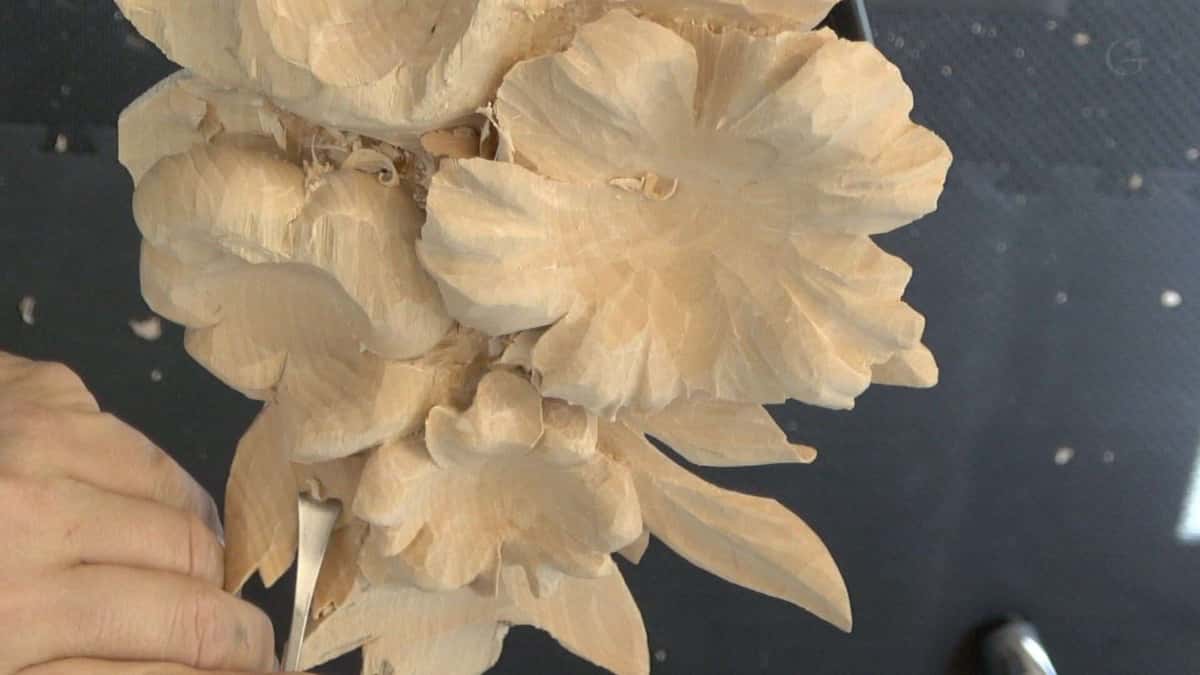
At this scale the wood is a spring, and the only thing holding that petal up is its own thickness.
So the shopping question and the physics question are separate. Which species to buy is settled over on the page about the best wood for carving, and whether the board in your hand is any good is settled by the hand tests you run before committing a design. This page only owes you the number.
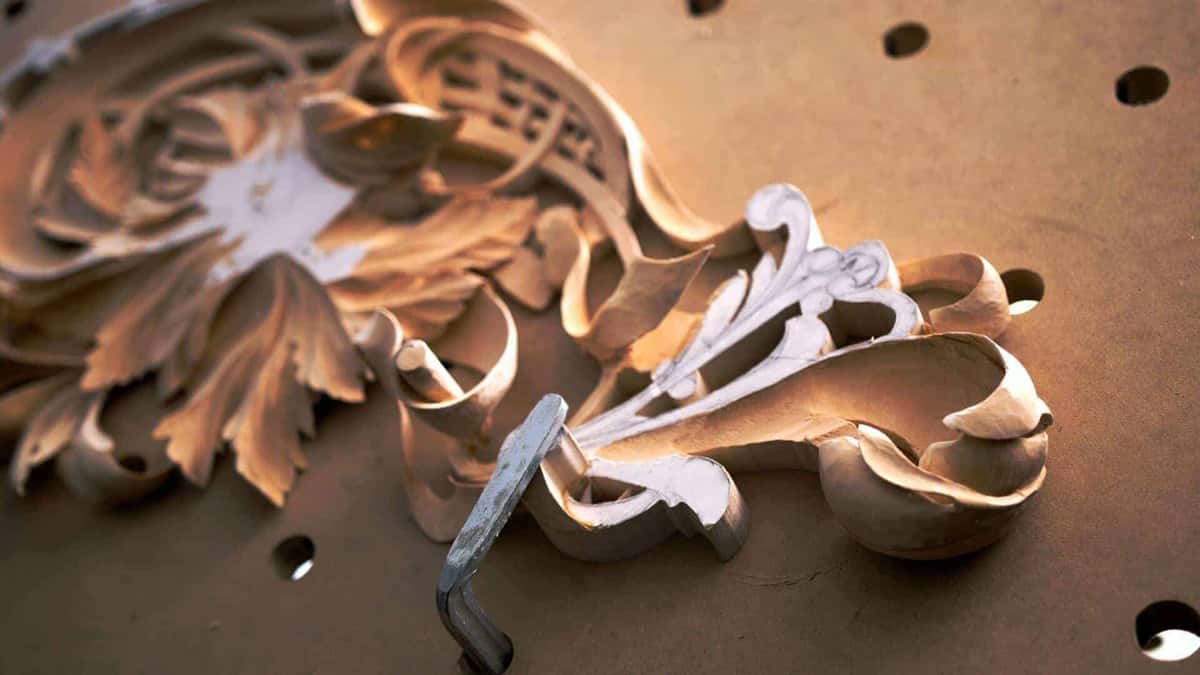
Hashemi flowers, still attached to their waste, and every tendril here is a small cantilever in its own right.
How do I test the springback of a board at my own bench?
Plane a scrap of the same board to your finished thickness, load it across a span, and watch whether the pencil line comes home when the weight leaves. No laboratory needed. You are not chasing a number to two decimals. One honest question about this board is enough.
Step 1, plane a scrap of the same board to your carving thickness
Take it off the same plank, as near the same growth rings as you can manage. A strip an inch wide and a foot long does the job. Mark the face that was up.

The whole run sits unsupported between its two ends, and the weak axis is the one nobody looks at.
Step 2, rest it on two blocks and hang a known weight at the middle
Set the blocks ten or twelve inches apart. A hand plane, a can of finish, anything you can weigh will do, as long as you use the identical weight on every board you compare.
Step 3, mark the sag against a straightedge
Lay a rule across the two blocks and pencil the gap. Most of stiffness testing is just owning something honest to measure against, and a straightedge you trust is that thing.
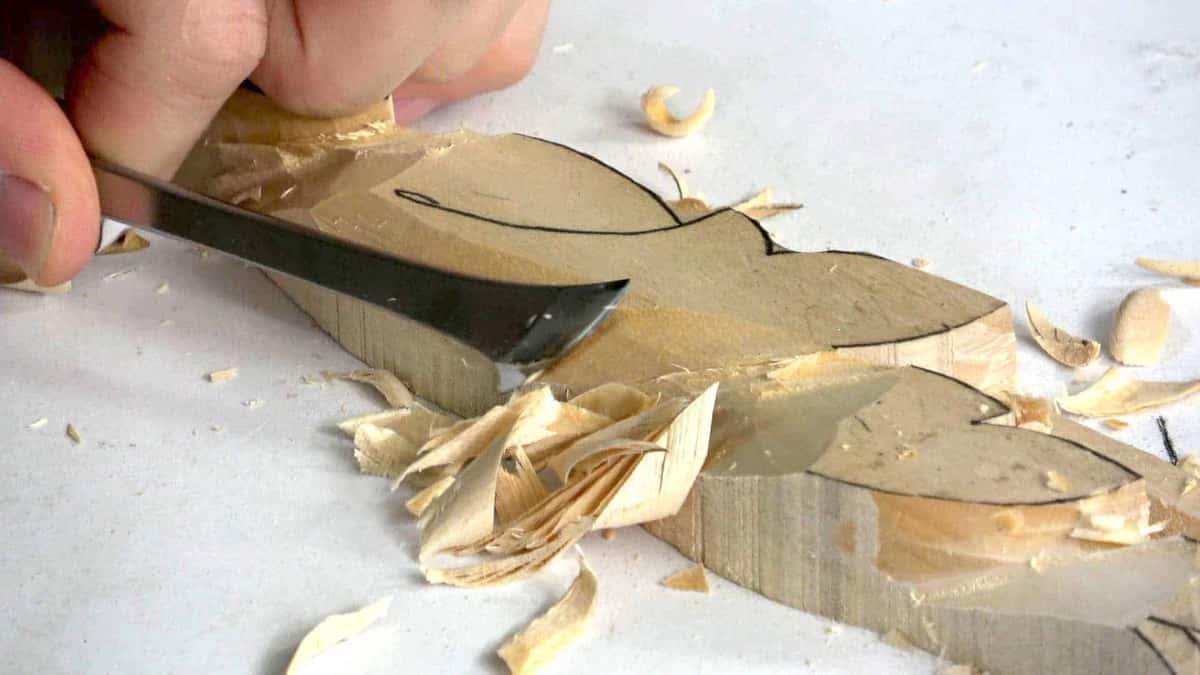
Every pass takes away material the piece was using to hold itself up.
Step 4, take the weight off and read whether the line comes back
A board that returns to the rule was inside its elastic range, and that is the range you want to live in. A board that keeps a bow was pushed past it. Do this twice with the grain running crossways and you will feel the anisotropy in your hands before you ever read about it.
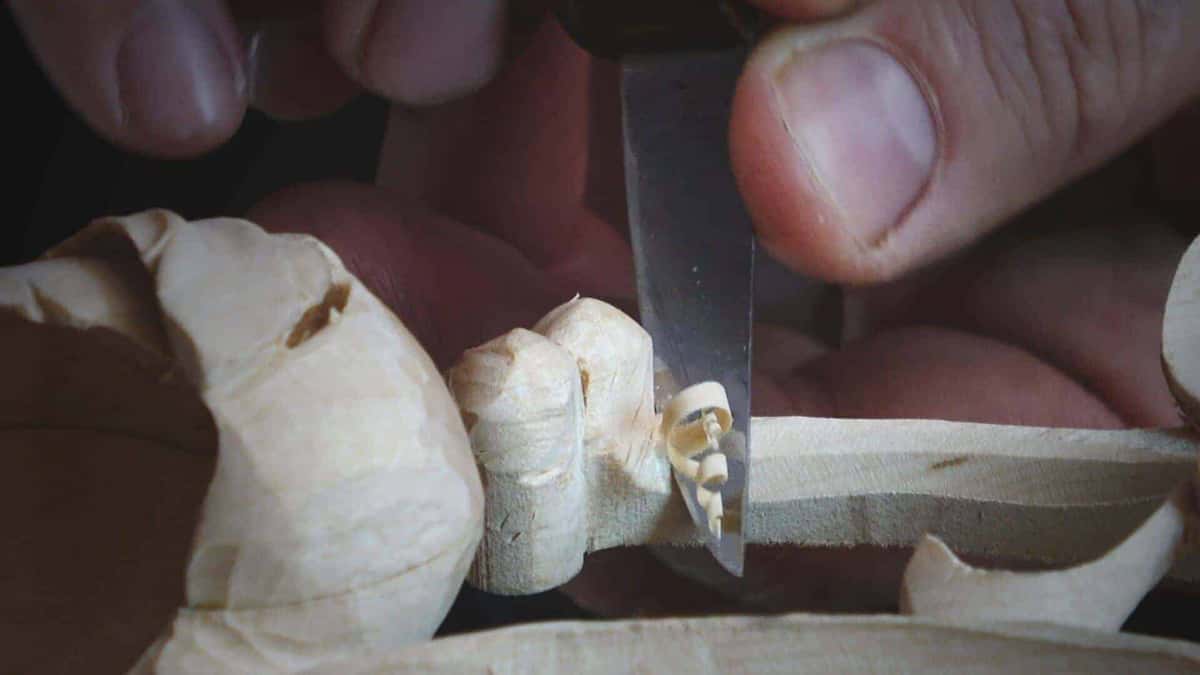
One slip here and a hundred hours ends in a sound you can hear across the shop.
Which carvings does stiffness actually decide?
Four shapes live or die on it: a thin relief panel, an openwork ground, a slender acanthus tendril, and any long element running crossways to the grain. The rest of your carving barely notices.
In the Venice Room workshops I say out loud that I need at least an eighth of an inch of thickness left, otherwise it is going to be too fragile, and that is a stiffness rule with a ruler attached.
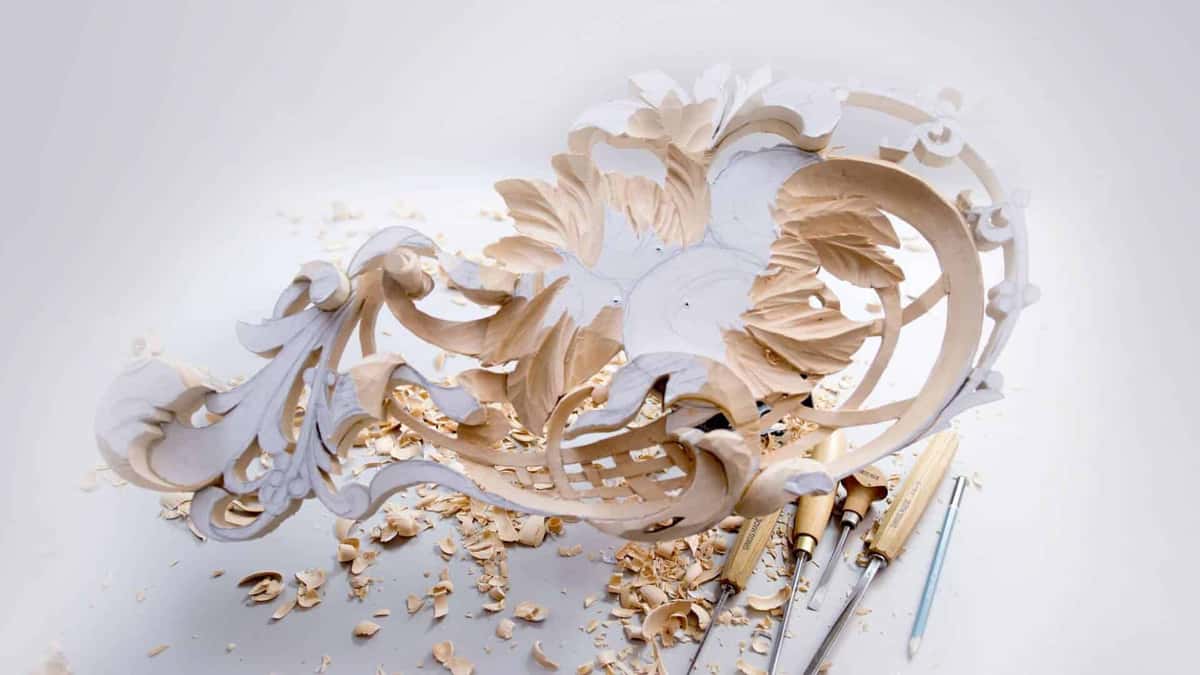
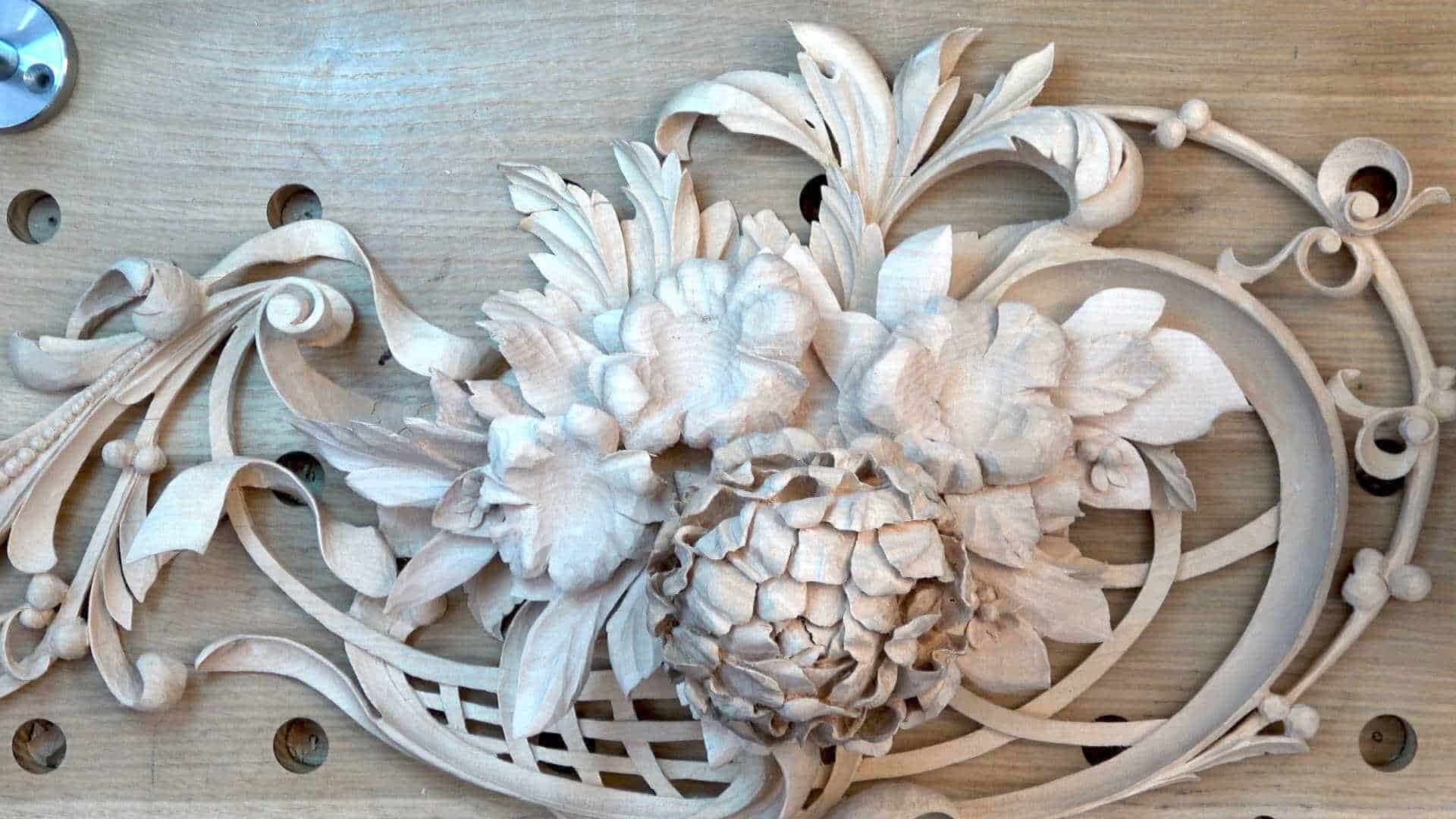
An openwork panel with the background sawn clean away, and nothing left under those scrolls except air.
Openwork is the cruel one. Take the ground away and every surviving strand becomes a beam held at two points, sometimes at one. In Venice Room workshop 77 I place my finger right underneath to support, because even with a quarter by quarter connection point it is still somewhat fragile. The question of whether it is possible to break it comes up in Hashemi flowers workshop 41. Yeah, and I have done it many times. There is a whole page on stabilizing thin carvings if you are already in trouble.

The ground is gone between the scrolls, so the panel now behaves like a frame rather than a board.
Cross grain is the other killer, and it is arithmetic, not bad luck. The Wood Handbook lists elastic ratios, and for basswood the tangential modulus is 0.027 of the longitudinal one. Sideways, your board keeps under three percent of its stiffness. The grain goes one direction and that is kind of weak, so keep an eye on how hard you strike when you are using a mallet. Reading which way it runs is covered under handling different grain directions.

The top leaves stand clear of everything behind them, carrying their weight on short stalks.
Grinling Gibbons died in 1721 and his limewood swags are still up, layered so the front leaves stand clear of the wall behind them. You can go and stand in front of the work at the Victoria and Albert Museum collection. He was not stronger than us. He simply knew where a thin part could go, and that same judgment runs through the Hashemi flowers workshops.

Mounted at last, and the board behind it now carries every ounce of the weight that the carving itself never could.
Why will your own board never match the published figure?
Those figures describe flawless sticks, and yours came off a tree. The Wood Handbook publishes a coefficient of variation of 22 percent for that stiffness figure across roughly fifty species.
Two clear basswood boards off the same mill in the same week can differ by a fifth in stiffness, and both of them are perfectly normal wood.
Outside a carving shop the same number does structural engineering work. Lumber is machine stress rated, which is what MSR means, by bending each board on the way past and reading its modulus, and a whole grade rests on that single measurement. Then the design value gets knocked down for real defects. ASTM D245 puts a quality factor of 0.80 on one common bending grade, so 12.4 GPa of clear wood becomes 9.9 GPa on the drawing, and the same haircut belongs on my table above.

Ordinary work at a thickness nobody worries about, and the physics only shows up out at the edges.
Add a knot and the fibers detour around it. Grain runout quietly turns your long tendril into a short grain tendril. Add water and the figure moves again, which is why the tables all name a moisture content of 12 percent, and why drying the wood first is not fussiness. The relationship between wood and moisture runs through every mechanical property on the sheet.

Before the wood ever gets touched, the drawing already decides how long the unsupported runs will be.
None of which makes the number useless. It makes it a starting point. And there is one lever far bigger than species anyway: the bending stiffness of a beam climbs with the cube of thickness, so the second moment of area hands you an eightfold gain for doubling a panel. Butternut up against white oak buys you 52 percent. Adding a sixteenth of an inch buys you more, which is the whole argument behind choosing a thicker board. The first workshop of my furniture panel design course opens on a piece only about three eighths of an inch thick, which is 10 millimeters, and that choice mattered more than the species did.
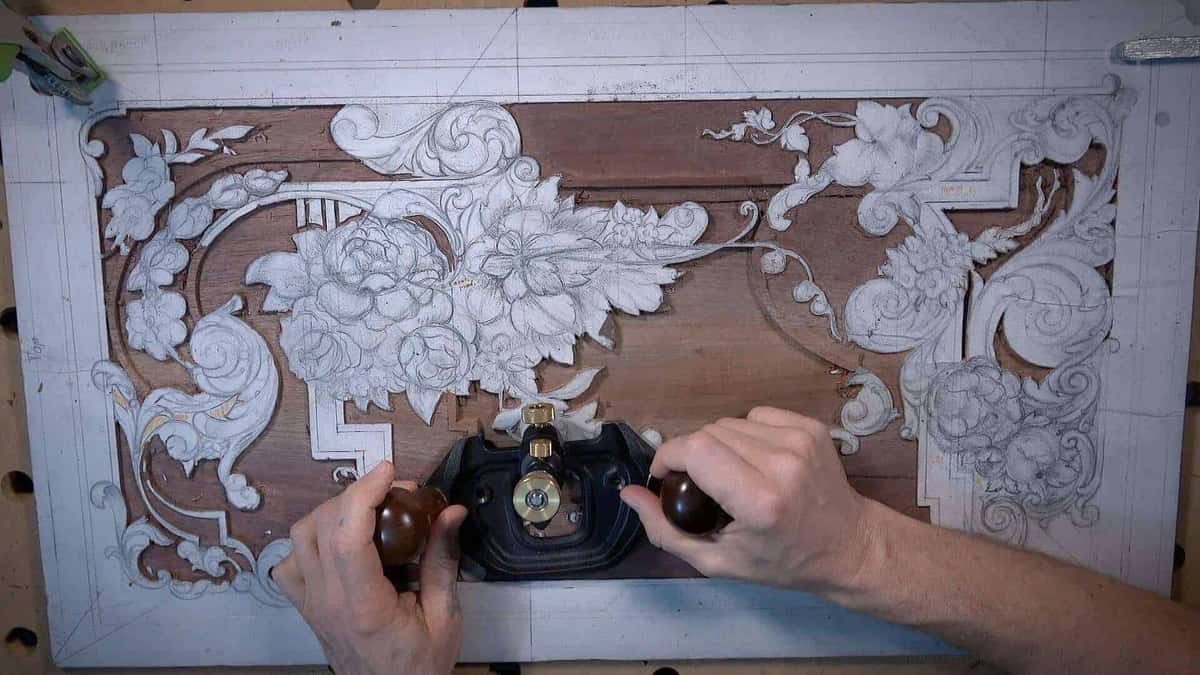
The router plane sets one number for the whole panel, how much wood stays under the ornament, and the arithmetic cares about nothing else.
If all of this sounds like one more thing to learn, it is, and the honest reasons carving is difficult are worth reading beside it. So is the plain list of what you actually need on the bench, and the expectations nobody sets for your first year. None of them will save a tendril. Knowing your panel is 10 millimeters of basswood and not 6 will.
I would rather you break a few pieces on purpose, in scrap, than lose one at the end of a hundred hours. That is most of what the school is for, and you can walk the whole path, first blank through pierced panel, inside the course library.
Frequently asked questions
What counts as a good elastic modulus for a carving wood?
Around 10 GPa suits most relief work, and that is where basswood and true mahogany both land. Butternut at 8.1 GPa is springier, so slender parts move. Oak at 12.3 GPa holds dead still and then fights your gouge every pass, which is a trade rather than an upgrade.
Does the elastic modulus change while wood dries?
Drying stiffens wood a great deal. Green basswood tests at 7,200 MPa, and the same species dried to 12 percent reads 10,100 MPa, a gain of about 40 percent. Every published figure names its moisture content, so check that line before you compare two tables.
How is modulus of elasticity different from modulus of rupture?
Elasticity describes bending that recovers. Rupture is the stress at which the piece finally fails, and for basswood those two numbers are 1.46 million psi of stiffness against 8,700 psi of bending strength. Two different questions, and only one of them warns you about a tendril.
Can I measure the stiffness of the exact board on my bench?
Only by testing it. Published tables give a species average from clear specimens, and individual boards scatter around that average by roughly a fifth. The bench springback test earlier on this page compares two real boards against each other, which is usually the comparison you actually want.
Does thickness or species matter more for a thin panel?
Thickness wins by a wide margin. Stiffness rises with the cube of thickness, so a panel taken from 6 mm to 12 mm gets eight times harder to bend. Swapping the springiest carving wood for the stiffest gains you only about half again.
Do carving tools care about the elastic modulus?
Your edge cares about hardness and abrasion, not stiffness. A 10 GPa wood and a 12 GPa wood dull a gouge at similar rates if their Janka numbers match. Where stiffness reaches your hands is in vibration, since a floppy panel absorbs mallet energy instead of letting the edge do the work.
Filed under
- Best practices for wood carving.
- Best wood types for carving projects
- Carving with basswood and other woods
- Choosing wood for carving blocks
- Comparing elastic modulus across wood species
- Effects of drying on wood's elastic modulus
- Elastic modulus and wood flexibility
- Elastic modulus in furniture making
- Elastic modulus of hardwood vs softwood
- Factors affecting wood's elastic modulus
- How temperature affects wood elasticity
- How to measure elastic modulus of wood?
- Impact of moisture on wood's elastic modulus
- Importance of elastic modulus in wood
- Typical elastic modulus values for wood
- Understanding Wood for Carving
- Understanding wood properties for carvings
- What is the elastic modulus of wood?
- Wood carving techniques and elastic modulus
- Wood grain direction and elastic modulus
- Wood treatments and elastic modulus changes