
September 17, 2024 · Updated August 16, 2026
By Alexander Grabovetskiy — Master Woodcarver · Founder, School of Wood Carving · 16 min read
What to know before starting wood carving
What to know before starting wood carving is mostly about expectations, not gear. Design comes first, and it is harder than the carving. Sharpening never ends. A 2x4 from the hardware store will fight you and ruin your edge. Your hands ache at the start, in the palm muscles, and nobody arrives able to do any of this.

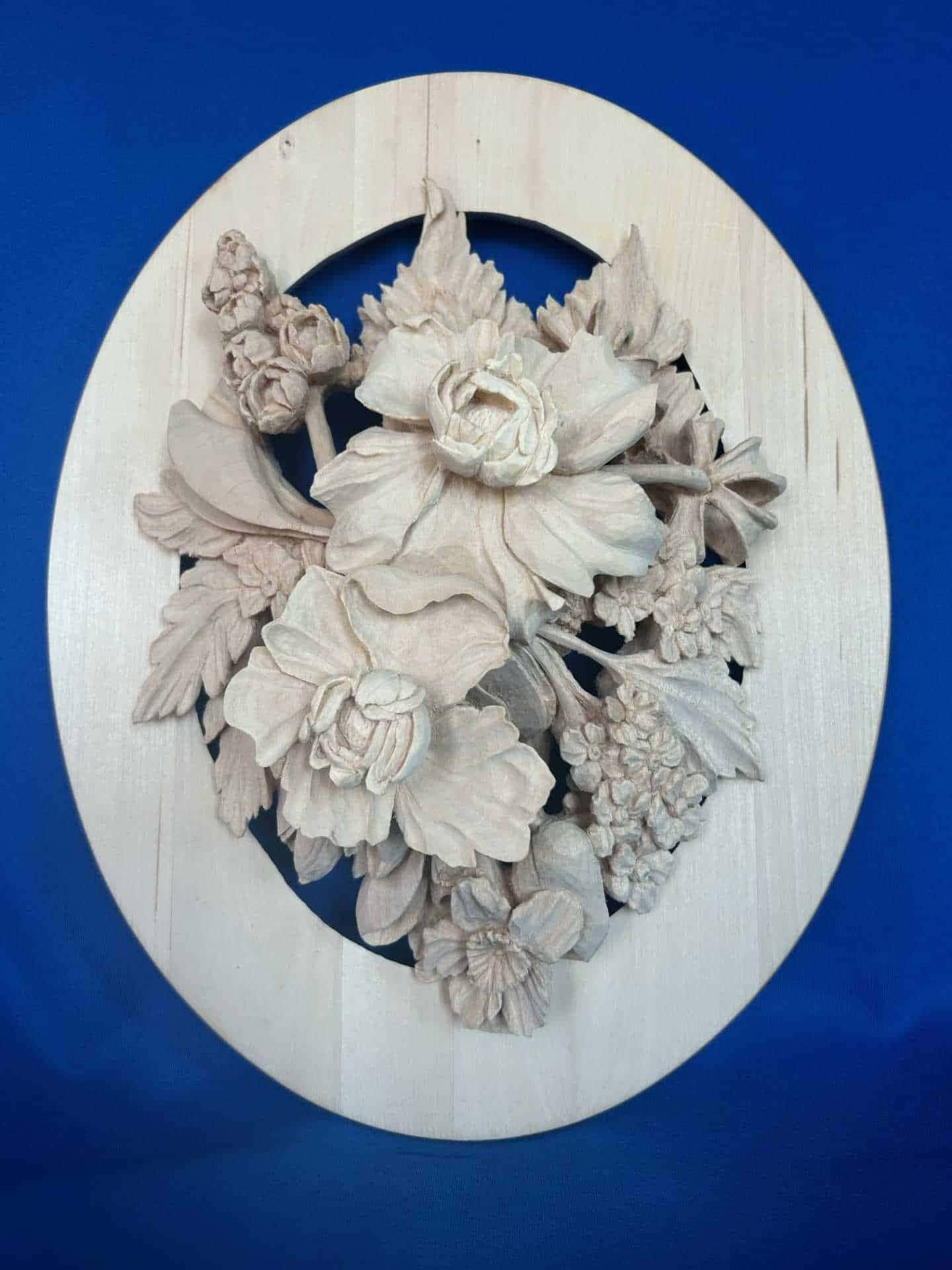
A Grinling Gibbons blank in its first session. The pile on the bench is most of the board.
People write to me before they buy anything, and almost all of them ask about tools. They want a list. The list is the easy part, and it is not what decides whether you are still carving next spring.
I was six years old when my grandfather's chisel came into my hands. I took it straight to a white brick, carved a face into it, used a second brick as my mallet, and killed that chisel completely. Killed it. My grandfather was really frustrated when he saw what I had done, and the passion was born in the same minute I destroyed his tool. My first lesson in expectations. It cost one good chisel.
Here is what forty years at the bench would have told that six year old.
- Design eats more of your first year than carving does, and it is the harder skill.
- A sharp edge is the whole game. It goes dull while you work, so you sharpen while you work.
- Basswood costs money. Framing lumber costs you tools.
- Your first finished piece should fit in one hand.
- Sore hands early on, from the palm and never the arm, until the grip settles.
What does the first year of wood carving really look like?
The first year looks like a lot of small practice boards and very few finished pieces, and how far you get depends almost entirely on how many evenings you actually sit down.

Somebody emailed me before signing up and asked what level he would reach in one month, then two months, then a year. Honest question, and I could not answer it. I said so out loud in the beginner course: it all depends on you and only you and the progress only you do.
I am a member of a gym. I pay every month. It would be foolish of me to ask what results one month buys, because the answer sits with whether I show up. Young kids come in, pump dumbbells for a day, then check the mirror for what grew. Nothing grew. Nothing grows in one day.
What that looks like at a bench is straight lines, angled slices, chips on the floor, and a leaf that finally reads as a leaf from across the room. When any of it arrives is decided by the evenings you give it, which is why I never answer the month question. The people below spent five days together in one room and each walked out with a panel. At home, alone, it takes longer. I argued the timeline separately in how long it takes to learn how to carve wood.

A week at the Marc Adams School. Five days, blank to panel, and everybody walked out holding theirs.
Progress is not smooth. You will have a good week and then a week where everything you touch splits. That is normal.
Why does design come before carving?
Design comes first because the tool cannot fix a shape that was wrong on paper, and most beginner disappointment is a drawing problem wearing a carving costume.
The man who taught me said it when I was sixteen, while I sat with a pencil and got nowhere. In my furniture panel course I say the same thing in five words: the design goes before carving. When I teach the principles of design I say it shorter. Design is the most complicated thing.
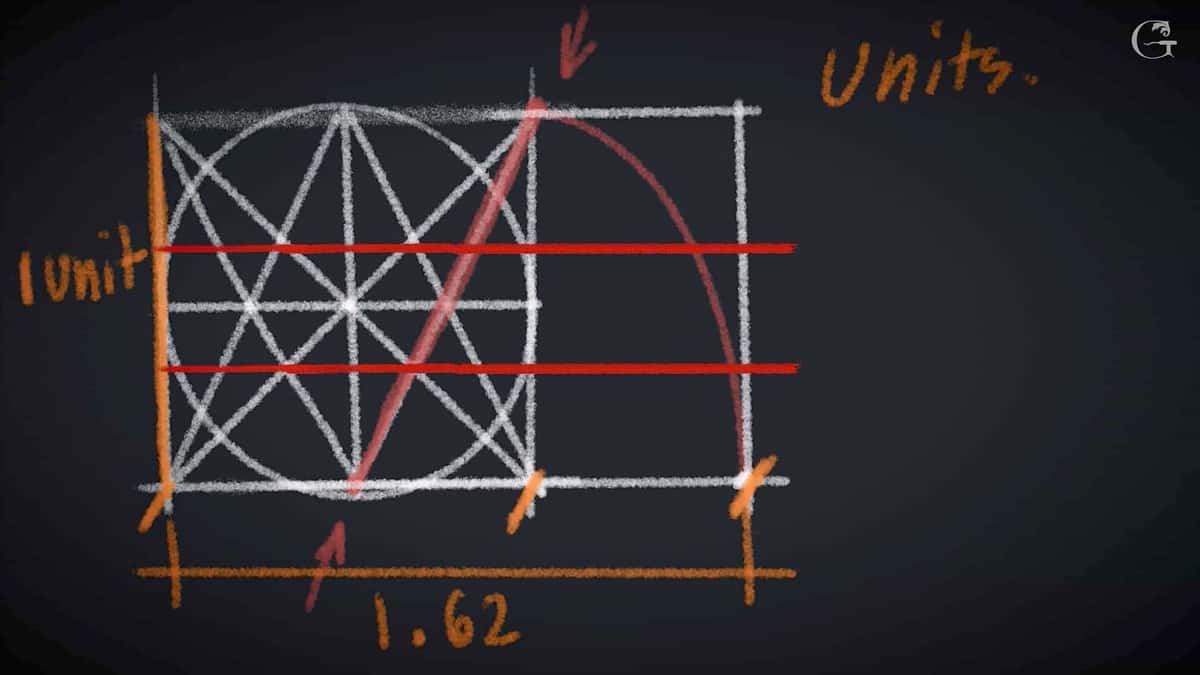
One unit high, 1.62 across. The armature is drawn before a single leaf is.
People hear design and think drawing. So design is a lot more than ability to take a pencil and a piece of paper and draw something. There are laws under it. A law of space, a law of rhythm, a law of repetition. The secret was not how to use a gouge, the secret was in design, and the old shops kept it quiet.
Some of it is arithmetic you can learn in an evening. Find sixty percent along any line and you have landed near the golden ratio, roughly 1.618, and your eye reads that spot as the important one. Every museum piece that survived is built on it. The acanthus leaf of classical ornament was never a botanical drawing. It is a set of movements.

I paid a fine art teacher for my daughter Jessica when she was small, hoping she would get what I got from a master. She lasted maybe a couple of weeks. The teacher told her to express herself and put something on the paper, and Jessica came home with a few splashes. One of my other daughters trained as an architect and graduated near the top of her class. Nobody taught her the golden ratio either.

My master used to hand me a fresh sheet and say: think. Think how you will carve it. What tools will you use, and how do you get in those areas. A drawing can look beautiful and still be impossible to carve. Design and tool knowledge are one subject, which is why I put the whole argument in the principles of design course.

The pencil never leaves the bench. Half the drawing happens after the roughing.
Will a 2x4 from the hardware store work for carving?
Construction lumber will punish you and dull your tools, because framing spruce and pine have hard growth rings, soft summer wood between them, and knots that stop an edge cold.
Start with basswood. In Europe the same tree is lime or linden, and in Russia we called it lipa. Tilia is the genus, and American basswood is Tilia americana. The Wood Database entry for basswood puts it at 410 lbf on the Janka scale and calls it perhaps one of the most suitable species for hand carving. That matches what I have felt under a gouge for forty years.

A framing 2x4 is not even the size it claims. Nominal lumber dimensions mean the board is really 1.5 by 3.5 inches, 38 by 89 mm, graded to hold a roof up and nothing finer. Carve it and the tool skids off a hard ring and dives into the soft wood behind.
Buying is its own small shock. Craft stores sell small basswood planks. Real hardwood yards sell to furniture makers and want a minimum order, which for me started at three hundred dollars and is five hundred now. The dollars side I put in what wood carving costs as a hobby. Ask for kiln dried stock, and read whether wood has to be dry before carving before you accept a bargain board.
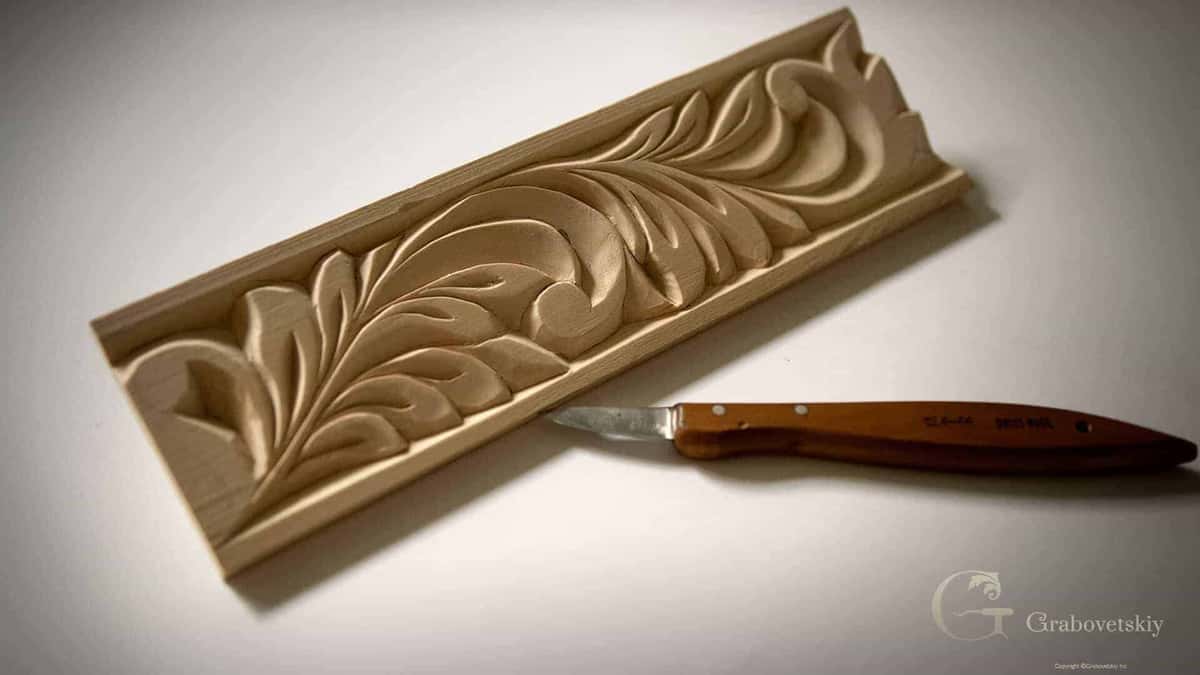
The same species, a few months later. Basswood holds an edge on a leaf tip like this.
Once you own a board, judging it is a skill of its own, and the hand tests live in how to know if wood is good for carving. Why one board flexes and another snaps is what the elastic modulus of wood means. For species shopping, the best wood for carving covers the field, and the USDA Wood Handbook is the reference behind all of it. Butternut is the other wood I would allow a beginner, and the butternut page shows why.
How much of your bench time goes to sharpening?
More than you expect, and it never stops being part of the work instead of a chore you finish once.

A new gouge out of the box is ground, not finished. The knife I have used for twenty years is a Swiss made number 12 from Pfeil, and even that one went to a stone first. After that you strop. Not once a month. Every ten or fifteen minutes of real work, before the tool tells you.

The tell is resistance. In my Hashemi flowers course I put it this way: if you do have a resistance, you feel like wood is not cutting, so that means your tool is not sharp enough. And from the furniture panel course: do not make the mistake and use your tool with a dull blade.

A sharp gouge leaves that shine. Sanding cannot put it back once you tear the fibers.
Beginners blame the wood. I hear it constantly, and about walnut or cherry or basswood my answer never changes. The problem is the tool. Sharpening is the skill that takes the longest to own, which is a large part of why wood carving is difficult for reasons beginners never guess. Taught properly instead of mentioned in passing, sharpening fills the tool sharpening course.
Do your hands hurt when you start carving?
Your hands will ache when you begin, mostly in the muscles inside the palm, and the ache quiets down once your grip learns itself.

Carving is physical labor. In the beginner course, working an outline with nothing but a knife, I told students plainly: it is a workout, believe me, you are going to sweat when you are doing it. And after five days of an in person class, people who have been in my classes know by Tuesday night they get really tired, and not just the physical, I am talking about brain.
Blisters are a different matter. Blisters mean you are gripping wrong. On the Tray of Blessing project I said it while carving: that is why I am not getting tired and I do not have any blisters on my hand. The work comes from the small muscles inside the palm, never from the arm or the shoulder. Forcing the tool burns your forearm.

Austin School of Furniture. Note the posture, and the amount of bench covered in chips.
One safety rule I repeat in every class, and it has never changed. Your hand never goes in front of the blade. Not to steady the piece, not for one second. Clamp the work instead. Reading the grain before you commit saves fingers too, which is covered in handling different grain directions, and the basic grain terminology is worth ten minutes.
What is a realistic first project?
A realistic first project is a flat practice board with three or four leaf shapes on it, carved with one knife, and it should take you an evening rather than a season.
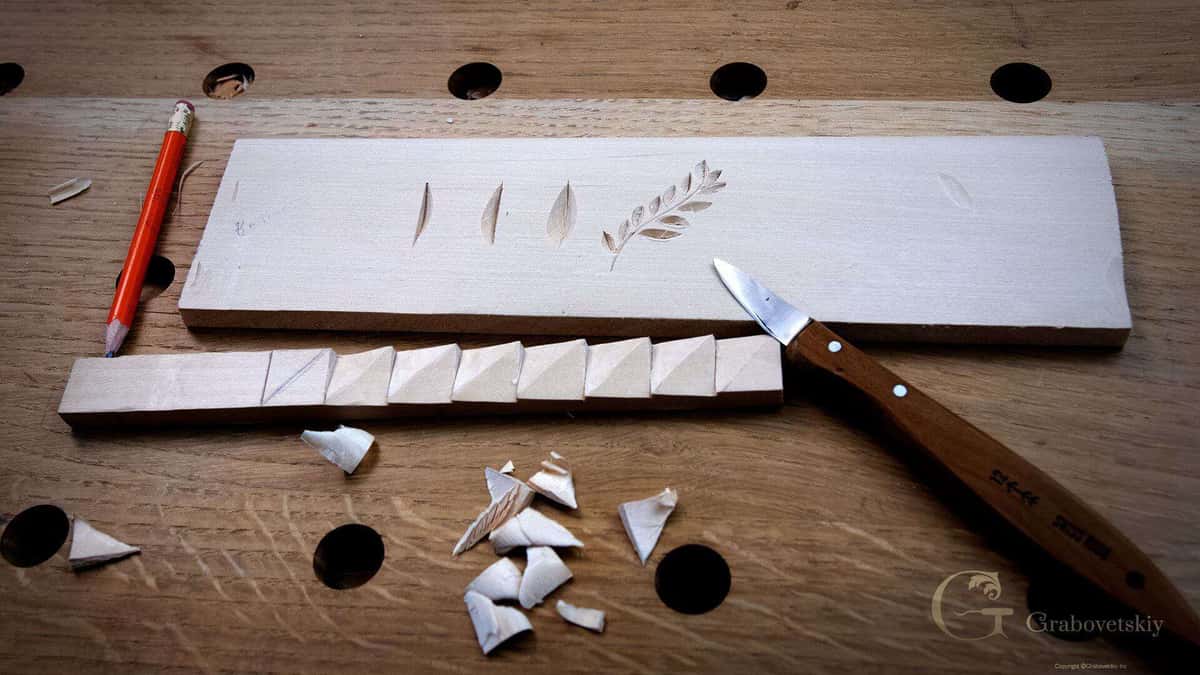
My beginner course starts on this board. Straight pass, right angle, left angle, then a small branch.
That board above is the whole first workshop. A straight line pulled toward you, then a right angle slice and a left one to meet it, and the chip pops out. Then the same three moves on a small branch of leaves. Below it is a strip of ancient molding, roughly 20 mm wide and 10 mm thick. Both were carved with one Swiss made number 12 chip carving knife. That knife has sat on my shelf for twenty years and it paid my housing, my food and my clothes.
What I would steer you away from is no mystery. Beginners aim at something in the round, usually an eagle or a face, and the thin parts snap off. Here is the honest comparison.
| What beginners plan | What actually happens in the first month | The reason | What I would tell you instead |
|---|---|---|---|
| A large carved eagle | Three evenings in, the thin wings snap off | Short grain everywhere | Carve a leaf on a flat plank |
| A boxed set | Twelve gouges, and none of them sharp | Edges arrive unfinished | Buy two gouges and one knife |
| Framing lumber from the aisle | Hard growth rings tear, and the edge dies | Spruce is stringy | Order kiln dried basswood, at least once |
| Carving every Saturday | Twenty minutes in, the tool goes dull | No strop | Strop every ten minutes, before it feels needed |
| Drawing the design later | The shape wanders and the leaves lose their rhythm | No armature underneath | Draw the whole thing before touching the wood |
You will still ruin boards. I told my beginner students exactly this. Do not get frustrated if it is not going to be the same result at the first try. Just keep trying. The worst thing that can happen is you buy a new piece of wood. A basswood offcut costs a few dollars, so the losses stay small.

Carved by a student of mine. Look under the petals on both pieces, undercut until the shadow shows through.
Two forms sit near the beginning and get confused. Chip carving is geometric and came later in history than people think. Relief means the design stands off a background. The exercise board above is neither, strictly speaking, and it does not matter. The mistakes I see most often after month one are listed in common beginner mistakes.
What should your first month at the bench look like?
Five habits, repeated on cheap offcuts, will teach your hand more in four weeks than any tool purchase will.

Step 1, draw the whole design at full size before you buy wood
Paper is free and a ruined board is not. Draw it, walk away, come back and look at it from a distance. It is a good practice once in a while just to step away and look at your composition from a little distance.
Step 2, glue the paper straight onto the basswood
I do this on real commissions too. Print to scale, glue it down, let it dry properly. You carve through the drawing, which keeps the shape honest for the first hour, while your eye has not learned the form yet.
Step 3, outline every line with a V tool before you remove any background
The outline is your fence. Once it is in, the background can come down fast without eating the design. If a chip refuses to release, go back and repeat the same pass instead of levering it out.

One brass bench clamp, biting on waste at the top edge, so nothing presses on the carved flowers.
Step 4, strop the edge before it starts to drag
Set a timer if you have to. Ten minutes. And it takes much longer to fix the mistake than to do the first pass right the first time.
Step 5, finish the small piece even when you stop liking it
Around day three of anything you will hate it. Finish it anyway. We have a saying in Russian folklore: if you rush it, you are going to make people laugh. The finishing is where the learning compounds.

You need less space than you fear. If you do not have a dedicated space in your house, no workshop at all, you can just use your kitchen table, and I have done lots of projects on the kitchen table. Somewhere to clamp the board, a flat top, and light. That is the room. More on the very first evening in carving wood, your first steps, and the full kit belongs to what is needed to carve wood.
Do you need talent to carve wood?
Talent decides very little in the first year, because everything you struggle with in month one is a trained habit and not a gift.

Every master who ever lived started at the same place you are standing. Four thousand years ago, a thousand years ago, two hundred years ago, it does not matter. They all began with one knife and a piece of wood, and almost all of them began badly.
A question I heard once stuck with me. Which place on earth is the richest? People say a country. The richest place on earth is a cemetery, because it is full of talented people who never used what they were given. That thought is heavier than any carving advice I can give you, and it is the reason I keep teaching.
So the honest answer about talent: you do have your potential inside of you, and you can become a really good wood carver. What you need is a bench, an evening, and somebody who has already made the mistakes, which is who I am and how I got here. Grinling Gibbons worked without a machine, and his limewood in the V and A collection is three hundred years old and still crisp.

Ornamental carving is actually the most difficult branch of the craft, which is a strange thing to tell a beginner and I am telling you anyway. Nobody walks in able to do it. I teach a week of it every year at the Marc Adams School of Woodworking, and I was terrified of teaching for two years before I said yes. Between evenings, Woodcarving Illustrated and the history of wood carving are both worth an hour. On whether the craft suits you, how do I learn to carve wood answers without a sales pitch.
You want the real test? Buy one basswood board and a single knife. Give it three evenings. If the third evening feels shorter than the first, you already have your answer, and the first cuts course for beginners starts exactly where you are, with a straight line on a plank.
Frequently asked questions
How old is too old to start wood carving?
There is no age that closes the door. Look again at the class photograph above and count the grey heads. I believe working in three dimensions builds something in the brain that flat drawing never touches, so a late start buys you more than the carving. Steady hands beat young hands.
Do I need a workshop, or will a kitchen table do?
A kitchen table is enough for at least the first year. I have finished real projects on one. You need a surface, a clamp to hold the board still, decent light and somewhere to sweep chips. Knife work needs no mallet, so noise is not a problem.
Should I learn to draw before I pick up a gouge?
Draw and carve together, starting the same week. Waiting until your drawing is good means never starting. My master handed me paper before he handed me steel, and the pencil work is what decides the carving. The two skills grow together from there.
How many hours a week does a beginner actually need?
Three short evenings will move you further than one long Saturday. Short sessions keep the edge sharp and the hand fresh, and you finish still wanting the next one. Separate sittings seem to matter more than the total hours you log.
Is it normal to ruin your first few boards?
Ruining boards is the tuition everybody pays. Forty years in, I still break a detail now and then, and I broke one off a Venice room panel on camera, thinner than a sixteenth of an inch. Buy offcuts instead of expensive planks for the first month and the losses stop stinging.
What is the one thing beginners underestimate most?
Sharpening, by a wide margin. People budget for gouges and forget that a stone, a strop and the hour it takes to learn them decide the result. A cheap sharp tool beats an expensive dull one on every single pass.
Filed under
- beginner wood carving tips
- best practices for wood carving
- best wood for carving
- choosing carving tools
- common mistakes in wood carving
- DIY wood carving projects
- easy wood carving designs
- how to start wood carving
- needed wood carving tools
- patience in wood carving
- planning wood carving projects
- setting up a wood carving workspace
- sketching designs for wood carving
- styles of wood carving to try
- why carve with the grain
- Wood Carving Basics
- wood carving community resources
- wood carving for beginners
- wood carving projects for kids
- wood carving safety tips
- wood carving techniques for beginners