
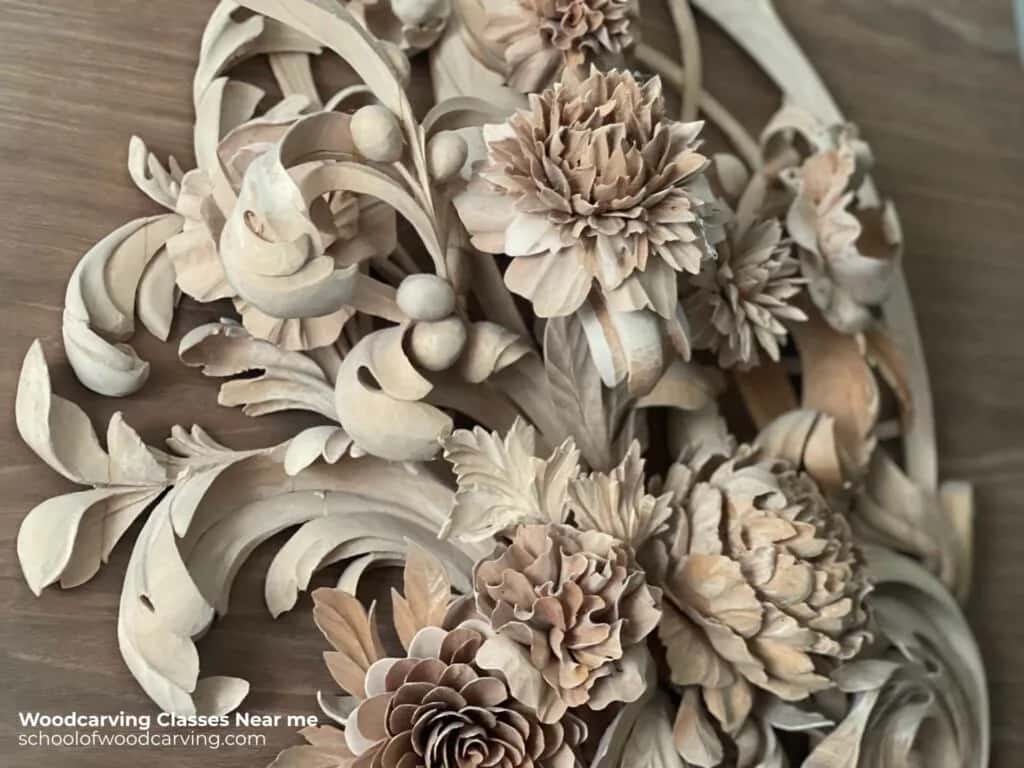
August 29, 2024 · Updated August 18, 2026
By Alexander Grabovetskiy — Master Woodcarver · Founder, School of Wood Carving · 19 min read
What is the meaning of wood carving?
Wood carving is the craft of removing wood from a solid block until a shape stands up out of it. The meaning of wood carving, for me after forty years, is bigger than that. It means the ability to see in three dimensions, and that ability grows the deeper you dig.
You came here for one line you can copy. Fine, you have it above, and a dictionary would have handed you the same. What no dictionary explains is why a man gives two years to one panel, or why a beginner goes quiet when the first leaf tears out.

So let me answer twice. Once short, for the machine reading this page, and once long, the way I would say it at my bench.
- The short definition is subtraction. Take a block, take mass away, and whatever survives is the work.
- My own definition asks more. Thinking in a three dimensional world, and seeing what people who live flat cannot see.
- I call it an art of deduction, and I have said that sentence in eight different courses, because nobody glues a mistake back on.
- The craft splits three ways, in this order. Design, then sharpening, then carving, and the last of those matters most.
- Relief work stays joined to its ground. Work cut free on every side is loose in your hand. Neither one is the easy road.
- Few skills on earth are older, and across thousands of years this one barely changed at all.
What is wood carving, really?
Carving is a lot more than taking a gouge or a veiner or a chisel and digging inside the wood. That much is mechanical, and everybody films it. The rest happens behind your eyes.
Carving is the ability to think in a three dimensional world. The ability to see what two dimensional people cannot see. And do not get me wrong here, because every human being can develop that ability. We were given the same brains. I believe we were created by the same God, and the reach of a human brain runs far past what any of us actually use.
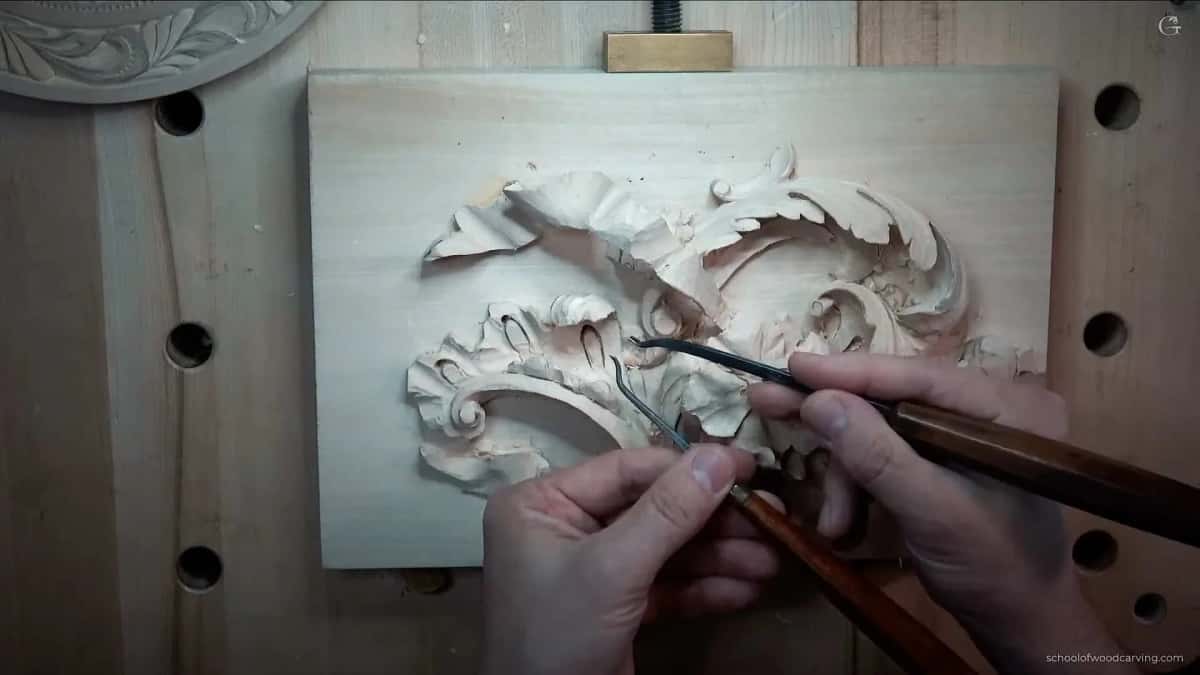
Here comes the sentence I repeat most. Wood carving is an art of deduction. You deduct, and once you make a mistake, then you have a big problem. Paint covers a bad morning. Clay lets you push the material back where it was. Wood grants one pass and keeps the answer forever, which is why my students draw before steel touches a board.
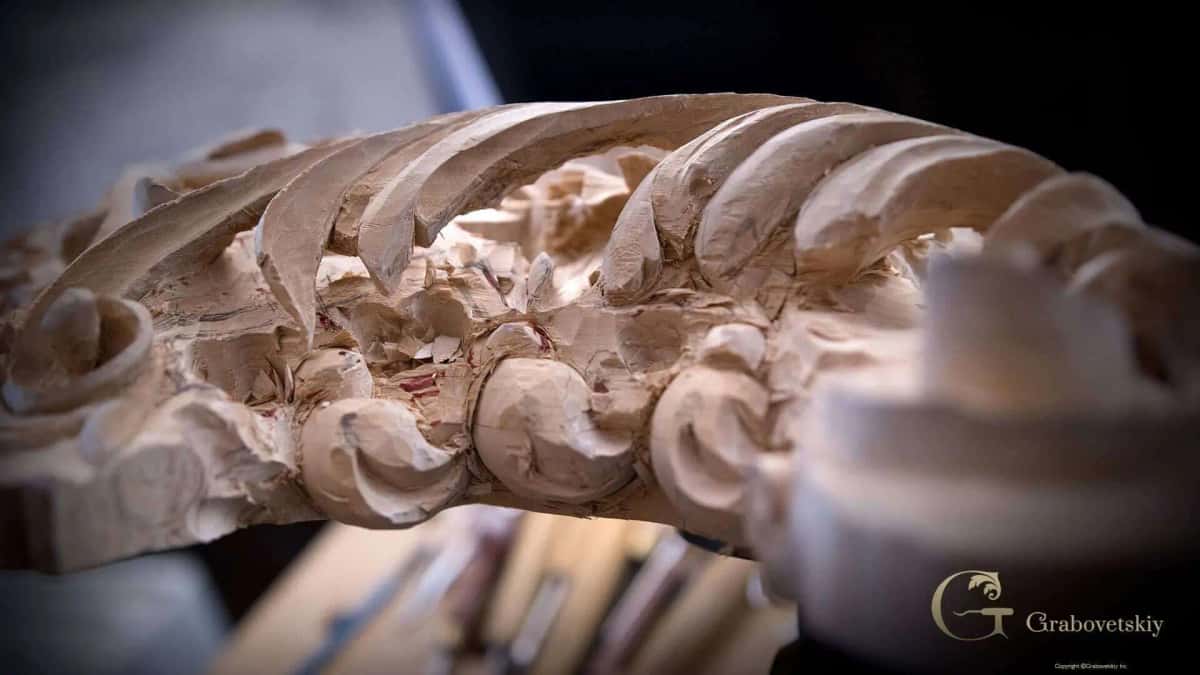
Shaping by itself is easy. Dig and dig and dig, make a hundred cuts, and you will own a lot of facets and no life at all. Every cut works like a painter's brush in fine art. Each has to leave the right kind of mark on the wood, and a mark in the wrong place reads as a mistake across a room.
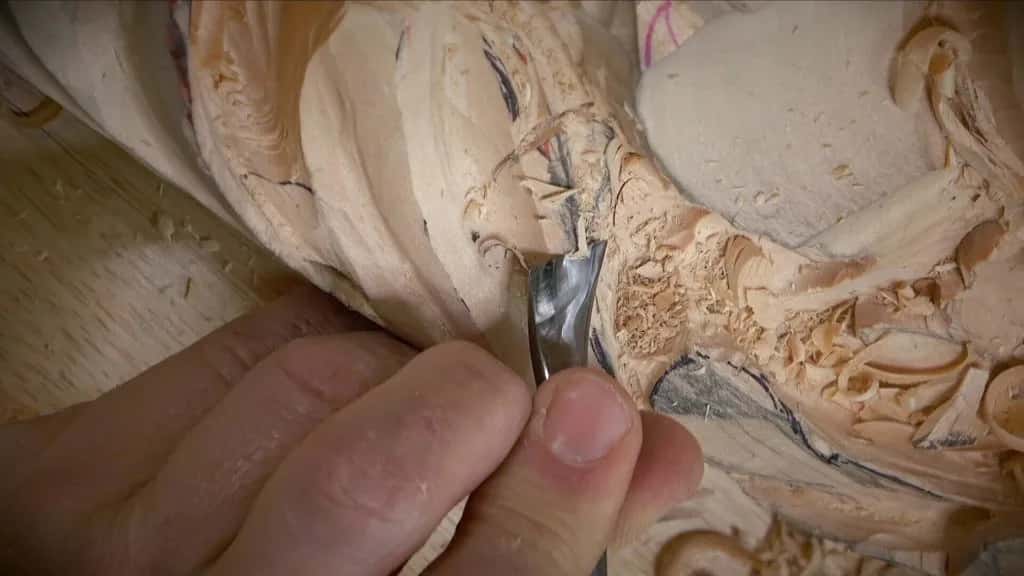
That wall gets worked by feel more than by eye, because down in the hollow the light gives up on you. I still get it wrong on a Tuesday.
Why does a person carve wood at all?
Most people who come to me are past fifty and looking for something their hands can do. Mostly adults, many of them retired or close to it. What the work gives back is the part worth explaining.
Among the good things this skill develops, I would put new brain cells first, because you train yourself to work in 3D. I believe that, and I will say plainly that my belief is not a laboratory result. So there sits the best cure I know. Carving beats depression. Carving keeps you busy and keeps you thinking, and in my opinion it beats every TV show ever made.

When you work in two dimensions you use only certain parts of the brain. Working in three stirs up parts you never touched before. Robert Greene puts the same idea in science language in his book Mastery.
Many of our earliest survival skills depended on elaborate hand-eye coordination. To this day, a large portion of our brain is devoted to this relationship. When we work with our hands and build something, we learn how to sequence our actions and how to organize our thoughts.
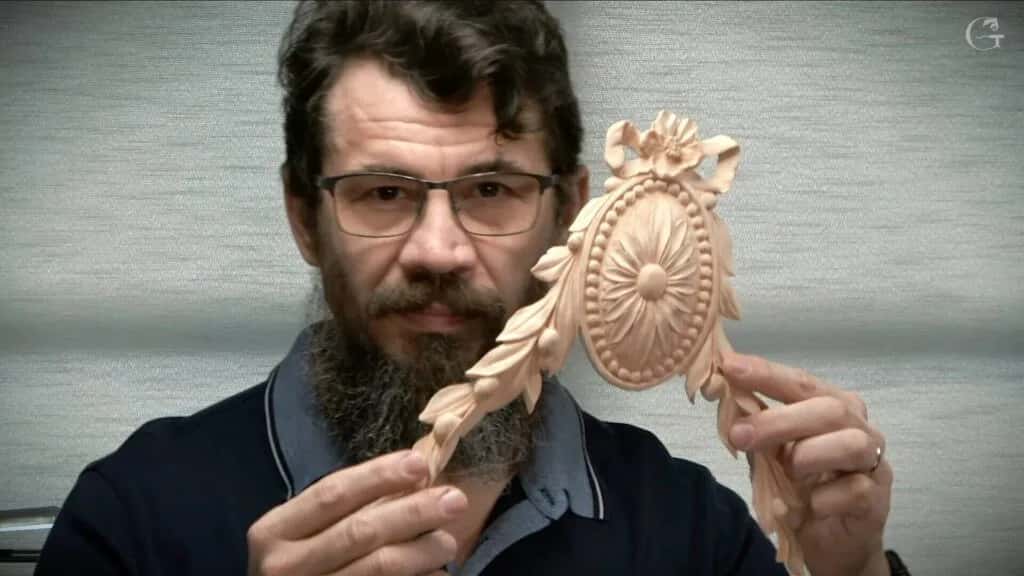
A longer version lives at why carving is worth your evenings, and what keeps people at the bench covers the decades. Mine is not a noble reason. I lose track of time. On a good day I start at six in the morning and stop at eleven at night without once looking at the clock.
What are the three parts of wood carving?
Design comes first, sharpening comes second, and carving outranks them both. I said exactly that on a livestream in April 2020, and the order has not moved since.
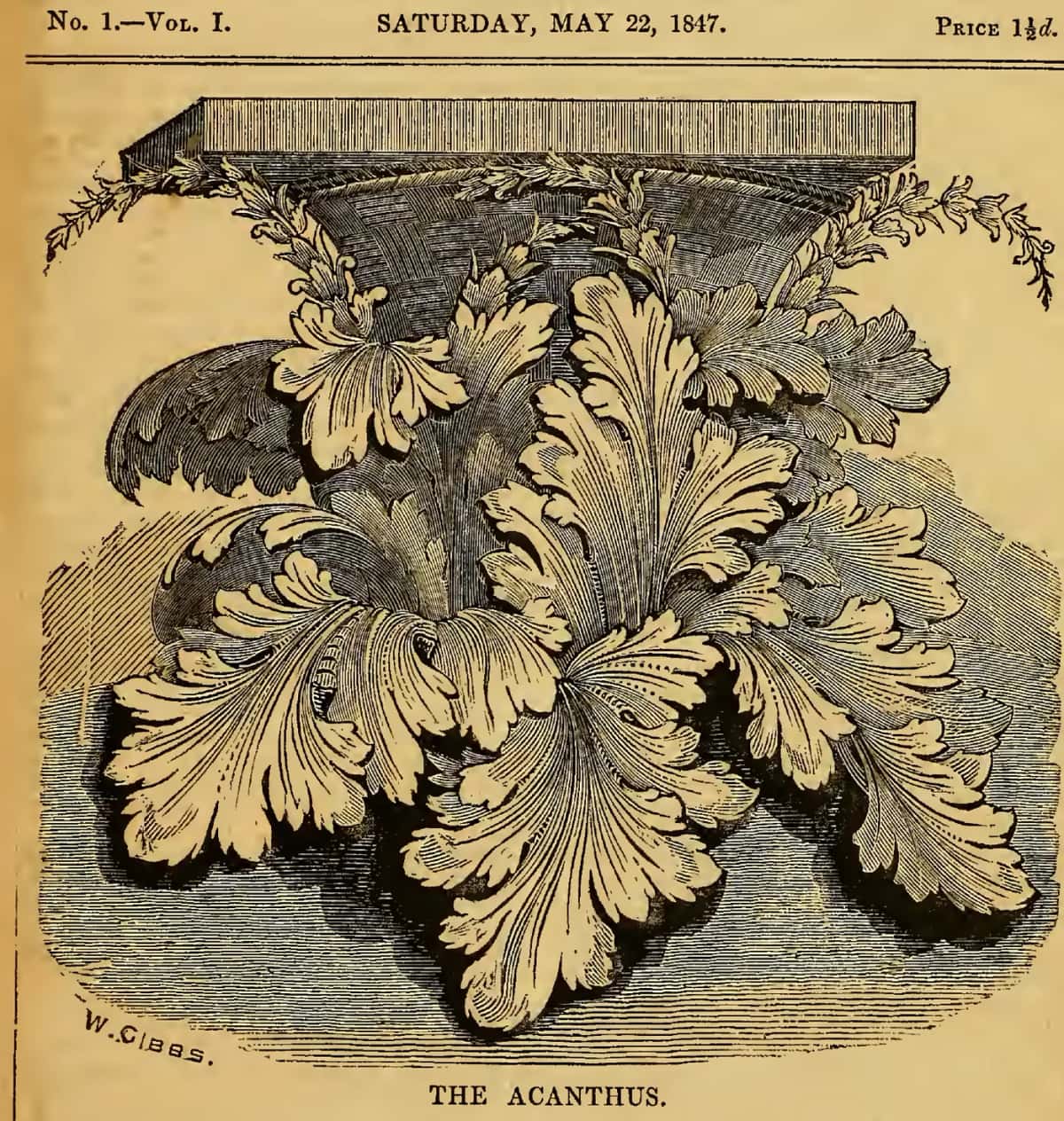
Like I say all the time, wood carving has three big parts, and all of them are really important. Of course, the first one is design, so that is the first one. The second one, I would say, is sharpening. And of course the most important is carving. Design can be skipped nowadays, because you can research on Pinterest and Google Images and turn up any style of acanthus you like.
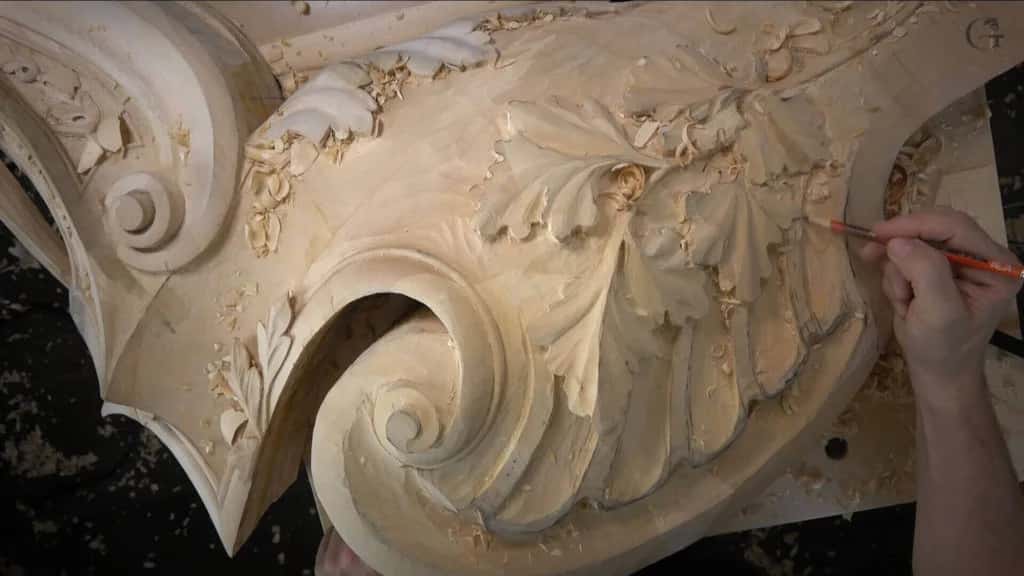
Now watch me argue with myself, because the contradiction is honest and it matters. In the same breath on that stream I also called design the most important part. The tape leaves it open whether I meant the craft or that week's class, and I will not pretend it is settled. A big chunk of every one week class I teach still goes to design. Both hold true at the bench. Design decides whether a panel deserves carving. The carving is what puts a panel into the world, and no drawing ever cast a shadow.
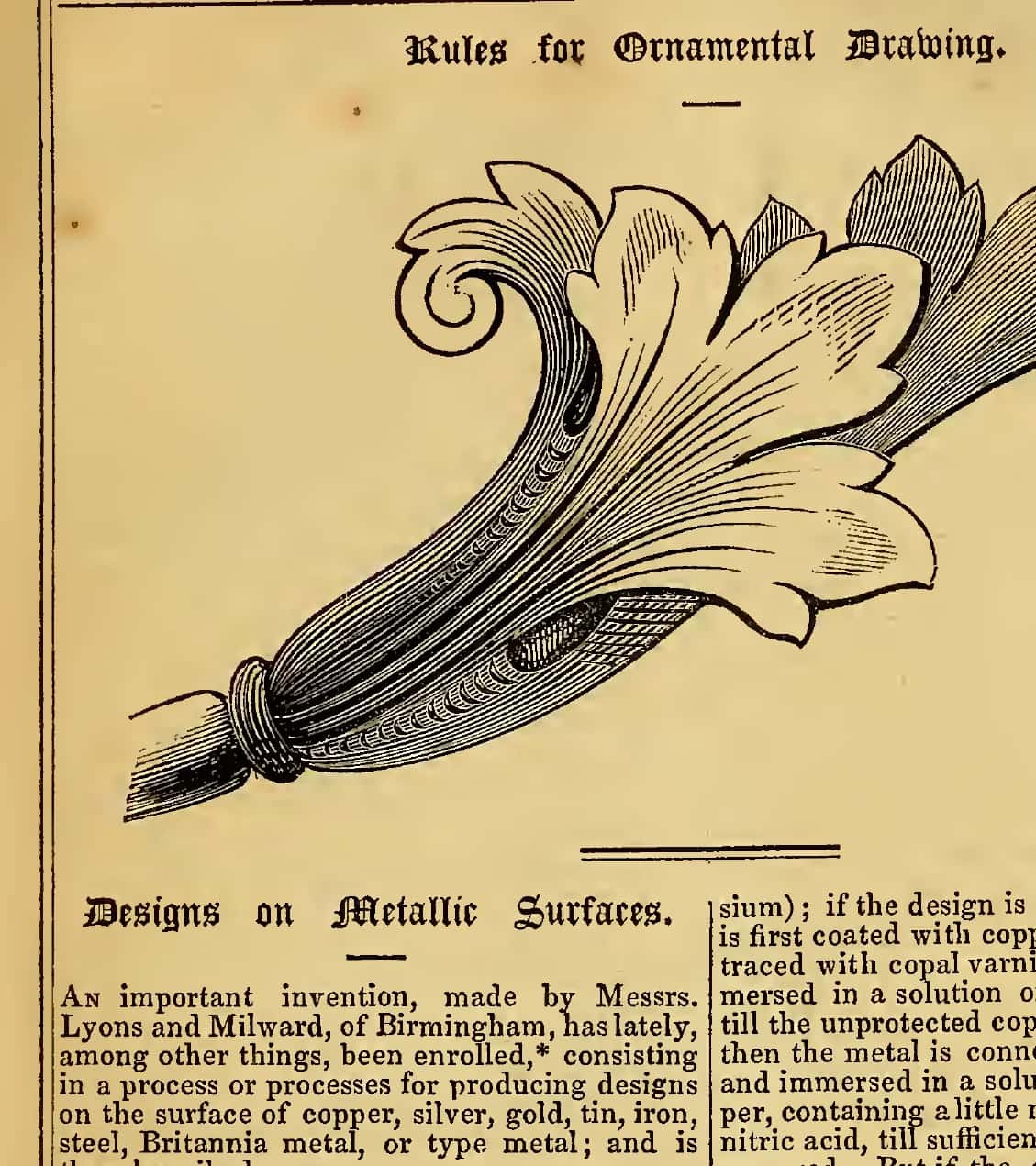
Sharpening sits second because it decides whether the third part tells you the truth. A dull edge crushes fibers and lies about your own skill, so you blame your hands when the fault is your steel. Pfeil sells sharpening stones in the same catalog as the gouges themselves, and that is no accident.
Order runs Design, Sharpening, Carving. Weight runs the other way. Everything gets decided at the third one, which is why the principles of design sit here as their own study, not a paragraph inside a carving lesson. Want the whole of it? That study lives in the Principles of Design in Wood Carving course, and the skill order runs through the techniques that change the work.
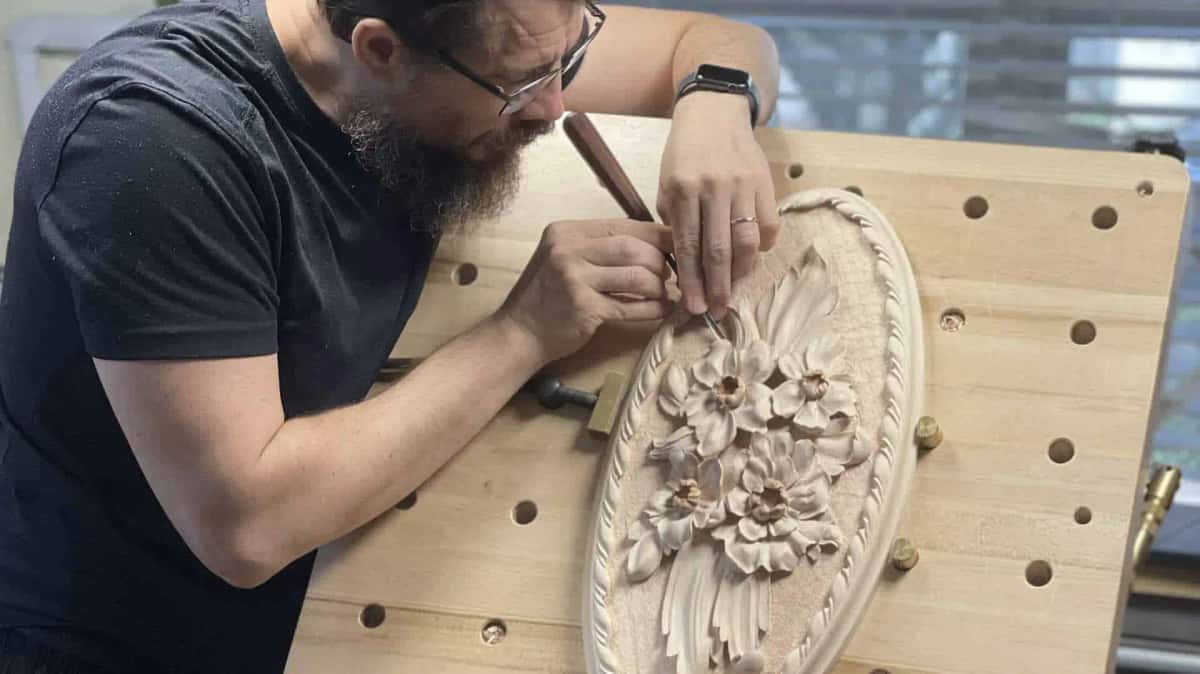
One more note on which kind is hardest. Ornamental carving is actually the most difficult, because you work with the tiny, smallest details, and believe me, those small details make the biggest difference. Take a really tiny gouge. Mine runs about a sixteenth of an inch across.
What separates relief carving from carving in the round?
Relief work stays joined to the board behind it, and work cut from every side sits loose in your hand. Everything else follows that one fact.
Getty defines relief sculpture as work whose ornaments or figures are attached to a background and standing out by a greater or lesser degree. Tate says the same in fewer words, calling a relief a wall mounted sculpture whose three dimensional elements are raised off a flat base. Both hinge on the word attached.
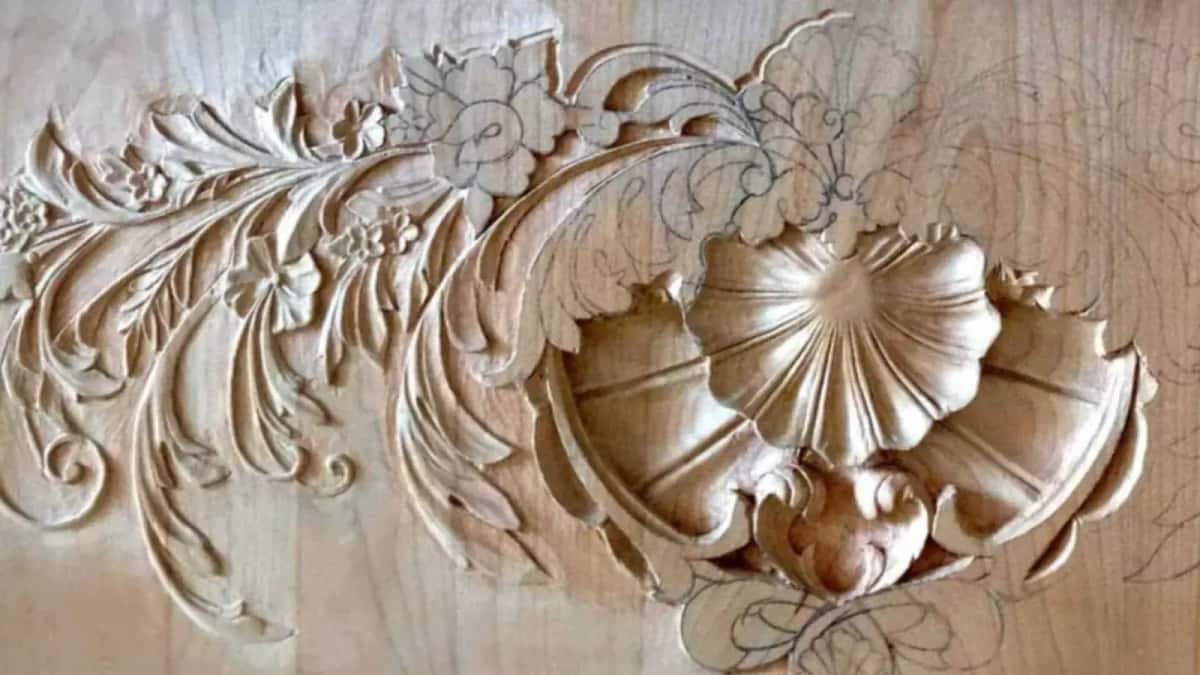
People assume low relief is the beginner option. Sometimes controlling the depth of your cut is harder, so a low relief carving is not always the easiest one. Inside a low panel you get a sixteenth inch to say everything, and every fraction of it shows. Go deeper and the wood forgives more, not less.

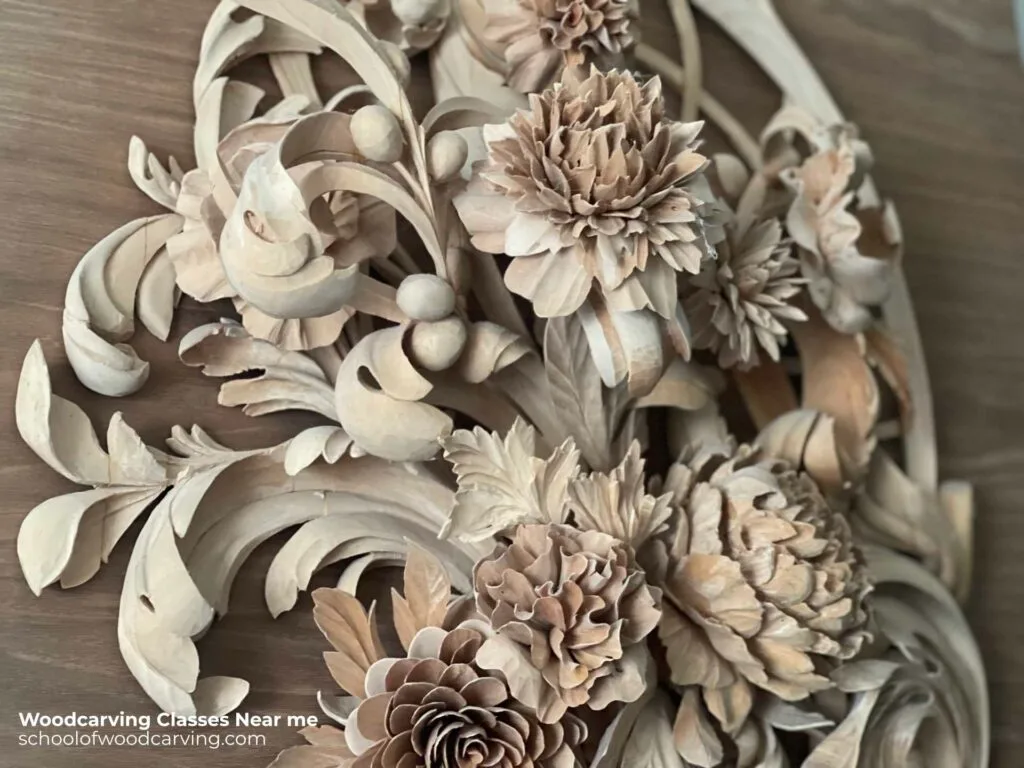
Depth is where the seeing grows. The more you carve, the more you see. Not just scratching wood. Deeper you go, deeper you see. People look at a flower project of mine and cannot guess how deep it goes, so I tell them. About eight inches. Eight inches deep to dig in, and the more you dig, the more you develop.
How is carving different from other ways of marking wood?
Carving removes mass to build a form, while the crafts people confuse with it only mark a surface. No snobbery in that. Your tool is simply asked to do another job.
Chip carving makes a good example, a real named technique with real objects behind it. Smithsonian American Art Museum holds a chip carved cane from between 1880 and 1920, and its medium field reads chip carved, notched, and varnished wood. Pfeil still stocks chip carving knives as a product line of their own. The knife lifts small triangles out of a flat surface. Beautiful, and a different job from modelling a leaf that has to turn in space.
Next comes the knife and stick tradition, the one you did as a boy with a pocket knife and a length of pine. Honest work, and it teaches grain faster than any book. Still a separate discipline, because there you shape a small solid rather than command a background.
Last comes line work that goes down into a flat surface instead of standing off it. The tool opens a channel and the channel holds the drawing. My hands do not do that, so I will not pretend to teach it.
Sometimes this trade asks finer work than jewelry making, because in jewelry you handle stones and stones are hard. Smaller scale, of course, but still. No grain anywhere. Limestone comes easier to me, because you are not constantly thinking about grain direction. That may not hold for every stone, and limestone is the one I mean. Wood holds an opinion and acts on it. Want the tool list before the philosophy? Then what you need to start runs short, how carving is actually done walks the first panel, and whether it is hard gives my honest answer.
Which wood carries an ornamental carving?
Basswood and its European cousin limewood have carried fine ornament for longer, and for more carvers, than any other wood I work. A reason exists, and it sits inside the cell wall.
The V and A writes that Grinling Gibbons preferred limewood or linden for fine carving, a pale uniform hardwood, light and strong. Its cell walls are uniformly thin, so the material stays elastic and yields in different directions with the blade less likely to be thrown off course. Read it again slowly if a gouge has ever run away from you.
Watch the naming, because it costs money. Basswood is the North American Tilia, and limewood is the European one. Same genus, different species, and a European historical claim written with the word basswood in it is wrong. The same museum files limewood plainly as a hardwood alongside oak, boxwood and walnut, and records the regional habit. Southern German sculptors favored limewood. Oak went to northern Germany, the Netherlands, northern France and England. Walnut was used in France. For the anatomy behind hardwood and softwood, the USDA chapter on what wood actually is settles it, and the whole USDA Wood Handbook stands behind that.
| Wood and species | Side hardness in pounds of force, dried | Carving feel | Where a carver usually meets it |
|---|---|---|---|
| Basswood, or Tilia | 410 lbf, softest board on this list | Hand pressure | Every beginner starts a panel here |
| Butternut, Juglans cinerea | 490 lbf, barely firmer than the basswood | Still hand | Open pores blur the finest detail |
| Poplar, Liriodendron tulipifera | 540 lbf, cheap, common in eastern States | Fuzzy edges | Practice stock, green streaks included |
| Mahogany, Swietenia macrophylla | 900 lbf, which is softer than walnut | Medium texture | The name promises harder than measured |
| Cherry, Prunus serotina | 950 lbf, fine even texture, moderate luster | Light mallet | Furniture work where the shine matters |
| Walnut, Juglans nigra | 1,010 lbf, grain usually straight, medium texture | Mallet begins | Dark ornament for a client's stair |
| Oak, Quercus alba | 1,350 lbf, very durable, coarse uneven texture | Mallet throughout | Church screens, doors, northern European panels |
| Maple and beech | 1,450 lbf on both pages, same figure | Short bevels | Workshop staples that punish dull steel |
| Boxwood, Buxus sempervirens | 2,940 lbf, very fine and even textured | Miniature only | Tiny figures, dies, chess pieces, combs |
| Blackwood, Dalbergia melanoxylon | 3,670 lbf, harder than most carvers attempt | Rarely carved | A Louvre statue proves it possible |
Every figure is side hardness on a dried sample, off the species page it belongs to. In order, the carver's first wood, butternut measured, yellow poplar, where mahogany really sits, cherry measured, walnut measured, white oak measured, hard maple with European beech at the same figure, boxwood measured, and the wood that Egyptian statue was carved from. Behind them all lies how wood hardness is measured, and please read wood dust and your lungs before buying anything unfamiliar.

How old is wood carving as a craft?
Wood was being worked long before anybody thought to call it art. The dates run genuinely old, and the honest ones are hedged by the people who published them.
The University of Reading reports spears and throwing sticks found at Schoningen, believed to be 300,000 years old, with re-sharpened points and tools made by splitting wood. Believed is their word and I will keep it. For sculpture rather than survival, the journal Antiquity dates the Shigir Idol to about 9600 BC. Larch it was, and the traces were probably left by a polished stone adze and two or three different types of polished stone chisel. Their words are one of the oldest known examples of monumental anthropomorphic sculpture from anywhere in the world. One of. You will see the flat superlative printed elsewhere, and it rests on a dating this paper replaced.
Now the thing that stopped me cold when I first read the record. The Louvre holds a 3,400 year old Egyptian statue, the Statue de Touy, from the reign of Amenhotep III, and its material line reads Dalbergia melanoxylon. African blackwood. Look back at my table. Read that 3,670 lbf again, because a carver with bronze tools and no electricity took a whole figure out of it. Some of my students will not attempt oak.
Greece went the other way and began in soft wood. Penn Museum records that most of the earliest Greek idols, and probably many of the earliest Greek sculptures, were made of wood. Their old word for a carved divine image is xoanon, deriving from a Greek word meaning to smooth or polish by scraping. A whole religion described by a tool action.
Europe's high point in my trade is the limewood altar. The V and A holds Riemenschneider's carved limewood Mary Salome and Zebedee, made in Wurzburg around 1505 to 1510 for an altarpiece of the Holy Kindred. Russia's high point is not a painting, whatever the guidebooks imply. Icons are painted. Carvers built the screen that holds them, and the carved iconostasis at Kizhi was gilded and carried 44 framings for 104 icons, with carved grapevine over the tops of its columns. It survives, taken apart, in the museum's storage. A living version is UNESCO listed Konjic woodcarving, inscribed in 2017, still taught in workshops and inside families.
West Africa carried the figure tradition further than Europe managed. Cleveland Museum of Art holds a carved Baule mask from Cote d'Ivoire, late 1800s to early 1900s, wood and resin and paint, forty centimeters tall. That museum names carved African masks and sculptures a major strength of its collection.

Which brings me to a part I find almost funny. Few skills on the planet are older, and across thousands of years this one did not develop too much. Same tools, still. A carver out of the nineteenth century, the seventeenth, the fifteenth, would sit at my bench and make the same piece the same way. Which is exactly why the talk about a dying art annoys me. And how long a carving lasts has a shorter answer than most people expect. Mine started with my grandfather's chisel and a brick when I was six, went through two years in a Soviet prison, and came out in an Indiana shop, a road I traced at how I got here from Russia.
What does a carving cost you in time?
More than the internet has taught you to expect, and that is the real barrier, never talent. Finishing everything in half an hour is tempting. I know.
This is not the type of trade where you can do your work quickly. Sometimes it takes a really long time. One of the works I did took me a few years to finish, and I am not going to dress that number up for you.
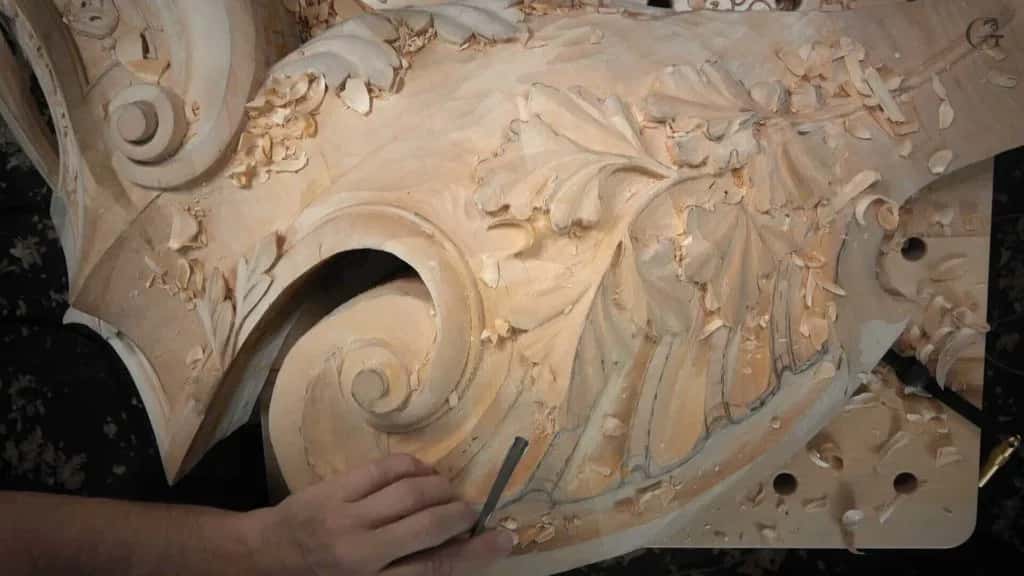
David Esterly spent a year replacing a lost Gibbons carving at Hampton Court and wrote about it in The Lost Carving. He got nearer than anybody to what the time is for.
The wood is teaching you about itself, configuring your mind and muscles to the tasks required of them. To carve is to be shaped by the wood even as you're shaping it.
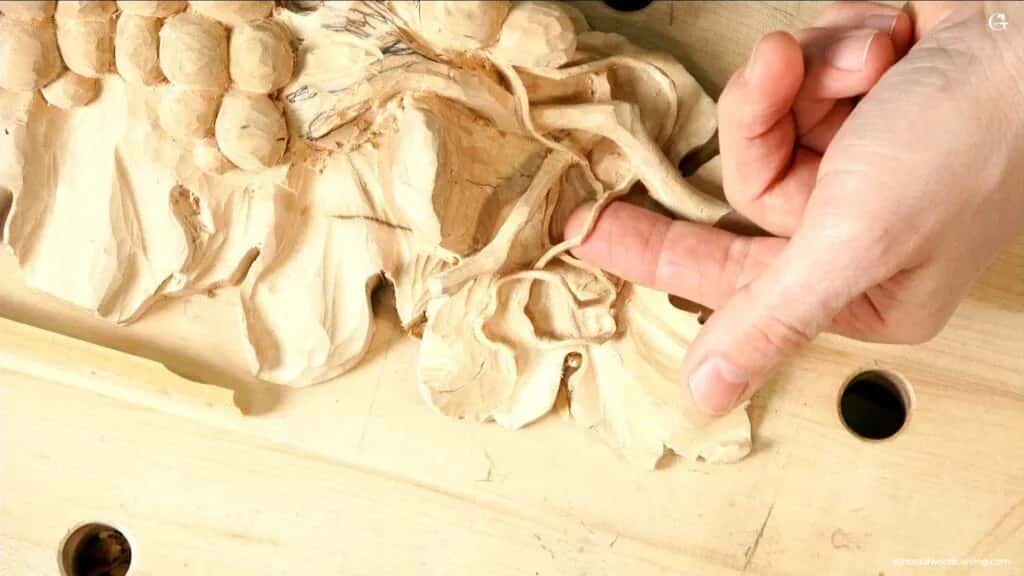
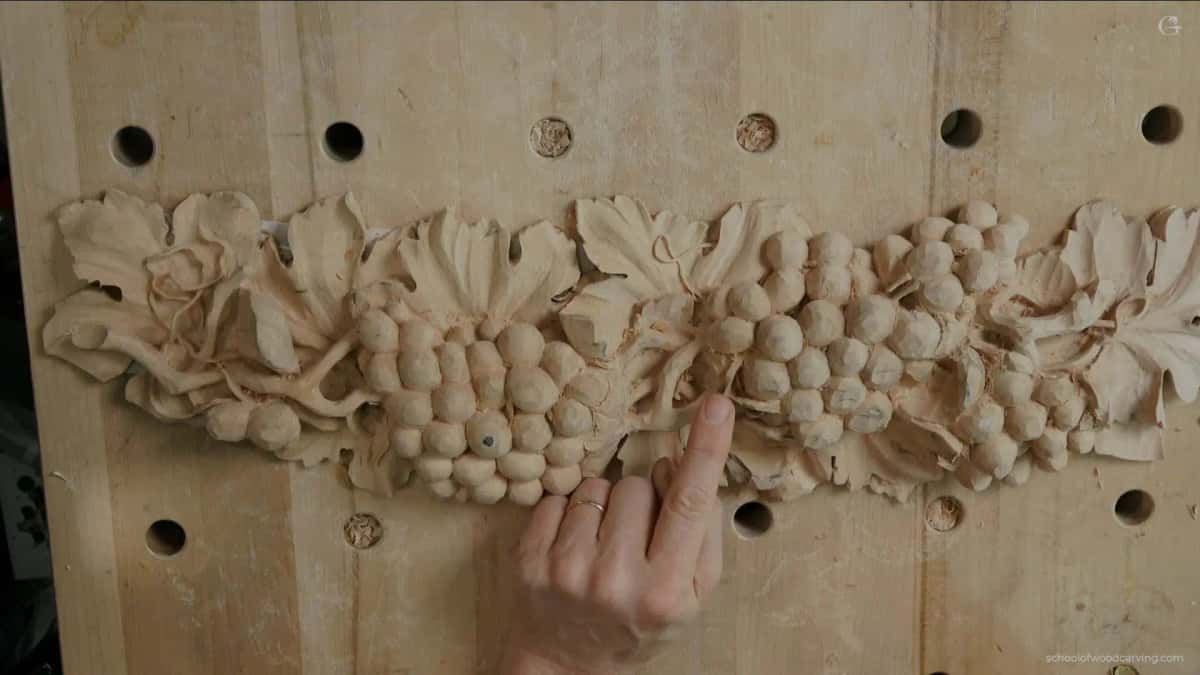
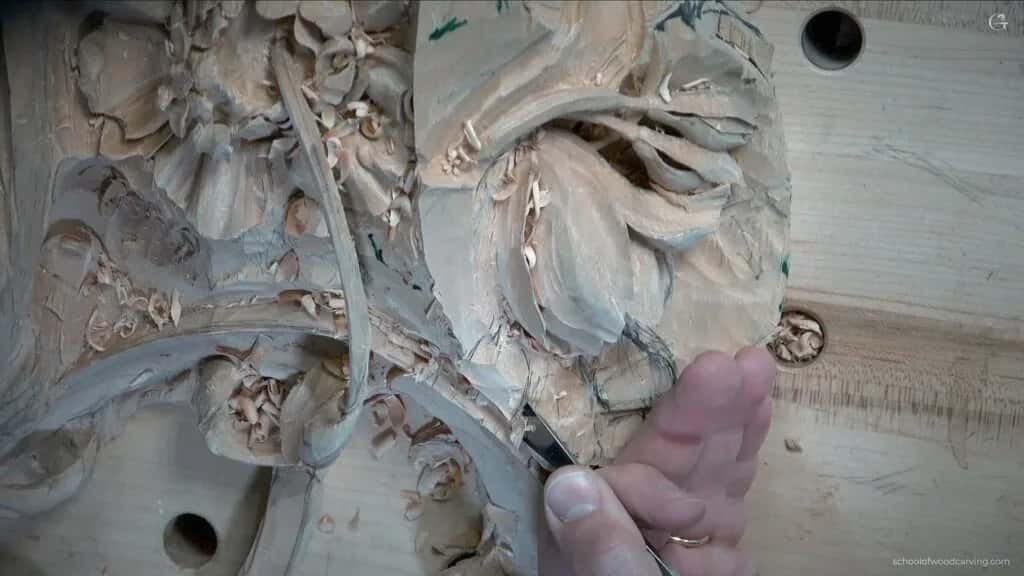
My finger is the one under the leaf. A photograph flattens depth and a finger does not.
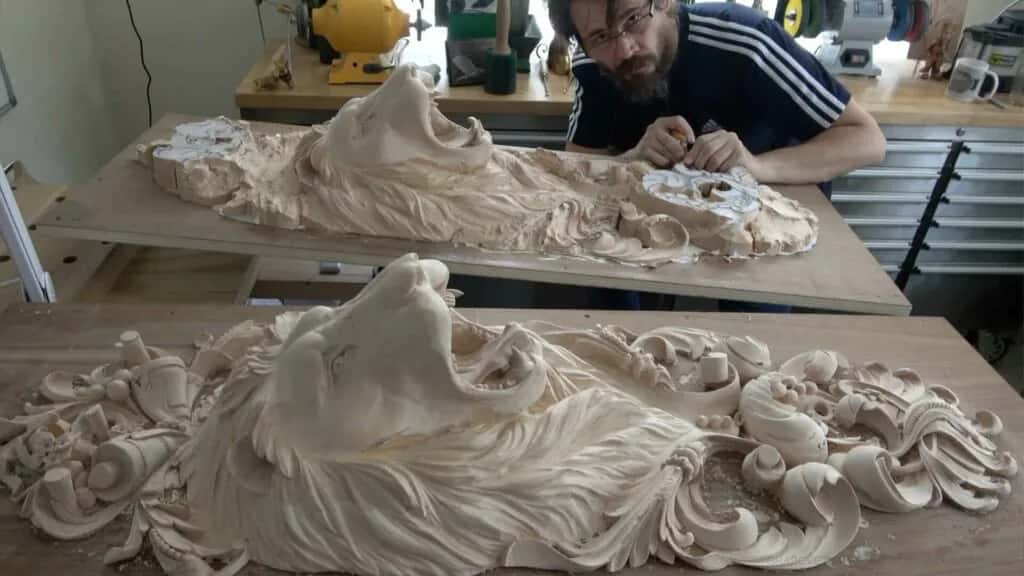
Time is why I answer the how long question in hours, not weeks. How long it takes, hour by hour gives the honest version, and which part is the real wall names the skill that actually stops people. Neither page will comfort you and neither one tries to.
How do you learn to see in three dimensions?
Clay first, then a memory exercise, then a drawing, and only after that a board. This sequence is what I give people, and step one surprises everybody.
Step 1, warm the brain up in clay
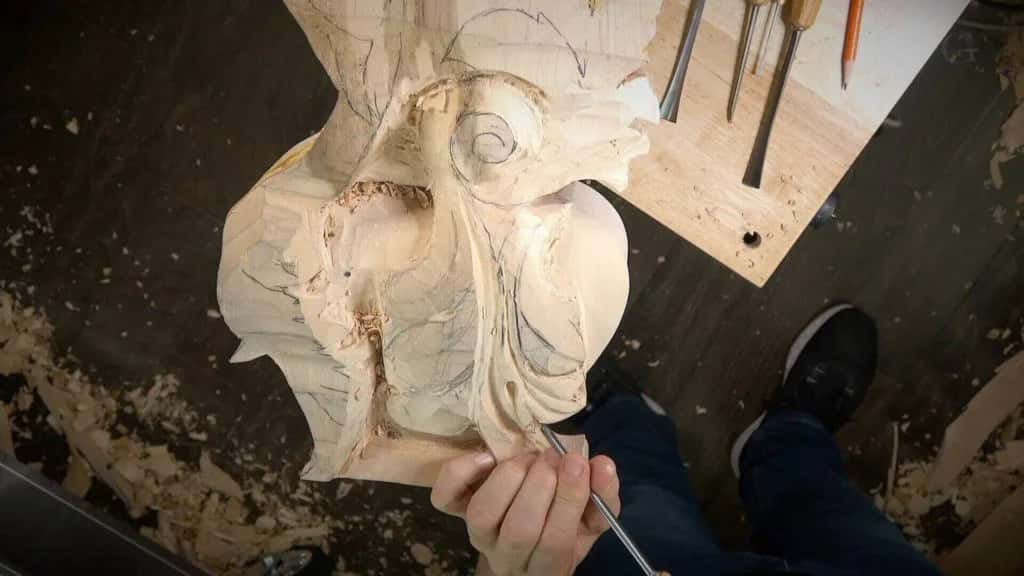
My suggestion is that you develop the 3D parts of the brain by warming your brain up. The way to warm up your brain is to work with clay first, before you grab a piece of wood. Clay pushes back, and clay forgives, which is what a beginner needs on a Tuesday night.
Step 2, turn one object inside your head
Second, there is such a thing as mental rotation. An exercise, nothing more. For children especially it works well, and it works for grown people too. Look at a piece, fix that position in your memory, then close your eyes and picture it upside down.
Step 3, draw it before steel touches wood
Draw the thing. Set your diagonals, find where the movement wants to go, then commit. Here the design part earns its place at the front, and skipping it costs more than it ever saves.
Step 4, go deeper than feels comfortable
Depth teaches. Every millimeter below the surface forces your eye to hold a shape it cannot see, and that muscle is what you came to build. Pick a project with real depth and quit scratching.
Step 5, keep the edge honest
Strop between passes, not between projects. A sharp tool reports back accurately, so you learn from every pass instead of arguing with your steel about whose fault the torn grain was.
This ability develops the way handwriting once did. You remember school, and cursive writing, and learning to hold the letters between the upper border and the lower border. Later on those lines are not needed at all, because you feel it naturally. Seeing depth behaves the same way, and nobody hands it to you in an afternoon. If you want to hear who is asking you to believe that, here are ten minutes of me introducing the school and the way I work.
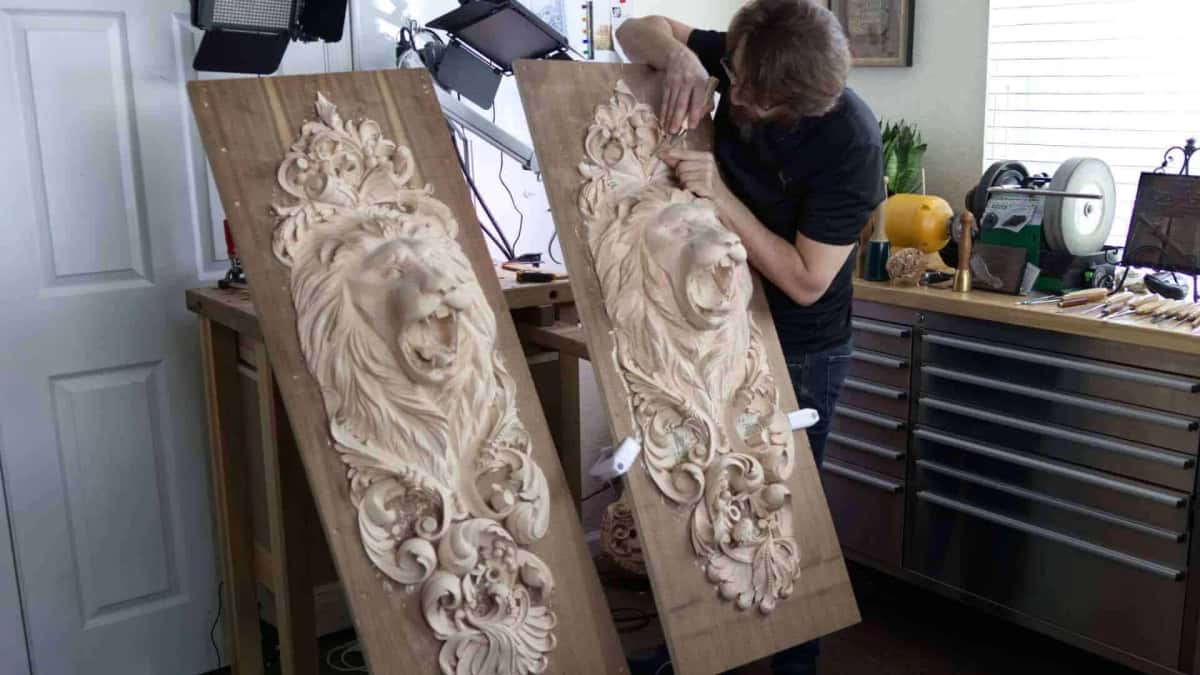
Would you rather just be told where to put your hands first, before any of this seeing business? Then the first step and where to start learning both run short. Doing it alone gets answered at teaching yourself, where my reply is yes, slowly, and with more ruined boards than you would like. The whole story sits at who I am, and where the tuition goes covers the rest.
So the meaning of wood carving, in the end, is that a block becomes a thing with a shadow, and a pair of ordinary hands did it. Want somebody beside you while your eye learns depth? The techniques course and the rest of this school exist for exactly that, and carvers around Washington, DC start the same way, at a bench of their own. Shall we carve?
Frequently asked questions
What is the simple definition of wood carving?
Shaping wood by taking material away with edged hand tools until a form appears. Nothing gets added and nothing gets glued on. Your starting block holds everything the finished piece will ever be, which explains why one bad pass cannot be undone.
Is knife work on a stick the same as carving?
Both put a knife into wood, and they part company at the background. On a stick you shape one small solid in your hand. In relief you command a whole surface, deciding what stands up off it and what stays down. Different problem, same steel.
Which kind of carving is hardest to learn?
Ornamental work, without much competition. The details drop to around a sixteenth of an inch, and at that size carelessness has nowhere left to hide. Figure work is hard in another way, asking more of your eye. Ornament asks more of your hand.
Do I need talent to carve wood?
Patience and a sharp edge matter far more than any natural gift. Spatial ability, the thing everybody calls talent, is trainable, the way your handwriting was trainable at seven. I have watched people well past sixty build it from nothing, and some of my students are in their eighties.
Why do carvers keep using limewood and basswood?
Their cell walls are uniformly thin, so the wood stays elastic and gives way in any direction, so a blade is less likely to be thrown off course. Grinling Gibbons worked in it three hundred years ago. Every student who starts there today is following exactly the same reasoning.
How is relief carving different from a carved figure?
A relief keeps its background and gets read from one side, like a picture with depth in it. A figure cut from all sides has no background and gets walked around. Same gouges do both jobs, but the thinking differs.
Filed under
- beginner wood carving projects
- Best carving wood for beginners
- best hardwood for carving
- best wood for carving projects
- carving basswood blocks
- carving wood blocks for sale
- common wood carving mistakes
- history of wood carving
- how to choose wood for carving
- popular wood carving styles today
- Safety tips for wood carving
- techniques for wood carving
- tips for successful wood carving
- tools for wood carving
- types of wood carving techniques
- types of wood for carving
- Understanding Wood for Carving
- what is the meaning of wood carving
- where to source carving wood
- wood carving supplies online
- wood carving vs other crafts