
Alexander Grabovetskiy, woodcarver, School of Woodcarving · Published 2022
What does a wood carver mean by a "nice shape"?
Quick answer: In Venice Room 162, video 3, I said I had a nice shape. Number two was the tool I planned to roll that part with. My other lessons put the words beside a number 11, a number seven, a rasp and the edge of a leaf.
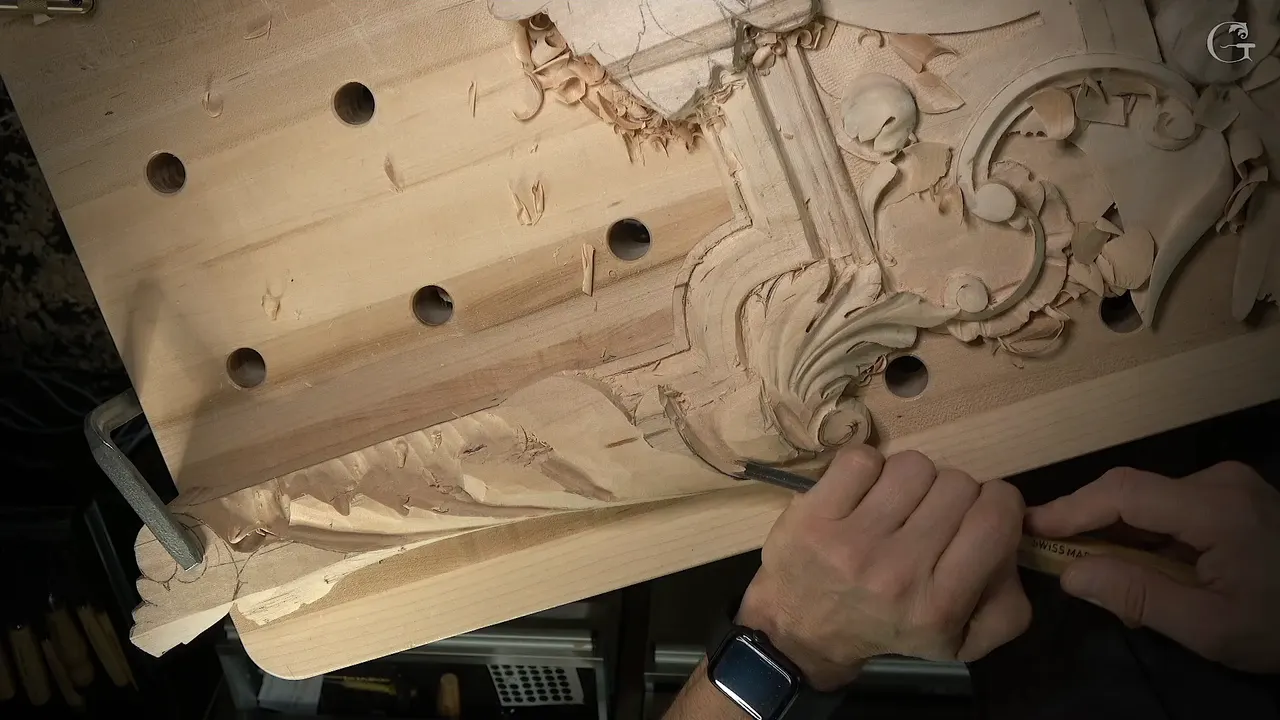

In the third video of Venice Room 162 I said "And I've got a really, really nice shape, which is wrapping all around," a line that comes after I told you I would slightly roll a part with a number two. The words nice shape come back in my other Venice Room lessons, and in Hashemi, Furniture Panel, Floral and the Lily Box, each time about a spot on the carving.
Ever pushed a gouge along a curl and then stopped to look at what was left? Did the part look round, or flat? Below is what I said around the words, first in lesson 162 and then in my other courses.
What came before the words in lesson 162?
The video opens with a plan: "And by the way, I can roll a little bit this part also." Next, "take again five millimeters" (0.2 in), and after that "And again, number two. I'm going to slightly roll it that way."

I kept going with "And here, I also going to roll a little bit" and ended on "Okay, wonderful," "I am happy" and "Happy with overall movement."
The volute came next: "So let me clean little bit this part of the volute." One more line: "Got to be careful, by the way, how I approach the edge of it."

What came next in lesson 162?
"So now let me get the pipes in place, and as you remember, that's the same operation." The first pipe came with a plan, "Make it really wide like this" and I called it "my concave cut number one." Of its path I said "And yes, I will go all the way underneath of this volute. You don't see that side, but it's okay."
Of the second concave I said "Also has to be really flowing and go to the same line pretty much right underneath." That pipe was "a little smaller" and after it would come "another movement, another pipe." About the first pipe: "this is the main one, so that is going to be the biggest show."

Then the tool. "Let me actually get bigger tool, I'll take maybe 16 millimeters or 15 millimeters, number 11, it's about 5/8 of an inch." In inches that is 0.63 and 0.59.
After "And I'll start concaving" came "From almost nothing, closer to the volute I get, and I get little deeper, deeper, deeper, deeper, even more deeper."

What was the goal of that pipe?
I stated it in these words: "And my goal is, as you remember, we are doing this part little raised, so which means it has to go like this." Next: "So I'm not sure if you understand that. So which means this part needs to be much deeper, and less once we pass this point."
The blend was a plan, too: I would "just blend that pretty much right away." As for the pipe, "I can probably just shave the side of that pipe also right away and make that part go right underneath."

One more explanation came: "Let me explain one more time. So my eye, the eye of acanthus, is right there." I wanted my future separation "going upward, just uphill underneath" and "so that way" there would be "a lot less for me to undercut this area."

The end of the video turns to history. "Romans, Roman Empire, they pretty much adapted the idea of acanthus leaf from Greek Empire, or Greek culture, I should say, not empire." "Byzantine Empire, they used acanthus leaves in churches." After it came gold: "They started to actually make carving more beautiful by applying gold on it." Wikipedia has plain pages on the Byzantine Empire, the Roman Empire and gilding.

Where else did the words come up in the Venice Room?
A deep part comes up in Venice Room 28, video 9: "it is so deep now, it's almost impossible to excavate." I also said "nice shadow" and then I turned to a nice shape for "this detail." My tool came with a reason, "because it fits the profile" and a size: "Straight number 11, maybe one millimeter" (0.04 in).

One gouge shows up in Venice Room 33, video 12: "I'm using number 11 and 10 millimeters just to give some" and then "nice shape, nice movement" (about 3/8 in). Before it I said "I don't want to use a big one. I mean, big tool." Later came "And yes, I could go much deeper right there, and I think I should probably. It's going to give me a really nice, interesting detail."
There is an undercut in Venice Room 35, video 8: "I can use just the back bend for undercutting and continue my movement inward." The next line puts the same nice shape on "the leaf which is underneath." "I think that is really nice," I said, and of the divisions "real nice divisions, not too small, but not too big also."

The words get explained in Venice Room 36, video 12: "so that surface is too flat and I need to give" the shape "to overall movement." Then came "Which is what I mean by that I need to give exactly the same idea. Convex, concave, and maybe concave on that side, but I don't have too much space on that side."
An edge starts Venice Room 37, video 1: "I'm talking about this edge, so got to be raised" and then "just much better if it's raised." I planned "a little better convex right here." Another spot got the same words: "And this one also, we can give" it the shape.

In Venice Room 39, video 8, there is "Number five upside down," a tool that "Could give" a nice shape "right away pretty much with this tool." Edge next: "I'm talking about this edge." Then "Take number 11 and 5 millimeters again and clean that" (about 3/16 in).

Venice Room 10, from Part 1 of the course, has "Again, let me create" and, after the shape, "It has to go more convex right here, so I need to actually create a lot deeper cut on this side." Then "Okay, here's a 20 millimeters, number nine" (0.79 in). A little later: "I probably could use a big number seven, let me see if I'll be able to or not."

A cut went wrong in Venice Room 15, video 11. I had "little separation going on right here" and I said "I want to make sure it also has a nice shape." Then: "That is not good. What just happened, that's not good." "See, that is exactly what I was afraid of," I said, and "When I'm just using the tool and pushing down, I'm creating too much stress to wood." And "I don't want to glue anything, but I can make it look like it's supposed to be that way."

The eye is in Venice Room 81, video 12. Of the eye I said "let me create the nicer shape of this eye with the number 11." The sizes: "And I used seven millimeters, but I'm going to switch to three millimeters" (0.28 in and 0.12 in). "Use that cut upside down," I said, and "create a really nice, beautiful cut." It creates a nice shape, "like an eye drop."

To clean it: "And with the two millimeters or a millimeter and a half, number 11, I can always clean" (0.08 in and 0.06 in). The shadow would be "a beautiful shadow, beautiful shadow, but it's still strong." "I'm really happy about this eye," I said too.
What about Hashemi, Furniture Panel and Floral?
Hashemi Flowers 36, video 1, has a V tool and a leaf. "Same V tool, number 16, but I have to keep an eye how deep I can go. Can't go too deep." About the leaf, "And that's actually" a nice shape, then "I kind of like the idea that leaf is actually sticking upward, so I just have to make it smoother."

I added "I can undercut" and "make the really beautiful shadow line. I have a lot of thickness right here, so I'm able to." Later: "Number four and 10 millimeters" (0.39 in).
Furniture Panel 19, video 14, has a step cut. "More like on 45 degrees, I would say, make a step carving, step cut, I should say, because I'm stepping in." Next: "Okay, now it's the time to fix that leaf, the edge of the leaf." Then "I can give" the shape.

After that came "I'm not going to be able to undercut too much underneath of this detail" and "I'll try to do some of it." The tool I planned was "a 1/16 of an inch" (1.6 mm).
Floral and Molding for the Panel 9, video 2, has a volute. "As you see, when you look at that piece, on that volute, it doesn't look like I have a nice shape, so I have to make it really flowing." Next, "And I can fix overall movement."

My tool plan came next: "Let me get the number seven. And I'll get the same number seven with what I used previously, 14 millimeters" (0.55 in). With it, "Although I have to be careful in this corner."
And in the Lily Box?
"It was fragile, but now it's even more fragile" comes before the words in Lily Box 9, video 1. Then: "All right, let me give a nice shape to overall movement, use maybe a big tool, let's see how my wood is going to behave."

Then came a number seven and a warning: "I'm using number seven at three-quarter of an inch, oh, no, it's catching, it's a little too dangerous" (Three-quarter of an inch is 19 mm.) Next, "Well, let me use number three and 14 millimeters, half an inch" (14 mm is 0.55 in).
The third video of that lesson has the same nice shape and goes on "I'll use number seven. That's six millimeters. One quarter inch. I'll just go around and just give a much better shape to this division." Six millimeters is 0.24 in.
Spiral cuts come up in Lily Box 12, video 3. "And if I need to create more spiral cuts, I will." Then "And maybe I should because I really want to give" and nice shape came with it. "It looks like I'm missing one. I really need to create extra movement right here." A tool followed: "I should use a number five, let me see, I use a number five." The spiral has a Wikipedia page.
A stem is broken in Lily Box 13, video 2. "Because right now the stem is broken and I don't have a really good connecting point. So that's why I got to do it that way." Next came "Okay, let's give it a" nice shape, "oh, I probably should use my rasp, my new rasp" and "I think it's a good idea, and give it one more roundness." There is a Wikipedia page on the rasp, too.
Where did I say nice shape?
The table keeps one row for each video, with what the words sat beside and a detail from it.
| Where I said it | What the shape sat beside in my lesson | Detail |
|---|---|---|
| Third video, lesson 162 | Rolling a part slightly, then a shape I was happy with | Slight roll |
| Room 28 of Venice, video 9 | A deep spot, then a shape for the next detail | Number eleven |
| Workshop 33 of Venice, video 12 | One gouge for a shape and for movement | Ten millimeters |
| Lesson 35 of Venice, video 8 | The leaf which is underneath, after an undercut | Real divisions |
| Venice Room 36, video 12 | A surface too flat, so convex and concave were the idea | Center line |
| Room 37 of Venice, video 1 | An edge that has to be raised, and a better convex | Better convex |
| Workshop 39 of Venice, video 8 | Held upside down, then a plan to clean that edge | Number five |
| Lesson 10 of Venice, video 9 | More convex, so a lot deeper cut on this side | Twenty millimeters |
| Part 2, lesson 15, video 11 | A small separation, then a line about what just happened | Not good |
| Part 7, workshop 81, video 12 | The nicer shape of an eye, with a small gouge | Three millimeters |
| Hashemi Flowers 36, video 1 | A leaf sticking upward, then a plan to undercut the flower | V tool |
| Furniture Panel 19, video 14 | The edge of a leaf, after a step cut | Sixteenth inch |
| Floral and Molding 9, video 2 | A volute that did not look like it had one | Number seven |
| Lily lesson 9, video 1 | Overall movement, after a spot that was fragile | Number three |
| Video 3 of Lily Box 9 | A division, and a much better shape for it | Number seven |
| Lily Box 12, video 3 | Extra movement, after more spiral cuts I might need | Number five |
| Video 2 of Lily Box 13 | A broken stem, then a rasp that I named for it | New rasp |
Which spot of your carving needs a nice shape first? Every lesson named here opens with access to the school, paid monthly or yearly and renewed automatically until you stop it. The Part 14 course page holds lesson 162, with lesson 161 before it and lesson 163 after it. Plain pages on wood carving, the chisel, relief, wood grain and the shape sit on Wikipedia.
How it's done
- Roll the part. In lesson 162 I planned a slight roll of the part, using a number two.
- Look at the movement. I said I was happy with overall movement, and next I planned to clean a little of the volute.
- Check the surface. In Room 36 I called a surface too flat, and the shape for it came next.
- Name the curves. For that flat surface I named convex, then concave, with maybe one more.
- Pick a smaller tool. In Room 81 I said I used seven millimeters and was going to switch to three millimeters, in the lesson about the eye.
- Reach for the rasp. For the broken stem I named my new rasp, in the Lily Box lesson on olives.
Frequently asked questions
Which tool was in my hand when I said the words in lesson 162?
Number two, with 5 millimeters named earlier in the video (0.2 in). The pipes got a number 11 in my plan, at 16 millimeters or 15 (about 5/8 in).
What did I say about a surface that was too flat?
The surface was too flat, I said, and the plan was exactly the same idea: convex, concave, and maybe concave, though I did not have too much space.
What happened to the separation in Venice Room 15?
Pushing down with the tool, I said, was creating too much stress to wood. I did not want to glue anything, but I could make it look like it was supposed to be that way.
What to carve next