

Alexander Grabovetskiy, woodcarver, School of Woodcarving · Published 2020
What does underdo mean in wood carving?
Quick answer: Underdoing is my word for stopping a piece short of what it could take. In part 11 of workshop 27 I said I could excavate a little more, with a worry about too weak a movement and a second worry, underdoing it, because I think it gives extra definition, extra depth.
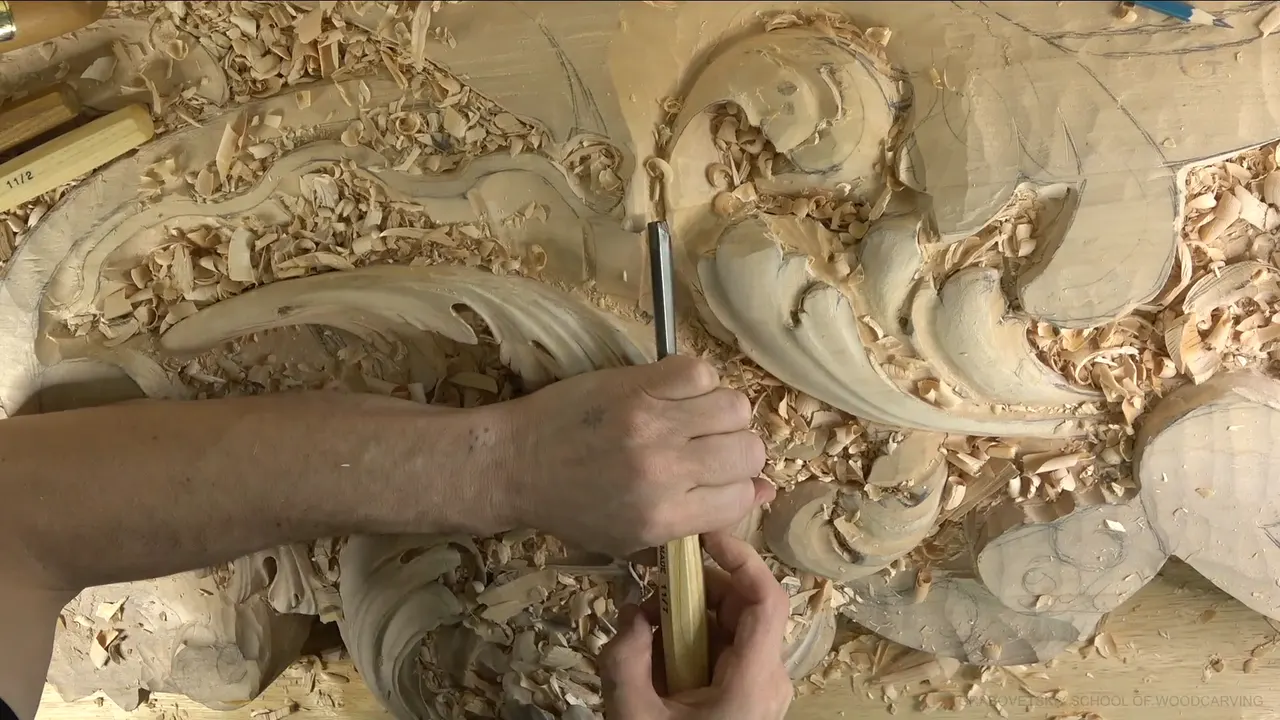

Underdoing is my word for stopping a piece short of what it could take. Part 11 of workshop 27 has it. The lessons below carry the same worry, and this page lines them up beside it.
Ever eased off a gouge in wood carving because one more pass might thin the wall, then wondered if you quit too soon? You know both sides of this word. The first stop is part 11. After it come lessons where I said the same thing about drawing, veiners, leaves and color.
What did I mean by underdo in workshop 27, part 11?
It opens on a warning to myself: "Got to be careful. See, I'm raising that." A line about tools follows. "Sometimes it's much wiser" to use smaller tools, I say, "not always." I name a number 11, seven millimeters (0.28 in).
What I'm after, I say, is that "it's supposed to feel like it's a gradual movement." A plan follows: "Let me use number seven."

At 3:09 I look at the work. "Doesn't look too bad, but I want to create even more concaveness on inside." My reason is short: "It's going to give me a much better feel." At 3:52 it's "really deep and nice." By 4:26 I'm "still not too happy what happened right here," yet "that is okay," and I tell you I just created a weak spot, then say "chop this out, but it's okay. I'll just fix it like that."
The line this page turns on starts at 5:29. Here is what I could do: "in this area right there, I could excavate a little more to create more like a flipping motion." Now comes the brake. "Again, I have to be careful because I don't want to create too weak movement. But I also don't want to underdo it, because I think it just gives extra definition, extra depth."

Two worries sit in one breath, one on each side. A weak movement is the first, and stopping short is the second. I name both and pick no winner, and the only plan I voice is more excavating.
A tool comes next. I wonder about a number nine, then settle it: "yes, number nine will do." The size gets fixed on camera. I say "maybe about half an inch" (12.7 mm), then correct myself: "Well, this is 5/8. I'm sorry, it's not half an inch." Five eighths of an inch is about 16 mm (0.63 in), a little more than the number I first said. The words that follow are "give really nice flipping movement, just like that." A few lines on, the worry returns: "I've got to be careful not to do it too weak, and it's already looking good."
A very short line comes next, "at a certain point, I have to just stop," and then "just stop." I add that I'll brush out some of that junk.

Another look follows. "That is how it looks from different perspective," I say, and "that is going all the way, just like that." I also want to round the inside a little, maybe, and I say why I can: "I already have removed some of the material, so nothing stops me from it." It ends on a plan, "let me think which tool I should use," and the two parts beside it echo the same worry.
In part 10 I want to make a movement more perfect, and I say one that is "too weak" is "always possible." Part 12 shows the other worry. "I don't really need to go too deep, but still," I want that shadow, and I say so twice.

Where else did I say I did not want to underdo it?
Same sentence, other benches. In each one it sits next to a different job.
First, an area that wasn't the star. In Furniture Panel design lesson 14, part 4, I'm still working out the panel design. That area is "not the main focal point," and I say I still want to feel it without overwhelming it. "But on another hand" comes the word, with its reason: "I still want to draw eye to this section also." That, I say, is "a little challenge."

What goes there? We "still repeat this movement, this curvature," I say, and maybe "a small section right here to give some more interest." A little later I want "some kind of separation from this main movement." It's "not going to be as visible," I add, and all of that will be my background. In that same part I'm still not really happy with the overall size of the volute, and I think I should probably make it bigger.
Background is next. In Furniture Panel 15, part 10, I want to be "right on the line," then I switch to "a little smaller veiner," a one millimeter one, "to remove that material right here." The same two-sided sentence follows, ending on the word underdo. Then I say I think I'm ready for a router plane, and "I hope I'm ready for the router plane."

My plan is to try "a couple more times down" so the router plane has "a lot less struggle" going around. I have a 1/8 inch blade (3.2 mm) as of then. Later I ask you something: "please don't dig too deep underneath of design." "Really important not to do that," I say.
A shape that wasn't flowing gets the line in Venetian Flowers Rosette 4, part 2. I want to finalize the shape on one side. "Right now, it's just almost like a triangle, although it has some curve, but it's not naturally flowing." So I need that part "slightly lower." The sentence arrives, ending on "underdo it. Okay?"

I use a number nine with the quarter inch (6 mm), carefully, "until I'm really happy with the curve." In my opinion, I say, it looks "much better," and a little later "it curls really nicely." That spot needs more, I tell you: I guess that will be my center line, I want the part bulging, "just going to be convex," and "to create that convex, I need to create a couple of concaves."
On a tiny eye the sentence comes in two halves. In Roman Acanthus 13, part 5, I take a gouge "about 1/16 of an inch" (1.6 mm) and make "my excavation right where the eye is deeper." First comes the overdo half, with a remark that I'm making mistakes "when I'm just trying to rush it." A few lines on, the other half ends "underdo it."

What I want from the leaf comes next. "Even if it's a simple form of acanthus leaf, I still would like to see this one as a piece of art, not just a furniture detail, although you could use that on furniture." My goal is "more unique, more ornamental." So I spend time on the details, because "I really want to see a beautiful end result." I change small gouges "from 1/8 of an inch to 3/32 of an inch" (3.2 mm to 2.4 mm), and right now it's 1/16.
Earlier in the same part I say ornamental carving is the most difficult. You're "working with the really tiny, smallest details," and "those small, tiny details make the biggest difference."
On a Venice board the word sits next to shadow. In Venice Room 61, part 7, I bring "everything to that cut, all the way," and I flow "all of those cuts to the center." I want "even more shadow somewhere." The pair of sentences ends with "underdo it too," and a reason follows: "I really need that shadow because it's all about the lights and shadow." Later I say I'll take a backbend and give "final shaving or semi-final shaving," with a number five sweep and 6 millimeters (0.24 in), "quarter inch."


A one millimeter tool shows it in Lily Box 7, part 5. First I want a concave on one side of a line, to "make this one look little higher than the middle part." "I'll use a one millimeter," I say, "just go around." A little earlier comes a plan to use "a one millimeter number eight gouge" and "create a micro pipe transition," with a "straight down cut" to clean it. The pair of sentences comes again, ending "underdo it. Okay?" Next, a number seven with a quarter inch (6 mm) comes in to blend.

Color gets the same sentence. In Lily Box 13, part 9, I'm mixing brown with the white, "just a little bit," to "get some pigments inside." The look I describe: "It's looking like light is hitting. Just some spots, not everywhere." The line arrives in two short pieces, the overdo half first, then the underdo half. Two minutes earlier I say what makes it work: diluted with water, it is "blending nicely inside of the fibers" and gives a lighter effect "without destroying the grain of the wood."

Next comes something small, "maybe some spots right here, too, just to blend it together." On the main flower I say what I could do: "hit a little bit with the white color the edge." And again, "just a little, okay? Not much, just a hint." So underdo is not a gouge word only, and I used it on color too.

Can you underdo a piece on purpose?
I said so in Lily Box 12, part 7. It starts with the other side. "Again, goal is not to overdo it." Next, a tendency to overdo "actually tells something good about you, not bad thing." And the flip: when you're under-doing it, I said, you "really don't understand" art's beauty.
I say it holds for any form of art. A true artist, I say, "always, always wants to do something else to the piece he works on," and "always finds something to fix, to finish." For that artist the piece "always looks unfinished, honestly." My next words are blunt: if your piece looks finished, "most likely you're not an artist anymore." And "those people, they usually under-do."

Then comes the turn, "you can do underdo on purpose," and my example is money. If you can't afford much time, "if money depends on the speed and so on, you have to make the decision." The way I put it, "already that's a stopping point" because "I really need to pay my bills." It's "justifiable," I say, "absolutely okay." And again, a little later: "if you're doing it for a living, absolutely, sometimes you have to underdo."
Old work comes up too. Some classical carvers of the 17th, 18th and 19th centuries, I say, "really didn't do completely fine, full work." They "didn't undercut deeply," and "they would stop without finishing." It wasn't a "classical idea," I say. They would get paid the same either way, "they knew they needed bread," and some clients "really didn't understand what is a deep undercut is."
On that same box I say I'm "doing actually extreme." I like the project, I say, and I love the selection of wood, and the idea behind it, a box for the Bible. A small plan follows. I could hit one spot with sandpaper, and I say I wouldn't do too much. The paper I name is 320.

How do the lessons line up side by side?
The table puts each recording on one line. The last column holds a short phrase of mine from near the spot.
| Lesson and part | What I was working on when I said it | Word beside |
|---|---|---|
| Workshop 27, part 11 | Shaping a flipping movement with a number nine, 5/8 inch (16 mm) | Extra depth |
| Furniture Panel 14, part 4 | Working out an area that is not the main focal point | Draw eye |
| Furniture Panel 15, part 10 | Clearing background with a one millimeter veiner before a router plane | Router plane |
| Rosette 4, part 2 | Shaping a side that was almost like a triangle | The curve |
| Roman Acanthus 13, part 5 | Digging an eye with one of my smallest gouges | End result |
| Venice Room 61, part 7 | Flowing every pass to the center, wanting more shadow | More shadow |
| Lily Box 7, part 5 | Going around a line with a one millimeter tool | Better blend |
| Lily Box 13, part 9 | Mixing a little brown with white for color | A hint |
Run your eye down that last column and the words change every time. Hollows in relief, a design on paper, a background and color all shared the same word.
Look at your own board for a minute. Is one more pass going to thin a wall, or are you only afraid of the next stroke? Before I picked a tool in part 11, I named both worries in one breath. For everything in my videos, start here. The workshop 27 lesson and the Venice Room course for workshops 26 to 37 hold the rest of this board, and workshops 26 and 28 sit on either side of it.
How it's done
- Name both worries. My two worries in part 11 were a weak movement and one I underdo.
- Pick a tool for the next pass. A number nine will do, I said, and then I fixed the size at 5/8 inch (16 mm).
- Plan a little more. I floated more excavation in that area, to get more of a flipping motion.
- Stop at a point. At a certain point, I said, I have to just stop. I also said I'd brush out some of that junk.
- Look from another view. That is how it looks from different perspective, I said, and after that I said, let me think which tool I should use.
Frequently asked questions
Which two worries did I name in part 11?
A movement made too weak, and underdoing it. I voiced both in one breath, between 5:29 and 6:05, while talking about a flipping motion and digging a little more in that spot.
Which words describe what extra excavating gives?
Definition and depth, each with the word extra in front of it. I said I think it just gives that. Within that minute I also said I have to be careful, because a weak movement worries me too.
Do I call underdoing on purpose okay?
My answer sits in Lily Box 12, part 7. If you can't afford much time, or money depends on speed, you have to make that decision. I called it justifiable, absolutely okay.
What to carve next