
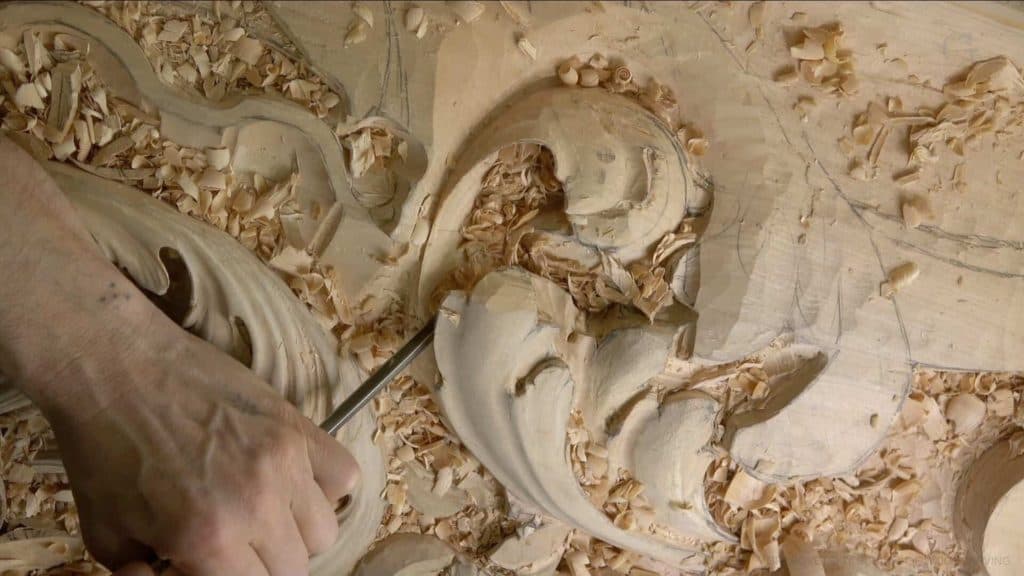
Alexander Grabovetskiy, woodcarver, School of Woodcarving · Published 2020
What makes a spot in a wood carving dangerous to carve?
Quick answer: A dangerous spot is the name I give a place where the wood can split or break. In part 12 I called an area dangerous because I was going against the grain, it was going up, and I could catch the grain, split and break. I also talked about going at it from another side.
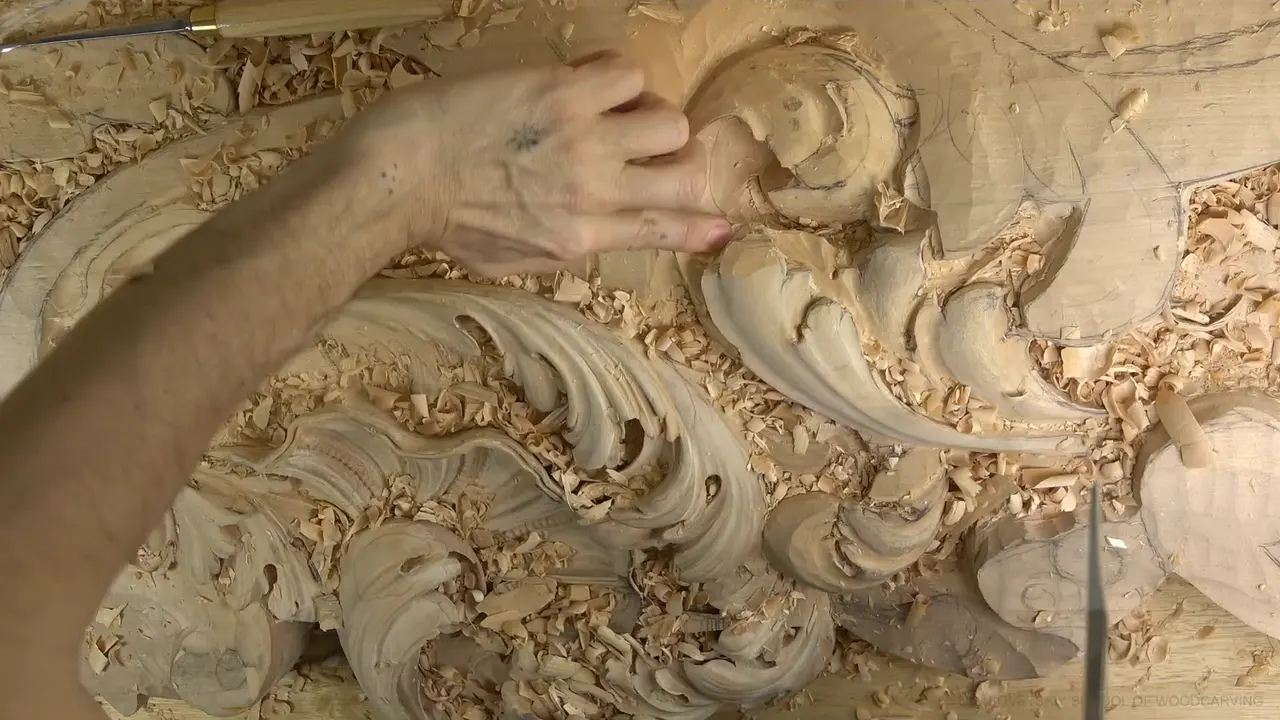

A dangerous spot is my name for a place where the wood can split or break under the tool. The twelfth part of workshop 27 has one, where the grain could catch me. Other lessons of mine use the same word for other reasons, and this page puts them side by side.
Ever pushed a gouge or a chisel into a spot and felt the fibers start to give? Then you know why I slow down. The twelfth part comes first. After it come sixteen other lessons where I called something dangerous and said what I would do about it.
What was the dangerous spot in part 12 of workshop 27?
My first words are a warning to myself: "Let's be careful how I do that." Next I plan a number three, "about half an inch, maybe about 12 millimeters or so," to "give that shape." I could probably use a number 11 to start undercutting "right there," I say. Before that, though, I want to knock down a little of the mess I created previously, "just slightly," taking it from the inside, where you "probably don't even see."

Taking the number 11 again is the plan, and I can probably start with seven millimeters (0.28 in), "and see if it's going to work or not." Then comes the line that names this page. It's "a dangerous area," I say, because I'm going against the grain, "it's going up," and I "could catch the grain" and "split and break." Short verdict: "That is not the most convenient spot."
Another side might help, so I try that thought: "Maybe I can just attack from this side." After it come the words "little by little." I'll try not to force it, I say, and try not to break it. A second plan is to relieve it a bit, with a "number five maybe," three-eighths of an inch, "like 10 millimeters or so," going in "upside down." That would make a number 11 "a lot easier" later, I say.

Few words fill the long middle of the part. At 4:29 I say I'm going "all the way to this detail" and need to go a little deeper. I also want to check from both sides, to be sure I'm "not doing something wrong," and then I get a number 11 to "excavate that way." By 5:46 I need a smaller one, "probably number 11, maybe about five millimeters" (1/5 in), "and maybe even smaller than that," though I'll try five millimeters first.
Close to the end, I say what I can't show. "I know the operation I'm doing," but for me it is "impossible to show that to you." You can "just get an idea," because I'm getting underneath of this one. I don't really need to go too deep, I say, "but still, I want to create that shadow." I say it twice. My last words are about following with the number five, then going in a little more.

Does the grain make a spot dangerous?
That is one reason, and my own part 12 shows it. Hashemi Flowers 18, part 2, shows another. I say "maybe I'll take a number five," and then, "carefully. Right now it's a kind of dangerous spot. I'm working along the grain." The next line follows: "But if my tool is sharp, I should be safe." A reminder comes with it, "don't create too much pressure," and then a plan for a spoon of "maybe about five millimeters" (0.197 in).
Over in Furniture Panel 16, part 8, the danger gets a sentence you can keep. If you need to relieve a little more, I say, "just do it." The reason comes right after: "That is a dangerous position when you're working along the grain because you can dig inside of wood and split it." Then I add that you've got to be "really careful."

A slip of the tongue makes Venice Room 58, part 10, a favorite of mine. Carving against it, close to a line, is how I start. A correction follows right away. The direction flips, and "that's dangerous." The tool must be "really, really sharp," I say, "super sharp." One millimeter is what I say I'm leaving, and then comes the fix to 1/16 of an inch, "about one and a half millimeters," with "maybe a little less" after it.

Venice Room 71, part 1, has a case too. Leaving maybe about 5 millimeters (0.2 in) is the plan, and I go that way. "And that's a little dangerous, but it's okay. It's still possible." Next: "If the tool is sharp, I shouldn't have any problem. And in my case, the tool is really sharp." Short and plain.

Force gets the plainest warning in a rosette lesson. In lesson 1, part 3, of the Venetian Flowers Rosette course, I say I have to keep an eye on the way the grain runs, because the chips are different. "If I'm going to just force it, I'll break this piece, and that's not going to be good." So I watch the grain direction "and how deep I go with the one cut," and I call the spot a "danger zone." Later I say I'm pretty close to half an inch deep (12.7 mm).

The Tray of Blessing, lesson 5, gives one more. Excavating "carefully" right underneath is my plan, and that, I say, "is already dangerous." The grain is the reason I give, "the short grain and you can break it." Penetrating epoxy comes up as a way to stabilize the wood, because it "just goes all the way through."

Both directions show up. Part 12 and Venice 71 go against it. Hashemi 18, the panel lesson, Venice 58 and the rosette go along it. I used the same word for all of them.
Is a part that goes underneath dangerous too?
In Venice Room 73, part 3, a shell that goes under is the worry. To relieve it, I plan "3 millimeters, number 11" (0.12 in), and I add "carefully." Then: "That is a kind of dangerous area right here, because a part of my shell going underneath." So I'm "really extra careful," and I go down in steps.

Going to the end of it is not the plan, since the line runs underneath. It's "pretty much continuous right here." One small section is going to be the exposed edge of a shell, and its depth is supposed to equal this side. "That's why I'm extra careful in this case."
A spot can be dangerous without being thin. Much deeper there, I say in Furniture Panel 18, part 5, so I should relieve it first. The same tool would get me there, "but now it's kind of a little dangerous." I ask why it is dangerous and answer myself: I can undercut, and I really don't want to undercut underneath. "So that would be a big mistake."

The answer is a number one, and I say I'm not going to get the big one. My pick is "a 5/8 of an inch number one" (about 16 mm), placed "right on the line," with "little by little" to follow.
Another spot gets the same fear in part 4 of that lesson. "I think that would be a little too dangerous," I say, and I need to make a micro cut "with the one millimeter number 11 first" (0.04 in). Otherwise "I create a weak point right here." Soon, at 11:10, comes "And I already did, I guess." I need to lower it a little. "So another mistake, which I don't like to make. I did it again."
The worry in Venice Room 16 of the Part 2 course, part 9, is that I can't glue it back. I want to flip something above this one, and it has to move the right direction. I call the way I'm doing it right now dangerous, "because if I'll mess up, which I don't want to mess up, I can't glue it back." So I take my time and "think every cut," and then a number seven is next.

Shorter, in Venice Room 22, part 11. A one-millimeter number 11 could get me inside, I say, and what I'm doing there is dangerous too, "but you can see I'm connected." Any straight tool, like a number one, could then "pretty much undercut."
Can the tool itself be dangerous?
Knives and slips come first. Students in the Roman Acanthus Leaf course, lesson 6, part 1, hear from me that carving toward yourself is dangerous, since "you can actually slip with your tool and poke yourself." And I've "done it," I say. I had multiple cuts, and some days I remember cutting myself over 100 times, on complicated work with paper-thin leaves.

One student showed me a hand lock. He locked his hands and used just the palms, and I called it "applicable for all types of carving." A locked hand is "really hard to slip. Almost impossible." You still have to be really careful, I say, "but if the hand is not hanging in the air, if it's locked, it is safe." The grain direction gets a mention too, right after the hand lock.
Lily Box 11, part 9, goes further. I remember a day I carved myself many times. I did not bleed much, just small micro cuts, and it was "still uncomfortable." My words: "you could damage yourself with that knife. It's really dangerous tool." A knife in your hand can be, sometimes, "even more dangerous than a table saw." With really sharp tools and no control of your movements, I say, "you can cut almost your finger out."

Not every tool is a knife. An operation in Venice Room 64, part 5, is dangerous "sometimes because you are cranking against or leveraging against that shape of the eye." You've got to be careful, I say, and "watch not to smoosh it too much." And then: "See what I just did." I get a little on the inside. That's okay. "It's not a big deal, but I wish I didn't do it."

Hashemi Flowers 21, part 2, uses the word before the pass. I could use support, I say, but I'll see if I can do without it. "If I going to feel it's dangerous like that, then I'll use exactly what I've done before." That means my MDF board. For now, I can probably attack it like this, and I say I could even use a small mallet, since with it I have "much more control."
Something "already became weak, or weaker I should say," in Venice Room 56, part 7. And I own it: "The way I'm doing it is a little too dangerous, by the way. I shouldn't do it." A really long bevel like this tool would "create a lot less stress on the fibers." The straight tool "I don't think going to fly," so I need at least a long bent: a number four, about 10 millimeters, three-eighths of an inch.

The last word of the pile comes from Grape Onlay lesson 5, part 3. I have to be careful not to push on this part, and I call it a dangerous area. Shadow and light are plenty there, I think, so I don't really have to overdo it. A straight down cut is out, I say, and I call it a big mistake, so it's small steps with the number 11.

What did I do next when a spot was dangerous?
The table puts each lesson on one line, in my words. Down the last column you can see what I said I would do about it.
| Where I said it | What made it dangerous, in my own plain words | What I planned |
|---|---|---|
| Workshop 27, part 12 | Going up, with grain I could catch | Come from another side |
| Hashemi 18, part 2 | A number five, working in that direction | Light pressure, sharp tool |
| Furniture Panel 16, part 8 | A tool digging inside the wood, and a split | Relieve a little more |
| Venice 58, part 10 | Close to the line, leaving about 1/16 of an inch | A super sharp tool |
| Rosette lesson 1, part 3 | Chips that look different, and forcing the wood | Watch grain and depth |
| Workshop 73, part 3 | A shell going underneath, beside an exposed edge | Down in small steps |
| Panel 18, fifth part | The same big tool, with a chance to undercut | A 5/8 inch number one |
| Panel 18, fourth part | A spot that would leave a weak point | A micro cut first |
| Venice 56, part 7 | My own way of working, after a spot already became weaker | A long bevel, a long bent |
| Roman Acanthus 6, part 1 | Carving toward yourself, where a tool can slip and poke you | Lock the hand |
| Lily Box 11, part 9 | A knife in the hand when you do not control your movements | Control your movements |
Read down that last column. A light touch, a super sharp tool, a micro cut, a long bent tool, a locked hand. The danger sat in the grain, in a part that goes underneath, in a weak spot and in the tool, and each lesson answered it with its own plan.
Look at your own bench for a minute. Is there a spot in your wood carving where your gouge heads up through the grain, or under something that holds? Say what could split before the first pass, the way I said it in part 12, then look for another side to attack from, the way I did. For everything in my videos, start here. The workshop 27 lesson and the Venice Room course for workshops 26 to 37 hold the rest of this Venice room, and workshops 26 and 28 sit on either side of it.
How it's done
- Say why the spot is dangerous. My reason for that spot was a tool going up, where I could catch it and split the wood.
- Look at another side. I said I could come at it from a different side, and I wanted to go in slowly.
- Pick a smaller tool. I talked about a number 11 at seven millimeters, then one of about five.
- Relieve it from the side. I planned a number five, around 10 millimeters, entering upside down.
- Keep your tool sharp. In Hashemi 18 I tied feeling safe to a sharp edge.
Frequently asked questions
How did I plan to handle the area in part 12?
I looked for a different side to come from. A number five came up, with about 10 millimeters (3/8 in) and an upside down entry, to relieve the spot.
Is the grain the only reason a spot is dangerous?
Nothing in these lessons says so. Hashemi 18, Venice 58 and the rosette lesson named the grain. Venice 73 named a shell, and the lily lesson named a knife.
Did I call a knife dangerous?
In the lily lesson, part 9, I called it a dangerous tool, sometimes more dangerous than a table saw. A sharp one you do not control can cut almost your finger out.
What to carve next