

Alexander Grabovetskiy, woodcarver, School of Woodcarving · Published 2020
How do you avoid splinters when you carve wood?
Quick answer: Avoiding splinters in carving is mostly about the wood under your resting hand. In Venice Room 27.9 I paused the excavating to clean rough spots, since my palms keep resting on that wood. Crunchy acacia and white oak can give you one, I never got one from basswood, and a brush beats bare fingers.
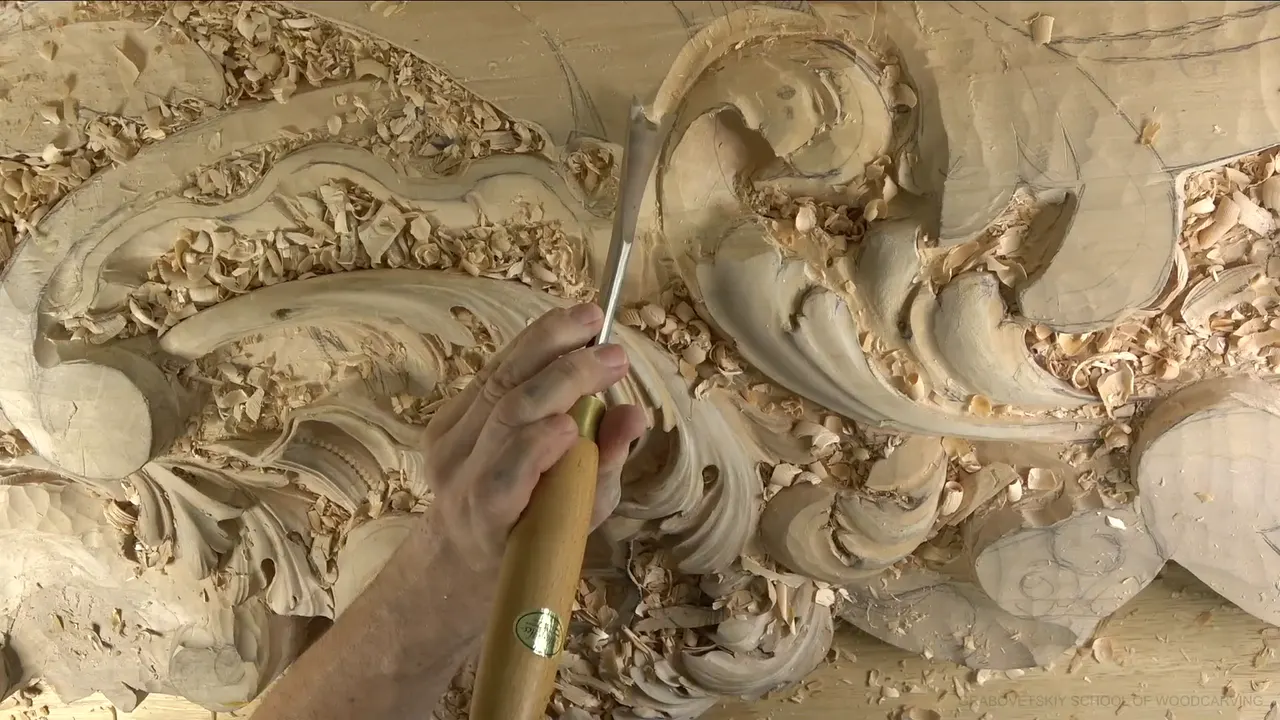
Avoiding splinters when you carve wood is mostly about the spots under your hands, and in part 9 of workshop 27 of my Venice Room I stopped digging to clean them. My hands always rest on the work. If a spot like that is too rough, you could get a splinter, and I don't think you want one. That pass wasn't the final cleaning, just a potential danger taken away.
Would you like to carve a whole afternoon and go home with no sliver in your palm? Want to know which woods are worse for it? Then keep the wood under your resting hand smooth, and let a brush take the chips. What follows is that short video, plus what I said about splinters and rough spots on an acacia lily box, a furniture panel, other Venice Room workshops and one live stream from April 2020.

What my lessons say about splinters
In part 9 the rough spots got cleaned in the middle of the digging, because my hands rest on top of the work all the time.
The cleaning there was not final. A danger came out, and the digging went on.
Basswood never gave me a splinter. The acacia of my lily box could, and white oak sometimes can.
A brush takes the chips, or I blow them off. Sweeping with bare fingers is a habit of mine I warn you about.
On Venice workshop 116 an 11, a small one, cleaned inside, partly so a sharp splinter was less likely.
Some rough spots wait on purpose, until I'm happy with the overall movement.
What was I carving in part 9 when the splinter came up?
A Venetian ceiling. It's the same board that fills all of workshop 27, and part 9 opens with me saying let's excavate a little better right here, around.

Not too much, though. I still had to keep some of the material, because I didn't want to hit one movement, one line. Hit it, and the transition to the ceiling would not be as nice. That is probably the deepest I can go right here, I said.
Number seven, not going to do. I took the number 11 again and excavated around. After that I went even deeper, because I need that shadow. I really need that shadow.


Next I said I'd get maybe a skew chisel and give it an overall shape. It's going to move gradually downhill like that, which is what I'm after. One spot could go a little lower. I'm okay with that, I said, since that spot would be part of a movement.

Then a small thing I liked. You can see that I left a small detail right here, which I think is going to look awesome. There were a couple of ways I could develop it, and I wasn't sure yet what kind of movement it would get. One idea was to put one part right on top of another, so it creates interlocking almost. Should I do that or not? I wasn't sure. But something could be done, I said.

And one more honest line before the cleaning. Still not too happy about how it grows from there, I said. It's nice and gradual, and it goes underneath, but still not to the degree I want to see it.
Why stop digging to clean a rough spot?
My hands, mostly. Let me clean again all that mess, I said, I don't want to see it.

And there was a second reason, the one about my hands. It's not wise to leave areas like that, because I'm always placing my hands on top of the work. If those spots are too rough, you could get a splinter, which you don't want. I don't think you want a splinter, I said, more than once and back to back.
So I removed whatever needed to be removed. The spot sat on what I call the marriage line, where the grain meets together from two directions, and you kind of have to blend that together. It was not the final cleaning yet, of course, because that area was still to be developed. Just eliminate potential danger for me, I said.

Right after it, the wood itself got a compliment. It's beautiful wood right here, I said, and I could probably chip with the same tool, before I forget. Then I said I could probably turn my tools this way, go around and make almost an undercut. Which is actually an undercut, okay, not almost.

Why are my hands on the work at all?
Control. On the Greek acanthus, lesson 3, I had a knife in my hand, and every time I use my knife that way my hand goes solidly right on the wood. It's not always possible, I said. On really complicated pieces that are all pierced, it's almost impossible to reference, and you can actually break a piece. That leaf was still semi-relief, I said. It had a background, and the leaf was just raised above it, a kind of prototype of a relief carving, so the hand had a place to sit.

Lesson 6 of the same course put the reason in plain words. It's all about how you're controlling your tool. I keep my hand solidly against something, so I can use just the muscles of my hand to make movements, with my left hand as close as possible to the edge of the tool. That way the control gets much, much easier, and tiny movements come with ease. The tool in my hands that day was a V tool, number 15.
My Furniture Panel, lesson 17 says it again. Slicing, and trying to control my tool as much as possible, I kept my hand solid on the board, so I could gain much more control. On the Modern acanthus, lesson 4, the one from a 1903 design, my hand stayed really solid on the wood. My thumb was the leverage point. And in Maine, during the Grinling Gibbons class, my hands sat solidly right in the middle, so I could pretty much hold the piece without the clamp.
Put those next to part 9 and you get the link. The hand rests on the wood for control, and anything rough under it can end up in that hand.
Which woods give you splinters?
Crunchy ones. On my lily box, in lesson 2, the first layer, I was cleaning chips away with my fingers and warned you. Be careful if you use this wood for carving and clean by your fingers, just as I was doing. It's really crunchy. You could get splinters, so it's better to use some kind of brush.

You usually don't get any splinters from softer woods, I said. I never got any splinter from basswood. The box was acacia, and it was a different story. White oak made my list too. If you're going to carve white oak, you can also get splinters sometimes, but this acacia was more crunchy than oak.
I'm not sure if I am supposed to say it that way, crunchy. For me it's probably the best word I can find, the crunchiness of wood. And I actually like this wood, I like it a lot. Really, really happy with it.

Should you clear chips with your fingers?
Better not. I'm guilty of it myself, though. In lesson 3 of the same lily box I said I have a tendency to clean with my fingers just like that. With basswood, it's okay. With this wood, I'm still blessed. I did not catch any splinters, but you could. And for some reason, I don't like splinters.

The Furniture Panel, lesson 15, has the warning without the confession. A router plane was taking the background down, and I was okay with 80 percent or a little more of consistent depth. Be careful when you're doing what I'm doing, I said. If you're going to try to get rid of those chips, you can always catch a splinter. So don't do that. A little later I got a better tool for cleaning and brushed it out.

The brush is nothing special. In lesson 3 of the lily box I answered the question before anyone asked it. I usually just blow on the wood, and all my chips fly away. Other times it's a brush I found on Amazon, and I don't even know what type it is. Any brush will do, even a really cheap painter's brush from a Home Depot, a Lowe's or a Menards, if you live up north in the United States.
Blowing has its own manners. In workshop 7 of the first Venice Room course I said sorry when you hear my blowing, I don't want to be rude or mean, and of course it's better to use just a brush and brush out all that waste. On workshop 30 of this course some of it would not come out even with the brush, so I said I'd probably just have to blow. And back in workshop 27, part 4, the reason was plainer. Let me brush this out, because I can't see. I got too many chips.

Gloves are a different subject in my lessons. In the questions and answers course they came up for body oil on bare wood. The white painter's gloves come out sometimes when I carve, I said, but the problem with the gloves is I can't grab my handle. Most of the time I don't.
Do you have to clean every rough spot right away?
Not every one, and I said so. In workshop 100 of the Venice Room I asked you not to pay attention if you see some rough spots, and you just wonder why he left those, why he doesn't do clean carving right away. Sometimes I do, I said, but not all the time. There was a cove to carry all the way around a volute, and after I'm happy with the overall movement, I'll clean everything.
Workshop 23 gave a reason that is about the eye. Deep inside one part I wanted no roughness at all, because it would be visible from the bottom. Leaving rough spots right there would be a mistake for me, I said.

And workshop 116 gave the hand's reason again, close to the words of part 9. A small number 11 cleaned a little better inside. It is going to be done anyway, I said, but just to make it look nicer, and less chance to catch a sharp splinter.

Part 9 is that last kind. The spot was not finished, it was only safe.
Has anyone ever worried about my splinters?
Once, live. In a livestream in April 2020, a kind of live broadcast, I was moving my camera closer so you could see, and someone wrote in that they felt so anxious about me getting splinters. I read it out loud. I'm not getting splinters whatsoever, I said. I don't know why. I guess wood loves me. Don't worry about splinters, I'm not going to get them.
Right after, I went back to work on the next movement, an acanthus movement sticking out from underneath. That was one answer to one worried person. The lily box and part 9 carry the rest of what I think, and both say you could get one.

Where splinters came up, and what each moment comes to
| Where | What was on the bench | Kind | In my words, more or less |
|---|---|---|---|
| Venice Room 27.9 | Rough spots cleaned where my hands rest | Hand rest | rough wood there could give splinters |
| Lily Box 2.4 | Cleaning acacia chips with my bare fingers | Crunchy wood | never got any splinter from basswood |
| Same box, 3.9 | Same habit, fingers sweeping the waste inside | Still blessed | no splinters yet, but you could |
| Furniture Panel 15.3 | Router plane background, chips cleared by hand | Plain warning | So don't do that, I said |
| Workshop 116, Venice | A small 11 cleaning a little inside | Sharp splinter | less chance of a sharp splinter |
| Livestream, April 2020 | A worried viewer wrote in about splinters | Live answer | not getting any, wood loves me |
| Venice workshop 100 | Spots left rough until the movement settles | Left rough | right away only now and then |
How could you keep splinters off your own hands?
Start with the hand that rests. Wherever it sits on the work, the wood under it should be smooth, even halfway through the job. In part 9 I cleaned that spot, said it wasn't final, and went back to digging.

Keep some kind of brush on the bench for the chips, any brush, and be most careful on a crunchy wood like acacia or white oak. My fingers are the habit I keep warning you about, so don't copy that one.

Want to watch the whole run of that ceiling, deep shadows and all, and see which rough spots wait for the final cleaning? Then workshop 27 of Venice Room part 3 has it, between workshop 26 and workshop 28.
How it's done
- Excavate around the movement. Not too much near the line that leads into the ceiling, then a number 11 again, all the way around.
- Go deeper for the shadow. That spot got more depth, since a shadow had to sit there, and I said so twice.
- Plan the overall shape. Maybe a skew chisel, I said, and a shape that moves gradually downhill.
- Clean where your palms sit. A rough patch under a resting hand can leave a sliver, so it came off before the final cleaning.
- Blend the marriage line. Grain meets there from two directions, and the two have to blend.
- Turn the tool and undercut. With my tools turned this way, I said, I could go around and make a real undercut, not almost one.
Frequently asked questions
Does basswood give you splinters?
Basswood has not put a splinter in my hand, as I said while carving the acacia box. That acacia was crunchy, and it can. Softer woods usually don't, white oak sometimes can, and that acacia was even more crunchy than oak.
Do gloves stop splinters while you carve?
Gloves came up in my lessons for body oil, not for splinters. I sometimes carve in white painter's gloves, but I can't grab my handle in them, and most of the time I don't wear any. If oil worries you, a cloth or paper towel laid over a finished section does the job.
Is it bad to sweep chips away with your fingers?
On a crunchy wood it can be. Cleaning by hand is a habit of mine, and on basswood it's okay. With the acacia box I told you to be careful and reach for a brush instead, and at the router plane I told you not to.
What to carve next