

Alexander Grabovetskiy, woodcarver, School of Woodcarving · Published 2020
What does "don't rush it" mean when a wood carver says it?
Quick answer: "Rush" is the pace I warn myself about at the bench. My example is Venice Room workshop 27, part 2: I chopped away a section of a leaf, called that okay, and said I had to be more careful and not to rush anything. Here it was okay, I said, but in some spots it would be a huge mistake.
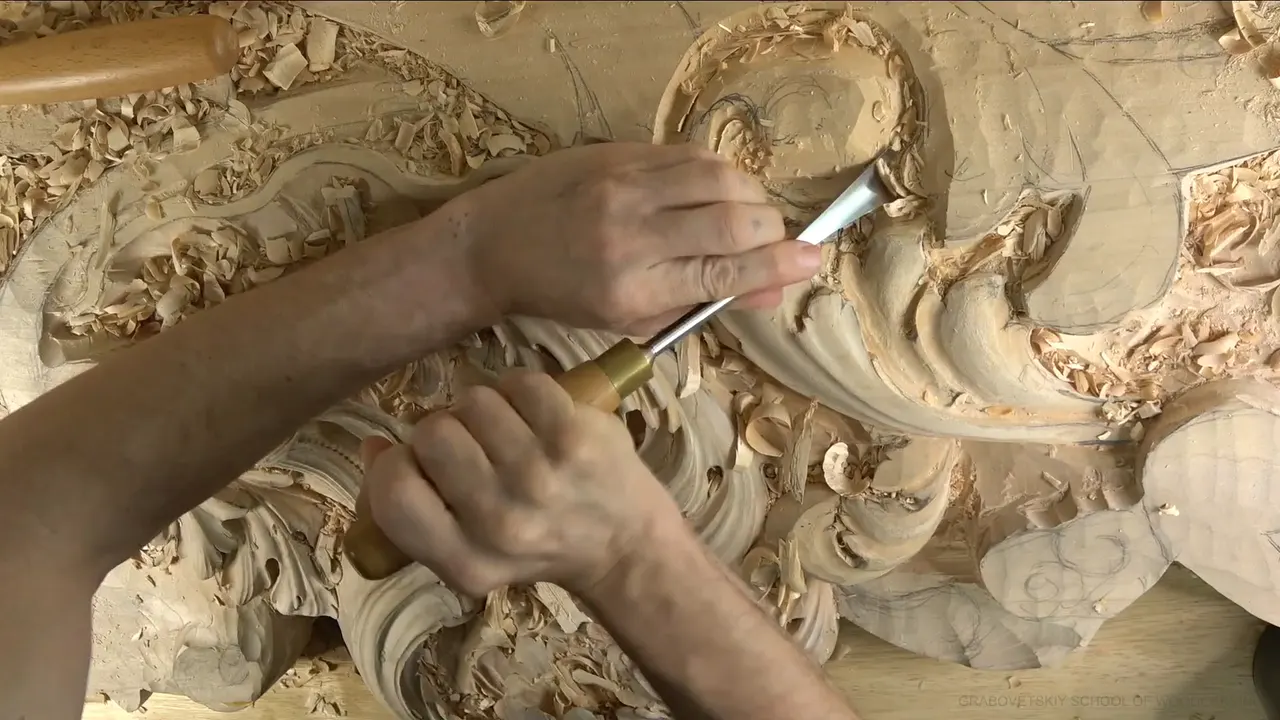

Rushing is what I warn myself about at the bench, sometimes right after a slip and sometimes before a careful pass. The warning sits in one short stretch of workshop 27, and my other lessons repeat it in plain words.
Ever chopped away more of a wood carving than you planned? This part is short, and it holds my answer in a few lines. The rest of this page lays twenty of my other videos beside it, one slip at a time.
What did I say in part 2 of Venice Room workshop 27?
The part opens quietly. "Make sure I'm not touching that future acanthus," I say, about a leaf that is not carved yet. Then comes the plan for one spot: "the rest of it right here, I really need to excavate much deeper, otherwise it's not going to look nice."
Getting there meant taking wood away. "So I need to get rid of that and go much deeper." A preliminary movement came first, I said, and then probably a number 11 gouge again, or a number nine. By 01:41 I had added that I could go a little lower on one section of the leaf: "It would make probably more sense."

Then came the slip. "And yes, I just chopped a section of this, which is okay." Three seconds later: "This section I just lost, that's absolutely okay. I can reestablish it, no problem."
Is losing a section of a carving a mistake?
Here the loss was okay, I said. My words: "But honestly, I have to be more careful and not to rush anything. It is okay in this case, but in some spots, it would be a huge mistake." The part does not name those spots.
Digging filled the next stretch. "Okay, go deeper even," I said, and "I can go right inside just like that." Next, I named number three. "That's a mess" came at 03:53, and at 04:00 I told myself to get my tools back to my chest.

A second reminder arrived seven seconds later. "Now I'm going to be just more careful how I work around this area." Something smaller, "like number three," was probably needed, I said, to settle the idea of the movement and how it would look.
Probably I could start on "the main movements, how I want to see it," I said, and my next line comes at 06:10: "I don't really worry about how clean and if it's clean or not clean, how it looks as of now. All I worry about are the main movements."

Plans, not finished work, close the part. One part, I said, and then I had to do another part. I could do an eye, I said, and there was going to be another one. A judgment followed, "not good," and then a maybe: move something a little bit and "create a bigger chunk right here."
Did the rest of workshop 27 say it again?
Yes. Early in part 4 a piece broke. "I'm not too happy that I broke my piece right here. So that is not too good. It's still going to look good, but that's something I could avoid and I didn't. I guess I was rushing too much."
Next I planned to excavate underneath, "where I can see much better what material I have." For undercutting I said I would use number 11, seven millimeters (0.28 in), "a little bigger than a quarter inch," and I wondered whether a straight tool would work. Care took other forms later in the workshop. In part 5 I said, "I have to be careful because of the limitation of tools I have right now. Not the tools, but limitation of movement with the tool." Going "even deeper" was the plan, using four millimeters (0.16 in) and number 11.
Part 11 turns the worry around: "I've got to be careful not to do it too weak." Later in that part, "At a certain point, I have to just stop." The reason in part 12 was the grain: "it's going up and I could catch the grain and I can split and break."
What does a rushed pass look like in my other lessons?
One slip and one reminder sit in part 2. Other videos show what a rushed pass can leave in the wood. The table holds four of them, with the tool I named and my words about it.
| Lesson | Tool | Words |
|---|---|---|
| Hashemi Flowers 11, part 3 | A small gouge, 3/32 of an inch (about 2.4 mm) | I just rushed |
| Fifth lesson of the Hashemi course, part 4 | Number seven, again | Oops, I should not do that |
| Venice Room 65, part 7 | Number five | No good |
| Lesson 29 of Hashemi, part 3 | Big number seven | That's not what I wanted to do |
Carving Hashemi Flowers 11, part 3, has me saying I would take a small gouge again, a little smaller than the original 1/8 (3.2 mm), "just a 3/32 of an inch" (about 2.4 mm). Next came "I don't like what happened. That's okay. I think I just rushed too much a little bit. That is always a mistake, to rush it."
The shadow line got a number 11 at 1 millimeter (0.04 in), and "now I have to fix this." For the fix I named a number seven, then a number five at a quarter of an inch (6.35 mm), and told myself, "Carefully remove the chip."

Hashemi Flowers 5, part 4, runs shorter. "Again, number seven. Oops, I should not do that." After that: "I made a rushing move. You should not rush. Or should I say, I should not rush." Look at the turn there: the advice started at "you," and I took it back to "I."

Lesson 7 of the Hashemi course, part 5, has me saying at 02:14 that I took too much, "which is okay." What followed was "Usually, I'm more careful, but I don't know why I'm rushing too much." A number one was next, I said, and I counted my slips out loud: "Make a mistake after another mistake."
On a small knife I said: "This small knife helps me actually a lot right now. I can have much more control."
A broken piece shows up in Venice Room 65, part 7. Moments earlier I had said, "Number fives and number six, just to get around, and that's going to do the trick," and then, "This is a little too big. Use number five." The line that matters: "Number five that way, and I just broke that piece right here. No good. I didn't do the right thing." Seconds later came "I did rush it, and I shouldn't. I should not."

Bigger passes were the plan in Hashemi Flowers 29, part 3, using the big number seven again, so the carving would look much cleaner. Then: "Oh, that's not what I wanted to do. It's okay."
Later I put it this way: "when I am trying to be really quick, when I'm rushing." And, "I know I made too many mistakes on this project." A number five at one inch (25 mm) came next. "I think it's a little safer."

Pressure came up too. In Hashemi Flowers 12, part 5, I said, "when I'm trying to pry too much, I can break it. So don't create too much pressure." Over in Hashemi Flowers 26, part 4, a number 16 V tool at six millimeters (0.24 in) went with this: "Just don't create too much pressure. It's tempting. I know, because I'm also trying to rush it." A big mistake, I said.
Why do I rush when I know better?
A few lessons give a reason, and speed comes first. The third Hashemi lesson, part 3, has this: "But I am guilty myself. I do have a tendency to rush it because I want to make sure I'm done quickly. But it's better just to work your way in than rushing." A little earlier in that part I had said number seven would do for the inside, or probably a smaller number five.

Big tools and tiny tools gave me another reason. The thirtieth Hashemi lesson, part 1, covers getting as much as possible done in one day, with setting in and final detail on the same day. I have a tendency, I said, to make "little more mistakes because with the big tools, you're trying to rush everything, make quick movements and so on."
After the big ones, I said, you take tiny tools in your hands, "but your hands already done the big stuff."

Past slips taught me something too. In Carving Furniture Panel 17, part 10, I was getting closer to the final line with a number 11. "I know maybe I'm too careful sometimes." Then: "I made too many mistakes before when I was rushing and trying to do stuff too quickly. And it's not good, okay?"
A missing deadline came up too. In Furniture Panel 19, part 8, some of you probably wonder, I said, why I spend so much time on a small detail. "I don't have a deadline," and "this panel is not for a client, no deadline, so I really don't have to rush it." Then, "if I don't have to rush it, so I can probably create much nicer project."
How much time does a rush really save?
I put the math in plain words in Furniture Panel 15, part 1. I told you to carve straight down, like 90 degrees, and to keep that area high, because "there's no way you can fix that later."
Then came the math. "It's going to save you actually time if you not rush it." Hurry, I said, and you will make a mistake, and then you will have to fix it. The fix is the slow part: "much longer to fix the mistake" than to get the first pass right the first time.

A short line from part 6 of the same lesson sits well beside it. "So no rush. Absolutely no rush." Right after, I said I was working across the grain as much as possible.
What do I do in place of rushing?
The tool comes first in Venice Room 70, part 10. "Maybe it's a good idea to use the smaller tools first, and then clean it with the big tools. A smaller tool is a lot easier to control." More time goes into it, I said, "but I'm okay with that."
My plan there was a number nine at 10 millimeters (0.39 in) and, in my words, "carefully start excavating little by little." I changed my own word on camera. First it was better "sometimes." Next: "Well, actually, it's always better," and then "I found that when I'm not rushing, I'm getting much better results." Half a minute later came a twist: "And you know what? In this area, I could use probably a bigger tool."

Along the grain, the pace stays the same in Venice Room 62, part 4. I named two things to watch, "how deep I'm carving and how much shavings I'm taking out." Then, "Little by little. I'm not going to rush it." Taking the spine even lower, I said, was a maybe too.

Some really deep excavations that go underneath a movement were the plan in Venice Room 71, part 11. I called for real care in that area, and I added: "Not in this case at least."

Small was the plan in Venice Room 69, part 4: "Maybe I can take 20 millimeters number nine or something like that, like 3/4 of an inch, and chop a little bit. Not much, because I don't want to rush it." Maybe the mallet was needed too, I said.
The Chamomile and Bow Rosette 2 course has me rounding, number three, about 10 millimeters (about 0.4 in), and saying, "I don't want to rush it." In Chamomile and Bow Rosette 4 came "Just don't rush it. Check the grain."

One more line, from Hashemi 12, puts it as a trade: "it's much better to do multiple cuts and to get the result slower than to rush it and make mistakes."
Is it the same call every time?
The calls differ. Part 2 gave me "in this case" and "in some spots." Workshop 71 had "not in this case at least." Firmer still is Venice Room 77, part 7: I put "whatsoever" on it and called rushing there a big mistake.
The videos give no single fixed rule. Each shows a slip, my words for it and the tool I reached for next. What part 2 shows is a chopped section and a promise of more care around that area.
Look at your own bench now. Is there a spot where one fast pass looks tempting? Would you rather fix a mistake there, or take the same spot in smaller bites? The lessons linked on this page show me doing both. For all my lessons in one place, start here.
The lesson 27 page and the Venice Room course for workshops 26 to 37 hold the rest of this acanthus carving, with workshops 26 and 28 on either side. These videos come from my Venice room carving and other courses of mine in wood, and the figures in millimeters and inches on this page are mine.
How it's done
- Name the slip. In part 2 I said I just chopped a section and lost it, and I called reestablishing it no problem.
- Weigh the spot. The loss was okay in this case, I said, and other places would make it a huge mistake.
- Slow the hand. I told myself to take more care, and later in the part I promised more care around that area.
- Reach for the smaller tool. I needed something smaller, like number three. In workshop 70 small tools go first, with big tools to clean after.
- Read the grain. In the rosette course I said to check the grain, and in workshop 62 I said I was carving along it.
Frequently asked questions
What did I lose in part 2 of workshop 27?
A section of the leaf. My words were that I just chopped it, that losing it was absolutely okay, and called reestablishing it no problem. After that I reminded myself to take more care.
Which lessons have me warning about rushing?
The Hashemi course has it in lessons 5, 7, 11 and 29, workshop 65 of the Venice course has it, and so does part 4 of workshop 27. Each followed a pass that had gone wrong: a spot I did not like in one video, a broken piece in two others.
How did a small knife help in Hashemi 7?
I said, "This small knife helps me actually a lot right now," and, "I can have much more control." The words came after I had counted my mistakes out loud.
What to carve next