

Alexander Grabovetskiy, woodcarver, School of Woodcarving · Published 2020
What does junk mean in wood carving?
Quick answer: Junk is my name for wood a pass has already freed that still sits inside or under the carving. On my Venice Room ceiling board, workshop 27, part 5, I named the junk twice right after a number 3 set my boundary, and then I said I need to check the shape from all positions.
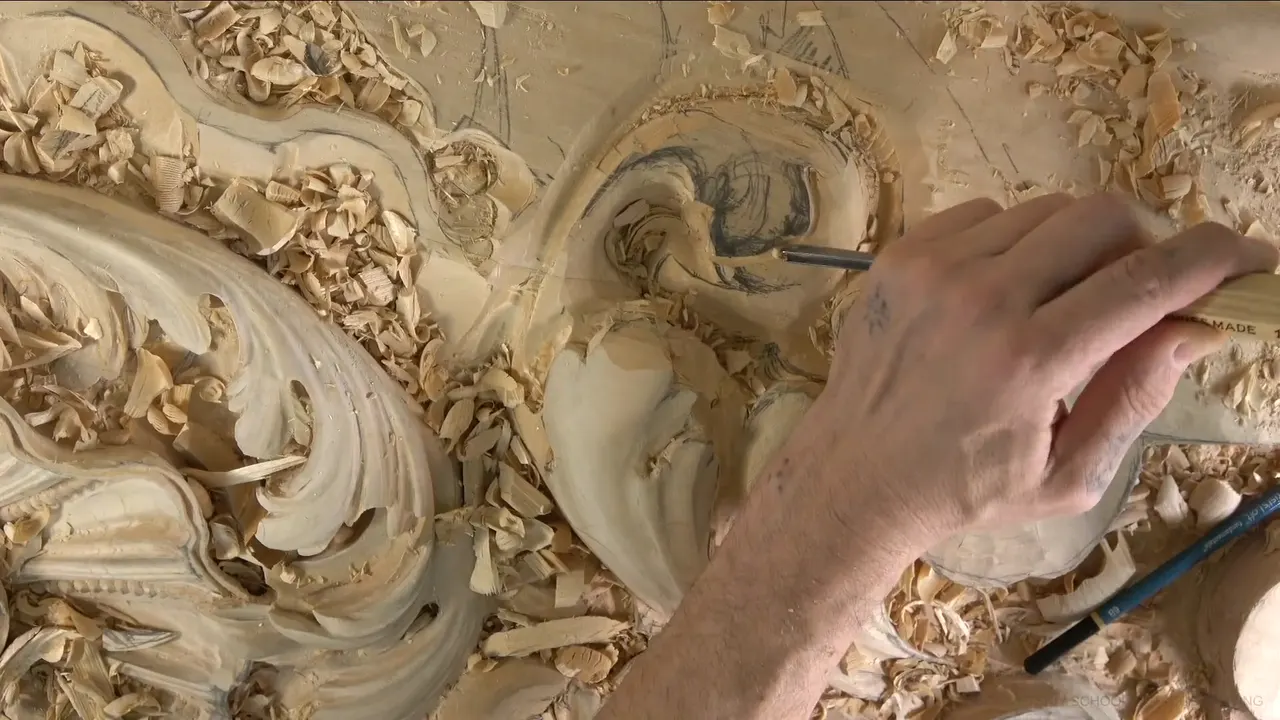
Junk is my word for wood the gouge has already carved loose that still sits inside or under a carving, waiting to come out. It is wood carving waste, caught in the middle of the job. About six minutes into part 5 of workshop 27 of the Venice Room, a number 3 went in to set a boundary, and twice in a row I called what was left inside junk.

Do you want to see the true shape of a hollow, and not the crumbs lying in it? Would you like to clear those crumbs without snapping the edge you just made? Then this one plain word of mine is worth a few minutes of your time.
I'll start on that ceiling board, then follow the word through the other courses where I said it, with my reason each time.
Junk, in six short lines
Wood a pass already freed, still stuck in the hollow, is junk.
On the lily box I called it the junk I just created.
Some can wait.
It has to go when it hides the shape, and before paint goes on, since forgotten junk sticks to a painted hollow.
I lift it out slowly, with no force.
Small tools get the last of it, down to a #2.

Where did the junk come from in part 5 of workshop 27?
In part 4 I had said the only way to get a smaller leaf underneath the upper part was to excavate a really deep undercut. Part 5 opens right there, with a really deep undercut. I have to be careful here, I said. I first said limitation of tools, then fixed it, limitation of movement with the tool I had right then. I went even deeper with a 4 millimeter number 11 (about 5/32 in), and a little past the one minute mark I stopped myself, because if I push too hard, I'm going to break that.
That was enough for now. The upper part still needed a better form and a nice, smooth movement. I named a smaller number 11 next, maybe 3 millimeters (about 1/8 in), to clean that better. Later on, I said, a 2 mm (about 5/64 in) could follow, then one and a half (about 1/16 in) or one millimeter (0.04 in), if I need them to get that completely beautiful finished look. Those last sizes came with an if.

Then came the eye of the acanthus. The movement goes down from there, which means that part needs to be gone. I fixed my own words right away. That part has to go.

Next I had to decide where the point of this movement would be, somewhere right there, in the letter S shape I could see. I said sorry for blowing again, because I had to.

That spot would be another separation, and the wood in it was in the way of my eyes. I needed to relieve that section, otherwise I'm not going to be able to see what is going on. So I took a bigger number 11, 10 millimeters (about 3/8 in), and kind of poked it straight down from two sides.
A number 9 or number 8 will do exactly the same idea, I said, and you can rotate both, though I called the 9 even better. With a 10 mm number 9 I rotated and excavated, and I said those blocks are going to just pop out. A few seconds later you could see my separation cut, and I could see the preliminary movement. Another eye could go there too, I said, not too big, a little one, though I wanted to think first about the best way to do that.

Why did the junk line come right after the boundary?
Watch the minute before it. Around five minutes in, I chopped what I didn't need in one spot, so it would not distract my view, and I cleaned some of that right away, and a little more right there. Next a number 3 went in to pre-establish my boundary, and about twenty seconds later I said so much junk inside, then said it again.
After that I said I need to check how it looks from all the positions, and I thought one part needed to roll a little bit downhill, otherwise it doesn't look round enough for me. Not much. A little bit.

A canvas, I said, was what I had just created, or canva, I should say. The separation went a little deeper, more pronounced, and the last thing I asked for in part 5 was a little more roundness in one area, almost impossible to see from the bottom, though from far it will be detectable.
That one wood carving on one board is only the start, because the word turns up in my Greek, Roman and Corinthian leaf courses, on the Hashemi flowers, the lily box and a molding panel, and in workshop after workshop of the Venice Room.
Is junk the same thing as waste?
Close to it, and on camera I argue with myself about the word. In lesson 5 of the Corinthian course I picked a 1 mm V tool (about 1/25 in), a number 16, to clean the junk underneath the leaf. Then I caught my own word. Well, I shouldn't probably call it junk, I said, because it's still wood, still live wood, and I love live wood.

Same thing on the lily box. At a half millimeter (about 1/50 in), in the first layer lesson, I said maybe I shouldn't even call that junk, and maybe there's some different name for it I should use. In Hashemi flowers 3, with a tiny 1 mm V tool (1/25 of an inch), I wasn't sure the word was right either, but right then it was in my way, and I don't like to see that.
The nearest I came to a dictionary answer was workshop 60, where I wanted another division, so some wood had to become junk. Not junk, but you know what I mean, I said. I mean waste.
When can the junk stay where it is?
For a good while, on more than one board. Take workshop 54, where I had just made a deep excavation, and the shadow was like framing it. Of course I had a lot of junk on the inside, but this junk doesn't bug me at this point, I said. My next tool, I said, could be a number 7, to clean a little and get rid of those distractions.

The same went for workshop 44. That is all junk, so don't pay attention to it, I said, and in the next breath, I love the movement so far.
In acanthus over moldings 8 I pulled one chip and said forget about all the junk, you should be able to see the result, how it looks. And back on this course, in workshop 30, the junk inside was something I didn't have to worry about, I said. It could stay like that, or I could take the side of a number 11 and exaggerate that ridge a little bit.
Hashemi flowers 46 put it plainly. I had just made a curl, and I said all that junk, later on, I'll take it out and just clean it.
When does the junk have to come out?
The ceiling board gave the first reason. That one section had to be relieved first, so I could see. My Hashemi line, about junk being in my way, says the same thing another way.

Painting is the second. Back on the first Venice Room course, in workshop 12, I hooked the junk out of a deep excavation with number 11 gouges, and then I explained why I won't leave it. Sometimes you forget that stuff, and when you paint, it sticks to that area. It was a really good, deep excavation, and I liked it.
The finish is the third. Before the final details of workshop 32, I wanted to hit one edge with the rasp to find my high spots, and I called the rest all just junk, junk I don't need. On a Roman leaf, in lesson 11 of that course, I took some out and said I don't want any junk left.
Here is where the word came up, what I said about it, the tool in my hand, and what came next.
| Where | Junk | Tool | Then |
|---|---|---|---|
| Venice Room 27.5 | So much junk inside, I said twice | Number 3 | it went in for my boundary |
| Greek leaf twelve | already cut, but it's kind of stuck | Number 3A | dug and hooked, little by little |
| Hashemi flowers 45 | better to go back than force it | Half millimeter | it took out all that fuzz |
| First Venice course | sometimes you forget that stuff, I said | 2 mm | because paint sticks to that area |
| Fifth Venice course | the junk did not bug me there | Number seven | it could clean those distractions next |
| Venice Room 30 | the junk inside, nothing to worry about | Number 11 | I can leave it like that |
| Lily box three | Maybe I shouldn't even call that junk | Half millimeter | it followed, with barely any pressure |

How do you get junk out without breaking the carving?
Slowly, and with no force. Lesson 12 of my Greek acanthus course had me under the leaf with a short bent number 3 of 5 mm (about 3/16 in), a number 3A to be exact. I could pull stuff from underneath, but you got to be really careful, I said. All that junk is actually already cut, but it's kind of stuck right there, and it's better just to dig and hook it little by little than to force it. After that, a number 7 back bent went underneath, to make more passes and hook it without it breaking.

In Hashemi flowers 45 the junk was already cut and just had to be removed from inside. Again I would not force it. It's better to go back and attack with a number 11, a half millimeter, I said, and remove all that fuzz. Sometimes it's not that easy to take all the junk out. Kind of hard, but I have to. A knife could do it too, maybe, I said. Plenty of junk was still there at the end, and I said it was okay. I was happy with the first band.
Workshop 12 shows the size question. I began with a 2 mm number 11 (about 5/64 in) and went both directions. Then I tried a bigger one, 5 mm (about 3/16 in), said it was maybe a little too big, and kept using it as long as it carved. Just hook it, I said, and change the position. The 2 mm went back in after that, and a number 9 of 3 mm (about 1/8 in), I said, would give exactly the same result in there.

Which small tools take the last of it?
Later in that same lily box lesson I said let me use a 1 millimeter to get rid of the junk, then the 1 millimeter and a half millimeter to get even deeper, and then I brushed it. Workshop 17, from the second course of this room, had a little bit of junk right there, and I said I can just clean it with the number two.
My line in workshop 46 was that the junk I can always take care of with the number 11, the smaller one, because I've got pretty close to the finish line. Over on the left-hand side of workshop 54, all that was junk, so I had to remove only that. I've got to be careful how I do it, I said. A 5 millimeter number 11 came up next, again.

Does every pass make more junk?
On that box a half millimeter followed, to remove the junk I just created, as I put it. Going deep makes it harder to get out, too. Back in workshop 15, also in that second course, I had junk inside, a lot of it. I said I don't want to go too deep, because it's going to be much harder to clean for me, and I really don't want to do what I don't have to do. Next I needed to clean a little from one side, and I said maybe I could use just small tools.
In part 11 of this same workshop 27 I said let me brush out some of that junk, and then I showed it from a different perspective. On that same molding panel I called it junk chips and said it's up to you, you can always blow on it and it flies away. I was trying not to blow because of the camera, I said, but it's a normal practice.

Where to watch the junk come out
The whole of workshop 27 sits on one lesson page, and part 3 of the Venice Room holds workshops 26 to 37 of this relief ceiling. Tuition opens every one of these videos.
Want to see the blocks come loose under a #9 gouge? Would you like to hear me name it junk and then take the word back? Then come to the bench with me.
How it's done
- Clear the view first. When waste hides the shape, relieve that section. I pressed a 10 mm (3/8 in) number 11 straight down from two sides, then rotated a number 9 of the same width.
- Let some of it wait. Junk that does not bother the shape can stay until later, the way it didn't bug me in workshop 54.
- Hook it out slowly. Hook the stuck pieces out one small bit at a time instead of forcing them.
- Go smaller near the finish line. Take a smaller number 11 close to the end, and a 1 mm (1/25 in) or half millimeter (1/50 in) tool in the tightest spots.
- Brush, then look again. Brush the loose bits off and check the shape from another angle, as I did in part 11 of workshop 27.
- Empty it before paint. Take the junk out of any hollow that will be painted, since forgotten bits stick when the paint goes on.
Frequently asked questions
Is junk the same as wood chips?
Sometimes they are one pile. On the acanthus over moldings panel I called it junk chips and said you can always blow on it. Under my Greek leaf, though, the junk stayed stuck in place after the tool had freed it, and I dug and hooked it out a bit at a time.
Do you have to take every bit of junk out?
Plenty of it can sit for a while. Workshop 30 of the Venice Room had junk inside that I didn't need to worry about, so leaving it was fine with me there. Before paint, I want it gone, since forgotten junk sticks to the area when you paint.
Which gouge clears junk from a deep hollow?
Mostly a number 11 on these boards. Workshop 12 started with a 2 mm one, close to 5/64 inch, then a 5 mm, near 3/16 inch, that felt a little too big, used while it carved, and then the 2 mm again. A #9, 3 mm wide (near 1/8 inch), would give the same result there, I said.
What to carve next