

Alexander Grabovetskiy, woodcarver, School of Woodcarving · Published 2020
What does it mean when a wood carver says it won't hurt?
Quick answer: Won't hurt is my way of saying a small extra pass does no harm to the carving. In part 8 of workshop 27, in the Venice Room, I said I did not want many more troubling areas for my brush, then said a little bit was fine. Other lessons use the word for cleanup, depth, grooves and scraping.
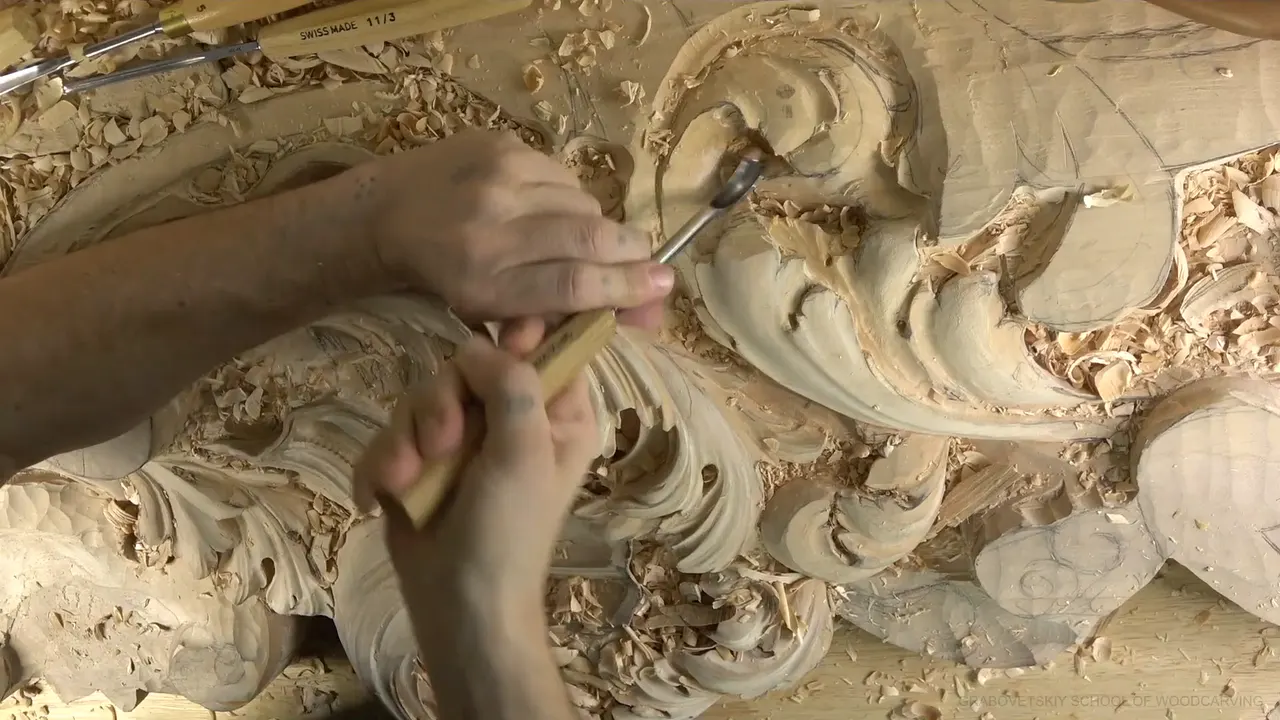
When I say a small extra pass won't hurt, I mean the carving can take it at that stage. In workshop 27 of the Venice Room, part 8, the word comes with paint. A brush has to reach inside that carving later, and I say so. So I allow myself a little bit anyway. Other lessons of mine give the same word to cleanup, more depth, grooves and scraping, all of it wood carving of one kind or another.
Ever stopped before one more pass, wondering if the piece could take it? Is a little extra a risk to you? Here is what I said in each lesson, what the extra was, and what limit sat beside it.

What does it mean when a wood carver says it won't hurt?
It names a small extra and says the work stays safe. The extra in the lessons below is a bit of cleanup, a deeper pass, one more small groove, or a scrape. A limit or a reason sits beside the word in several of them, and I say it out loud.
What did that word cover in workshop 27, part 8?
The part opens with me saying that, even before the final details, I can set some of the movement inside the carving. Next is a tool line. "And I'm using number nine and 10 millimeters as of now." A line later comes "I'm going to, again, grab 10 millimeters number 11 and get all that stuff out." That 11 gouge at 10 millimeters is three-eighths of an inch, a pairing I say aloud later in the part.
Depth comes next. "I don't have to excavate too deep, just deep enough." My reason for holding back is paint. I always have to remind myself, I say, that later on I have to finish the carving and "put paint on it." Next is a line about the brush: "I don't want to create much more troubling areas for my brush to go in." And here is the line this page is about. "But little bit, it's not going to hurt." The brush sets the limit, and a small extra is allowed inside it. Next I give a number for the spot I dug: "I excavated about, I would say about three-quarter inch inside." That is 19 mm. Two more things are still open, I add. The shape needs a feel that it is flipping, and this area needs a lot more excavating.

For the next area I say I could start with a number five. A five, six or seven "will do exactly the same trick," I say. I would probably change to a seven or an eight. Closer to one spot I plan to rotate my tool and go downhill. "At a certain point, I have to switch to spoon again." I also want it to feel like it has a full movement and rotates this way. Those are plans, said out loud before the cut, in words like could, would and have to.
Back to a number 11 of 10 millimeters, to "excavate little more right there." I need to probably wiggle a little, I say, and attack from the opposite side also. A mallet is one more maybe. "In certain cases, I could use even a mallet." I do not say I used it, only that I could. Next, something the viewer does not see. "And I know you don't see it, but I am trying to get as clean as possible."

The cleaning has a shape of its own. The deep spot looks clean to me, except for a hump or a bump, whatever you call it, which I do not need to see. For that I pick a number seven, at one inch (25 mm). "And really, it creates beautiful shadow. Nice and deep shadow." Then comes "I'm going to take again number 11, 10 millimeters, three-eighths of an inch," to hit the spot and "clean it one more time," blending all the cuts together until they are connected and clean.
One choice there has a reason attached. Nine could do the job, I say, but I really like hitting with the U shape, the upper part of my movement, because it cleans very much by itself. Near the end of the dig I call it "really deep excavation," then say "Really deep" and "Deep and nice."

Late in the part there is a look at the spot. "Now, I am ready, and I think I probably should take care of that because it doesn't look too good as of now." The next line is "Use number seven." Last, a house rule about the bench. "Let me get my tools back to places where it belongs," I say. I usually do not like to keep them out, I add, because they create a messy look, and I lose them sometimes when they are out. The lesson page for workshop 27 holds all twelve of its parts.

Can a little more cleanup hurt a carving?
In my lessons a little cleanup is fine, and each time I give a reason. Within workshop 66, part 5, I still have to develop some concaves and convexes, so I am not really worried about how clean that cut is. "But little bit cleanup, not going to hurt." A moment later I add that it will be okay. About a minute after that I say I am safe now to excavate on the inside, and I think about a long bent number 11, since it is a somewhat hard area.

Over in workshop 9, part 10, the cleanup gets a reason and a worry. The background there should not go too deep, because I still want a really good development of acanthus right there, and I do not know yet how deep I will go. Too messy, I say, and you kind of lose the overall feel. So a bit of cleaning costs nothing in that spot, and my plan is probably a number 11 again, a spoon gouge, maybe about 4 millimeters (5/32 in), to start removing some material underneath.

Over at workshop 20, part 9, a cleanup and a brake share one line. No undercutting yet, because I do not know if this is my final depth. Cleaning a little is fine there as well. After it I say I can excavate inside a little bit, and that I got to be really careful with this eye. I use micro tools, a number eight of 3/32 of an inch (2.4 mm). There is a line on the inside that I do not want to lose, and I still want to excavate deep and create a really nice shadow.

The paint comes back in workshop 23, part 8. "Maybe some cleaning because the pencil marks left a lot of dirt on the surface." Then I say it plainly: "And in this case, I really don't worry about it because like I said, it's going to be painted, but just give a nicer, cleaner look." The nicer look does the piece no damage, I add. In part 9 of that workshop I say I can fix a little bit on the inside also, and that costs nothing. I get exactly a quarter inch (6 mm), then call it "Approximately quarter inch," since I am not measuring it.

Can a bit more depth hurt your carving?
In my lessons a little more depth is fine when a reason stands beside it. At workshop 35, part 1, I use a number 11 of 3 millimeters (about 1/8 in) to create a movement, going to the eye and around a future separation. "And yes, I could actually go a little deeper." The reason follows in my next words, "It's just going to give me a really nice movement."

The scary one is workshop 7, part 1. A number seven again is the plan, to kind of excavate a little deeper, which is fine. Pressing inside the wood, I say, still creates a lot of pressure, and it becomes a really deep cut. It is kind of scary, since it creates that opening. But "you shouldn't be scared because it will close back." That takes a little time, like a day or so, and you will not see the gap at all.

Lowering gets its turn in workshop 43, part 9. Part of the check is how it looks from down below. I will probably lower a spot a little bit, "Not much, but a little bit," because rolling it too much is the worry. The Roman Acanthus course, lesson 13, part 1, gives a subdivision about 3/32 of an inch (2.4 mm), the same depth I did right there. "If I can do eighth of an inch, it wouldn't hurt." That is about 3 mm, and I think I am still able to. In workshop 43 I add "Use number 11 and knock some of it below," and I think it is still going to look good.

One more depth line sits in workshop 35, part 2. The plan is two millimeters (5/64 in) to get a little deeper inside right there, then a little bit of undercut this way. I could take care of the undercut right away underneath of this ridge, I add, and I will use a back bend, because it is one of the best tools for this job.
Will one more small cut hurt?
The Hashemi Flowers course, lesson 6, part 4, puts a count on the small cut. A few strokes could be done with a smaller tool, let's say a number nine of 1/8 inch (3 mm). Some spots could take even deeper grooves, and they would look even more beautiful. Then the limit: "Just don't overdo it."

Grooves everywhere would pull the eye, and "it's just going to be too much." So: "Just a few spots. Not everywhere, but just a few spots." Hashemi lesson 7, part 6, counts the same way on a different job. Not every leaf has to have that division, I say, "but some spots," a division is fine.
The Furniture Panel course, lesson 23, part 5, adds a small number to it. I say concaves and convexes can go inside those movements, and that gives a really nice feel. Not much, I say, but a couple of them do no harm, though they need blending, since there should be no sharp edges at all. Part 13 of that lesson has a maybe: a mallet, a little bit, on the middle of a flower, which has to go underneath three divisions.

Optional extras show up in workshop 30, part 11, where micro concaves on those movements are a thing I could give. "That would not hurt, but I don't want to do too much." Next I say "give an extra pop," and "Don't have to, but it is something really nice."
Can scraping or sandpaper hurt the wood?
Either one, a little, is fine, I say, and I name the cost. The Furniture Panel course, lesson 20, part 3, has me saying you could actually scrape with the same knife. It is not the best idea, but it is still possible. Would that destroy the tool? It will absolutely not destroy the tool, I say, only make it dull a little bit. Scraping a little gives a lot nicer, cleaner, smoother look, almost like sanding, without leaving any abrasive parts inside of the wood.

The Lily Box course, lesson 11, part 13, tries sandpaper on a lily flower. Hit some details with it a little bit, I say. Essentially, I say, it hurts nothing. The final detail goes on anyway, and we do not lose the overall feel. The paper is 320, and I am not using really aggressive paper. Sometimes sandpaper lets me see all the imperfections, and I find one spot I do not like.

Where did I say it, and what limit came with it?
Each row below comes from a different lesson. The last column holds the limit or the reason I gave in the same video.
| Where | Line | About | Next |
|---|---|---|---|
| Venice workshop 66.5 | Cleanup, just a little bit, is fine | A cut | Concave and convex work comes next |
| Workshop 9.10 video | Some cleaning on that background costs nothing | The background | I still want acanthus development there |
| Room workshop 23.8 | Giving it a cleaner look is no damage | Pencil dirt | The piece will be painted anyway |
| Lesson 35.1 video | Going a little deeper is no problem | The eye | It gives me really nice movement |
| Clip 43.9 Venice | Lowering it a bit is safe enough | A point | I'd rather not roll it much |
| Hashemi Flowers 6.4 | Deeper grooves in some spots are okay | Small grooves | Only a few spots, not everywhere |
| Hashemi Flowers 7.6 | A division on some leaves is all right | Leaf division | Not every leaf needs that division |
| Furniture Panel 20.3 | A touch of scraping won't ruin anything | A petal | It dulls the knife a little |
| Lily Box 11.13 | A light pass of sandpaper is acceptable | The legs | The final detail goes on anyway |
Which extra are you holding back?
What is the pass you keep stopping short of right now? Cleanup, more depth, one more groove. Name the limit first, the way I name paint, and ask if the extra fits inside it. Workshop 27 sits in the Venice Room course, workshops 26 to 37. Access to the course opens every part, and I tell you the truth about what each one takes.
How it's done
- Name the limit first. The limit in this part was paint, and the brush that has to reach inside later.
- Say the extra is small. I allowed a little bit, and I put the dig at about 19 mm (3/4 in) inside.
- Say what still has to come. One area needed a lot more excavating, and the shape needed that flipping feel.
- Clean what the extra left. A 10 mm number 11 (3/8 in) was my plan for blending the cuts until they were connected and clean.
- Look at the spot again. Last, one spot did not look too good yet, and the next line was a note to use a number seven.
Frequently asked questions
Does a little extra depth hurt a carving?
In a Venice Room workshop numbered 35, I said a bit more depth was possible, and that it would just give me movement I liked. A number seven for a deeper pass came up in workshop 7, and I called that fine.
Can cleanup hurt a piece that will be painted?
The pencil dirt in workshop 23, part 8, did not worry me, because paint would cover the piece anyway. I still said a nicer, cleaner look was fine. Paint set my limit on depth in workshop 27 itself.
How many small cuts are too many?
Hashemi lesson 6 allowed deeper grooves in some spots, and then drew a line: small cuts everywhere would be too much. Only a few spots. In Furniture Panel lesson 23 a couple of them would do.
What to carve next