

Alexander Grabovetskiy, woodcarver, School of Woodcarving · Published 2020
What does "somehow" mean when a wood carver says it?
Quick answer: A somehow, in my lessons, is a job I have named before I have picked the way to do it. In Venice Room 27.3 an area needed to go deeper, and soon after I planned a number nine, 14 millimeters.
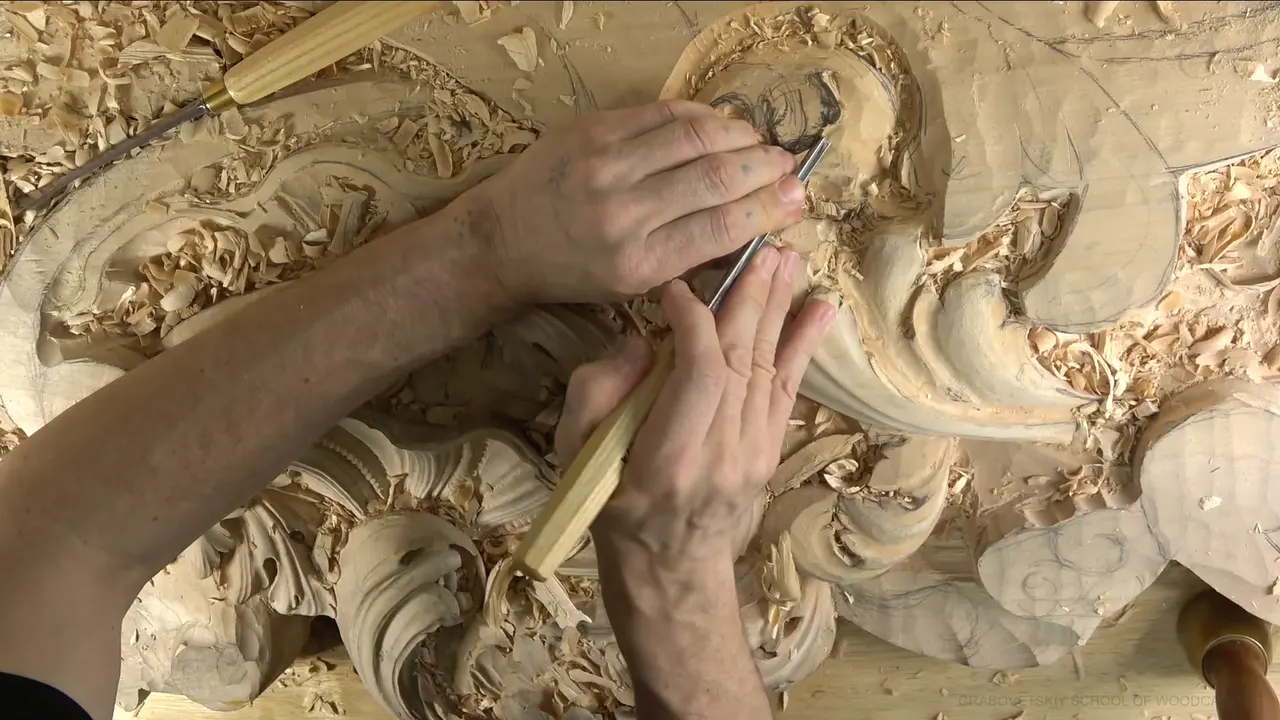
Somehow is the word I say when I can name the job and I do not yet know the way. In Venice Room part 27.3 I told the camera, "So I really need to get that deeper somehow." About twenty seconds later my plan had a tool in it: a number nine, 14 millimeters, half an inch or so.
Ever see a spot on a carving that is wrong, with no idea yet which gouge takes the wood off? Does the next pass feel like a guess? Stay with this one word of mine through my lessons, and watch what I do in the seconds after I say it.

Six jobs I named before I knew the way
One area in 27.3 needed more depth.
Workshop 38, part 10, needed me to reach the bottom of a shape.
Raising a part in workshop 60, part 5, was a job I could name but not yet solve.
One husk in the Hazelnuts course had to blend into the husk around it.
Two mistakes, one in workshop 59 and one in Hazelnuts, left me a fix to find.
A Furniture Panel lesson needed a curve repeated.
What does somehow mean in wood carving?
The job is clear and the way is still open: that is how the word works in the lessons below. In 27.3 I said it about one area, right after I named what was on my mind: "But what bugs me is this area right there."
Look at what came before it. Something was going on top, with a separation right there, and that part needed to be probably a little bigger (00:17). I would need an extra division, I said, and I apologized, because I was just thinking out loud how it would look (00:50). Where the point of that division would sit was still open too: somewhere right here, I said (01:09).

By 02:09 I had a preliminary outline. Sometimes it is hard to envision the detail, I told you, but I already had a picture in my mind. An eye was coming, one that would not show from the bottom, though you would still see it from the farther point of the room. By 03:09 I could probably excavate a little deeper around it. Then the area that bugged me.
What did the video do right after that line?
A tool, a size, and two short lines. The plan, I said at 04:21, was that number nine at 14 millimeters. Next came "Go in," and at 04:45, "Get this out."

A second job followed: another section to remove, and for that I could use a number seven and start doing it that way (04:53). The detail had to have a feel, I said, going like that, and that was the reason I was doing what I was doing.
Back at 05:43 the plan was the number nine again, to excavate this way. A limit came with it. Not too deep yet, because I still had to establish the final form of this movement, and later on I would go really deep.

By 06:47 I was saying: let me get this movement, and oh, so much material I do not need right here. The last lines are about the shape, full movement, really nice and full.
Did the same job come up in the parts next to it?
In both, and each time the tool changed. Part 27.2 has me saying I really needed to excavate much deeper in one area, otherwise it would not look nice, and that I needed to get rid of one part and go much deeper. Probably number 11 again, I said, or number nine.
Part 27.4 brings the need back at 07:20. I did not like the distance in one place, so the inside had to go kind of deep, because I needed that material. Otherwise it would look awkward. See the thickness of one division, I told you, how wide it is, and "that is a lot smaller." So that leaf had to go underneath, inside of the upper part, and the only way to do that was a really deep undercut.

One workshop, then, names the same need three times: a number 11 or a nine in 27.2, a nine in 27.3, and a really deep undercut in 27.4. That is workshop 27, and workshops 26 and 28 sit beside it in the same Venice Room course.
What do I do when I cannot get to the spot?
I name the spot and look for a tool that can reach it, then try one. Venice Room 44.9 opens with marks I did not want to see. Let me clean those, I said, and make one like that, which was undercutting pretty much. "I need to get to it somehow." I needed a spoon, though it did not have to be a number 11.
A small number three would probably do, since the spot was already undercut, and I could just remove that side. Inside of it, a number eight or nine is always a good idea, I said, to take the plug out and create a shadow. This one was a little too big, and I would go with two millimeters (about 5/64 in), number 11.

Over in workshop 38, part 10, one side had to feel completely round, growing from underneath and flipping this direction. I needed somehow to reach the bottom of it. Not every tool would be sufficient for that operation. A number one back bend would help me a lot, a little bigger one, like 10 millimeters (about 3/8 in). "So don't pay attention to zero," I said. It is still absolutely flat like a chisel.

Down in workshop 43, part 3, a warning rides along with the way in. I had to be careful how deep I went underneath, because there is a point when it is almost too deep, for a couple of reasons. One was making it too weak. The other was finishing it. "I have to get inside somehow," I said, and then, "And finish it." Soon after, I could excavate inside of those eyes with a small number eight, two millimeters (0.08 in) approximately.

What if I only know the part I do not want?
I say what I do not want, and the tool comes after. The size in Venice Room 60.5 is 2 millimeters (about 5/64 in), and I would just go on one of the sides, a little less pronounced, a little less exaggerated, if you wish. Then: "But I still want to raise it somehow. I don't know yet how."
A guess came next. Maybe I had to knock that part, because it was just sticking too much, the middle part of this acanthus. Nine seconds later: "That's exactly what I'm going to do." The tool would be a spoon, a number 4, a medium-bent one, and I showed a short-bent spoon beside it so you could see how short the spoon part is.

A chunk sat that far away in 46.8, and I was not really happy about it, so I wanted to hide it somehow. Let me get a little closer to that one, I said. A bigger number 11 would remove around, just a little bit, because most of it would be hidden anyway.
The first part of workshop 85 has a lowering job. One part had to come down somehow, and it would be a lot of lowering. To show that side is almost impossible, I said, so I guessed I would do it off camera again and just show the final picture of what is going to happen.

What do I say when I make a mistake?
That a fix is needed, and then I name the next step. Next, 59.7: micro tools could work right then, I thought, "although I made a mistake and see what happened?" It was not bueno. Now I had to find a fix, or create a bigger eye, and maybe I would just do a bigger eye.

A calmer version sits in workshop 82, part 9. I did not like too much what happened in one place. "I'll fix it somehow," I said, though I was not the biggest fan of what I saw in that section, so the fix could wait a little. For now: round everything up, and chamfer it.

The longest case sits in lesson 3 of the Hazelnuts course, part 1. At 03:41 it did not look right, as of now. It actually looked absolutely awful. That was the mistake, an error I made, and I had to admit that. "And now I have to fix it somehow."
The mistake came at the beginning stage, I said, and that was not good. For the depth I would go maybe one-eighth of an inch, about three millimeters deep, from that point to the inside. The same way on the other side, and hopefully nobody would notice. Only you and I would know it. Earlier, at 02:19, I had said those two nuts were going to be kind of small.

Can a mistake be saved?
I said I would try saving it first. The word came back at 08:32 with another job: "So I have to somehow blend the whole thing." I was not sure I would be able to, or maybe I had to chop the whole thing, glue a new piece on top and redo that. "But let me try first saving it." If there was absolutely no way, I would recreate the thing.

It turns up again at 16:53: "I need to connect somehow." This time the how follows right away. I can in-cut underneath of that side also, and leave that excavation a little deeper. Pretty deep already, I said, maybe half an inch on the inside. For me it was really important to connect that messed-up area with the rest of that movement.

Next door, in lesson 4, one side would go right underneath of the first layer, and "we'll make it happen somehow." A little later I needed to chop that part even more and make it more flowing. Later on I would blend it better, because I had a big chunk in my way.

How does somehow help with a design rule?
In one lesson it pointed at a spot where the carving broke a rule. In the Furniture Panel course, lesson 22, part 8, I looked at the curvature and the straight line right there. Just not appealing. It was not repeating, and I was breaking the law of repetition. "I have to repeat somehow this curvature and this element."
So I was going to create a little bit of curvature right there, so it had to repeat. Stuff like that I have to fix once in a while, right in the process of carving. If I did not catch it right away in the process of design, sometimes it happens, and once you carve, you have a lot more time to look at it, justify and adjust. Then I could undercut slightly to make it pop out, just 1 millimeter (about 1/25 in).

When is it not somehow?
When I already know how. In workshop 75, part 7, a hump looked not too appealing, so I needed to knock that down somehow. Then I stopped myself: "Not somehow. Of course, I know how I'm going to take care of it, but that is one of the things I need to do." A moment later: "I could use just a skew."
The Floral and Molding course takes the same turn in lesson 11, part 2. "So now I need to blend that somehow," at 00:42, then "Not somehow, I mean I know how." At 01:00 comes "let me blend it."
A third time comes in workshop 56, part 2. More movement inside, a little bit, still had to happen somehow, and right after: "Not somehow, but I still have to do it, okay. I got to do it."

What did somehow turn into in workshop 56?
A plain method. In part 5 I needed to create somehow a relief, because I could not go straight down with a spot in my way, so I needed a different technique. The plan was just little by little, with the same number nine, to relieve that area.
I describe the how at 02:03: with the same tool, little by little, one side, the other side, plug cutting, without forcing. One, two, one, two. After that I could excavate deeper, and I had to attack from three sides until I had plenty of space for the full rotation motion.

Which of my somehows do you recognize?
The table has the main ones, row by row. Each line is a different video. The middle cell holds the job I named, and the right cell holds my next words in that same video.
| Where | The job I named out loud | My next words |
|---|---|---|
| 27.3 itself | get one area deeper, then name a number nine | That number nine |
| Workshop 38.10 | get down into a shape that grows from underneath | Number one back bend |
| Venice 44.9 | get to a spot that was already undercut | Small number three |
| Room 60.5 | raise a part when I did not yet know how | Number four spoon |
| Hazelnuts 3 | blend the husk, and later connect the messed-up area | In-cut underneath |
| Venice 59.7 | fix a mistake, or make a bigger eye | Maybe a bigger eye |
| Panel 22.8 | repeat a curve that a straight line was not matching | More curvature |
If you carve, you have probably stood over a spot with a job in your head and no way yet. Does saying the job out loud help you find the tool? Would you write down the number of each tool I name after a somehow? Access to the course opens every part, and I tell you the truth about what each one shows.

How it's done
- Say the job out loud. In part 3 of workshop 27 an area has to go deeper.
- Pick a first tool. A number nine is the first tool named there.
- Hold back on depth. That video keeps the movement shallow until its form is set, then plans to go really deep.
- Try the save first. Hazelnuts lesson 3 plans to rescue the piece before recreating it.
- Park a fix for later. The video for 82.9 plans a rounding pass before the fix.
Frequently asked questions
Does saying somehow mean there is no plan?
Workshop 27, part 3, names a deeper area first and a tool soon after. Workshop 60, part 5, admits the way is unknown, then wonders about knocking a part down.
Is somehow the word when you already know how?
A hump had to come down in 75.7, and a breath later the word was corrected, since I knew how. The Floral and Molding course makes the same correction, then moves straight to blending.
Which tool reaches a spot that is already undercut?
In 44.9 a number three spoon would probably do, with an eight or a nine inside to take the plug out. For the base of a shape in 38.10, a back bend of about 10 millimeters (3/8 in) was the tool named.
What to carve next