

Alexander Grabovetskiy, woodcarver, School of Woodcarving · Published 2020
What does wrapping mean in wood carving?
Quick answer: Wrapping is the word I use when a carved movement turns around a form or slips underneath it, sometimes where you cannot see it. In Venice Room workshop 48, part 4, I plan a double wrapping that grows from underneath. Other lessons give it a depth, a curve and a grain warning.
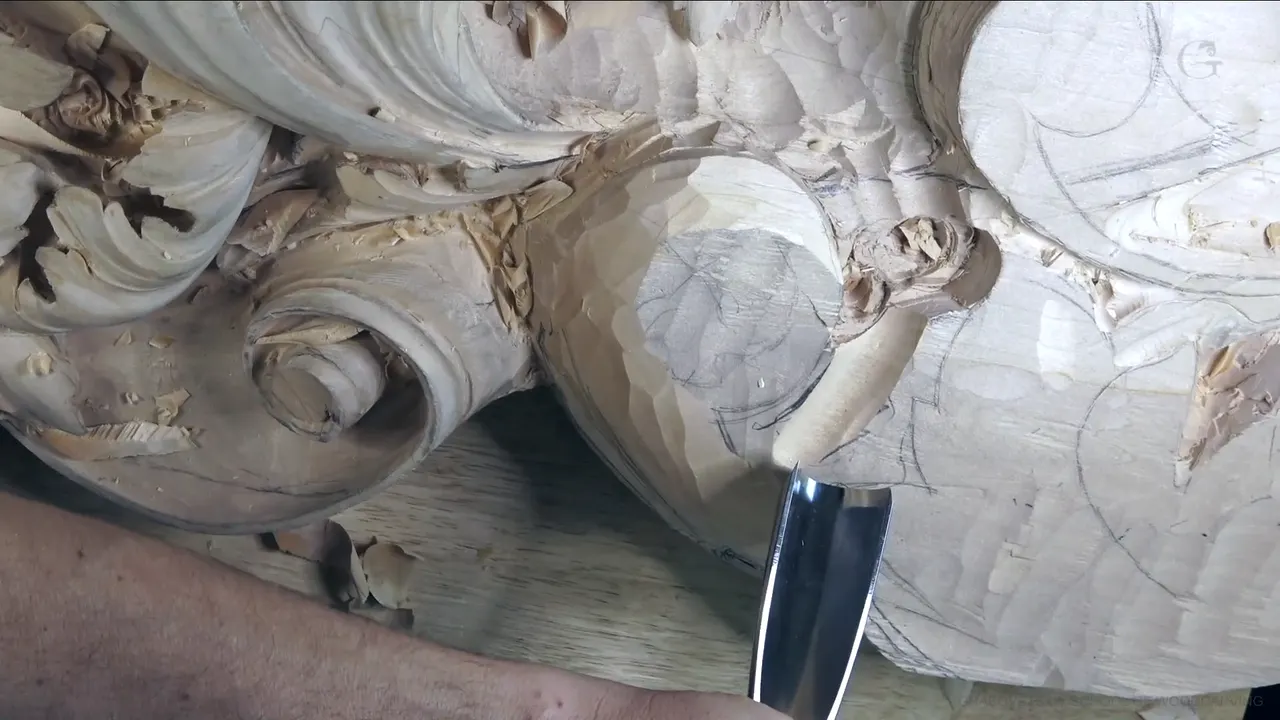

Wrapping is my word for a movement that carries on around or underneath a form, often on a side the camera cannot show. Part 4 of Venice Room workshop 48 has me planning a double wrapping that would grow from underneath.
Ever looked at a carved leaf and wondered where its end goes? Does it turn, drop under another shape and come back out somewhere you cannot see from the front? Here, the word comes up three times in the 453 words of part 4. I went looking for it in my other wood carving lessons. It turned up in the lessons below, with a depth, a curve and a grain warning attached.
What did I plan for the wrapping in part 4?
The part opens mid-thought. "Or maybe, what I should do, and I think it's going to be a good idea, I could develop the same idea of wrapping like that, like a double wrapping, going on this side which you don't see. I apologize."

A plan, nothing more. This second wrapping would grow from underneath, and that way I can keep this outline and roll it. A few seconds on comes "Maybe," and then "That's what I'm going to do." By 00:51 I tell the camera it should give me a chance to tie together two elements, this one and that one.
Only the bottom would get rolled. "And roll just the bottom of it, okay?" comes at 01:03. That way, I say, it would be much easier to establish the nice movement right here. The spot needs some space, and I still have to decide what that moment should show, because there are multiple ways I can establish it.
Which tools did part 4 use for it?
The waste goes first. A big number 11 of 30 millimeters (1 3/16 inch), a wide gouge, will take it out, I say at 01:50. Maybe right away I chop a little bit this way, I say at 02:43.

Near 03:00 I think I should go deeper right here, "because I really want to see a full motion." Next comes something I don't worry about, since it still has to be gone anyway. Where the movement ends is what bothers me.
A line about the bottom comes at 04:22. "I think I got really nice idea how I'm going to wrap it inside. On the bottom, I mean." Hard to understand if you don't see it, I say, and I leave the camera where it is for now.

By 05:13 the side has to match the opposite one, so I can excavate deeper, much deeper, and get more of a chance to develop a nicer head of acanthus. A tool follows. I ask myself if a big number seven will fit, and the answer is "Yes, and I am." It gave me a really nice movement at once.
I call that work clean and nice at 07:00. It should be about the same as other movements I've done before, in line with them. Then comes "let me make it round."

The parts around it add two lines. A couple of concaves, I plan in part 3, would go underneath to create that feel like it's grown from underneath, and part 7 has me checking whether it reads as wrapping, with a high spot I don't really like. A number 7 helps there, and then it's more gradual.

What does wrapping need on the inside?
It needs wood taken out beside it. Nothing is final yet. In Venice Room 51, part 1, I say a movement will go and wrap on the inside, so I have to excavate on the side and create what I call a semi-final form.

A tough spot, I say, because there is a ceiling again. "I'm hitting the ceiling." I redraw the line and tell the camera that another development will sit underneath, and I want to keep it. My plan is a number 11, 7 millimeters (0.28 inch), and an outline.
The same worry shows up in Venice Room 50, part 11. "I don't want to lose that part because this bottom wraps an inside going like that." My plan there is to reestablish my movement, then undercut. I admit it is a little confusing, and once it's done, you'll see how beautiful it will be. A ridge counts too, because this movement is part of that development, and I do not want to lose the ridge.

How low must a part go to feel like wrapping?
The figure comes from Venice Room 71, part 1. "To make it feel like it really wraps, I have to lower this part all the way to 1/16 of an inch." That comes to close to 1.6 millimeters, and I say that is what I left right here, so I have to be careful.

Then the bottom. The thickness I plan to leave there is three millimeters, like 1/8 of an inch, and that way my deep spot would sit about 1/16 inch down. Maybe even more, I add, and about five millimeters (0.2 in) is what I plan to leave. How deep to go there is a big question, so maybe I improvise a little.
The curve matters just as much. In the next part of that workshop I say, "I want to make sure that it has some curvature, just goes inward. Otherwise, it's not going to feel like it is wrapping." It has to be slight, not huge. A few seconds later, I say, it does wrap around.

The end of part 1 repeats the verdict, and a triangle there needs to flow on inside. Since you can't see it, I try a different view.
Where does a full motion fit in?
I use that phrase in part 4 too, and Venice Room 56, part 4, goes further. "What I'm after, I want to create a full motion. I want to create that piece that just feels like it's wrapping underneath." Because I have plenty of space, I could take a number 11 skew veiner, after naming a skew gouge and a skew chisel first, and scoop out whatever I need.

A worked example sits in Venice Room 54, part 7. It created that really nice movement on inside, like wrapping, I say, though I used a small tool. I wondered if a number 9 of 5/8 of an inch (16 mm) would fit, then answered myself, "it's not going to work." A number 7 of 14 mm (0.55 in) was much better, without rushing anything and without forcing anything.

Can a second wrap sit beside the first?
Venice Room 64, part 2, says it can, and the line is short. "I have wrapping going on, okay? This part wraps on inside and wraps beyond that piece. But I also have a secondary wrap, which is this one." Then I plan to bring it one way, and I decide I don't have to go far, because I can probably stop somewhere right here. Maybe yes, maybe not, maybe a little farther.

That one is also "some kind of wrapping." I plan a number 11 at five millimeters (0.20 in), and I call the outline preliminary, since some concave on inside comes a little later.
A marker comes first in Venice Room 70, part 5, where I will probably use it to indicate my movements. "Let me start my wrapping somewhere right there in this area." Then it wraps around to the opposite side, and acanthus will grow from it.

One movement I don't like, so no division will go toward that side. My divisions will go only toward the main body. That would give me "really beautiful wrap or wrapping movement," and I plan to take the same number 11 I used before, ten millimeters (0.39 in), probably.
Does wrapping change how the whole piece feels?
It did, and Venice Room 53, part 3, shows how. "I am changing my design, okay? Not changing design, it's still same flow, but I am changing little bit how it's going to feel overall. Okay. So that is going to wrap." I like the idea that I moved my middle line in this direction. It will stay feelable, invisibly, below this movement.

Another chunk, I say, will carry "exactly the same idea, just wrapping, okay?" It will roll inside and underneath.
Camera position comes up again in Venice Room 84, part 1. From different angles, I plan to show how it looks, and now it should make sense. It's actually wrapping around, going this direction. The camera sits a little away, so you don't see how it is supposed to look, and later on I'll make a picture. The piece wraps, goes that direction and falls back to the main body.
How deep should the point of a wrapping go?
Venice Room 56, part 11, has a point too, and I say it is coming and "that has to wrap." I do not want really deep excavation at this point, but I'm not sure, and maybe I will do it, maybe not. That leaves the depth open, so we'll see. What I can do is define that separation and start the eye of acanthus, preliminary.
Little material is left in Venice Room 70, part 6. I still want the feel that this part wraps around that element, so I need a place to begin. A skew follows a little later. Any tool will work, I say, but I like the idea of using skews.
A shorter one sits in Venice Room 81, part 8. "The idea is to make it go like this and then wrap it." That means undercutting a little more, and I go this way.
Does the grain change when a piece wraps?
Workshop 91, part 2, says it does at 00:14. "I do have to keep an eye the grain direction because it does change. It changes because it wraps around and the grain does all kinds of weird stuff." That is the grain warning.

Depth comes up in Venice Room 83, part 10. One side is approximately an inch (25 mm) deep, I say, so I can wrap it nicely and make it rounder. "When you start wrapping, you're losing the true dimension." Then a piece that is supposed to stick out. "But which one is it? That is the question."
About an inch and a quarter (32 mm) I can take down with no problem, I think, but I plan to round this side. "Fillet it, if you want to say it that way."

The word grows in Venice Room 87, part 11. "It's already one side, two side, three side, and it's still going to be visible for four sides, wrapping around, almost 360, if you wish." A part I plan to work later runs on backward from one point. It just wraps around four sides pretty much.
Do flowers and moldings wrap too?
A flower part in Lily Box 12, part 4, is supposed to go over another part. "So it's supposed to just kind of wrap it." One part goes underneath the lily flower, and I need to lower this section. Another part will wrap around the main acanthus movement.

Acanthus Over Moldings 4 has one line. The part is going to go like wrapping around that molding. That comes right after I plan a division on another side.
Wrapping can also fool the eye. Another one is in Venice Room 47, part 8, where I could probably get the illusion that a piece wraps from underneath, a really nice technique, I would say.
And in Venice Room 43, part 1, an eye will wrap around and go down. So I could create a much deeper concave there, one that could be exaggerated, and it would give the human eye some area to follow.
The table puts a few of these places side by side.
| Place | What wraps there | What I say about it |
|---|---|---|
| Workshop 48.4 | A double wrapping, out of view. | I mean to roll just the bottom. |
| Lesson 50.11 | The bottom wraps inside, and I keep it. | My movement gets reestablished first. |
| Venice 51.1 | One movement goes in and wraps around. | The wood beside it has to come out. |
| Room 56.4 | A piece that feels like it wraps underneath. | I want a full motion there. |
| Room 71.1 | A part lowered until it wraps. | I give one exact depth for it. |
| Part 71.2 | A slight curvature, not a huge one. | Without it, it won't feel like wrapping. |
| Lesson 91.2 | A piece that wraps around. | The grain direction changes where it wraps. |
| Lily Box 12.4 | A flower part that covers its neighbor. | Another part goes underneath the lily flower, and I lower this section. |
What do I take from all of this?
In part 4 wrapping is a plan for a side nobody sees, and the other lessons give it numbers and warnings. A shallow depth comes first and a slight curve second. Grain turns strange. A form can show four sides. The idea is only said aloud in part 4.
Which part of the piece on your workbench goes underneath, where a camera cannot see? You can find part 4 on the lesson 48 page, beside its eleven siblings. For all my lessons in one place, start here.
The Venice Room course for workshops 38 to 49 holds this carving, and each lesson above holds the line I quote. Every size on this page is mine, with a conversion beside it when I gave only one.
How it's done
- Mark where the wrapping starts. A marker comes first in workshop 70, part 5, to indicate my movements, and my wrapping starts in that area.
- Take out the waste. The waste area is the first job in part 4, and a wide gouge handles it.
- Keep the curve slight. Curvature goes inward, slight and not huge, in workshop 71, part 2.
- Lower the part. My figure in workshop 71, part 1, is 1/16 inch (about 1.6 mm), so the part wraps.
- Watch the grain. The grain direction changes where a piece wraps around, so I watch it in workshop 91, part 2.
Frequently asked questions
Where did the double wrapping go in part 4?
On the side you don't see, and I apologize for that at 00:21. Further on I tell you it's hard to understand if you don't see it, and I leave the camera where it is for now.
What bottom did I plan in workshop 71?
I say I have to lower that part all the way to 1/16 of an inch (about 1.6 mm), so it really wraps. At the bottom I plan on three millimeters (about 1/8 in) of thickness, or maybe five (0.2 in).
Why does the grain act strange on a wrapped piece?
I keep an eye on the grain direction in workshop 91. It does change, I say, because the piece wraps around and the grain does odd things.
What to carve next