

Alexander Grabovetskiy, woodcarver, School of Woodcarving · Published 2020
When does a wood carver carve a part right away instead of waiting?
Quick answer: Right away is the phrase I use for a carving step I do now instead of leaving it for later. In Venice Room 48.9 it covers lowering one part, an outline and a low spot. In my other lessons I also say when a step should wait, and I give my reason.
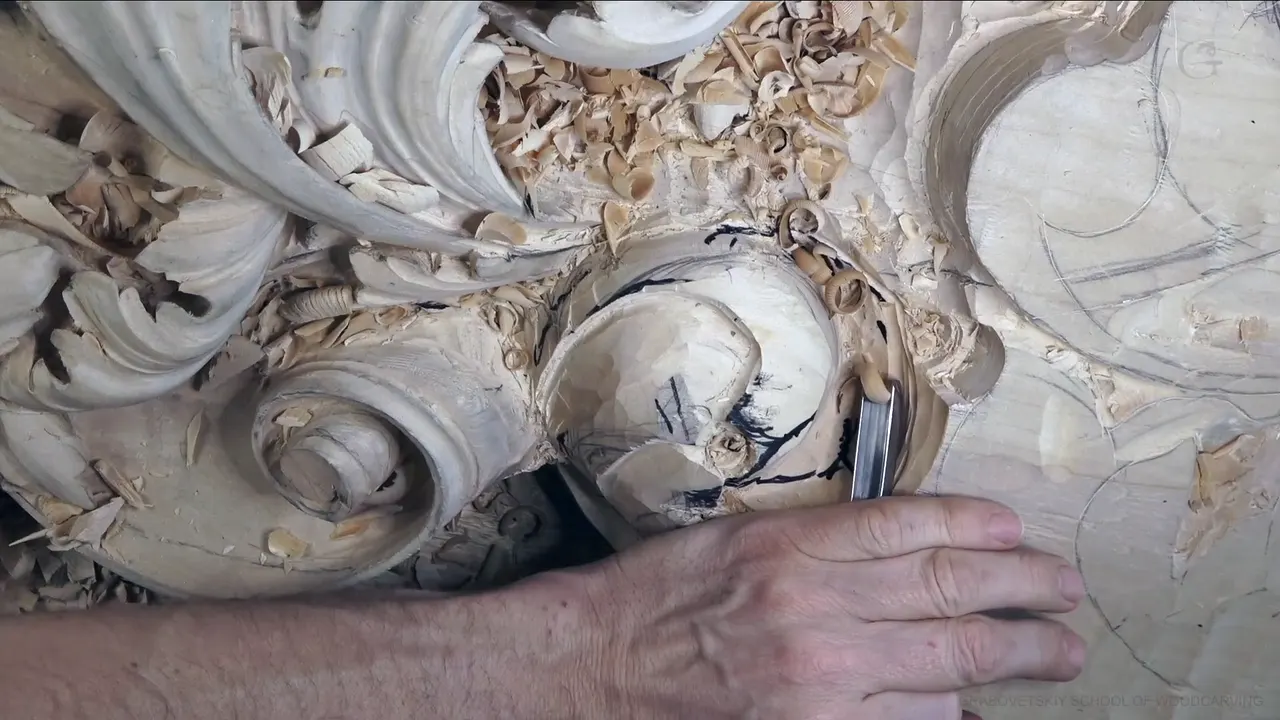

The words "right away" mark a wood carving step that happens now, before the work moves on. In workshop 48 of the Venice Room, part 9, it lands on a high part I want lowered, an outline, and a low spot. Other lessons use it for a bump I fix the second I see it. In the grape leaves course I take it back.
Ever seen a spot you don't like on a carving at your workbench? Did you fix it then, or tell yourself you would get to it later? This part is short, 407 words, so twelve more of my lines sit beside it, from other parts and other courses, and each one is linked.
What do I mean by "right away" in part 9?
It comes up five times in this seven-minute part. It first shows at 00:07: maybe I have to just lower it right away, pretty much, and the reason follows in the next breath. A second thought comes after it: "It could be raised, but not as much."
Right there underneath, I say at 00:51. The words come back at 01:04, this time about a line. Get this outline right away, too. By 01:19 I'm saying "And that is wonderful," and at 01:21, "Okay, so I'm happy with that." Maybe just slightly cleaning up the movement is the next thought.

Then a plain note. "It's not the final form, as you understand." One part has to go underneath, so it's going to be much, much lower, and I could take care of it right away.
The tool comes next. I name 30 millimeters (1 3/16 in) again, a number 11, to make it low right away. By 02:30 it's "Now it's going to make sense." That part is going underneath this moment. I hope it makes sense, I say it should make sense twice, and then I plan to outline it a little better.
Why lower that part before anything else?
At 00:11 the first reason is that it doesn't make too much sense raised up like that. A minute and a half later the reason has changed, and the part simply has to go underneath.
No depth is given for the lowering. Where it goes next is clearer. We're going to start attacking those movements, I say at 03:15.

Which tool followed the low part?
A spoon, going uphill. First I name a bigger number 11, maybe 18 millimeters (0.71 in). A change of mind follows, since I have to go upward, uphill. That calls for a spoon, maybe 15 millimeters (0.59 in), I'd say, and then "go upward like that."
The same upward move is next on another spot, I say: "Just go upward." Then comes the reason. That's actually what I'm doing, I say: pre-establishing the division, since one of the sides is supposed to go up anyway.
A reminder from earlier lessons sits behind it. The acanthus leaves I explained had a really common convex in the middle, with a concave on one side and a concave on the other. That's what I'm pretty much doing here.

The fifth one comes at 05:21: "And right away, right here, too." Then, at 05:36, "Okay, wonderful."
A little concave on this side, too, is something I say I could do at 05:38. It's "So also concave" at 06:11, and at 06:16, maybe actually a little better this way. A straight tool was possible, "but I didn't." The spoon is what I used, I say at 06:48, and now the work needs blending, because it's a really pronounced ridge and I don't need that.
Two tools come to mind, a number six or a number five. The five goes first, I say, because I need convex, and the last line, at 07:27, is "And let me see."

What do the next two parts add?
Part 8 comes right before mine and opens with one part rolling underneath another. Later I tell you I was just trying to catch the main shape, and I think I did it. Eyes and divisions underneath are still ahead, but the main form is there.
Then I say let me get the marker, so you will understand: one part goes right underneath a movement. That way there's no empty spot right there. A smaller tool crosses my mind, and then I go the other way: maybe even bigger, not smaller, because I want a really nice transition. So 20 millimeters (0.79 in), I say. Near the end I say I don't need that high, but preliminary I can just outline it.

In part 10 the timing words are "now I can." One comes at 00:50: "now I can probably start creating my divisions." Later the concave may come out a little exaggerated, and I'm okay with that, as long as I have that really nicely raised up part. Once the division is nice and somewhat big, it makes me happy, and I can probably go on inside with no problem.
Near the end of part 10 I say I could probably hit straight down like that, and the reason is that nothing is going to hurt me, since I have a big chunk of material, so I should be safe. I'll be able to see much better where I'm going, at least.
When do I fix a problem as soon as I see it?
A sideways look starts Venice Room 2, part 9, and what I see is that this bumps too much, and that's just no good. Looking from all the sides is really important for me, and when something needs fixing, the better time is right away.

The clearest version is in Venice Room 4, part 5. I need to place my line back, and I see a problem I don't like. "This is not flowing nicely," I say. It's not a final line, but if I can catch it right away, I can always fix it right away. At least it's not going to bug me.
Then comes a choice about going deeper. Driving a gouge straight down is going to stress too much fibers on both sides, I say, so it is always better to use a gouge first, like a number 9 or number 11, and get closer to the line. The long bend I name is a number 11, about half an inch (about 13 mm). A spoon gouge would do, too. Chopping a little bit comes first, I say, and that becomes my background deeper spot.
I wish I had moved sooner in Venice Room 5, part 7. I just got too many lines, and it is not good, so I say let me double-check my curvature. "I don't know why I didn't do that right away, because logically I should." Next would be a number 9, or even a number 11 at 3 millimeters (0.12 in), for concaves on the side.
What makes me hold a step back?
Both ideas sit a minute apart in Furniture Panel 19, part 2. I mark a part that is going underneath, and then, maybe right away I can just give a little shape to that volute. The tools are a number 7 and 4 millimeters (5/32 in). The detail waits for later on.

Next I say I'll hit another side, but only partially. I mean only part of it, not the whole design, because I still have to develop that volute. Here is the rule in my own words: if I don't need to do it right away, there is no reason to rush it. I'll gradually lower it down.
The same patience shows up in a tool in Furniture Panel 15, part 2. A router plane will help me make the final cut, I say, but I don't want to really use it right away. With just the gouges I can always remove a lot of the material. For now the depth is one-eighth of an inch (about 3 mm), no more than that.
My example is a number 9 at 10 millimeters (0.39 in). The line needs care, because you really need to keep that high spot for the router plane to get the support.

The Vase with Grape Leaves course, lesson 1, part 8, opens with a reversal: if I use a knife, I have to start separating the main separations right away, pretty much. Then: "And I don't want to do it right away." Next comes outlining: I say I can take a 3 millimeter number 11 (about 1/8 in) and start by just outlining, carefully. The middle stem line goes about 1/16 in (1.6 mm) deep, and I remind you I said there's only 6 millimeters (1/4 in), so a problem I can't fix later is what I'm steering clear of.
The Flower Rosette course, lesson 2, part 4, has a smaller case. I could take my background tool right away, but I think it would be easier for me just to create multiple cuts first. A minute later, I say I can take my background tool now, our grounding tool, I add.

Where else does "right away" turn up?
Two in a row come in Venice Room 45, part 3, and the first one is about shape. I can probably give a shape to a part right away. A few seconds later I can actually undercut, because I like the movement and I'm not going to reshape it.
Maybe just slight concaves, I say, not big ones, so an undercut that early doesn't worry me. A nicer undercut is possible, and a deeper one.

An eye I can do pretty much right away turns up in Venice Room 56, part 2, with a note to myself about which way to go at it. Another area gets the same treatment a few seconds later. After that it's time for a number five, to start creating really nice roundness around the shapes.
A size change shows in Venice Room 42, part 9. A 7 millimeter tool (0.28 in) is probably too big at this point. So I name 3 millimeters (0.12 in) right away, and a deep shadow is the plan, cleaned with the 5 millimeter spoon (0.2 in). I think I love what I see, I say a few seconds on.

What about a part I decided to leave for later?
In Furniture Panel 18, part 12, the order flips. Done, at least for now: a number 3 at 6 millimeters (1/4 in), and I'm going to leave it like that. We can take care of that a little later. Then I change my mind. I ask why I don't attack it right away, and I'm pretty sure I can do that now.
A bigger number one is the tool I name for my indication cut, and later a number two comes, to kind of outline right away.

A similar switch about an area happens in Furniture Panel 21, part 1. Let me attack right away this area here, I say. I'll change position and come at it from both sides, without pushing all the way. One more spot is waiting, so I kind of have to attack right away.
How do these moments line up?
Each time I give a reason, and the reason changes with the lesson. In 48.9 the raised part made little sense, and earlier a bump or a line didn't flow. On the volute I don't need the detail yet. The table sets them side by side.
| Where | Timing | Tool |
|---|---|---|
| This part, 48.9 | A part raised too high may get lowered at once | Number 11 |
| Venice Room 4.5 | A line that does not flow gets fixed when I see it | A long bend |
| Workshop 5.7 | I did not do it at once and I say I should have | A nine or eleven |
| Part 45.3 of Venice | A shape I like, so the undercut can come early | A seven, upside down |
| Venice 42.9 | A 7 mm tool was too big, so I name a small one | A small tool |
| Furniture Panel 19.2 | No need to do the volute detail yet, so no rush | Number 7 |
| Grape Leaves 1.8 | Main separations wait, and I outline first | Number 11 tool |
| Flower Rosette 2.4 | Background tool waits for a few cuts | Background tool |

Where can you watch these steps happen?
Workshop 48 of the Venice Room has twelve parts, and I used part 9, with parts 8 and 10 beside it. The Part 4 course covers workshops 38 through 49 of the Venice Room.
A bump on your own carving? Ask one thing. Is it something to fix at once, or something that can wait? A gouge is a curved chisel, so pick yours up and decide for that one spot.

The tuition opens every workshop in this room, so you can hear me say these words in the footage. One small thing from part 9: I apologize for the light, at 05:56.

How it's done
- Look at the part from every side. In Venice Room 2 I saw a bump while looking from one side. Looking from all the sides is really important for me.
- Say what is wrong with it. In 48.9 I wanted the part lower, and in workshop 4 a line did not flow.
- Decide if it must be done now. A step that isn't needed yet gives no reason to rush, as I said on a furniture panel volute.
- Name the tool before you start. I named a number 11 for the low part, 30 millimeters (1.18 in), then a spoon, about 15 mm (0.6 in), to go upward.
- Blend what the tool leaves. The spoon left a really pronounced ridge, so I said I needed to blend it, and I planned to try a number five first.
Frequently asked questions
Why did I lower one part first in Venice Room 48.9?
I said it made little sense raised that high, and that it could be raised, but not as much. Later in the part I add that one part is going underneath, so it will be much, much lower.
Can you fix a carved line the moment you see it?
In my fourth Venice Room workshop I saw a line not flowing nicely. In that workshop I said I can always fix a problem if I catch it right away.
Why would I wait on a step?
On a furniture panel volute I said what doesn't need doing yet can wait. With a router plane I said I'd rather not use it yet, since I can remove a lot of the material with just the gouges.
What to carve next