

Alexander Grabovetskiy, woodcarver, School of Woodcarving · Published 2020
What does "the main idea" mean when a wood carver says it while carving?
Quick answer: The main idea is a plan held in the head for the way a part should go, carved in big before clean-up and undercutting. On a Venice Room acanthus head I said I had a main idea, and the first pass, with a big number 11, was only preliminary movement.
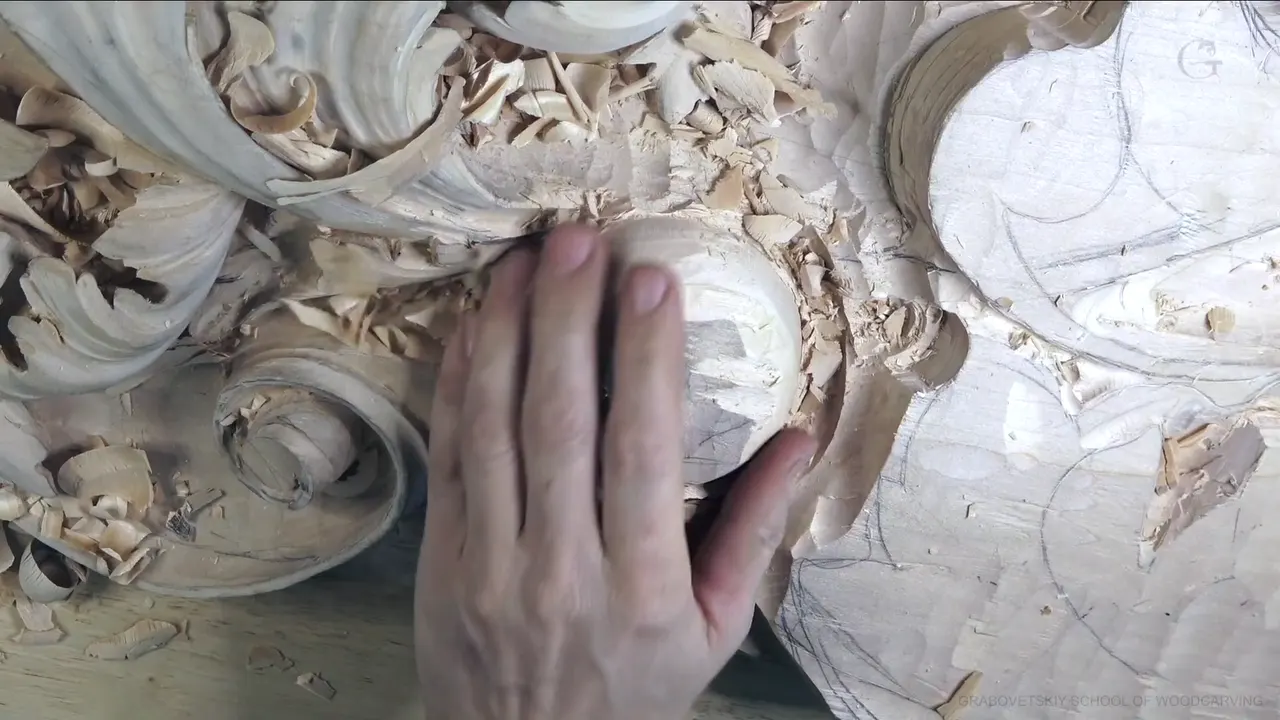

The main idea is the plan I carry for how one part of a carving will go, set into the wood before the details. I say it 34 seconds into part 5 of Venice Room workshop 48, on an acanthus head. The first pass after it, with a big number 11, was not undercutting. Preliminary movement, I called it.
Have you ever held a gouge over a block and not known which way the next pass should run? Or finished one spot clean, then found it no longer fit the rest? The plan comes before the pass. This part runs 460 words and says main idea once, so I went through my other wood carving courses and read the places where I used the same words. Twenty-two more video parts sit on this page, each with what I was carving and what I said, plus a link to its lesson. If you came here to learn how to plan a wood carving, this is one piece of it, the piece that happens at the bench with a tool in your hand.
What the main idea comes down to on these boards
- It's the plan for one part, carried in my head before the wood shows it.
- On this head its first pass gave preliminary movement, not an undercut.
- Clean-up and undercutting wait until it's there.
- Once it's set in, I don't want it lost.
- On an old table apron, the main idea was the original carver's, and I followed it.
- In design talk the same two words can name the hero of a whole composition.
What happens in part 5 of workshop 48?

The piece is an acanthus head, low on a relief board, with a carved shell to its left. I call the spot a little challenging, then take it back. Not challenging, but I have to be careful with it and control how hard I'm pressing.
Then, at 00:34, the line this page is about. "Now, I have a main idea of how it's going to go." Eight seconds on, I say I can probably start developing the movements.
Space comes first. "I know you don't see that from the camera point," I say, but I left about 10 mm (3/8 in) from the outside and placed a line. My plan from that line is a movement going in, logically up, up, up, and then rolled.

The first tool is big, an 18 mm (about 11/16 in) number 11. It's not undercutting, I say, but preliminary movement, and this side also needs to roll downhill. Then a short aside. That roll is one of the ways to finish up the bottom of a piece, or the top if you're working on a bedroom set or something like that. One of the solutions.
Rolling it a little bit in is my plan at 02:17, because it has to have that nice shape. It also has to be really nice, and right now it looks like a straight line. "It has to go with all the design together."

I outline a little better at 03:09, and at 03:32 I tell you it looks kind of extreme, but it is not. Seven seconds later I half take that back: it is extreme, but it's not really.
The tools change fast after that. "Use number one," I say at 03:45. Then skew at 04:02, because I got to use skew again, and at 04:21 I think I probably have to turn to little smaller number 11s.

At 05:04 I name the stage. "So what I'm actually doing, I'm just creating the main shape." I also add that I know sometimes it's just kind of hard to see at the beginning, but I already have an idea in my head. Twenty-four seconds after that I say it again, in fewer words.
I go carefully, little by little, and at 06:02 I want to get rid of the big marks, because I really don't want to see them. At 06:32 the plan is to chamfer it, slightly, slightly, and go in completely. Nineteen seconds on, I say I don't have to. Maybe I should just leave it like that for now, I say, and see what else I can do with this area.

The part closes on a choice. There's a couple ways I could develop this side, I say, if you look at the leaf: going all the way like that, or only partially, some of it going this way and some going that way. What decides it is the movement of my middle line. The part ends there.
Is the main idea the same as the main shape?
Close enough that twice on this page I use both words for one thing. Carving the chamomile and bow rosette, I said, "I've got the main shape, main idea," with a little cleaning still to come later. In Venice Room 53, part 7, I said I had the main idea, then named it: a concave, convex, concave, the main ones. I called that the main shape, if you wish.

In part 5 the two come apart: the shape is what the wood shows at 05:04, and the idea is what I already have in my head while the wood doesn't show it yet. The same workshop splits them in part 4 too. I'm just establishing the main form first, I say there, and ten seconds later I think I've got a really nice idea how I'm going to wrap it inside. Part 1 talks about the main form, and all twelve parts are listed on the lesson 48 page.

When does the main idea go into the wood?
At the setting-in stage, on several of my boards. On the Corinthian acanthus leaf I called the outlining setting in, and said we actually set the main idea in, with just a number nine in my hand. The card on screen says 20 mm (about 0.8 in). A minute later I added that I'm not going right on the line. Staying away from it was the point.

The Roman acanthus went the same way. I took a big number eight, one inch (about 25 mm) to be exact, to work around the leaf, and called that stage setting in, where the main idea goes in place. The design runs almost to the edge there, so I had to work carefully.
I said it twice in five seconds on the grape leaf vase. I'm pretty much just setting in the main idea. Then again, the main idea, setting in.
Venice Room 53, part 2, put a brake on setting it in. I didn't want to go too deep, because I still had to develop something between two high spots. Too deep an excavation there would leave too much of a void, and that's no bueno, I said.

Why does the clean-up wait for the main idea?
Perfection can come later, and I said so in workshop 38. I could go and clean everything and get it to perfection, I said in part 6, but for me the main idea comes first, or the main goal, I should say: first establish the main movement.

The same thought opens workshop 57, part 10: I don't worry about cleaning all that mess yet. All I worry about is to pre-establish the main idea. A lot deeper excavation, probably right in the middle, was my plan for later on.
The undercut waits in workshop 49, part 9. I'm not going to undercut yet, I said, so no carving too deep, just a little, to establish my main idea. Later on I will go much deeper and do a much better job. After that I planned a 25 mm (about 1 in) number seven to clean that area a little, and said a six, an eight or even a nine would work. It all depends what you're after.

Workshop 46 gives the reason in one breath. Before the second concave goes all the way, I still have to undercut, so this pass is just preliminary, and I'll have to fix it once I undercut everything. "Just to give a main movement, just to give a main idea."

A lot of cleanup still needed doing in workshop 40, part 9, and I said I can do that off camera. Cleaning inside, taking care of the mess. What you should see there is the main development, the main idea.
Back in Venice Room 13 I said I can always go and clean underneath, and that the main idea was established. My next pass was preliminary, with a number 11, after first calling it a number 12 by mistake. It needed sharpening, I guessed.
And on the Greek acanthus leaf I stopped there for the day. We would find different shapes and refine everything later on, but for now I already see the main idea, so that should be plenty for today.

Can you lose the main idea once it's set in?
You can. At the lowest part of the overall design on the furniture panel, I said it straight. Again, I don't want to lose my main idea, main movements. What followed was just kind of outlining.

Workshop 49, part 3, shows how it slips. Everything there is supposed to go to the center line, the pipe included, and because of that we are losing the main idea right here. Then I correct myself. Well, not really losing. We're going to establish it, I say, with another separation, another eye and an invisible separation inside. That way it's going to give me logical movement, and I'm not losing this ridge.

Over in workshop 38, part 7, keeping my middle movement counted as the main idea for that one, and my plan was to move it slightly to the right side.
What if nobody else can see your main idea yet?
I had that problem in Venice Room workshop 56, part 3. I know it didn't make any sense at the beginning when I developed the idea, I said, but I kind of had that idea already in my head, and I knew how it was going to look. My plan after that was to excavate completely underneath that section, so it would almost fly in the air. Then it would look good.

Even in part 4 of workshop 48 I ran into it. I was going to wrap the movement inside, on the bottom, and I said I know it's hard to understand if you don't see it, and I wasn't going to relocate the camera right then. The line about my head came five minutes into part 5, right after I named the stage.
Whose main idea do you follow on an antique piece?
The original carver's. Working on the dining table apron, I was trying to find the biggest parts of the original carving and reestablish the main idea. Eighteen seconds after that came the rest. I have to make sure I do exactly what the original wood carver did. I really like to work on antique furniture. It has some history attached.

Further along the same apron it got shorter: just follow the main idea, whatever the original carver did. "Main idea," I said, "is the big idea."
Is there a design meaning too?
There is. On a Grinling Gibbons tulip in my Maine class, I called the flower the focal point. "That's the main guy. It's the main idea." The hero of the design, and the tulip is the highest spot. The flower cluster on the furniture panel bouquet was the main hero of the overall composition, the main idea of overall movement.
Picking that hero is design work, and the furniture panel design course covers it. In the places on this page, at the bench, the words mean my plan for one part of the ornament.
Where else did I say main idea, and what came after?
| Place | My words just then | What came after, or what had to wait for later |
|---|---|---|
| This part, 48.5 | So what I'm actually doing, I'm just creating the main shape. | Big marks next, then two roads. |
| Room 38, part 6 | Main idea first, or the main goal, I should say. | Cleaning to perfection, later on. |
| Venice 46.7 | Just preliminary, then I have to fix it. | The undercut, then a fix. |
| Room 49, part 9 | Not too deep yet, just a little. | Later, much deeper, a much better job. |
| Venice Room 57.10 | All I worry about, just pre-establish the main idea. | Deeper excavation in the middle. |
| Part 5 course, 53.7 | I've got the main idea, concave, convex, concave. | The middle line, to recreate. |
| Greek acanthus 2.4 | For now, I already see the main idea. | Different shapes, refining everything. |
| Corinthian leaf 2.2 | So we actually set the main idea in. | Stay away from the line. |
Where can you watch part 5?
You'll find part 5 beside the other eleven parts on the lesson 48 page, and the Part 4 course runs from workshop 38 to 49.
Is there a spot on your bench you can already see in your head? Can you feel which way it should roll? Set it in big. The clean-up can wait. For all my lessons in one place, start here.
One small thing from the start of part 5. Before any word about a main idea, I was watching how hard I was pressing.
How it's done
- Hold the plan first. At 00:34, before any movement on this head, I already had a main idea.
- Mark the space. A line went in about ten millimeters (3/8 inch) inside the outer edge.
- Set the movement in big. My first gouge, a number 11, gave preliminary movement, with no undercutting yet.
- Build the main shape. I said use number one, then that I got to use skew. By 05:04 the main shape was what I was making, the idea already in my head.
- Stop and weigh this side. Maybe I should leave it like that for now, I said, and I named a couple ways to develop this side, decided by my middle line.
Frequently asked questions
Was the main idea drawn on the wood?
Part of it was, on this board. I left about 10 mm (3/8 in) from the outside and placed a line there. The rest I carried in my head, and I said so twice in part 5: hard to see at first, but I already have an idea in my head.
Which gouge went in first on this head?
A number 11, 18 mm (about 11/16 in) wide, and I called that pass preliminary movement. Not undercutting. The Corinthian leaf got a number nine, 20 mm (about 0.8 in) by the card on screen, and for the Roman leaf I took a number eight, one inch (about 25 mm) to be exact.
Should you undercut before the main idea goes in?
I held it back in workshop 49. No undercut yet, I said, and no carving too deep. Later on I will go much deeper. In workshop 46 the pass was preliminary, and I'd fix it once I undercut everything.
What to carve next