

Alexander Grabovetskiy, woodcarver, School of Woodcarving · Published 2020
What does a wood carver mean by "single leaf"?
Quick answer: A "single leaf" is what I called my block in Venice Room workshop 77, part 1: a rib, a folding shape, and small details and separations still to come. Other lessons carry the same idea for a flower's leaf, a simple leaf and a leaf I wanted to divide.
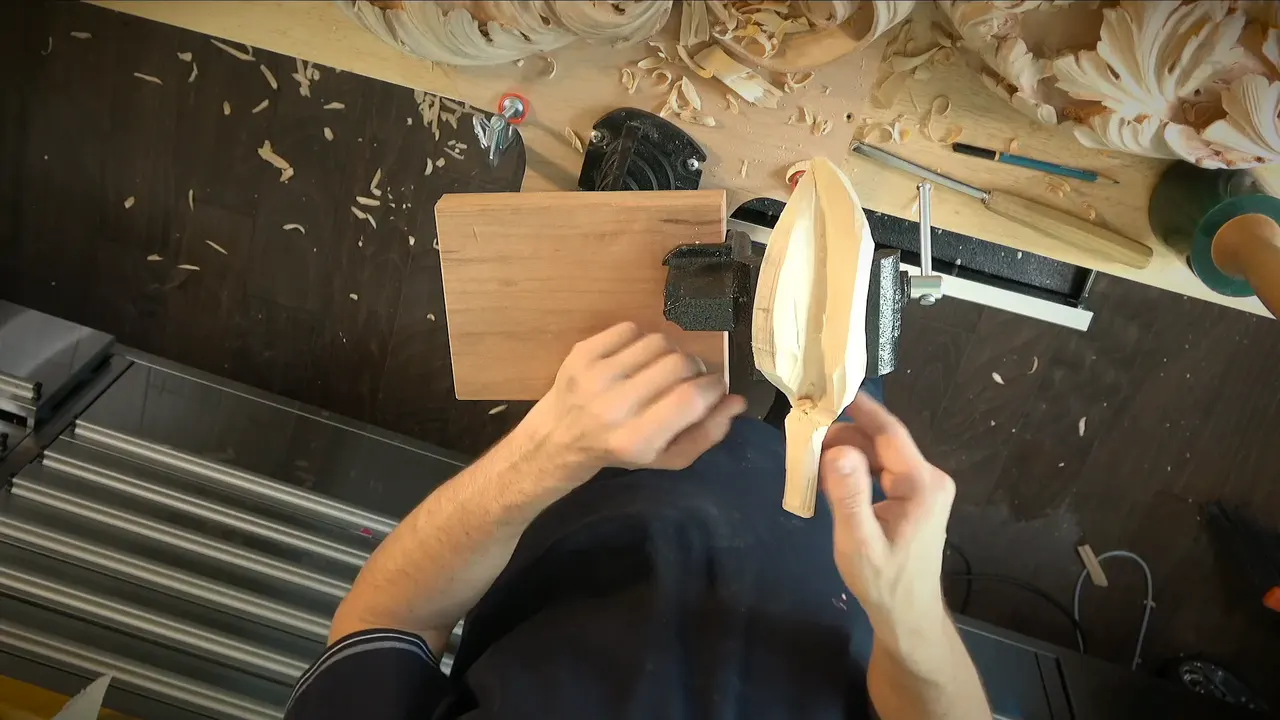

"Single leaf" is the shape I named in Venice Room workshop 77, part 1. I looked at my block and said it looked like a single leaf, ribbed and folding. In other lessons I used the same idea for a flower's leaf, a plain leaf and a leaf I wanted divisions on.
Ever stood over a block and seen a pile of leaves, when the shape under your tool was really one? Did the first pass feel heavier because of it? Come through part 1 with me, then through the lessons where I put the same words in front of a leaf, and see what came next.
What did I mean by a single leaf in workshop 77?
"If you look at it like this, it looks almost like one single leaf," I told you. Then I said it again: "Just like one single leaf."

There was a rib in it, and I said so. "But yes, I do have a rib, but it's just a leaf which is folding like that. Okay. Almost like a boat." Details came second in my plan: "From that, I'm going to develop the small details and separations and stuff like this."
An acanthus leaf could be carved that way too, I said. For this block I put it differently. "In my case, I don't have to because it's a different design."
How much wood stayed on the sides?
A number opens the video. "Like I said, I'm leaving approximately three quarter of an inch, about 20 millimeters, I would say, on the sides." Three quarters of an inch is 19 mm, so my two figures agree.

The skew could take some of the rest: "some of the material I can remove with the skew." The move itself got two words. "Just slice it."
Then I looked ahead. "Maybe I should create some movement right here, too." Plans like that came first. One more is a need: "I still have to create a little deeper channel."
Why a deeper channel, and why 7 millimeters?
"For some reason, I can't find my 5 millimeters, but 7 millimeters will do." That swaps 5 millimeters (0.2 in) for 7 millimeters (0.28 in). I had said "I think I need little deeper channel."

Grain came into it. "And again, I am safe yet even if I'm carving along the grain." I also needed a new position: "But I need to change the position right now and the carve for the channel toward that direction."
The block was thick. "Since I do have a thick piece, I can probably just, at this point, it's still safe to fasten... Not fasten, but to clamp like that. It's still safe, I would say." One more line closes it: "And go that direction."

Could I clamp it another way?
"Let me see if I'll be able to open up wide enough," I said. "Maybe I could actually clamp it even like this." Then, "No, it's not. So not such a good idea." Then, "If I would have a little bigger, otherwise, I would be able to."

Where did the eight leaves come from?
"And let me take number 7 and 14 millimeters," I said. The plan was a number 7 at 14 millimeters (0.55 in). "And little by little I'm going to create a little deeper excavation in those areas."
I did not want to take too much wood, because I did not want a leaf that looks "too plain looking."

Next came the middle. "That is a middle stem, which I could probably leave it almost like that." Separate leaves would come off that stem, I said, and
Then the count. "So one, two, three, and I've got four." The other side followed: "And on this side, we're going to do one more, actually, to be close to Fibonacci." "So I need to create four more," and "So now it's going to be eight total."

One line says what this leaf was and was not. Not acanthus, I said, and then "absolutely different leaf." The video closes on "So that is how it's going to look."

Could the scroll saw take the waste?
Part 2 opens with an offer. "At this stage, what I could do, I could take it actually right now to a scroll saw. Why not?" The waste was the target: "just take out whatever the waste." On the line: "I don't have to be a really straight line." Then "There's absolutely no reason."

Part 2 also says where the cut piece would sit. Some of it would go underneath a detail, and most of it would have some curl. "I have to create a concave right here," I said, to wrap around a line.
The blade was my next question. "Can I change the blade right now to a spiral blade?" Next, "I usually don't like the spiral blade, but in this case, I did use the spiral blade because it's, like I said, I don't care about how clean the cut I'm creating," I told you. The saw gave me one more reason: "but it's a lot easier to create the movements without changing the position."
"Here you go. That's the result, what I'm after." From that shape I could work "my details and all the waviness." With it held in place, the spot "just looks like a little too empty," and I said "this piece going to work like a filler." My name for the piece was "a preliminary, whatever weird looking piece."
Which tool went in at part 3?
Same size again, in part 3. "Number 7 and 14 millimeters, that's what I'm using." And "Of course, I have to be really mindful how I'm doing it." For support: "I placed my finger right underneath to support." The connection point, I said, is still "somewhat fragile."

Handles came up too. "Sometimes it's a good idea to leave extra handles on both sides," I said, "and that way you can flip it and work around that double handle." About the metal part, I said to be careful "not to hit the metal part," and I had a plan: "Maybe I could glue little pieces of wood, which is probably a smart idea to do."

Part 3 also has a line on depth, said about a part that would go underneath the acanthus: "I think that is probably low enough, so I don't need to go lower." Then a want: "I kind of somewhat want to create also waviness right here." The way in, I said, was undercutting: "I can probably do it."
Does another lesson of mine say it?
Other lessons use the same idea, with small changes. Venice Room 19, part 1, names the overall shape of an acanthus and what comes after it: "It's the overall shape of it," and after it "main separations, at least the three main parts." I added "Lots of times that would be five separations that would give you an acanthus."

Carving Byzantine Acanthus 8, part 1, has the same idea. "We're going to start just outlining it, that main boat shape," I said. "I'm not sure if you like that comparison to boat," and I offered a leaf shape as another way to say it. "Or some people don't know how the leaf looks."

Why did I want divisions on a leaf in the Furniture Panel?
A leaf stuck out in Carving Furniture Panel 23, part 9. "That is a beautiful leaf, and I can probably even attack it right away pretty much." Next, I said, I would decide on a form. Then came "Oh, I don't want to see just a leaf. I want to see some divisions on that."

I planned three main divisions. Relief cuts would go in "those triangles with the same number 11," I said, at 3 millimeters (0.12 in). Then a short line of its own: "those relief cuts, they do matter."
Can a flower have a leaf of its own?
Carving Furniture Panel 32, part 1, says yes. I wanted to outline "this section" of the flower, a section I called a leaf. For the outline: "I'll use again number 11. And in this case would be two and a half millimeters." In inches, 0.1.

Carving Floral and Molding for the Panel 10, part 1, has a near twin. A line like that had to be done, I said, "because that is going to be a part of that leaf," and the leaf was one "from those flowers." At that end I planned to leave "only about maybe one-eighth of an inch, about three millimeters." Then "I'll just excavate like that. Attacking that from three sides without undercutting."
Did a stem belong to the leaf in the Lily Box?
In Lily Box 3, part 6, I numbered the stems. "Here is a stem number one." I also meant to use a color: "Let me use a pink, brighter color." Number two came next: "And number two supposed to be connected somewhere." And on how it looked: "I know it looks messy and a little confusing at the beginning."

How thick was the wood under a small leaf?
Venice Room 3, part 8, gives a figure that looks familiar. Going really far on that point was fine, because it was only a leaf of the flower and "it has to be tiny anyway." My plan was to "leave approximately maybe 20 millimeters, about three-quarter of an inch thick material to work with. And the rest of it could be gone."

Will a plain leaf still get movement?
Over in Carving Roman Acanthus 15, part 3, I said that even if it was only a leaf, I was trying to "exaggerate the movements and separations." A spoon effect was a plan: "let me also jump on those two, and also create a spoon effect." I planned "number 11 and 5 millimeters," which is 0.20 in. On a gouge or veiner, I said, "you can see it, one side is clean and another side is really rough."
In Venice Room 92, part 7, the leaf is meant to be simple. The plan there was to finish "just one leaf," and "you'll get an idea because it's nothing complicated." It would be exactly the same as I would do everywhere else.

First of all, I said, a nicer shape, with little sloping this way, to "just give a little more movement." The next one would slope the opposite way. "Nothing special about those leaves," I said, and "they're just pretty much really simple ones."
When is a part still a single leaf?
Carving Corinthian Acanthus 4, part 2, has a correction in the middle of a sentence. "Well, I should not say leaves. It is still single leaf, but those parts."

Carving Corinthian Acanthus 1 lists the types of acanthus leaf, and I named a Greek leaf, a Roman one and a Byzantinian one before I said "And those all Acanthus leaf still represent one leaf, which is the Acanthus plant."
Carving Grape Onlay 1, part 1, says what the unfinished piece held. "We didn't finish it." It had "pretty much just one leaf" worked, plus a start on the grapes.
Which lessons say it, side by side?
Each lesson on this page, the words I said in it and the next thing I named.
| Lesson | Phrase | Next |
|---|---|---|
| This video, 77.1 | A single leaf folding, almost a boat | Small details |
| Workshop 3 of Venice, part 8 | A tiny leaf | 20 millimeters (3/4 in) of thick material |
| Venice 92.7 | One leaf, nothing complicated, same everywhere | A little sloping |
| Corinthian Acanthus course, lesson 4, part 2 | Single leaf | Well, I should not say leaves |
| Furniture Panel 23.9 | Beyond a leaf, I want some divisions | Three divisions |
| Furniture Panel, lesson 32, part 1 | A flower's leaf | Number 11 outline, 2.5 mm (0.1 in) |
| Floral 10.1 | Part of that leaf, those flowers | From three sides |
| Corinthian Acanthus course, lesson 1, part 1 | One leaf | Greek, Roman, Gothic and French types |
| Lily Box 3.6 | A leaf, then stems one to three | Connected somewhere |
| Roman Acanthus, lesson 15, part 3 | Exaggerate the movements | One side clean, the other side rough |
| Venice 19.1 | Overall shape, then the main separations | Three main parts |
| Carving Byzantine Acanthus, lesson 8, part 1 | Leaf shape | Start by outlining the main shape |
Where can you watch part 1 and the lessons on this page?
Part 1 sits in Venice Room 77, and Venice Room Part 7 holds workshops 74 to 85. Workshop 76 comes just before it and workshop 78 just after. Every other lesson here has a page of its own, linked above, and each opens with school access. A plain workshop number means the Venice Room, and every other lesson carries the name of its own course.
Looking for Furniture or wood carving that starts from one plain shape? Want to hear it in my own voice? Start here.
How it's done
- Leave wood on the sides. I left three quarters of an inch (19 mm) and planned to slice off part of the rest with the skew.
- Plan a deeper channel. A deeper channel was still needed, I said, and I settled on the tool I could find.
- Name the shape. I called the block a single leaf with a rib, almost like a boat.
- Count the leaves. Four on one side, then four more planned on the other, eight total.
- Send the waste to the saw. I used a spiral blade, because the cut did not need to be clean.
Frequently asked questions
What did I call the block in workshop 77?
Looking at it, I said the block looked like a single leaf, with a rib. Developing the details from that shape was my plan, and I added that it is a different design and not acanthus.
How much wood was left on the sides?
Approximately three quarter of an inch, about 20 millimeters, on the sides. Slicing would take off part of the rest.
How many leaves came off the middle stem?
Four on one side. On the other I said "one more, actually, to be close to Fibonacci," and that I needed four more, so it would be eight total. The middle stem I could probably leave almost as it was.
What to carve next
- Venice Room 77
- Venice Room Part 7
- Venice Room 76
- Venice Room 78
- Venice Room 19
- Venice Room 3
- Venice Room 92
- Carving Byzantine Acanthus 8
- Carving Furniture Panel 23
- Carving Furniture Panel 32
- Carving Floral and Molding for the Panel 10
- Lily Box 3
- Carving Roman Acanthus 15
- Carving Corinthian Acanthus 4
- Carving Corinthian Acanthus 1
- Carving Grape Onlay 1