
Alexander Grabovetskiy, woodcarver, School of Woodcarving · Published 2020
What does a wood carver mean by "more light"?
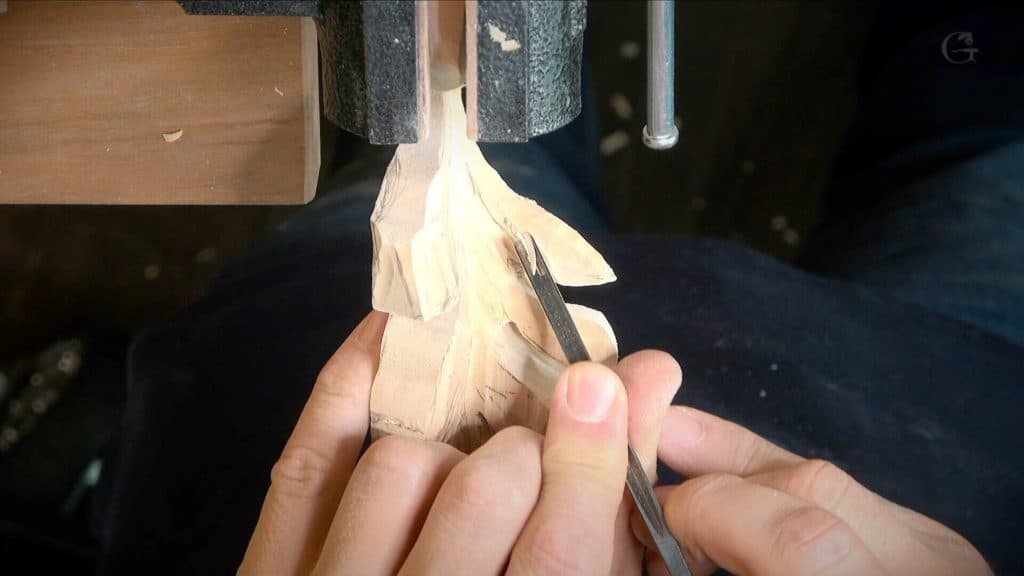
Quick answer: More light is what I asked for in Venice Room workshop 77, part 4. At that point I was using a number 7, 14 millimeters (about 0.55 in), and I said the light came "closer to myself." Other Venice Room workshops, the lily box and the furniture panel have me asking for light or a lamp closer.
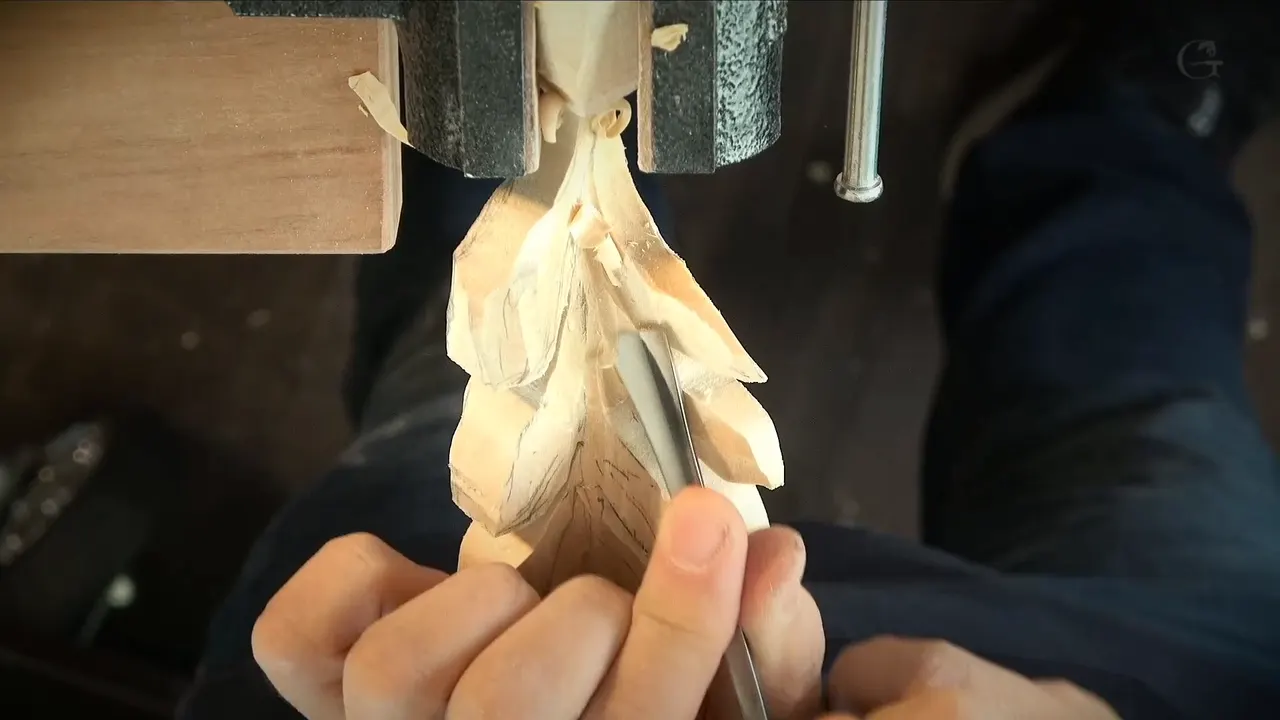

I said I needed more light in Venice Room workshop 77, part 4. Light, or a lamp pulled closer, comes up again in workshops 63, 78, 79, 88, 89, 97 and 99, in the olive wood lily box and in the furniture panel.
Ever bent over a small cut and could not tell what the gouge was doing? Did you reach for a stronger bulb, or just lean in closer? Here are the places where I said it out loud, and what I said in the lines after it.
What did I say about light in workshop 77?
The first lines of that part name a tool: "Number 7, 14 millimeters," that is 0.55 in, roughly. It would be "beautiful once we're going to get done," I said, and a few lines on came "Maybe I need a little more light."
"Yeah, got a little more light closer to myself," I said next. A line that says only "Okay" follows. After it comes "Don't rush it, okay? If you're going to do that, just please don't rush it."
Which jobs came right after the light?
A fit check came next, with "I need to probably recheck how it fits," and then "Double check, double check how it fits inside."

I talked through the piece out loud: this part "definitely going to go underneath, but that piece can go up maybe, just raising up a little bit." And how far? It all depends, I said, on how far I will mount that.
A decision followed: "I think the edge of this one has to go up," and that was exactly what I planned to do. Curling it up was part of the plan I voiced.
How did I plan to get that edge up?
One option was the back: "I could actually go and attack that from the backside, and create some excavation that way."

Further on I reported "So I got that up about quarter inch, I would say," or 6 mm, near enough. Another line, about something else on the piece: "that has to be gone also."

How far was the edge by then?
I told you I was working toward the edge: "you can see I'm trying to get closer to the edge, although it's not the final edge yet." And now, I said, "I can work even more details in this section."

The piece did not look finished, and I said so: "I know it doesn't look too appealing yet, but hopefully it will." "I know it will," I added, and "I really need to crank it little better."
What happened on the pipe side of that piece?
For the pipe side I named number 11 in 4 millimeters (5/32 in, near enough). Next, my words were "try to get underneath of this part."

I described the result ahead of time: "a little separation like this" would belong to the movement, and another one coming. Then a warning about the job: "It's not going to be as simple as it looks, I should say."
The wood needed a check too. "I have to also check how thick material I left. Don't have too much material." "Personally, you could do just that detail, and that would be like a project on its own," I said.

A smaller tool came next, a number 11 at 2 millimeters (0.08 in), with "Going to go a little deeper." One limit was clear: "I don't want to cut all the way through." The part closes on "Use one and a half millimeters," near 0.06 in.

Did light matter before the measuring in workshop 79?
Video 10 of workshop 79 has the same request. Before it I said that the closer I get to that point, the tinier the tools I have to use. Next came the request for more light.
Straight after came a second job: "But I also need to measure from the backside." A tool came up, "One of the tools I really, really like, it's a pointing machine," and I said "Sometimes it's hard to use even calipers, but pointing machine is good." Wikipedia has pages on the pointing machine and on calipers.

Could I see the work in workshop 78?
Not well, I said. The words came with a reason in workshop 78, video 10: "I don't really see what is going on." Extra light, I said, "will help me a lot."
Then the wood: "Don't have too much material left," and "Have to be really careful now." I wanted "to clean around this section with the half a millimeter" (roughly 0.02 in). I named "the half millimeter number 11" for it, and the job was "Just remove all that fuzz."
"I really need to get close to it, but otherwise, I can't see," I said. Later in that video I planned to "probably clean this up off camera," and gave the same reason, a need to see the spot up close.

Was it dark in workshop 88?
A little, I said. Just before the light in workshop 88, video 10 comes a line: a little cleanup, and I would need the spoon. Then the light itself: "You know what? I'm going to need to add a little more lights. Right now, just a little too dark." Next: "Okay, so I've got extra lighting on, so it should be much better."
Further into that video came a choice, whether to keep that part or "get rid of it." And right away: "I don't know. That's kind of hard."

Is closer light the same as more light?
Video 4 of workshop 97 began the same way, with "I guess I need a little more lights" before I changed it: "I mean, closer to me. I don't need more lights, but just get the light closer to me. That's what I need."
A goal in numbers came in that video: "10 millimeters or 12 millimeters" from the upper part of the movement to the background, "three-eighths of an inch, half an inch, something like that." That is about 0.4 to 0.5 in. I added "I'm approximately right now six to eight millimeters deep," or 0.24 to 0.31 in.

Video 1 of workshop 89 has "I can lower down even more there." The same video has "I think I need more light, even more light." It also has a spot that would change direction, from undercutting to sloping the opposite way.
How much did light matter for micro cuts?
In video 9 of workshop 99 I said "I need some more lights, okay? Because I don't really see really good, so I'm going to use much more lights and get a little closer to it." What was at stake? "Otherwise, it's just almost impossible for me to get to the details."
After the change came "now I'm a little closer, and I'm able to actually see much better," and "I could just do micro cuts." My next tool, I said, would be "number seven again and half an inch," about 13 mm.

Why did I wish for more lights in workshop 63?
In workshop 63, video 9, I said I would use "a really small number 11" and that "I want to create beautiful pipe." A wish followed: "I wish I have a lot more lights." I also thought I might have to get them.
Next: "Okay. I've got a lot more lights now, so hopefully, I can see much better. So it's really dark outside." About the weather I said "It's about 11:00 AM, but we have for a couple of days already really stormy days. It's not too common to Florida."
Where did the light show up in the olive wood lily box?
Lesson 3 of the lily box has a line in its eleventh video: "Let's see," I said, and that I would need more light. Further on: "I think it's about there, approximately," and "Okay, so I've got my lines and I'm ready to apply glue."

Lesson 6, part 4: I had just said "I need to recreate this line, I mean, this ridge," and then "more light to myself." Then 1 millimeter, number 11 (0.04 in), was my plan, and I said I could "right away pretty much undercut underneath of this acanthus."

From there: "Now I can see clearly what I'm doing," and again "Now I can see clearly. Give a straight-down cut to separate my second volute from the first one." Between the two ridges I said there was "just a 1-millimeter space," and I needed "clear separation between those two volutes."
The grain got a comment in that part: "Really interesting grain in this area," and "It's not as easy to carve." I also said the second ridge was "little too high" next to the main body, and that I would take it "3 millimeters above the main level," about 0.12 in.
Does a lamp need a good angle?
Lesson 5 of the lily box, part 12, has a lamp and a doubt about what you can see: "I got closer with my lamp, but I'm not sure how to do that, that you can see it. Try to change the angle, and maybe you can see that better."

For the notches I could use "number one and double bevel," and you can call them "notch or separation cuts." Later came "See through the lamp," and the next tool was "just the one millimeter, number eight."
Is it easier to see through a magnifier lamp?
For me, yes. Part 8 of lily box lesson 2 has me saying I might need my lamp: "If it's going to be too bright, please forgive me, but for me, it's more convenient to see through the lamp." Then: "Magnifier lamp is what I'm using." Wikipedia explains the magnifier and the lens if you want the optics.

The lamp came with a note about sound: "when I'm using my lamp and talking, I'm losing quality of the sound. Please also keep that in mind and forgive me for that, okay?"
And about the small stuff: "I know it's a really tiny details, and those tiny details hard to see. I do apologize for that." Then "those small, tiny details, they make all the world of a difference," and "when people going to look really close, they're going to like it what they see."
Was the lamp ever in my way?
Sometimes. In video 6 of workshop 79 I said "It's kind of hard to see with the lamp." I asked you to forgive me in the lily box if it was "too bright," and I said I was "losing quality of the sound" while talking.
What about the lamp in the furniture panel and the rosette?
Furniture panel lesson 21, part 1: "Let me raise my lamp, and let's start." Later came the noise: "I apologize for that squeaking noise. That is just my magnifier lamp. And if I don't need to use it, I'll just move it away."

Lesson 22, part 5: "Get little closer with my lamp magnifier because I don't want to mess up." On the screen: "we're talking about one millimeter tool, and you see that on the screen much bigger than what it is in real life."

In Flower Rosette lesson 3, part 4: "I'm not measuring because it's a micro." Because it is a micro carving, I said I would use my lamp, "which I utilize a lot when I need to work on the small details because I can see a lot better."
Video 1 of workshop 93 has "I have to do it really slow. Usually, I really like to see through my lamp." My target was a space "exactly one-eighth of an inch," and I called it three millimeters, about 0.12 in. If you wonder how light is measured on a surface, Wikipedia has a page on illuminance.
Where did I ask for more light, in one table?
| Where | What I asked for in my words | What came next |
|---|---|---|
| 77-4 | Light brought a little nearer to myself | A word on pace |
| 79-10 | Light before the measuring job | Back measuring |
| 78-10 | Light, since I could not see the work well | Careful with the wood |
| 88-10 | Extra lighting because it was too dark | The cleanup |
| 89-1 | Even more light after lowering it again | A change of direction |
| 97-4 | The light nearer to me, not more lamps | Blend into acanthus |
| 99-9 | More lamps, and nearer the detail | Micro cuts |
| 63-9 | Lots of lights because it was dark outside | Talk of the weather |
The words repeat, and the lines after them differ.
Where can you watch these lessons?
Venice Room 77 holds this part, and Venice Room Part 7 holds workshops 74 to 85. Workshop 78 and 79 sit right after it. The later ones are 88, 97 and 99, with 93 between them, and 63 sits in the part before. The lamp lines in lily box 2, 3, 5 and 6 are in the olive box course, and furniture panel 21 has the squeaky lamp. Each lesson has its own page, linked above, and each opens with school access.
Want to see a gouge work in better lighting? Looking for wood carving lessons where you can follow each pass, with good task lighting in view? Start here.
How it's done
- Ask for the light you need. Workshop 77 has me asking for more light, and then having it near me.
- Bring the light closer. Workshop 97 has me moving the light nearer, with no extra lamps.
- Add lighting when it is too dark. Workshop 88 has me calling it too dark, then putting extra lighting on.
- Get closer to a tiny cut. Before the micro cuts of workshop 99, I added lights and moved a little closer.
- Move the magnifier lamp away. Furniture panel 21 has me planning to move it off when it is not needed.
Frequently asked questions
Which line in workshop 77 asked for more light?
Part 4 has it: I said I could use more light. The next line says I had it near myself, and checking the fit and a plan to curl an edge follow it.
Is closer light the same as more light?
Workshop 97 has me saying the number of lights was fine and the light only had to come nearer. Workshop 99 had a plan for many more lights and a move a little closer.
Why ask for light before a tiny cut?
My reason in workshop 99 was plain: I did not see really good, and it was almost impossible to get to the details. After the change I could see and do micro cuts.
What to carve next