

Alexander Grabovetskiy, woodcarver, School of Woodcarving · Published 2020
What does a wood carver mean by "variations"?
Quick answer: In Venice Room workshop 77, part 7, I said "variations" about a leaf on a thick block that I could take downhill or curl up. In other lessons I said it about petals, flowers, shells, concaves and the softness of lime wood.
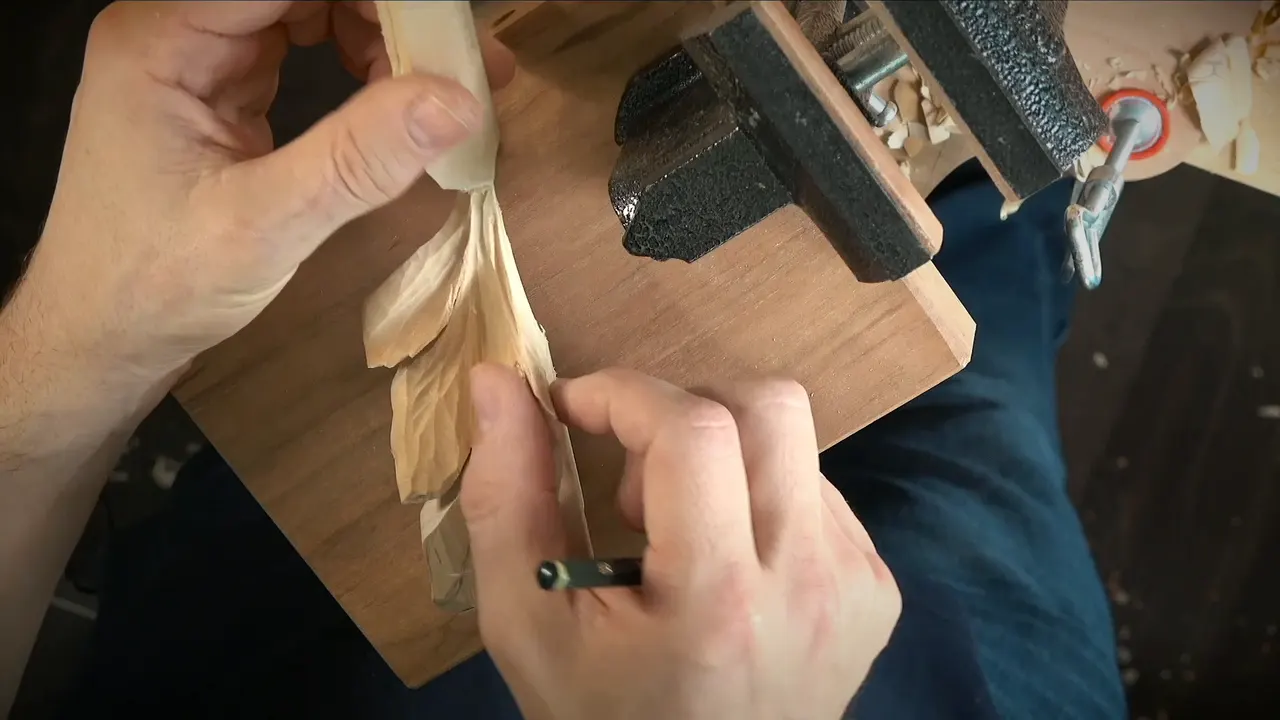

In part 7 of Venice Room 77 I used "variations" while I chose how one leaf on a thick block should go: downhill, or curled up. Other lessons of mine use the word for petals, flowers, shells, hollows and even the softness of lime wood.
Ever carved a second leaf and watched it come out as a copy of the first? Here is where I said the word, and what sat around it.
What was on my bench when I said it?
Part 7 opens with a break. "I broke this part. It's really tiny, less than a 16th of an inch right now" (1/16 in is 1.6 mm), and "when I unscrewed that thing right here, I just hit that and broke."
The fix was glue: "it's easy to fix that. I just glued that." It will be okay. The piece is paint grade, so I do not really worry about how it will look, though I must be careful.

Holding comes next. I named a few different ways to approach that type of carving. Clamping the piece to the surface is one. Another is to "just butt against some solid surface." My block has "a couple holes on the sides" that take the same clamp.
Nothing special, I said: "pretty much a block of cherry," about four quarters (1 in, 25 mm), "and that's my workbench as of now." A later part comes back to it: "But see the advantage of a handle, a little leg extension, so you can fasten it multiple ways. You can put that in a vice, or you can clamp it to a surface." And "You can butt against that if you wish." Then "That's really safe."
Then the tools. "Sometimes I think it's safer to use smaller tools," I said, "maybe like this, just the Micro Tools by Dockyard or something like that." I warned that you would hear my granddaughter in the background, "so please accept that as a reality."
Smaller tools take longer. "But on the other hand, it could be much safer." In my hand: "I'm using five millimeters, which is a Dockyard, 3/16 of an inch."

Where does the word come in?
Right after "little by little, I can work my way in." Then the choice: "I also have to make the decision how I want to see that leaf because I have a kind of thick block right here. So I can do a lot of different ways."
Two of them: "I could go with this one downhill, I could go and curl it up, and that's what I'm after, just to do some variations."
A plan came next, said as a plan. "Let me think. Maybe I'll just curl this one a little bit like this." For the curl: "I'll create the cut across the grain just like that."

A clamp is possible again, but "in this case, I could probably just hold it by finger."
Not a full roll, but "somewhat curly." Then "little by little, cut by cut, slice by slice, I can dig in." With a small tool, "it's less dangerous. It takes a lot less material at once."
Slower, yes. Still, "even that way, I still able to pull pretty quickly that shape, or I should say variation of a shape."

Next I described two leaves. Here is the plan: "a curl up" on "only one side, this side." Of the next one, "it curls up that way." The third curls two ways, this way and that way, "if it makes sense."
So one side has to go lower. I put it as "alternative or alternate different way, opposite direction, just like in real life." And "if it's all the same," the leaf would not look good. Then "That's what I'm after."
Two lines near it sit in part 6 of this workshop. I said I could create some convex and concave on the inside of a piece, "just to give some more interesting look and maybe create some waviness also." Of another piece, "more convex," and "Doesn't have to be the same."
Did I say it about petals?
Hashemi lesson 43 has the word twice, back to back. I said not to make every petal the same size: "So it has to be just some variations. Okay? There's got to be some variations."
The next line: "Some of them bigger, some of them smaller." And "make sure you don't do the perfect form."

In rosette lesson 2 I planned to show the process on one petal, and I said "you're going to create your own movements in all of them." Without different variations, I said, it looks less nice.
In the next video I list one section: "concave, convex, concave, another convex, and another concave," with "no repetition." Another one has the same idea, "but it's not repeating it on its own." The wood looks "that little darker," I said.

For flowers, rosette lesson 3 gives the same advice: "just play with variations." Before a curl I said "I have to make the decision first," about how big the curvature should be.
A double layered flower in part 4 of that lesson gets "the same idea" on its outer and inner petals: curl some up and some down, and then, I said, you are safe. As for variations, "I really would love to see what you're going to come up."

A finished flower in rosette lesson 4 shows "most of the variations you can do," and a rule: "the edge has to be really wavy." The waviness has to show from above and from the side, and I was "following that rule everywhere."

What about a flower I carve twice?
The chamomile and bow rosette has a pair: "I've done one side already, and you can see. So that is the part which is equals, but it's mirrors." For the second piece, "some variations."

In floral lesson 13 the flowers I finished are "exactly what is on that side, on the right-hand side. Just different variations and so on." The center flower is "exactly the same, just a size bigger," and I did not work on details yet.
Floral lesson 12 says it of a few more: those flowers match what I did on the opposite side, and "some variation," I said.
In floral lesson 8 I planned to work on petals off camera, since I did not want to make "mileage of footage" you cannot watch. One part will go right on top of a volute, and I planned "some variations" for those ones.

Does a shell, an eye or a tool have variations?
Shells, in Venice Room 5, "look beautiful, and there is just so many variations." There is more than one design. Those work on furniture and in architectural carving, I said. "Anywhere."

A shell gets a reason for depth in Venice Room 4: it will not sit on the same level, and "it's also going to have a variation in three-dimensional world." My need is plain: "I need that depth."
In Roman acanthus lesson 6 I planned to take a small gouge, "one-eighth of an inch" (about 3 mm), for "my straight down cut." I could use a different sweep, I said, but "I don't want to make it too complicated." The leaf has eyes, and "you could make variations of those eyes." Some smaller, some bigger. I did not do that, I said, but "you could."

The word reaches a tool too. On the skew chisel, Venice Room 21 has "there's different variations of the skew chisel." A second tool, I said, is "just a more developed tool, this one."

For a swap of tools, Venice Room 120 has "Let me get different number three for just variation of tools."
In Greek acanthus leaf lesson 15: "it's only one variation of acanthus leaves of many different variations." This leaf is "based actually on an ancient Greek acanthus leaf."

Where did I want the hollows to differ?
Grape leaves vase 3: "Although I really don't want to do it too even. It should have some variations, like right here I've got really deeper spot and that's really good." I could blend it more, but "I kind of like to use a deeper color on inside of concaves."

In lily box lesson 7 the line was a drawn movement. The result will be just approximate, I said, and not too much off from the drawing. I still have to stay accurate to "the original design I've got." Then "But nothing wrong with some variations, okay?"
Further on I said "let me take 1 millimeter and number 11, and make relief cuts" (1 mm is 0.04 in).

Grape onlay lesson 5: I planned "concaves on the inside to create even, even more variations." Lesson 3 has the singular: "I got some variation in my motion." Of some spots I said "They don't have to be on the same level like in real life."
I planned a side underneath "this little guy" in Venice Room 137, and "I'm just going to create some variations."
In Butterflies lesson 12 I could "also make the cutout" inside, without repeating one shape everywhere. The idea stays, "but I still want to do some kind of variations." And it does not have to look "like it's done by machine."

Light brings it up in lesson 5 too: "When the light is going to hit that, a slight variation is going to give a different shadow."
Does a row of leaves or flowers need them too?
In acanthus over moldings 7, about nature, the middle part "usually just repeats the same pattern," and the petals "can just create all different variations of movements."
Moldings lesson 8 has "I think it's gonna look a more unified." Then "It's not always the case." And "Even in that style you could have like the flowers some variations and I'm okay with that."
In Grinling Gibbons, Maine class 14: "They're gonna be about the same. You can just do some different variations all around."

Maine class 4 has "I want to have some variations of movement." Of two close flowers: "not as much variation."
In Maine class 17 I wanted some flowers to differ, and "I'm gonna introduce some variation if you look at the original."
Class 15 of that Maine course has me saying a look in the center, seen from above, "creates some kind of interesting variation." Then "Much better than original," and "that's just my opinion. But I like it better."
Does the wood itself vary?
The board gets the word in Venice Room 63. "sometimes the wood itself, the density or softness of wood, even if it's the same species, I'm talking about the same lime wood."
"But even with the same lime wood, you can see variations of softness, and you can see the color, actually, changing. This is a lighter color versus this darker color." And "on a darker color right here, in my case, the wood is a little softer."

Olive wood gets the word in lily box lesson 4: "I have a stubborn grain in this area." And "Some parts, you can see the variation of color. It's harder to carve on a darker wood and easier to carve on a lighter wood. So density is different."
The lines side by side
| Which lesson | What I was talking about when I said it | A line near it |
|---|---|---|
| Hashemi 43 | The size of petals on one flower | "don't do the perfect form" |
| Rosette 2 | A run of concave and convex petals | "I've got just different variations." |
| Rosette 4 | The edge of a petal, seen from the side | "it also has to have a waviness" |
| Floral 13 | The center flower of a panel | "exactly the same, just a size bigger" |
| Venice 5 | Light hitting the project I am carving | "a different shadow" |
| Roman 6 | The eyes of an acanthus leaf | "you could make variations of those eyes" |
| Lily 7 | The movement of a line I drew on the wood | "nothing wrong with some variations" |
| Grape vase 3 | A deeper spot inside a concave | "really deeper spot" |
| Venice 63 | The softness of one board of lime wood | "a little softer" |
Wikipedia explains the gouge, the chisel, the knife and grain, and another page covers flower petals.
Where can you watch these lessons?
This part is in Venice Room 77, and Venice Room Part 7 holds workshops 74 to 85. The other Venice Room lessons are 5, 4, 21, 120, 137 and 63. The rosette lessons are 2, 3 and 4, and the floral panel ones are 8, 12 and 13. Care to follow wood carving one leaf at a time? Pick a lesson you saw above, and carve the second one differently from the first.
How it's done
- Choose how the leaf goes. In workshop 77 I said I had a thick block, so I could take a leaf downhill or curl it up.
- Change one side. My plan in part 7 was a curl on one side only, and the next leaf would curl two ways.
- Let petals differ. Curl some petals up and some down, I said in rosette lesson 3.
- Keep the idea, move the rest. In Butterflies lesson 12 I said the idea stays, but I still want some variations.
Frequently asked questions
Which part of workshop 77 has the word?
Part 7, as I chose between taking a leaf downhill and curling it up. My words: a lot of different ways, just to do some variations. A curl on one side only was my plan for that leaf, and the next leaf would curl two ways.
Can every petal be the same size?
In Hashemi lesson 43 I said not to make every petal the same size, so draw bigger ones and smaller ones. A row without different variations looks less nice, I said in rosette lesson 2.
What did I say about the wood itself?
Venice Room 63 has me saying that one kind of lime wood shows variations of softness, and the color changes from a lighter to a darker one. The darker color, in my case, was where the wood was a little softer.
What to carve next
- Venice Room 77
- Venice Room Part 7
- Hashemi flowers lesson 43
- Venetian flowers rosette 2
- Venetian flowers rosette 3
- Venetian flowers rosette 4
- Chamomile and bow rosette
- Floral and molding 13
- Floral and molding 12
- Floral and molding 8
- Venice Room 5
- Venice Room 4
- Roman acanthus 6
- Venice Room 21
- Venice Room 120
- Greek acanthus leaf 15
- Grape leaves vase 3