

Alexander Grabovetskiy, woodcarver, School of Woodcarving · Published 2020
What does a wood carver mean by "ornamental"?
Quick answer: In Venice Room workshop 77, part 10, I said the leaf piece was a real project and not just an ornamental piece, so it had to stay somewhat solid. In other lessons I said ornamental about a style of carving, a kind of carver, tiny details and a kind of design, and I set it beside architectural and furniture carving.
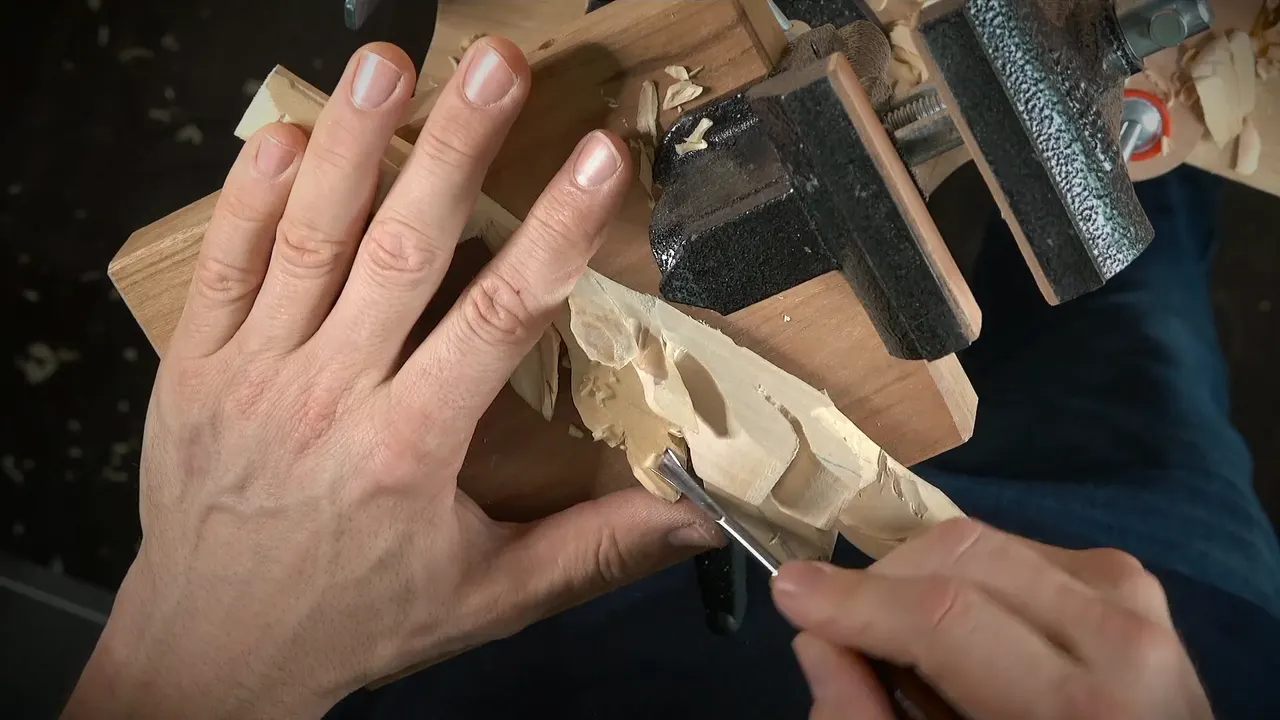

Part 10 of workshop 77 of the Venice Room is where I said the word ornamental about a leaf piece that was a real project. Over the other courses I said it about a style of carving, a kind of carver, a kind of detail and a kind of design, and I set it beside architectural and furniture work.
Have you carved a leaf so thin that it looked ready to snap? Do you wonder where a piece made to be looked at stops and a piece made to be used begins? Here are the places I said the word, and what came next.
What did I say before the word in part 10?
The part opens with a limit. "Yes, I can spend a lot longer just creating beautiful detail on it," I said, and then came the other side: "But I also have to be mindful that is a real project, and I need to deliver that project by a certain date."
Next came "Not that I have to cut corners, but still, I'm going to just be really mindful how much time I'm spending in one area." Then, to you: "But you should be able to catch what I'm creating, okay?"

A thought about the edge came up. "By the way, right here, I could actually carry my concave all the way to the edge, and it's going to look really good, I think." My plan for the next step was to create "those notches right here," and I wanted care for it. "Got to be really careful again," I said. "Just really, really careful."

Where did "ornamental" come in?
It came while I was talking about how thin the piece should look, and here is the whole thought. "I want to make it like illusion of a paper thin," I said, and "It's not going to be paper thin because it would be a mistake in this case." Then the line this page is named for: "It's not like just ornamental piece. So it has to be somewhat solid, but still, illusion."
"There you go. I've got the one notch," I said. "And let me carry that inside like this. Okay. Oops." Then came "I already got two mistakes on this one," and "Ai, ai, ai. That's not good." I added that I know it will still look good, but "I don't know why I made those mistakes." My next plan was "Let me clean it a little bit."

The glue came up here. "And yes, I've got that CA glue inside, the fibers, and it's just really solid, almost like plastic. I didn't expect that." About one side: "It slices really good with no problem. But closer to the break point I'm getting, it's actually like a plastic. It's actually really good."
Then a thought: "Maybe I should use that CA glue much more often and stabilize some of the work, or some of the areas, I should say."

The carving went on. "Okay. Put a couple concaves on the side, just to give some interesting movement." Then "There you go. Got this one. Although I need to create little deeper concave on inside."
Next I looked at the result. "That's how it looks already. So see? It's catching some shadow, and I think it's looking not bad at all." Then a move to the next piece: "Let me move to another one."

The next piece went a different way. "And this one, going to go opposite direction, moving that way. Okay? So I'm going to use alternative to this one." My plan was "I need to chop this side a lot," and after some thought I said "Well, I probably should clamp it. Okay? I can just clamp it. Just to work on a big chunk." To close the thought about clamps: "Again, any clamp will work."
I apologized for something that might be "right on screen," then said "you should be able to see this part." The part ends with "And I can actually work with my skew, but I got to be careful."

Is ornamental carving the same as architectural carving?
I set the two side by side in several lessons. Greek acroterion lesson 5 has me saying "this carving is actually considered as architectural wood carving." About my own work, I said I had done "quite a lot of my projects" that way, and "they're not that ornamental." Then "I've done architectural carving because it's somewhat easy carving."
Another part of that lesson goes again. "This piece is a more architectural carving than ornamental, but still you can utilize it in furniture if you are especially in a replication of period or antique furniture."

The antique style rosette workshop 1 puts the two together. "You can probably consider this type of carving as architectural carving, since that is mostly used as architectural or sometimes as ornamental on the furniture, like in the corners and so on." That workshop was an order, too: "I've got an order. I have to make 15 rosettes, and they are based on antique style rosette."
One piece, in lesson 10 of the Roman acanthus course, sat between the two. "Yes, it is architectural, but it's more decorative, ornamental." It could go on a wall: "I can frame it and I can place it on the wall." And about the extra work: "If it's more artistic, if it's not practical like for furniture, I can go to the extreme."

The Corinthian acanthus introduction lists them in one line. "As far as the ornament, it's used in architecture woodcarving, ornamental woodcarving and the furniture woodcarving." The sharpening straight gouge lesson 2 has a list of what we would learn, spoken to people who signed up: "carving for furniture, architectural carving," and next in the list, "ornamental carving, just fun carving, just sculpture carving."
And Corinthian lesson 3 has a plan: "And we're going to carve later also more ornamental."
Who were the ornamental carvers?
Roman acanthus lesson 13 starts with history as I told it. "I know for a fact in history, there are different types of wood carvers." First came boat carvers, and they "would carve for the big boats." Then came "other carvers outside carving for the vehicles," and "inside carvers for the houses."
The inside carvers were split in two, I said. "On inside, you can find architectural carving or architectural wood carvers who would just concentrate more on architectural details. And you would find also ornamental." Next, "And ornamental wood carving is actually the most difficult."

My reason: "You're working with the really tiny, smallest details if you work in an ornamental style of wood carving. And believe me, those small, tiny details make the biggest difference." For that I said "You take a really tiny, small gouge," and gave its size as "about 1/16 of an inch" (about 1.6 mm).
The Livestream April 2020 has the same history with more detail. "They would divide those wood carvers in three different skill sets or different groups." The first, boat carvers, "usually huge movements," considered "rough carvers." Of them I said "they were not able to do really detailed work."
The second were "vehicle carvers or buggy carvers." They were "little higher level than boat carvers because there's a lot more details." The third were architectural carvers, who "would just work inside of the houses, inside of the palaces." And a higher level still: "It would be artists."

Next, a project of mine: "Look at that piece, which is with the flowers. It's really complicated." The piece was "a decorative or ornamental carving, which is actually the name ornamental wood carver or decorative wood carver."
How much time do ornamental details deserve?
In that same Roman lesson I gave a few thoughts on it, one after another. "Again, I don't want to overdo it." Then "You can see I am making mistakes when I'm just trying to rush it." And "But I also don't want to underdo it."
My goal for the piece: "Even if it's a simple form of acanthus leaf, I still would like to see this one as a piece of art, not just a furniture detail, although you could use that on furniture. But my goal is to make it look more unique, more ornamental." And "That's why I'm actually spending time on those details because I really want to see a beautiful end result."

About the tools: "I'm constantly changing my small gouges from 1/8 of an inch (about 3.2 mm) to 3/32 of an inch (about 2.4 mm). Right now, it's 1/16 of an inch" (about 1.6 mm).
How does furniture carving differ from ornamental carving?
Furniture panel lesson 31 gives the measure "about one and a half millimeters from the background" (1.5 mm is about 0.06 in), "So about one 16th of an inch." Then "I could actually do some kind of cut right underneath and you can see all the way through, but it would not be practical."
Here is the line: "That is the huge difference between carving for furniture versus like ornamental carving. You don't create too much airborne stuff because it's gonna be low enough and people gonna hit that. Okay? So that is not good idea."

The Greek acanthus leaf lesson 13 goes the other way. "Like I said before, I really like extreme undercutting. I'm not always doing it, but for example, this piece is not a furniture piece, it's just a decorative piece, and nobody's going to destroy that." Then "And the deeper undercut you make, it's just going to look much nicer, in my opinion."

Venice Room 110 has a small detail. "A little detail, but I think it looks awesome." On how close to nature it should be: "I really don't have to be really close to nature because it is ornamental carving or architectural carving, but some details just to spice it." And "Yeah, I know it's a tiny spot, but still, I think it just worth it."

Where did I say ornamental carving began?
Greek acroterion lesson 3 has my line on old carved wood: "in different parts, they found some carved wood dated really from the 8th to 12th century." Next came "And that was a chip carving style, but it's more ornamental chip carving style. It was done only pretty much with just a knife."
The curly kitchen cutting board, lesson 4, has a line on history that I corrected as I went: "But the history of wood carving, chip carving came later. Well, I shouldn't say that it came later." Then "It's still sort of chip carving, but people didn't call it chip carving, and you associate chip carving with just more geometrical." After that: "before geometrical carving, ornamental carving was in its existence."

In butterflies lesson 13 I said what the project was for. "The idea of this project is just to give you knowledge of the technique what was used back then. We're talking about a thousand years ago in northern Europe." On what else you could carve: "You can do a fish, you can do birds, you can do lots of different stuff. Or just pure ornamental."

What are ornamental details in a small project?
Feathers show up in the kitchen cutting board, lesson 15. Here it is. "And now we are ready to move on those, it's not even feathers." My reason it was not feathers: "You can't even say it's feathers because it's just ornamental details, but they represent feathers." And a plan followed: "Let me refine again to make all of them flow into the same flow line."

Lesson 4 of that board has a rule. One line was "I need to make sure my lines are really clean and my flowing is really good." Then "When I'm saying flowing, almost every line should go to the same line. So that is called flow line." After that: "That is one of the really important rules in wood carving, especially ornamental."
The chamomile rosette lesson 2 names a tool. "I really like to use a half a millimeter number 11" (about 0.02 in). And to long-time members: "if you're a member of my school for a long time, you already know that I'm using that all the time." The projects were "furniture style or just decorative style, ornamental style. I just love it."

What does a real project change?
Part 10 said a real project has a date. The same thing came up in workshop 56 of the Venice Room. "I still kept going, okay." Next, "I really have to finish my work. I can't stop." Then "So I do have a certain deadline I have to meet." The date was tied to the install: "It's more like a month when it's going to be installed."
That project "is going overseas, so it has to be shipped right there and also conditioned." It had to be conditioned "to the humidity, to temperature, and so on."

In Venice Room workshop 57 I said "I do have a kind of deadline. It's not a real deadline, but deadline where I want to get the stuff finished, and if I can save a minute, I'd rather save a minute, not to walk around." The limit came next: "Only if it's still safe, okay?" And "if it's a safety concern, no."

The floral and molding lesson 2 has the date as well. "Even if there is a deadline, rushing is not really a good thing." Then "As you know, woodcarving is an art of deduction, art of subtraction, and once you take too much, you can't put it back."

And furniture panel lesson 19 had a panel with no date. "I know for some of you, it's probably big question why I'm spending so much time on just a small detail." My answer: "First of all, I don't have a deadline, okay? And I can create and get to the perfection if I need to. So this panel is not for a client, no deadline, so I really don't have to rush it."

The lines side by side
| Which lesson | What the piece or the passage was about in that lesson | A line |
|---|---|---|
| Venice 77 | A leaf piece that is a real project with a date to meet | "just ornamental piece" |
| Acroterion lesson 5 | Calling a piece architectural first, with a use on furniture | "you can utilize it in furniture" |
| Roman 10 | What I can do with the piece: frame it and place it on a wall | "more decorative, ornamental" |
| Roman 13 | The tiny details of a whole style of work, and why they matter | "an ornamental style of wood carving" |
| Panel 31 | Why seeing through a piece is not practical on furniture | "furniture versus like ornamental carving" |
| Acroterion lesson 3 | Old carved wood that was found in different parts | "dated really from the 8th to 12th century" |
| Kitchen board 4 | What I said came before geometrical carving | "ornamental carving was in its existence" |
| Kitchen board 15 | Details on the board that stand for feathers | "just ornamental details" |
| Chamomile rosette 2 | A half millimeter number 11 used on all kinds of projects | "furniture style or just decorative style, ornamental style" |
| Livestream April 2020 | My project with the flowers, and what its carver is called | "ornamental wood carver or decorative wood carver" |
Wikipedia has a page on ornament and another on ornament in art, plus one on acanthus ornament. For the words on this page there are architecture, furniture, chip carving and rosettes. The history lines touch boats, carriages and palaces. The tools, glue and weather are covered under gouge, CA glue and humidity, and one gives the wide view of wood carving.
Where can you watch these lessons?
This part is in Venice Room 77, and Venice Room Part 7 holds workshops 74 to 85. Carving a piece for a wall, a table or a client? Look at who will touch it and when it is due before you choose how deep to go.
How it's done
- Ask what the piece is for. Part 10 gives a real project with a date to meet, and a piece kept somewhat solid.
- Watch the time in one area. Part 10 has me being really mindful of the time I'm spending in one area.
- Think about who will touch it. Low spots on furniture get hit, I said in lesson 31 of that panel course, so keep the work there from reaching out into the air.
- Give tiny details their time. In Roman 13 I kept changing small gouges, from 1/8 of an inch (about 3.2 mm) to 3/32 of an inch (about 2.4 mm).
Frequently asked questions
Which line in part 10 mentions an ornamental piece?
I wanted the illusion of a paper thin and called making it paper thin a mistake in this case. The piece had to be "somewhat solid," I said, with the illusion kept.
Is architectural carving ornamental?
One piece in lesson 5 of the Greek acroterion course got called more architectural carving than ornamental. The antique rosette workshop describes a rosette as mostly used as architectural, or sometimes as ornamental on the furniture.
Why did I call ornamental carving difficult?
In lesson 13 of the Roman acanthus course I said "the most difficult." Right after, I said you're working with the really tiny, smallest details, and that those small, tiny details make the biggest difference.
What to carve next
- Venice Room 77
- Venice Room Part 7
- Greek acroterion 5
- Antique style rosette workshop 1
- Roman acanthus 10
- Corinthian acanthus introduction
- Sharpening straight gouge 2
- Corinthian acanthus 3
- Roman acanthus 13
- Livestream April 2020
- Furniture panel 31
- Greek acanthus 13
- Venice Room 110
- Greek acroterion 3
- Kitchen board 4
- Butterflies 13
- Kitchen board 15
- Chamomile rosette 2