

Alexander Grabovetskiy, woodcarver, School of Woodcarving · Published 2020
What does a wood carver mean by "scrolling"?
Quick answer: Scrolling is the word I used in Venice Room workshop 77, part 2, at the saw: "you can actually create a lot of stuff just by scrolling out." Other lessons carry the same word over a flower, a printed design and sections of a panel.
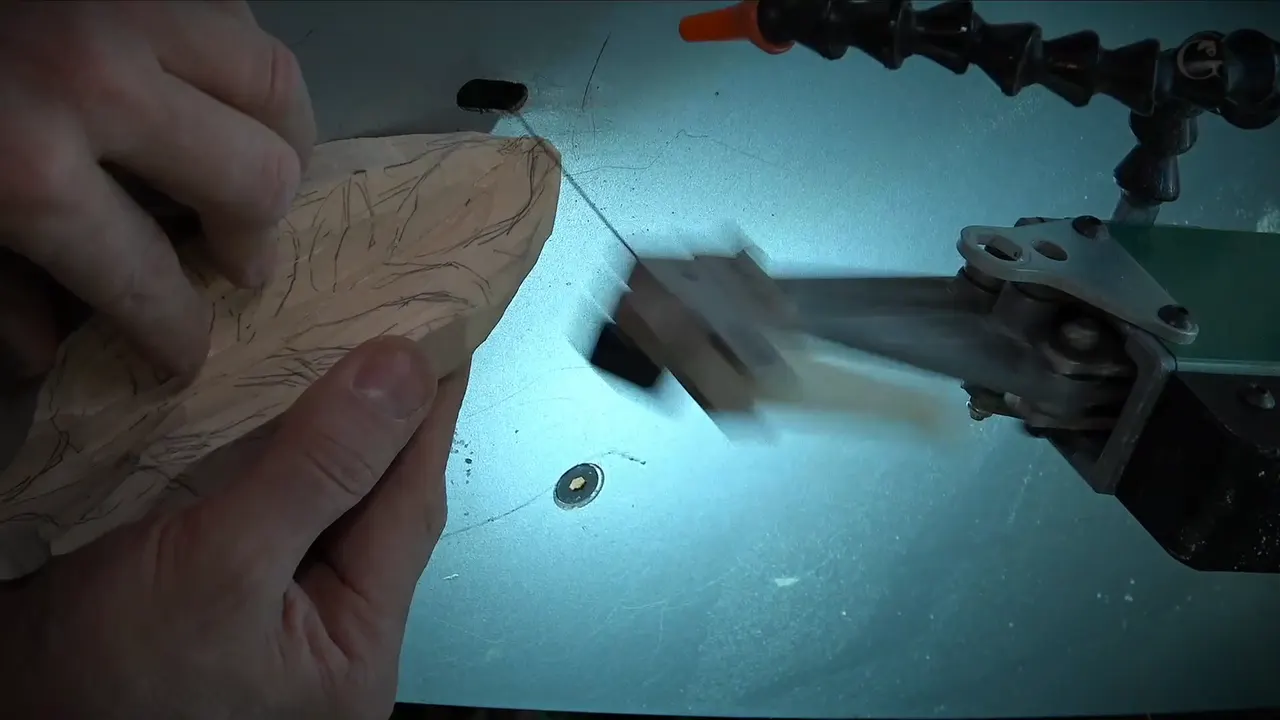

I said "scrolling out" in Venice Room workshop 77, part 2, while I worked at the scroll saw. The lessons below carry "scrolled" and "scroll it" over flowers, a printed design and a couple of sections on a panel.
Ever stood at a saw with a drawing glued to a board and wondered how much of the carving the saw should do? Did a gouge ever sit on your bench while you asked what it was for? The word came up in part 2, and in other lessons, and what followed it changed with each piece.
What was coming off the saw in that video?
The part opens on an offer. "And yes, at this stage, what I could do, I could take it actually right now to a scroll saw. Why not?" Then came the job, put in a few plain words: "And just take out whatever the waste."

"And again, I don't have to be a really straight line. I really don't want to do a straight line. There's absolutely no reason." My next question was about the blade: "Can I change the blade right now to a spiral blade?" I usually do not like that blade, I told you, and I did use it there because I did not care how clean the cut I was creating came out.
"Here you go. That's the result, what I'm after," I said. And from that piece, "I can work right now my details and all the waviness and stuff like this."
Which cuts did I plan on the saw?
One spot did not please me. "But what I don't like, I don't like this. Maybe I need to remove some of that." The way came next: "I can actually do it on a scroll."
A little later: "And yes, I could probably also take out some of that part." Then: "So you can actually create a lot of stuff just by scrolling out."

The middle leaf got two ways. "I could take it by chisel at those cheeks, or I could actually just place like this and create a cut on the scroll saw. No problem." Then "And the second side the same way."
One more detail from that stretch: "Even if I didn't cut that all the way, so it's easy to break." And for the leftover bit: "that part, little part, I'm going to just shave with the gouge or with the tool." Chisel or saw for the cheeks, and a gouge for the leftover bit, were the choices I named.

Which spot looked too empty once the piece sat in place?
"So let's take that in place and see approximately how it looks." Next came what I saw in that spot: "Right now, it just looks like a little too empty in this spot, okay?" "And this piece going to work like a filler."
"I already can see the main movements, what I have to do. This piece has to go down underneath of that movement. That can just wrap above." Then a marking plan: "Let me mark it. Got to mark it what I have to flip above. So that section needs to be gone."

The part closes with work still to do. "And now we can work some of the details, although got to be careful." And at the very end: "Got to work my way in a little bit and clean up the backside."

When did I say scrolled and not cut?
I gave myself a correction in the first Hashemi lesson, in the middle of a sentence about saving material. Carving Hashemi Flowers 1 has it in the first video: "when I cut my design, or should I say scrolled my design, I kept all my pieces."

The offcuts went to work. I took offcut pieces, peeled the original paper off and reapplied it on them. It came off easily because of the photo mount glue, I said, and I told you to draw the direction of the grain and match it.
Did the saw leave me a finished edge?
A line on what the saw leaves sits in Lily Box 5, part 4, and I said: "when you're doing a scroll saw, it's never perfect. It's never really good. And I need to fix that edge." What I use for it: "I use number three and whatever bumps and unevenness I see, I can actually remove it."

A ridge in Lily Box 4, part 11, looked really sharp to me, and I said why: "That is original wall from a scroll saw." Over in Lily Box 7, part 5, the line was "Clean that mess." After it: "Whatever my scroll saw left." I corrected myself: the mess was what I left when I was cutting it.

How does a missed spot look?
Floral and Molding 2, part 1, has me catching a mistake. "It's not like big mistake, but I see I forgot to scroll a couple sections." I added, "that has to be scrolled all the way through. It has to be pierced."

The fix I named was a drill, and I said I probably should use one: "Why not?" On one side, the plan was to "just drill a few spots."
Scrolled places change what comes next, too. Floral and Molding 3, part 1, plans a sloping motion, but not everywhere. "Where I scrolled that, so it's impossible to slope it."

Could I have scrolled it and decided not to?
The weighing shows in Byzantine Acanthus 4, part 2, where I talked about picking a spot for a separation. "So you take a spot, calculate approximately what's logically the spot you're supposed to create the separation. And yes, I could draw that in the beginning, and you could scroll it out, but then you would miss the point how to carve if it would be a solid piece of wood."

"That's why I left that part for a little later," I said. Carving Hashemi Flowers 23, part 2, had a line to refine, and the saw was an option. "I could actually scroll it. But I don't really need it." After that came the next job: "Let's work on this volute."
Why did I leave the saw out of a hazelnut carving?
Carving Hazelnuts 1, part 1, says it plainly. I would like to leave some space for the background, I told you. "I'm not going to scroll, I'm not going to do a bandsaw around and glue on some background. It's going to be solid."

Venetian Flowers Rosette 5, part 3, has the same choice. The piece was a single solid piece, and I said "I could just scroll all that." Another line: "I could just scroll that and carve it and apply it on a background." "But I thought that's a good idea to do solid. That way, you'll see exactly what is going on."
You can hear me argue it out in Lily Box 2, part 1. "I had to debate inside of myself. Should I just scroll all those parts?" "I call it inlay, but anyway," I told you, and I had leftover pieces. A second option came in Lily Box 2, part 5: "you would just scroll that from separate piece, like an eighth of an inch thick, and apply it, and I entertained this option." An eighth of an inch is 3 mm.
Did other carvers scroll everything and glue it on?
Carving Furniture Panel 15, part 7, tells how others did it, and what we want instead. "There's other ways they've done it also." Then: "they would just scroll everything and just glue on and work on whatever they glued. But we want to make sure we carve it."
Grinling Gibbons, Class in Maine, lesson 2, part 3, calls the saw "the easy way" for a piece that was not big. "It is possible because the piece itself is not as big." Then a thought about a huge piece: "how are you gonna scroll that?"
How thick a board can the saw scroll?
Workshop 76, part 9, speaks to it. "If you do have a band saw, that would be probably the quickest, but I'll use just a scroll saw, and I can prove it to you that scroll saw is sufficient for a really thick scrolling." One of the questions, I said, was about thickness: "Can I scroll two-inch thick stuff? Yeah. And absolutely, you are able to."
Two inches is 51 mm. In Lily Box 1, part 1, the slab was thinner: "approximately 20 millimeters, I would say, or 3/4 of an inch," and 20 mm is 0.8 in. Then: "And on a scroll saw, I cut stock two inches thick."
Not everyone owns a saw, and I said so. "I do realize not all of you have a scroll saw. You could use just a Fretsaw." And then: "You can get just a normal fretsaw and just do it by hand."
Which part stayed on a piece so I could hold it?
In part 5 of Lily Box 11, a flower is already cut, and the line was "I already scrolled. I don't think I need to show you how to scroll it. That is not that complicated and all." A question about the part sticking out got this answer: "If I would just cut or scroll that part and without that part, it would be hard for me to hold it. But this extension will serve me as a holding device, okay?"

A leg does that job too, and it shows in Lily Box 12, part 1. "So I just go ahead and cut, scrolled out the surrounding of flower." About the leg: "I left some leg, and just because I left that leg, I'm able to clamp it." Carving Modern Acanthus 1 repeats it: "remember keep those legs." Before the saw, I said, you can actually chop the bigger chunks on a band saw.
Lily Box 11 gives more than one way to cut a piece out. "We can use a scroll saw to cut this out if you do have a scroll saw like mine." Then: "But even by hand, just any hand saw will do. Okay? Just don't try to knock this out with a hammer or something. So that would be a big mistake."
A scrolled section can follow the carving. The fourth video of the twelfth Lily Box lesson has me looking at a flower from the side: "I actually scrolled out the section because this part's supposed to go over that part right here. Okay? So it's supposed to just kind of wrap it." And on the wood: "As far as when you're going to scroll it, just try to find the best grain for the flower."
What came right after the saw in other lessons?
In its first video, Carving Greek Acroterion 1 has the steps before the saw: I printed my design to scale and glued it on top of lime wood or basswood. I waited about overnight until it dried. "I took it to my scroll saw and scrolled that all around, and now I'm ready to carve it."

Tracing the existing piece and scrolling it out is in Byzantine Acanthus 6, part 2. "I cut another piece, and I left little longer just in case. I want to make sure it blends really nicely." Carving Modern Acanthus 4, part 1, has the same plain words, "We scroll this out," over a different piece.

When the scrolling was over I said so, too. The saw work ends in Lily Box 10, part 1, with "I already scrolled that out, so all the scrolling is done."
Why did I call the saw the safer way?
The twelfth lesson of the olive box course has a piece in its seventh video that was just a little too long, and I said I was going to make it shorter. A saw or a knife could do it, I said, and then: "Safer would be, of course, a scroll saw. Okay. So much safer."

My reason on fragile pieces is in Lily Box 13, part 1. "Of course, I try to use the scroll saw as much as I can. And it makes sense, I believe." Using the saw, I said, means a lot less damage, or "possibility of damage, I should say," to the piece.
I do not call the saw harmless. Carving Byzantine Acanthus 1, part 2, has me on its safety. "It's also one of the safest tools." And then: "When you use a scroll saw, it's also really safe, but don't be dumb. Okay? You still can damage yourself, okay? Be careful with that."
Which lessons say scrolling, side by side?
Each lesson on this page, with the words I said in it and the next thing I named.
| Lesson | Phrase | Next |
|---|---|---|
| This video, 77.2 | just take out whatever the waste | Details, waviness |
| Hashemi 1.1 | when I cut my design, or should I say scrolled | Kept my pieces |
| Box lesson 5.4 | when you're doing a scroll saw | Fix that edge |
| Molding lesson 2.1 | I forgot to scroll a couple sections | Drill a few spots |
| Byzantine 4.2 | you could scroll it out, but then you would miss the point | Left for later |
| Hazelnuts 1.1 | do a bandsaw around and glue on some background | Solid wood |
| Venetian Rosette 5.3 | carve it and apply it on a background | Do solid |
| Lily lesson 11.5 | I don't think I need to show you how to scroll it | Extension, holding device |
| Lily flowers 10.1 | I already scrolled that out, so all the scrolling is done | The second flower |
| Greek Acroterion 1.1 | I glued that on top of lime wood or basswood | Scrolled that all around |
| Modern Acanthus 4.1 | We scroll this out, this part is going to be convex | Concave undercut |
| Olive box 12.7 | Safer would be, of course, a scroll saw | So much safer |
Where can you watch part 2 and the lessons on this page?
This part sits in Venice Room 77, and Venice Room Part 7 holds workshops 74 to 85. Workshop 76 comes just before it and workshop 78 just after. Every other lesson here has a page of its own, linked above, and each opens with school access. A plain workshop number means the Venice Room, and every other lesson carries the name of its own course.
Want to see the saw work and the gouge finish it, in one run? Looking for wood carving that starts from a sawn piece? Start here.
How it's done
- Offer the waste to the saw. Part 2 opens with a plan: the piece goes to the saw, and the waste comes out.
- Skip the straight line. Not being a really straight line was fine, and I really did not want one.
- Set the piece in place. Take it in place and see approximately how it looks, I said.
- Clean what the saw leaves. A scroll saw is never perfect, I said, and I use a number three on the bumps and unevenness.
- Decide before you scroll. The Byzantine lesson weighs it, and the separation waits for a little later.
Frequently asked questions
Which words went with scrolling out in workshop 77?
The saw lets you make plenty of things when you scroll a piece out, I said. The cheeks on the middle leaf were chisel or saw work: I could take them by chisel, or place it on the saw and cut them. No problem, I said, and the second side the same way.
Which word replaced cut in Hashemi lesson 1?
The first video has me saying cut, then correcting it in the same breath to scrolled. I kept all my pieces, and I peeled the paper off the offcuts and put it back on them.
Does a scroll saw leave a finished edge?
Mine did not. Lily Box 5, part 4, has me saying it is never perfect and that the edge needs fixing, and I name the number three tool for the job.
What to carve next
- Venice Room 77
- Venice Room Part 7
- Venice Room 76
- Venice Room 78
- Carving Hashemi Flowers 1
- Lily Box 5
- Carving Floral and Molding for the Panel 2
- Carving Byzantine Acanthus 4
- Carving Hazelnuts 1
- Venetian Flowers Rosette 5
- Lily Box 11
- Lily Box 10
- Carving Greek Acroterion 1
- Grinling Gibbons, Class in Maine, lesson 2