

Alexander Grabovetskiy, woodcarver, School of Woodcarving · Published 2020
What does a wood carver mean by "waviness"?
Quick answer: Waviness is the word I used in Venice Room workshop 77, part 5, when I said I did not think a leaf was wavy enough and that I could add some more. In the lily box, the Venice Room and other courses I said it about edges, petals and small flowers.
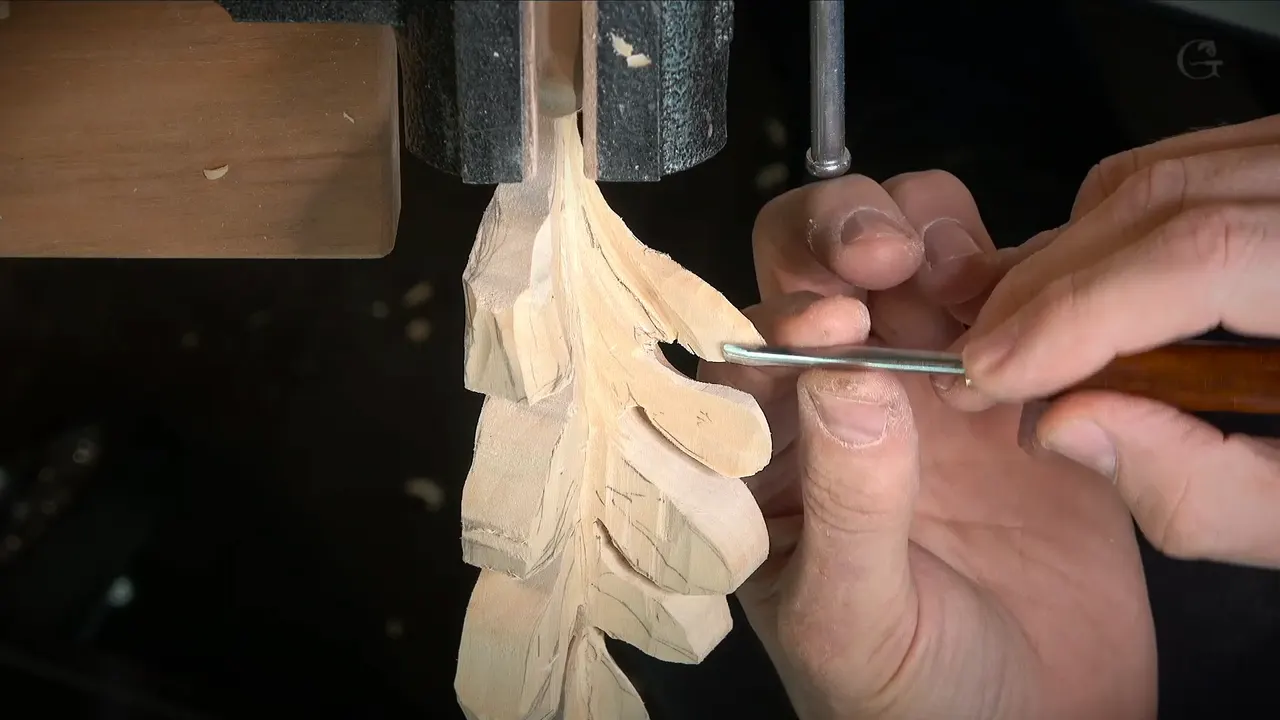

I used the word waviness in Venice Room workshop 77, part 5, on a thin leaf piece that I thought needed more of it. The same word turns up in my lily box, my floral panel and other Venice Room lessons, about a leaf, a petal and a tiny flower.
Ever held a carved leaf up to the light and felt it was too plain? Did one edge look as if you drew it with a ruler? Here are my lines about that, and where each one lives in the lessons.
What did I say about waviness in workshop 77?
The video opens on "this part is a little too thick right now," and I said "I can start shaving it out." Next came "Switch to micro tools or detailing tools."
Further on I said I could "create some more interest" with concaves and convexes, "by using micro tools." A few lines later: "And I don't think it's wavy enough. Maybe I can just add some more waviness."

That doubt returned a little later, and again with a "maybe." That was a plan, and no finished carving yet.
How thin was that leaf piece?
Thin enough that I talked about breaking it. My words were that I was going to "roll it a little bit," and with a finger placed underneath I told you to "be careful not to cut yourself, okay?"
For the middle I gave a floor. I "really need at least eighth of an inch thickness," I said, otherwise the leaf is "too fragile." That is 3 mm, near enough. The edge was another matter: "At the edge, it could be much less."

I planned to undercut from the backside. A moment later: "Oops." I did not want to do that, I said, and "That would be big mistake later on." I added "I could break it."
I called it a "really, really fragile piece." About the middle I said "it's about eighth of an inch, like three millimeters, but at the edges, it is absolutely not." I also said "tools, they must be super sharp," and "You can hear how sharp my tools are."
Later in the part I said "that is number one leaf," and that I could check "how it actually fits on this side." Then "this one can actually curl that direction." The transcript ends on "I think I have too much of material right now."
Did the other parts of lesson 77 use the word?
Part 2 of Venice Room 77 has it: "That's the result, what I'm after. And from that, I can work right now my details and all the waviness and stuff like this."

A small number shows up in part 6: "And I can create some convex and concave on inside. Don't have to do a lot, but a few of them, like two, three. Just to give some more interesting look and maybe create some waviness also." It also says "it's supposed to be from the same stem, so it has to be gradual movement."
Back in part 5, I planned a concave with "two millimeters number 11," about 0.08 in. Right after, I said "Let me switch to a small micro tool and remove some of that stuff right here."

Is waviness the same as curliness?
Both words came up for one leaf in lily box 3, part 8. "Although, I'm not too happy about form of this leaf. I need to give some waviness to it also."
Then I named the cut. My design called for an "inside cut like this." Of the cut I said "I call it waviness. Sometimes I call it curliness." Then "Like a curl."

The word can point the other way. The original design in part 1 of that lesson had a wavy middle line: "I do have it wavy, but I really don't have to. I'll make it a little more straight."
In video 7 I said I would make it "some more wavy," then "just approximately the same like I drew." About that side I added "there is not too many waves on this side."
How do I make a wave in a leaf?
The second video of that lesson has a number 11 for the "waviness of this leaf." A run of straight down cuts followed, and then "I'm going to flip it like this, and I again straight down, straight down, and straight down."
Then "And here is my waviness." One thing I did not like was the "sharp ridge, what I left right here," so "I need to kind of blend that."

How much waviness fits on a tiny leaf?
Tiny leaves got less. The tenth video has "let's recreate the middle line" with just a pencil, and then "my drawing showing little wavy line, but I'm not going to do too much waviness, because those leaves are really tiny."
My plan was to "create just more tangent to that movement, that direction," using a number 7.

Why do I give petals a wavy edge?
A real petal has a wavy edge, I said. Lily box 10, part 2: "when you look at the real-life flower, on the edge, I'm talking about the edges of the petal, they never are really straight line. They're all wavy. Okay? So that is what we going to try to replicate."

The concave came first: "first let me zig out that concave." Part 10 of that lesson wanted more than an outside edge: "I need to create the waviness, not just on the outside edge, but also I want to give some concaves and convexes right here."
Depth had a limit there. "I shouldn't make any really deep concaves," I said, and I planned to take "probably one-eighth of an inch" (3 mm) using a number 8.
The third video has me saying I could "probably establish my waviness at the upper part," and that I would "excavate much deeper a little later on. Not now, because it's going to be too fragile." I feared "I can break the edges" if I cranked on it.

In floral panel lesson 13 I said I drew what I was working on while recording without audio. "So I would like to see a lot of waviness on all of them," I said. I made "a couple concave on the side, on both sides, on every petal," with "Concave in the middle," a convex on the sides and "little bit concave at the ends." You can read about the flower and the petal on Wikipedia.
Does a tiny filler flower need waviness?
In lily box 12, part 1, I had to be creative and add waviness "even on a small flower like that." Only about 5 millimeters, 3/16 of an inch, of thickness was left on it.

Further along I called it "a really minor one," not a focal point, and said "I think everything counts. Every little flower counts." I also told you the name, "those flowers called just the filler flowers." Wood carvers "had to fill some space," I said.
The sixth video has "And just because I gave that waviness everywhere, it just look kind of nice." Something in the middle would look nicer, I thought, and for a smaller gouge I said "maybe just about 1/16 of an inch" (1.6 mm), to "give it even more waviness."

The seventh video: "And maybe just give some waviness. Not much, a little bit. Okay. You see? I think it looks much better that way."
Which parts did I want wavier?
Floral panel lesson 7 has "it is going to look awesome" once undercut, then "But again, I don't like that is not wavy enough." I would "introduce some waviness a little more."
A hole came up too: "that hole is just a little too round," and I needed "some waviness in that hole." After that: "You got an idea of waviness, not just a straight line."

It comes up about edges in Venice Room 115: "I don't want to see somewhat straight lines." Next came "I want to create some waviness. Otherwise, it's not going to look realistic because there is nothing in real life, almost nothing, really straight line." Then "Probably some stuff is, but not much."
A line was "just a little too boring" in Venice Room 110. My next words were "Why don't I make some waviness, okay? Like real-life waves." On Wikipedia you can read about the wave and the sine wave.
A quick one is in Venice Room 98: "Let me use again number 11 and 10 mm," for waviness and for the "outline of this leaf." Over in Venice Room 97 the middle line was "the main movement. And inside of it, I'll do extra waviness."
Which tool makes the waves?
A section sat "same level" in Venice Room 157, and I wanted it wavy. "To create that waviness, I'm going to use 20 millimeters number nine," about 0.8 in, and wherever "I have the wider spot," the cut is meant to go "toward the center."
In 115 I could take some of the stuff out with the number 11, the way we do relief cuts on acanthus. For 110 I planned "probably just a knife" to "hit that edge," and a few lines later I said "I'll create that waviness." The 97 video named "Number 11, 5 millimeters" (0.2 in) some seconds later. In 134 I called one spot "really wavy right here," and for it I planned "a plug cut pretty much with the number nine" in "20 millimeters, three-quarters of an inch." Wikipedia explains relief and acanthus.
A gouge number 11 did the straight down cuts in the lily box, and 2 mm (0.08 in) in a number 11 was the plan for the leaf in workshop 77.

Can waviness go too far?
A leaf in lily box 7 made me say so. A notch in part 10 was "supposed to be just like a wave." Because of a flip, it "looks like there's an extra one," and I said "I don't want to see that. Otherwise, it will be too much waviness."
After the fix I said "Now it really has a real nice S shape at the edge." In part 9 the word came with the wood itself: "this wood has a lot of grain, and waviness, just it distracts overall movement." Then "I have to constantly just check by finger, how it feels."
Workshop 2 of the antique style rosette course has "your eye can easily catch if your line is wavy," and "in this case, I can't allow waviness."
I wanted "a really gradual movement right here, so without any waviness" in Venice Room 131. And in Venice Room 1: "I'm not even going to worry about the waviness you see right now on those future leaves, because in reality, that would be big mistake if I would just outline that."

Does waviness have to be perfect?
About flowers, in Venice Room 134: "I really like the idea of being wavy when I'm carving flowers, because you're never going to find any perfect shape in nature, in creation."
Further on: "And again, waviness is actually only plus, so it doesn't have to be perfect. Because like I said, nothing is perfect shape in nature. Although it is perfect. It depends what you mean by not being perfect. By Fibonacci sequence, it's still going to be perfect." Right after, of an undercut: "I think about five millimeters, I'd say," or 0.2 in.

One more, from Venice Room 24: "you can see that waviness. It is wavy, but it's still perfect, okay? It just follows the movements and creates beautiful, beautiful look." In furniture panel lesson 19 came "my waviness is not necessarily set in stone, so you can just try your own waviness."

The lines side by side
| Where | What I said in my own words | What came next |
|---|---|---|
| Venice 77-5 | A leaf not wavy enough yet | A thin piece |
| Lily 3-8 | I call it waviness, sometimes curliness | A curl inside |
| Floral 7-3 | Going to introduce some waviness a little more | A hole too round |
| Venice 115-1 | Almost nothing in real life is really straight | A number 11 planned |
| Lily 12-1 | Waviness even on a small flower | Every flower counts |
| Panel 19-5 | My waviness is not necessarily set in stone | Try your own |
Wikipedia has pages on ornament and shadow.
Where can you watch these lessons?
Venice Room 77 holds this part, and Venice Room Part 7 holds workshops 74 to 85. More Venice Room pages: 1, 24, 97, 98, 110, 115, 131, 134 and 157. The lily box has lessons 3, 7, 10 and 12, and the floral panel course has lesson 7. Care to watch what a gouge does to a leaf? Looking for wood carving lessons where you can follow each pass? Start here.
How it's done
- Check the thickness first. In workshop 77 I said I needed at least an eighth-inch thickness (3 mm), or the leaf would be fragile, and that the edge could be much less.
- Add waviness once a part is nearly done. In part 5 one part was almost done, and then came my doubt and a plan to add more.
- Hold it down on tiny leaves. Lily box 3 has me saying I would not go heavy on waviness, since those leaves were really tiny.
- Reach the spot with the right tool. A number 9 at 20 mm (0.8 in) was my plan for a wide spot in Venice Room 157, and a knife in 110.
Frequently asked questions
What did I mean by waviness in part 5?
Part 5 has me doubting the leaf and saying I might add more. The doubt returned a little later. Close by I talked about micro tools and a concave cut.
Do I call waviness curliness?
In lesson 3 of the lily box I named an inside cut on a leaf waviness and said "Sometimes I call it curliness. Like a curl." I used both words for one kind of movement.
How deep should waviness go?
On a lily petal I said I should not make any really deep concaves, and I planned about one-eighth of an inch, or 3 mm. On a small flower in lesson 12 I wanted only a little bit.
What to carve next