

Alexander Grabovetskiy, woodcarver, School of Woodcarving · Published 2020
What does a wood carver mean by "best idea"?
Quick answer: In Venice Room workshop 77, part 6, I used the words "best idea" about the backside of a big skew. In other lessons I used them about grain, a cut toward myself, a V tool and a pencil, and also for a rushed cut, a mallet and calipers.
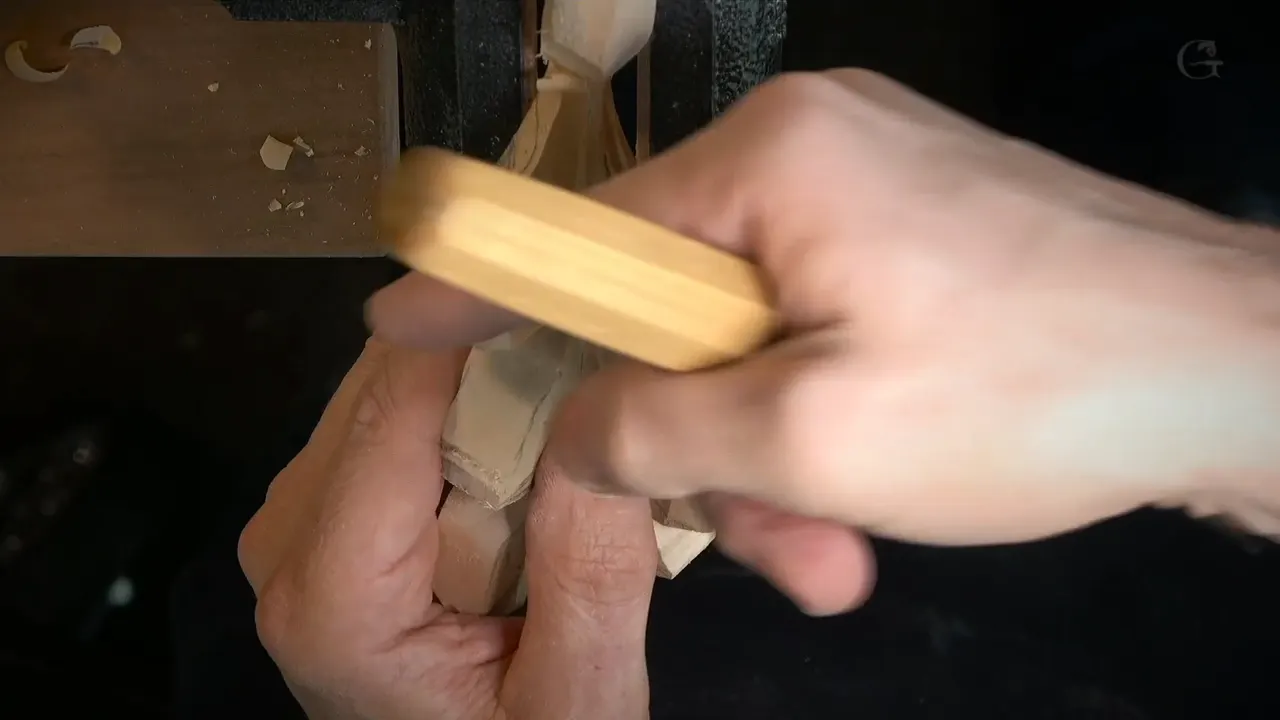

I said "Maybe it's not the best idea" in Venice Room workshop 77, part 6, about using only the backside of a big skew. I voiced the same doubt in other lessons, about grain, a cut toward myself, a V tool, a pencil and a rushed cut.
Ever reached for a tool, felt a doubt, and carried on anyway? Here is where I said it, and what I said close to it in each lesson.
What was I carving in workshop 77 when I said it?
Part 6 starts with "Number 7, 14 millimeters. That's what I'm using." Then "Half an inch," and 14 mm is 0.55 in. Next came "Again, it's supposed to be from the same stem, so it has to be gradual movement."
Soon after: "And now I can actually excavate from the backside." Further on, "Actually, I could do all the way to the edge, no problem." And "this one needs to be curling."

Then a comparison: "I did more like a raised middle line ridge. On this one, I could do opposite." Of that, "I think it's going to look really nice." Of the plan for it, "It's just concave inside."
On the tool again: "I'm sorry. Yeah, it is number 7 and 14 millimeters." I planned to remove some of the material, and "see, I placed my finger underneath. But be careful because you can actually cut yourself."
"I can probably create a little deeper now," came next. Taking a number 11 was possible, "of course," and then "let me take number 8 and 7 millimeters, like little bigger than a quarter inch" (0.28 in). The plan was "little by little, I'm going to excavate from inside like this."
Later: "I think it's wonderful, but I need a gradual movement." About the ridge: "I don't like it." I needed to "gradually move opposite direction," and yet "it's not bad at all. It looks really good. But we can do better than that."

"And now I need to actually take it with the number 7 all the way to the edge." I could add "some convex and concave on inside." Also "Don't have to do a lot, but a few of them, like two, three." And "Just to give some more interesting look."
Checking came next: "Let me check how it fits, how it looks." Next: "Now it's going to go like that." Then "And I also have to probably do exactly the same, but this one has to go like that. So I have to chop all of that material right here." And "that one is going to be more convex. Doesn't have to be the same."

What about the skew?
Near the end: "But I also could use some kind of skew. But there is a danger, so really have to control myself how deep I'm carving." And "I'm pretty much using only backside of the skew. It's a big skew." Then "Maybe it's not the best idea."
"Especially I've not fastened that as tight." Last: "I can actually lower that a little bit like this."

The middle of the leaf in part 5 was "about eighth of an inch, like three millimeters," "but at the edges, it is absolutely not." That part also has "I could break it." Also in part 5, in the same stretch: "Don't want to do that. That would be big mistake later on."
In part 7 I start with "I broke this part. It's really tiny, less than a 16th of an inch right now" (1/16 in is 1.6 mm), and "when I unscrewed that thing right here, I just hit that and broke." Further on: "Sometimes I think it's safer to use smaller tools." And "It could be much safer to approach that with the smaller tools."
Part 7 also has this line about rushing: "For me, probably it's a good idea not to rush it. Not to rush it whatsoever because that would be a big mistake."
Does the grain bring out the same doubt?
Venice Room 86 has "I am cutting against the grain," and I called that less than ideal. Then "Let me change the position." Also "For me, it would be probably easier to attack from opposite side." Then "go across the grain."

Hashemi lesson 10 brings the grain up again, and I flagged it there too. I was "about maybe 1/32 of an inch from the back" (0.8 mm), and "I want to keep that way, okay?" Then "my goal is to make it beautiful concave and keep that backside."

In Greek acroterion 4, "Again, really important to hold the same angle." My doubt came with "Although I'm cutting right now against the grain," and then the plan: "So I have to just rotate my piece and cut from this side."

Venice Room 127 names the grain as the trouble, and then "so I need to attack that from opposite direction."
What if I cannot rotate the piece?
The grain doubt is there in lesson 53 too. Then "sometimes I just can't change the position because this piece, particular project, I cannot rotate and I can't walk around my bench." And "Otherwise, I'm going to lose too much time."

In Venice Room 4: "you're supposed to attack from that side. But sometimes you're limited, and I am limited in this case because I don't want to rotate my piece, and I don't like to swap my hands because it's still not comfortable for me."
I called my way of working doubtful too in lily box 6, "but I feel safe." Also "Should not be a problem." And "But if you do have sharp tools, you shouldn't have any problem with that."
Is it the same when the cut runs along the grain?
The cut can run with the grain too. In furniture panel 22 I said "you can see this element, this part is aligned with the grain." Sometimes it is a doubtful choice to cut with it like that, I said. "It can split, and you can damage your carving." Then "you have to just check what is the best approach."
Panel 20 has "I have to be really careful because I am carving along the grain right now." And "the best idea is to attack from this side and this spot."
What about carving toward myself?
I carved toward myself in lesson 84, "just because of the camera position, okay?" Then the doubt came in the next breath. After that, I did not want to "stick my head in the camera all the time."

Lesson 144: "3 millimeters, number 11, of course" (0.12 in). I planned a cut that is "not advisable." Then I said I did not want to "walk around and block the camera."

Lesson 20 calls it normally a doubtful way to cut toward yourself, "but if you lock with the hand, so you should not have a problem." And "If you're not air carving like this, you're not raising hands above your surface, so you shouldn't have any problem."
Which tools did I doubt?
Hazelnuts 2 doubts a V tool. Then, "Reason why--" and "I'm using number five, by the way. Number five is about 5/8 of an inch, about 16 millimeters or so."

In Hashemi lesson 43 I said I would use a marker, but "I encourage you not to use marker, just to use pencil." The pencil got my doubt as well, since "your piece becomes really dirty after too much use." And "What you could use, actually, just a V tool. Use as a marking tool and make some cuts."

Panel 20 also covers sanding and what some wood carvers do: "you could just actually scrape it, okay, with the same knife." I had my doubt there too, "but it's still possible to do it."
Grape leaves vase 2: "to create the convex, I could try to use a number seven upside down," and then "in my case because the cut is not too deep. Let me try number three."

Another case is lesson 71: "Let me use 3 millimeters again. Number 11." (0.12 in) Next, "Maybe I should use already a spoon." Last, "Because right now I'm cranking against this edge," which I doubted.

A number seven is the tool in lesson 45: "See, I just used number seven." It was "not always" the best idea when I get "really close to detail like that." Of that number seven: "It just hits with the corner and breaks away." And "So that's why it is better to use proper tools."
Panel 20 names a mallet too. I said "Just controlling my tool." Then "Again, probably the best idea would be use a mallet because I see I need little more control right here."
Which moves did I doubt?
In lily box 7 I said "I should create that relief cut, but I didn't do that. I need to." Rushing things is sometimes a doubtful way to work, I said. Then "Okay, let me relieve it." What I mean by a relief cut: "I'm just placing tool and make my cut straight down, just like that."

In furniture panel 19: "I really wanted to see something right in the middle." I doubted starting from the middle section. After that, "So it's better just to move along."
Floral panel 10 is about rolling it too much: "if you roll it too much, all you're going to see is just a straight line, and that point not going to be visible, and that's not going to look really nice." I closed that line with the same doubt.
Over in lesson 111 it was a gap: "originally, I do have a gap right here." And "I need some kind of stability." Then "So why don't I take this part a little bit underneath of this acanthus part?" My plan was "4 millimeters, number 11" (0.16 in).

Where was it plainly the best idea?
Part 1 of the tenth Hashemi lesson has "especially in the beginning" and "when you just set preliminary forms." Then "it is always the best idea to use the biggest tools you have." And "You can achieve much quicker results."

For the depth of a channel in Greek acroterion 5: "I think it would be the best idea to keep it about 16th of an inch deep" (1.6 mm). On depth: "I always can go deeper." And "I'm not measuring it, I'm just eyeballing it."
Over in the Greek acanthus leaf course, lesson 5, I said "And I need the pencil for that. And let me redraw the major lines." Then "Probably the best idea for you would be if you can print the same paper and look at the paper and redraw on a piece of wood again all the lines." And "I'll just myself just eyeball."
In floral panel 4 I said "I need to measure the distance." Next, "the best idea for me, just to go back to my previous piece and just to get my calipers and measure it." On eyeballing: "I can always eyeball it, but I don't really need it if I can measure it." And "about half an inch, I would say, approximately" (12.7 mm).
The lines side by side
| Which lesson | What my words were about when I said them | A line near it |
|---|---|---|
| Room 77 | A big skew and its backside | "Especially I've not fastened that as tight." |
| Venice 86 | The grain named as the trouble | "And go across the grain." |
| Hashemi 10 | A spot about 1/32 of an inch (0.8 mm) from the back | "make it beautiful concave and keep that backside" |
| Room 84 | Carving toward myself because of the camera position | "stick my head in the camera all the time" |
| Hashemi 43 | A pencil used for marking petals | "I encourage you not to use marker" |
| Lily 7 | A relief cut I did not make yet | "Okay, let me relieve it." |
| Floral 10 | Rolling it too much on the panel | "all you're going to see is just a straight line" |
| Acroterion 5 | The depth of a channel in the carving | "I always can go deeper." |
| Floral 4 | Measuring a distance with calipers | "go back to my previous piece and just to get my calipers" |
Wikipedia explains the gouge and the chisel, and a third page covers the knife.
Where can you watch these lessons?
This part is in Venice Room 77, and Venice Room Part 7 holds workshops 74 to 85. The other Venice Room lessons I quoted are 86, 84, 144, 127, 111, 71, 53, 45, 20 and 4. Hashemi has 10 and 43. The panel course has 19, 20 and 22. I also quoted hazelnuts 2, Greek acroterion 4, lily box 6 and 7. Care to follow wood carving one decision at a time? Looking for lessons where you can hear each doubt? Start here.
How it's done
- Check the grain first. The 86 video has me saying the other side would probably be easier, and then going across it.
- Turn the piece. In Greek acroterion lesson 4 I said I had to turn the work and carve from another side.
- Try another tool. Grape leaves vase, lesson 2: I doubted a number seven upside down, and I said I would try a number three.
- Lock the hand. Lesson 20: with the hand locked, I said you should not have a problem.
Frequently asked questions
What did I say about the skew?
There is a danger, I said, so I really have to control myself and watch how deep I carve. I added that I was using only the backside of the skew, and that it is a big one.
Where did rushing come in?
In lily box lesson 7 I said I should make a relief cut and had not, and that I needed to. In part 7 of workshop 77 I said rushing would be a big mistake.
Why did I carve toward myself in 84 and 144?
In 84 I gave the camera position as the reason. In 144 I named walking around and blocking the camera as the reason.
Is a pencil a good tool for marking petals?
What to carve next
- Venice Room 77
- Venice Room Part 7
- Venice Room 86
- Hashemi flowers lesson 10
- Greek acroterion lesson 4
- Venice Room 127
- Venice Room 53
- Venice Room 4
- Lily box lesson 6
- Furniture panel lesson 22
- Venice Room 84
- Venice Room 144
- Venice Room 20
- Hazelnuts lesson 2
- Hashemi flowers lesson 43
- Furniture panel lesson 20
- Grape leaves vase lesson 2