

Alexander Grabovetskiy, woodcarver, School of Woodcarving · Published 2020
What does a wood carver mean by "the hero of the design"?
Quick answer: In Venice Room 87.3 the hero comes up beside "that detail, that drop. So everything just goes around that drop." My panel, lily box, Maine, grape leaves and design principles lessons use the same word beside flowers, clusters and a tulip, and beside a part and an antagonist.
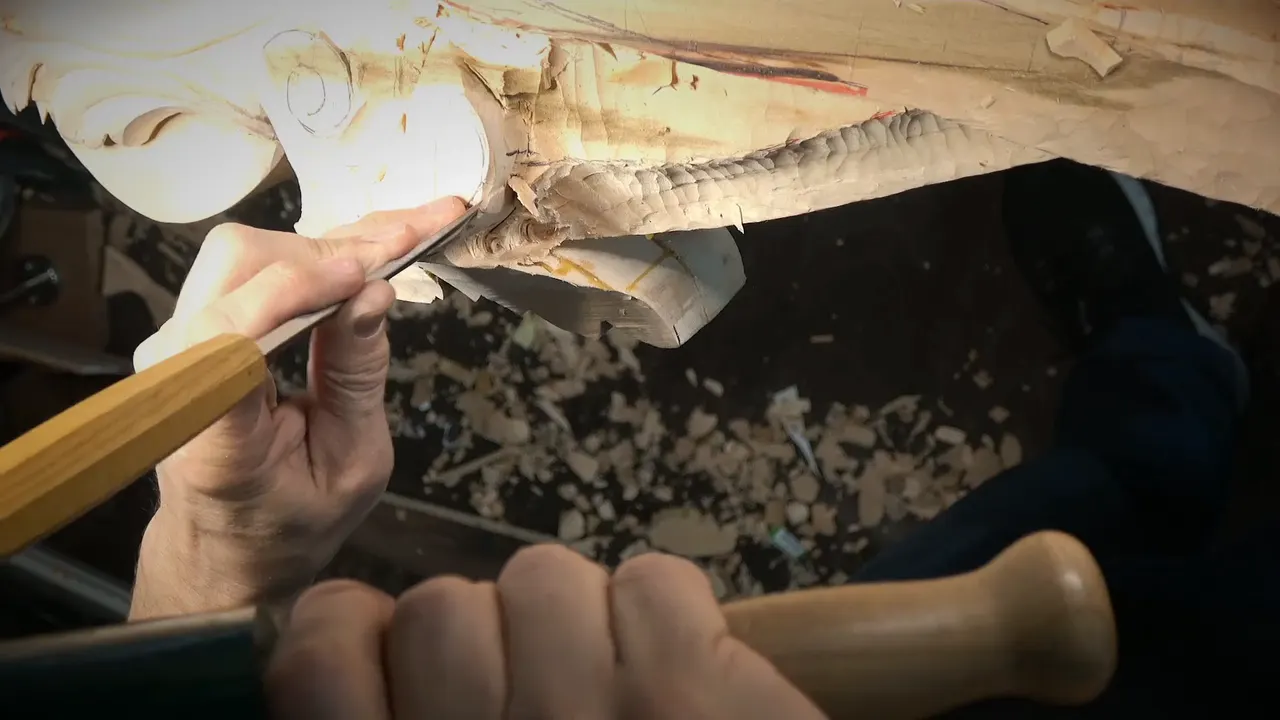

Video 3 of workshop 87 puts the hero of a design beside "that drop." My other lessons put the same word beside flowers, clusters, a tulip and pairs of movements. They are sorted below by what the hero was.
Have you ever lowered a part of a carving because another part mattered more? Which spot of your own piece would you call the hero? Below is that video, then my words from other courses, each with its own link.
What is in the third video of this workshop?
- A high part I'm "not sure yet" about keeping.
- A shape that is "a little too bumpy," and a big number seven for it.
- Hero, said beside a drop.
- A number seven, and a correction right after it.
- One line I can't go beyond, and 6 mm (0.24 in) to go down.
How does this video open?
"Although I'm not sure yet if I'm going to keep this part as high," I say, and "Maybe I have to lower that down" comes next. "But I'll see" follows. Then the plan: "Let me establish first form, and I can always lower that down with no problem."

What did I say about the extent?
I like that, I say. Next are "So that's probably the extent I want to take it" and, for later, "I'll take it a little more to the final form." My note on the section is "what I can see now, so I can actually chop a little bit this section, because right now, it just doesn't look really good."
About a hole I say "I can actually drill a hole down," and "or I could use just probably number nine and create the plug cut, which is going to give me exactly the same result." After that come "So that way, I'm not going to lose a picture" and "I'm not going to lose the outline." A short plan follows: "Let me also just get straight down cut right here."

When did the shape become the topic?
"I'm safe to take that down, so I can actually just create a nicer shape or roll shape," I say, and "Because right now, just a little too bumpy." A verdict follows, "No bueno, not good." For this job I say "I can use big number seven, 3 inches, 80 millimeters" (3 inches work out to 76 mm, and 80 mm to 3.1 in).

Another section is "a little too high also." A worry about the volute comes with it: "I don't want to lose the detail of my volute, so I've got to be really careful." My verdict is "right now, it's looking somewhat good," and I note "I'm talking about the shape-wise, form-wise." "Maybe I need to lower this way," I say a little later.
Where does the word hero come in?
The line comes after "All right." Here it is in full: "The reason why I'm lowering this, because the hero of this design is going to be that detail, that drop. So everything just goes around that drop. All right?"

I go on with "let me chop this out, recreate the movement" and "I need to chop a little more right here." "I need to remove it" is in the same stretch.
Which gouge came next, and what was the correction?
A gouge is named: "I'll use number seven and 5 millimeters," with "3/16 of an inch" beside it (5 mm is about 0.2 in, and 3/16 in is 4.8 mm). The correction comes at once, "Oh, I'm sorry, number 11, veiner." I add "I guess I was using too much number seven."

What was the line I could not pass?
"I do have a line, so I know exactly where that's supposed to end," I say, and "I have that line right here, which I can't go beyond that." My next job is "what I have to do, I have to lower down this section." Its limit is "no higher than that position." A check follows, "Let me double-check right here on this side."
A need comes next, "I need to go at least 6 millimeters down" (6 mm comes to 0.24 in). The last lines in the transcript are "let me use..." and "Well, I don't want to lose the line also," with "So that is the curvature. But I still have to remove." at the very end.

What do the videos around it add?
The same workshop has, in video 2, "I'm looking for the slope," with "a little concave" and "detail on inside" beside it. It also has "I have to find the right spot" and "I measured that with the calipers." Later in that video comes "So cut by cut, I can establish my form." The fourth video says "So that is the volute part I worked previously, which is not the height yet," and "But my goal is to work around." About a slope I say "I have to take a lot of material from this chunk." Another line is "I measured from both sides, and I do have a line that I have to slope everything down." My workshop 87 page holds the rest.

Where else do I use the word?
It turns up in my other courses, and each passage below names its course.
Can a hero be a flower?
My question in the first video of Design principles for wood carving 2 is about "the main flower" and "the main point." An answer follows, "that is my main hero." Later I say "my Peony, it's the main hero."

A rule sits beside it. "Every hero has antagonist," I say there, and the next video has "that is a hero of design, supposed to have antihero, antagonist." The antagonist comes up as "It's the bad guy, if you wish. Okay?" The same video has "It is a secondary hero" and "He's also powerful."
Lesson 4 of the design principles course holds the rule in video 4: "there should be only one hero, only one main idea, one hero." About "antagonist in those four points" a question is asked, and I say "Right away, you have a picture in your head." In the same lesson, video 2, comes "this is the part which is a hero part, just one minute, one second, bigger part."

Is it a cluster or a space?
In Designing Furniture Panel 1, video 4, I say "the main cluster, the main idea is going to develop in those two focal points." Movies come next, "there's always a hero or the main character," with "antagonist or anti-hero" as its opposite. The choice is "which cluster or which space" for "my hero" and for "my anti-hero."

Next come the names "my hero side" and "my main idea." About movement I say "we can always find the spiral movement in this overall design." Then come "we've got the main lines. Although I'm not happy yet."
Lesson 3 of the panel design course, video 1, has the line "Draw a long line corner to corner." Two names follow, "my hero or my main cluster" and "my anti-hero or antagonist composition." One point gets "my hero center." The other gets "my antagonist or anti-hero point," and "my second point or center." Further on I say "the centers are focal points for overall, including the outside boundaries."

In lesson 5 of the panel design course, video 2, comes "we've got the main hero, master of the composition point." Then "another point," described as "the second minor of the composition."

A second hero comes in lesson 11 of the same course, video 1: "anti-hero or the second hero." Earlier in it I say "I like that movement that repeats everywhere."
Can the hero be a flower in the finished carving?
In Carving Furniture Panel 25, video 1, I say "I'm going to jump on this flower right here." The idea I want is "I would like to develop that main main main idea," and "when we develop that cluster in design, that was a main hero." "The main idea of overall movement and so on" comes next.

The second video of that lesson brings the word back: "this is a hero of overall design, the main focal point." Before it comes a goal, "approximately to five millimeters" (0.2 inch), then "about 3/16 of an inch" (4.8 mm). walnut is the wood. I say "what I like about Walnut it's somewhat forgiving sometimes you could go against the grain."

Grinling Gibbons class in Maine 7, video 1, puts the word beside a tulip: "the focal point" and "the main idea," then "the hero of the design," and "tulip." The highest spot is named too, "the Tulip is the highest spot."

Another line in that video is "how I dropped that to approximately half an inch right there" (12.7 mm), followed by "See this space right here. Can you see that space or no?"
Is it a part, or a bigger idea?
In Venice Room 109, video 2, I say "I think it looks good even from above. So you can see it just rolls." Then comes "Main part, of course, like I said, here" and "the big hero of this part is this."

A plan comes after that, "what I can do, I can actually create that separation cut. And that separation cut now going to look awesome." Soon after, I say "Maybe I should," then "Let me think," and "So let me change it."
What stands against the hero?
In Lily Box 12, video 2, my words are "it's always a good idea to find opposite complementing movements." Then comes "it's always minus and plus, hero, antagonist in every little movement."

The fourth video of that lesson has "there's supposed to be a hero, and there's supposed to be antagonist," with "a plus" and "a minus" beside them. About the shapes I say "if I have a convex somewhere right in the middle, so logically, I have to create opposition." Next: "that would be concave right in the middle." For convex the words are "it's a raised part, just like that." Concave gets "a inside cut."

Then a plan: "Let me create that deep concave," and "I need to use probably a little bigger gouge, maybe 1/8 of an inch" (about 3 mm).
A shell is the counterpart in Venice Room 148, video 1: "opposite from this one," with "If this is a hero, that would be a antagonist."

The word anti-hero comes in workshop 102, video 2: "I could actually create the anti-hero and create some concave on this side." Later: "I don't know if I like it or not, what I see."

In Carving Vase with grape leaves 1, video 3, comes "I can make the small one like antagonist, like anti-hero, if you wish, right here." Then "Am I happy about it? I don't know yet."

Does the word mean a main part every time?
Video 3 of workshop 146 has "With 2 millimeters" (about 0.08 in), and "I don't have to be a hero and create a really long cut." The next words are "But looks like I'm able to." A pass follows, and then "2 millimeters is much better, but it's not the end yet."
Where does fungus come in?
Design principles 2, video 2, has me talking about the black or dark brown line between fungus in wood, "a country's division with the border, black or dark brown line between those fungus." Then "And on all of those pieces, all the time, one of the fungus conquers the most territory. He's going to be the hero of that piece. And surrounded by other fungus."
Later in that video comes "But it's always war going on for the territory." Later still comes "If there's no fight, there's no interest. If there's no war, there's no superpower."
How do the passages line up?
| Course and video | Beside what |
|---|---|
| Venice Room 87, video 3 | Beside a drop. |
| Principles of Design, lessons 2 and 4 | A flower and a part, with the overall design and fungus in wood as extras. |
| Furniture Panel design, lessons 1, 3, 5 and 11 | A cluster or a space, and a center. |
| Furniture Panel 25 | A main hero. |
| Grinling Gibbons class in Maine 7 | A tulip. |
| Lily Box 12 | A hero with an antagonist beside it, in a little movement. |
| Venice Room 102, 109, 146 and 148 | An anti-hero, the big hero of a part, and a shell as a counterpart. |
| Carving Vase with grape leaves 1 | A main idea. |
Is there a part of your wood carving that you would call the hero? Which part stands against it? Workshop 87 waits inside one tuition plan with the rest of the Part 8 workshops, and it is where I said that line about a drop.
How it's done
- Say why you lower a part. In 87.3 the reason given is a hero, a detail and a drop.
- Keep the line in sight. I know exactly where that's supposed to end.
- Name the gouge. I name a number seven, then correct myself to a veiner.
- Check the other side. "Let me double-check right here on this side."
- Plan the depth. The number I name is 6 millimeters (0.24 inch), said with "at least."
- Look for the antagonist. A hero comes with an antagonist.
Frequently asked questions
What came just before the line about the hero?
I said "Maybe I need to lower this way," and then the line about the hero came. It names a detail and a drop.
Which gouge did I name after that line?
A number seven at 5 millimeters (about 0.2 inch), and then "number 11, veiner."
How low was the section to go?
I said "I need to go at least 6 millimeters down" (0.24 inch).
Do I name more than one hero in a design?
What to carve next
- Venice Room 87
- Venice Room Part 8
- Design principles for wood carving 2
- Design principles for wood carving 4
- Designing Furniture Panel 1
- Designing Furniture Panel 3
- Designing Furniture Panel 5
- Designing Furniture Panel 11
- Carving Furniture Panel 25
- Grinling Gibbons Maine 7
- Lily Box 12
- Vase with grape leaves 1
- Venice Room 102
- Venice Room 109
- Venice Room 146
- Venice Room 148