

Alexander Grabovetskiy, woodcarver, School of Woodcarving · Published 2020
What does a wood carver mean by "chipped"?
Quick answer: Chipped is my word for a bit of wood that came off, and each video names what comes next: a plan to fix the spot in Venice Room 29, glue in a Lily Box video, and, in workshop 87, video 5, the single word "Chipped." and then "Sorry."
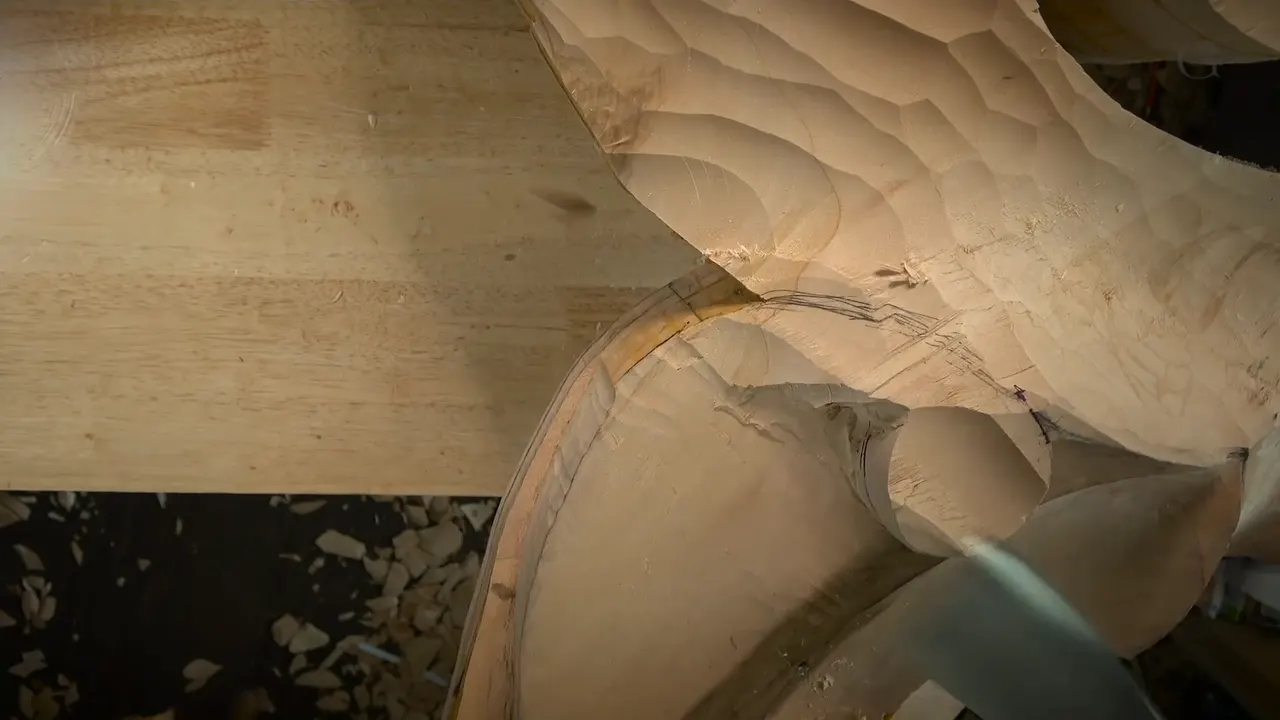

"Chipped." is the last word of video 5 in workshop 87, and "Sorry." follows it. In my other lessons the word means a bit of wood that came off, and I name what comes next each time: a fix, some glue, another tool, or no worry at all. The video comes first, then my lines from other courses, each one linked.
Ever watched a piece of the wood go that you meant to keep? Which words came out at the bench? Mine are below, along with every number, tool and gouge size I named.
Which pieces fill the fifth video of this workshop?
- A line for "a detail on this side."
- A plan, "Let me do a window," and "that's how I call it."
- A height that is "not established yet."
- A piece of paper and the calipers, to find the final height.
- A figure for the wood to remove.
- One last word, "Chipped."
How does video 5 start?
It starts in the middle of a thought, "And that also going to give me this line," and goes on with "There is going to be also some development on inside."
Next come a plan, "Let me do a window," and a name for it, "So that's how I call it." The video gives the word with no explanation, and this page leaves it that way.

Where does the height stand at this point?
"And the height is not established yet." Right after: "Okay, so the height is not there yet. But at least I can get approximate movement there now."
A verdict follows, "It doesn't look right," and a second one, "It doesn't look too right." Another thought is about the angle. "But you're looking from above, so I need to figure this out, and I'll outline it."

How did I find the final height?
"You know what? I think I probably should create the normal height, which is supposed to be the final height of this spot." This is a hedge, and it stays one here: "I think I probably should."
The method is borrowed: "the same method," "what I've done previously." Paper comes in: "So I've got piece of paper." Of the height, "that is the height of this volute from this point all the way there." To measure it, "exactly the same old way, just the calipers." It ends with "So that's going to be the final height. So from this line to that line."
A volute is the spiral form that ends a scroll, and in this video it is the spot I measure.

How much wood did I say had to go?
First a doubt: "I'm not sure. I have to double-check why is this one kind of little bit confusing even for myself today."
Then the number. "And looks like I have a ways to lower that down." Next: "like about an inch and a quarter or so to the final height." In millimeters, that is 32 for the first reading, and I say "Let me double-check." The follow-up reading is "About an inch or so" (25 millimeters).
A second tool joins in. "Well, I do have other calipers. Let me see if I'll be able to make sure I am going to get the same result."
Next comes a plan: "I'll take a big gouge again, and I'll just remove a lots of waste." A gouge is the carver's curved chisel. It stays a plan, because I stop to say "you know what" and "Let me measure the opposite side also." The answer is "Which is, I'm right on money," and the last line is "So all that has to be gone."

What came right before the word?
"And I knew that in the beginning, so that is not the final height." Then: "I thought maybe it's going to look good if I'm going to keep it higher, but no." And "It's not going to look good."
The captions then give two words, "Chipped." and "Sorry." They stop there, and what chipped stays unsaid. A guess would be mine, so this page makes none.
Which line in video 6 comes closest?
The closest line in video 6 uses another word: "So I'm about three millimeters off this way, so I chopped that a little too early." Three millimeters is about 0.12 inch. Right before it comes "I'm okay with that. Not big mistake."

A check comes first: "I got to check with my idea first." For the tool, the plan is "number nine and 20 millimeters, and I'll go around." Twenty millimeters is 0.79 inch.
On a hump, "I need to take this out," with "Although, I still want to keep this spot" beside it and "But right here, it has to be deeper." A limit comes last. "I do have a line right here, so I cannot go too much with this area."

The center is the worry. "All I'm worried about the center part," I say, and then "so I am okay." I also say "I have to measure from both sides," and of one line, "it's going to move slightly, okay?" Later: "there is some flexibility, I should say." And "As long as I'm pretty close, I should be okay."

What happened in video 4?
Workshop 87, video 4, opens with "number seven again" and "this direction like that." Its goal, as I say it, is "to work around," and I add "I have to slope it a lot." Then: "I have to take a lot of material from this chunk."
The slope has a hump to lose, and a tool for it: "a big gouge, number seven and three inches, like 80 millimeters." My two figures differ a little, since three inches is 76 mm and 80 mm is 3.1 inches. The plan reads "I'm going to slope it, which is a lot of material needs to be gone."
Afterward: "Okay, I've got approximate. Pretty close to the line, about maybe 3/16 of an inch, five millimeters to the final line on this side, and the same applies on this side." Three sixteenths of an inch is 4.8 mm, so five millimeters is close. I add "So it actually slopes. You don't see that on the camera, but that is the case."

What do I say when too much wood chips off?
Several other videos pair the word with "too much" or something close to it. Each passage below names its course and video.
Venice Room 29, video 12, comes in the middle of a talk about feel: "sometimes it just doesn't feel right." A moment later: "And yes, I chipped a little too much." A plan follows. "It's okay, I'll fix it because I still have to create the pipe."

Next, Venice Room 38, video 12, has a separation that "has to go all the way to that first layer." Just after: "But see, I just made a mistake, and I chipped what I shouldn't chip." And "I've got too deep." Then "Also mistake."
The verdict turns a moment later, and I say "Well, no, it's actually not," then "Actually, it's good," then "Shouldn't say that," and last "There was no mistake." The final words are "That's good. And I'll clean it off camera."

In Venice Room 159, video 2, two lines share one worry. First, "Important not to force it." Later, "Looks like I chipped too much in one of the points." After that: "Let me see if I see it or not. No, I did not. I'm okay." And "I'm pretty much right on the line."

Is a small chip a mistake?
A slow pass starts video 2 of Venice Room 24, "I'm controlling my tool and doing slowly, really slowly," then "Little by little," and "Slice by slice."
Then it happens. "Oh, that's what I was talking about. It's easy to break the edge." "I'm still good, but I got to be careful, okay?" And: "Don't want to do that. See that? I just chipped a little bit from this edge, which is still okay, but I don't want to lose the overall shape. So that would be a mistake." A question about light follows: "can you see that shadow? I hope you can see that shadow."

In Carving Floral and Molding for the Panel 12, video 3, a need comes just before the chip, to get the work "right on the line." Soon after: "And that is a mistake what I just did, but it's okay." And "See, I just chipped that, so not too careful. Got to be more careful. Which is okay." Last: "So I shouldn't have a big problem with that."

Carving Flower Rosette 6, video 5, is about a rosette. "Just remove the corners." A bit later, "This one has chipped away. That's all right." And "Maybe because right now, I should not rush it too much."
First the ring: "I'll just lower this ring." Next: "I have to hide the mistake I made because I was probably just rushing too much." Last, "I'll just lower my ring a little more just on this spot."
Which tool comes after a chip?
Lily Box 9, video 2, opens with "Let me use number seven, and I'll give a really nice roundness to the upper part." Then "Oh dear," then "I chipped too much," then "Maybe not." A tool change follows: "Use the bigger one." Later: "with the smaller, with the half a millimeter inside" (0.02 inch).

Using the smaller one, "Not too deep." A closing line follows: "Okay," then "And now it looks much better," then "Of course, that is just my opinion."
Over in video 9 of Lily Box 6, I start with "Let me use the 1 millimeter first" (0.04 inch), "And from both sides." Then: "That is actually chipped away, but it's okay. That just means I can't use anymore the same tool, and I got to use something different. Maybe just number three. And kind of clean."
I still want to make sure "this line is really nice and continuous. Not wiggly."
How do I handle a weak part that chips away?
For a weak part, Lily Box 3, video 9, has "this part is weak and you can see it's moving." Then comes "But that's okay." And a plan, "I'll glue it right away."
Then "It's chipped away," "Okay, let me glue it," and "Don't like when it happens." Then "like I said, this wood is crunchy," and the plan is "just the yellow glue."

The October 2020 livestream has a question read aloud: "If there is wood that chips off that should be there, is there a substance we can add that will harden and then be carved without throwing out the whole piece?" The answer starts with "that would be really bad idea, to throw everything out." Then "So you have to fix it."
Earlier in the same livestream: "But usually I don't let it break." And "Just glue it on. That's it." About stopping a break early: "the way to prevent and not to break it, what you can do, you can actually take glue." The glue is a translucent one. "Dilute that with the water little bit," then "brush that on a piece of wood, and that's going to penetrate inside of the fibers." One more line: "I wouldn't use any other hardeners."
When is a chip nothing to worry about?
Carving Furniture Panel 23, video 11, has it after a mallet comes in: "You know what? I should use a mallet." Finally: "And I don't worry about that chipping little bit away. I'm okay with that because we still have to do some concaves on inside."

Carving Furniture Panel 21, video 7, starts with mess: "I'm talking about I need to remove out the mess. Right now it looks too messy, and I need to create my canvas where I can see much better what is going on." Then "if you look really close, you can see it's chipped previously." Next come needs: "And I need to also attack that, and I need to blend it, go down, down, down."

What does "chipped out" mean when I plan it?
The word turns in some videos. There it is a job, not a mistake. The Venice Room 44 video 3 gives the plan form: "this needs to be chipped out right now because it just doesn't make sense anymore, when it's too big." Right after: "But for now, I don't need that material."
And what is "chipping away"?
A third use is slow work. In video 4 of Venice Room 84 I say "I feel like almost I'm air carving." Then "There is no support, and I have just been chipping away little by little."
The Lily Box 5 lesson, video 1, has "chipping away" again. In the Curly Kitchen Cutting Board 9 lesson, video 2, the knife work is "Just chipping away little chips multiple times." chip carving is a separate knife craft, and I am not describing it here.
How do the figures in these videos line up?
| Where | The figure I named | What that figure was for |
|---|---|---|
| Fourth video | about maybe 3/16 of an inch, five millimeters (4.8 mm and 0.2 inch) | the distance to the final line |
| Fifth video | an inch and a quarter or so (32 mm), then an inch or so (25 mm) | how far the height had to come down |
| Sixth video | three millimeters (0.12 inch) | how far off "this way," with a part chopped early |
| Sixth video once more | number nine and 20 millimeters (0.79 inch) | the tool for going around |
| Lily 6 | the 1 millimeter (0.04 inch) | the tool named first, ahead of the chip |
| Lily 9 | half a millimeter (0.02 inch), the smaller tool | the smaller tool named after the bigger one |
Which part of your own wood carving did a chip leave you with? What did you do next? Workshop 87 waits inside one tuition plan with the rest of the Part 8 workshops.
How it's done
- Go slowly. "I'm controlling my tool and doing slowly, really slowly."
- Look at the spot before you judge it. "No, I did not."
- Fix it, or leave it be. "I don't worry about that chipping little bit away."
- Think about glue when the part that chipped is weak. "I'll glue it right away."
- Pick another tool. "I got to use something different."
Frequently asked questions
How does the fifth video in this lesson finish?
With one word, "Chipped," and then "Sorry," and the captions do not say what chipped.
What figure did that video give for the wood to remove?
32 mm to start, then 25 mm after a second check with other calipers.
Is a chip a mistake?
One line says "I chipped what I shouldn't chip," and a moment later, in the same Venice Room 38 video, "There was no mistake." The weak-part video of the Lily Box course has "Don't like when it happens."
What did the livestream say about wood that chips off?
What to carve next