

Alexander Grabovetskiy, woodcarver, School of Woodcarving · Published 2020
What does a wood carver mean by "final form"?
Quick answer: Workshop 87, video 4, plans a small number seven and a distance of 14 millimeters (0.55 inch) to the line before the final form. Other courses of mine have "not final yet" beside edges, leaves, flowers and a concave, and "establish" beside petals, leaves and edges.
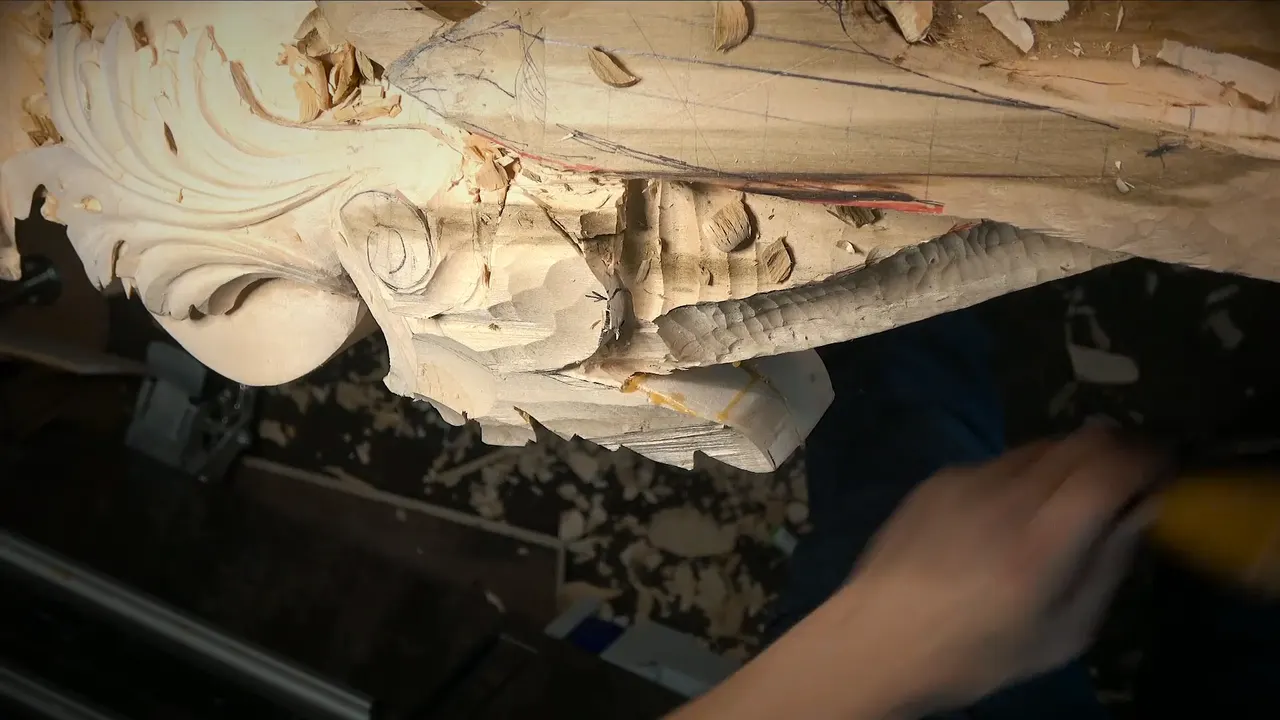

Video 4 of workshop 87 has a small number seven, a line, and "the final form" still ahead. My other lessons put those words beside a leaf edge, a petal and a flower, and beside the last moment of a carving. Below, the passages are sorted by what each one was about.
Ever stopped a pass because the piece was not done? Which part of your own wood carving still waits for its last shape? The video comes first. Then come my words from other courses, each with a link.
What is in the fourth video?
- A direction for the pass.
- A plan to clean one side, then "jump on that side."
- A mark, "right here," for the line.
- A big gouge, three inches wide.
- A distance to the final line, and a note that the camera does not show it.
- A volute still to develop, after a check of the curvature.
How does the video open?
It opens with "Now I'm going to take number seven again." Then comes "and go this direction like that."

What is the plan until the final form?
Cleaning is planned "just off-camera," because I "really don't want to make it a boring process." The rest is "soften everything." Then "clean everything this side," next "I'll jump on that side."
The plan for the procedure: "exactly the same," with "the small tool with number seven until I get my final form." A mark follows: "So right here is going to be my line." Then "my line for that detail."

The numbers are "just go with number seven," then "14 millimeters to the line" (0.55 inch). It also holds "blend everything, and clean it, but you don't have to watch it."
Why does the overall shape come first?
"I have to jump on this area because I need to get overall shape first before I can work on details." Of the volute I say "the volute part I worked previously, which is not the height yet."

Next, "I don't know yet," with "Maybe it's going to be the height" beside it. "my goal is to work around."
What does the slope need?
The job is to "slope it a lot" and "take a lot of material from this chunk." A line helps: "I placed both sides. I measured from both sides, and I do have a line that I have to slope everything down."
One more need: "really nice and continuous movement." One spot "has to be sloped like that in this area."

Which gouge starts the slope?
For the slope: "a big gouge, number seven and three inches, like 80 millimeters." My two figures differ a little (3 inches come to 76 mm, and 80 mm to 3.1 in). Next: "establish first this side," then "slope it." And of the slope itself, "a lot of material needs to be gone."

How close does the slope get to the line it follows?
"I've got approximate." Then: "Pretty close to the line, about maybe 3/16 of an inch, five millimeters to the final line on this side, and the same applies on this side." And "So it actually slopes. You don't see that on the camera, but that is the case." The two figures check out (3/16 in comes to 4.76 mm, and 5 mm to 0.2 in).

What comes after the slope?
"Now, I am actually able to work on more detailed look of my volute, which you don't see." Then "the volute I have to develop." A detail is planned, "going all the way this way."
A check comes first. "Before I do the volute, I want to make sure my curvature is actually good." It is "really important for me to establish that curvature," and "let me think how I can do that."

What do the videos on either side say?
Video 3 of workshop 87 has "Maybe I have to lower that down," then "But I'll see." And this: "Let me establish first form, and I can always lower that down with no problem." Further on: "Later on, I'll take it a little more to the final form."
In video 5 the phrase is "the final height": "I think I probably should create the normal height, which is supposed to be the final height of this spot." The way to measure it will be "exactly the same old way, just the calipers." Over in Venice Room 79, video 7, the words are "Not the final form," then "the final height." My workshop 87 page has the rest.
The distance first is "about an inch and a quarter or so to the final height" (32 mm). "Let me double-check." The next figure is "About an inch or so" (25 mm). "I do have other calipers" comes next. The same video has a plan, "Let me do a window." Then "So that's how I call it."

Where else is the form not final?
Each passage below names the course it comes from, so you can find it.
Is it an edge, a leaf or a flower?
Hashemi Flowers 7, video 1: "I just followed the main shape. I still did not work my edge. My edges of this leaf is not the final form yet." About "maybe 16th of an inch thickness" is left (1.6 mm), and the plan for the edge is "looking like a paper-thin."

Carving Furniture Panel 19 has it in video 12: "We're just establishing the main movement of this flower." The depth is "approximately maybe 1/32nd of an inch deep cut right here" (0.8 mm). Video 11 adds "That's why I don't really worry about it." Last: "I did not make my decision yet."

What still waits when I say a form is not finished?
Venice Room 42, video 12: "Don't pay attention." Then "Close to final, but not final yet." Last comes "So I can always take care of it like that."

In Venice Room 59, video 12, I "try to figure out if my overall shape is good or not." "Get rid of some of the marks." Next: "I can always hit that again with the gouge."

Lily Box 2, video 5, has the longest version. "I don't really worry about the final form yet of those leaves. I'm trying to get as close as possible to the final form, but not to the really final form. Because we're still going to undercut somewhat. Not much, but we still have to undercut little bit."

Video 1 of Lily Box 10 calls the pass "just preliminary." A messy area comes up in Lily Box 8, video 12: "right now there's a kind of messy area. I need to give a final form to the edge."

Over in Venice Room 132, video 1, a line ends "so I still have to redraw it."

When do I say establish?
"I'm going to establish my final form of those leaves," I say in video 5 of Hashemi Flowers 7. Then "make bigger divisions like this," for "a 3D look." The tools are chisels or gouges: "I'm not going to place any pencil marks."

Hashemi Flowers 44 opens video 3 with "let's now establish the final form of this petal." Then: "it looks like I can create multiple concaves and convexes." In Hashemi Flowers 41, video 2, it is "Let's make a final form." Next, "natural tendency to make a subdivision." The tool is "number three, but a small one, just about 3 millimeters" (0.12 inch).

What makes it easier to set?
Byzantine Acanthus 9, video 2: "we can start actually undercutting on that side." Then "a lot easier to establish the final form."

In Venice Room 83, video 1: "It's already placed back, and I can just shave it to the final form." Next is "maybe with a smaller tool right away, like one and a half millimeters" (0.06 inch).
Venice Room 23, video 8, ties it to an earlier pass: "you probably should understand why I left much thicker when I did preliminary cuts. Because now we are establishing final form, which I don't want to go back and redo." The tool named is "number seven, 14 millimeters, half an inch" (12.7 mm).

When does the final form wait?
Look at Venice Room 21, video 11: "I'm not doing the final form until the last moment." Then "that's why sometimes you'll see, and it looks little rough." And "when almost everything is done, I'm spending a few days, actually, just to clean everything and just refine everything and get to the edge, and so on."

Turn to Venice Room 35, video 9. Parts of my tool "crank against or leverage against," and "it would be a mistake if I would do it to the final form." Then "always at the end, I'll have a good chance to clean everything."

Back in Venice Room 99, video 8, a tool is named, "number 11 and 2 millimeters" (0.08 inch). Then: "I'm not going to do a final form." Reasons given are "a shell below" and "a chance to undercut and just to create the final form." And "this is like I'm after 60% done."

What if the part is glued on later?
A part will be "glued to the main idea," I say in Lily Box 12, video 5. After that: "I can always, like I said, create the final form right in place."

And Lily Box 13, video 4: "blends together with overall design." Then "really final form. I can always create right in place once it's glued." And "But by using knife, I can take a chamfer."

How do I come up on it?
Lily Box 11, video 5: "not to rush anything but carefully approach the final form. That is the goal." A warning follows: "you can actually make a big mistake." Video 2: "a kind of final form on this side." The same stretch: "So I can get really close to the edges now."
How much does the final form matter early on?
Another Hashemi lesson, number 8, video 1: "Again, the final form, really important, but not as important right now." And "I still going to reshape some of the edges of those leaves and so on."
Roman Acanthus 6, video 4, has "Those are preliminary, just to feel the overall shape." In Roman Acanthus 3, video 3, grain comes up: "If it's a final cut, yes, do with the grain, and that's not always possible."

How far from it do I stay?
Numbers come in Roman Acanthus 2, video 1: "just to stay away approximately couple of millimeters, three millimeters, or four millimeters, eighth of an inch, 3/16 of an inch from the final form." Its gouge is "number five and one inch" (25 mm). Checks: 3 mm is 0.12 in, 4 mm is 0.16 in, 1/8 in is 3.2 mm, and 3/16 in is 4.8 mm.

Modern Acanthus 6, video 3: "don't concentrate on a final form like you see that on a piece of paper." Then "I'm creating just the fingernail at the beginning just a straight cut like this. I'll be able to create that waviness little later."

Greek Acanthus 4, video 3, has "try keep the final form. Try to maintain that." And Grinling Gibbons Maine 17, video 2, has "Don't worry about the final form."
Roman Acanthus 10, video 1, plans to "remove some extra material to do some more undercutting and more to the final form."
What if the shape is only a concave for now?
One more from Venice Room 97, video 3: "it's not like I said, final form. That for I would have the main framework, the base, and I can always refine from it."

How do the passages line up?
| Course and video | What the words in that video sit beside |
|---|---|
| Venice 87, videos 3 to 5 | A volute and a slope with a line, and later a final height. |
| Venice 21.11 | The last moment, and then a few days of cleaning. |
| Venice 35.9 | Parts of a tool that could crank against or leverage against. |
| Venice 42.12 | A section described as close to final. |
| Venice 99.8 | A shell below, and a chance to undercut. |
| Hashemi 7, videos 1 and 5 | A leaf edge in one video, a set of leaves in the other. |
| Hashemi 44, video 3 | A petal, with multiple concaves and convexes in view. |
| Furniture Panel 19, videos 11 and 12 | The main movement of a flower, and a decision not yet made. |
| Lily lessons 2 through 13 | Leaves, a messy area, and a part that is glued on. |
| Lessons 2, 3, 6 (Roman) | A few millimeters away, the grain, and preliminary shapes. |
Which part of your wood carving is still waiting for its last shape? What are you leaving rough on purpose until then? Workshop 87 waits inside one tuition plan with the rest of the Part 8 workshops.
How it's done
- Pick the tool. "Number seven again," and "this direction like that" for the pass.
- Name your line. "My line for that detail."
- Start with the overall shape, then the details. "Get overall shape first."
- Slope with a big gouge. A number seven, 76 mm across (three inches in my words).
- Check the distance. Five millimeters from the final line, or 0.2 inch.
- Check the curvature. "Make sure my curvature is actually good," before the volute work.
Frequently asked questions
Which tools does video 4 name?
The small seven first, and later a big one, three inches across (76 mm).
How far was the slope from the line?
About 5 mm (0.2 inch).
Was the height set in video 4 of the workshop?
"Not the height I'm looking yet," and video 5 has "the final height."
Does a carver set it at once?
What to carve next