

Alexander Grabovetskiy, woodcarver, School of Woodcarving · Published 2020
What does a wood carver mean by "deal with"?
Quick answer: In Venice Room 87.2 I used the words "deal with" right after I told the viewers about the wiggle. Earlier I had said the piece is super heavy and I found no vice for it. The same words come up elsewhere in my lessons, beside holes, voids, cracks, marks and breaks.
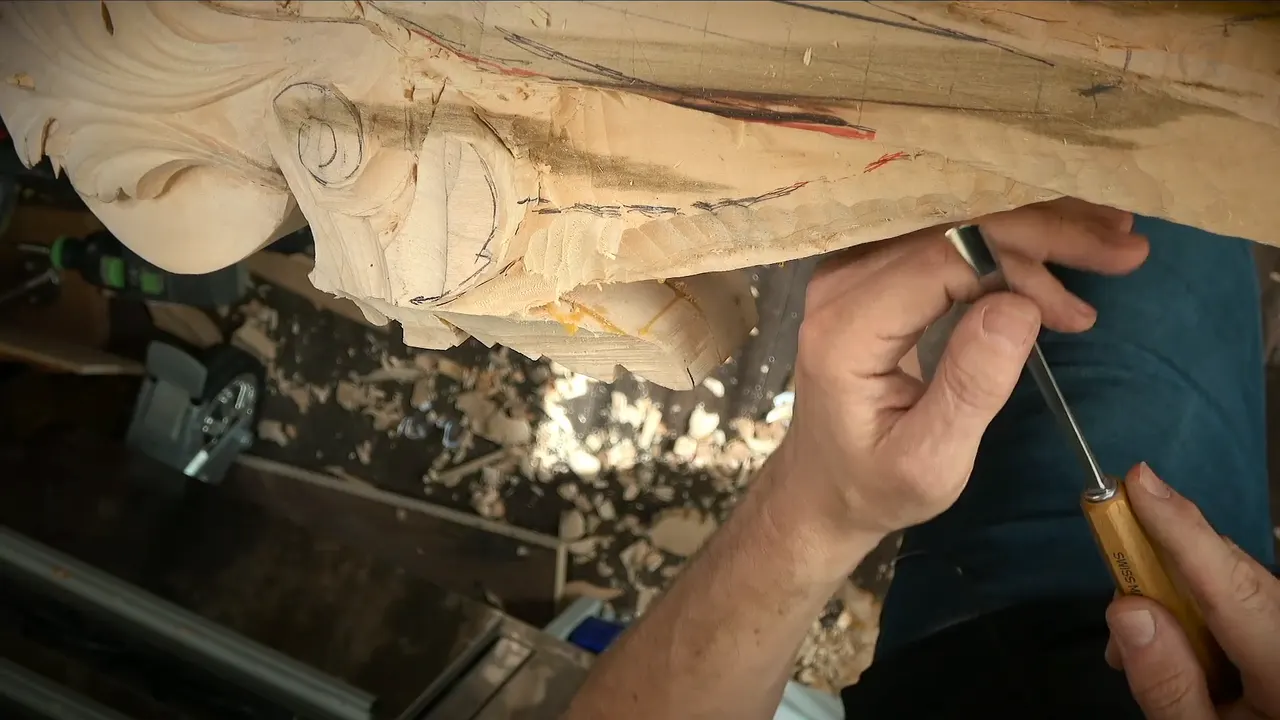

In the second video of workshop 87 I told you the wiggle in the vise is kind of annoying for those who are watching, and then I said "deal with." My other courses use the same words for holes, cracks, voids, tool marks and breaks. They are sorted below by what the "that" was.
Have you ever had a piece move under your chisel while a camera was running? Did you stop and tell the people watching? That is the spot in workshop 87 where I said it. Below is that video, and then my words from other courses, each with its own link.
What does the second video of workshop 87 hold?
- The right spot, found by a measurement with calipers.
- A wiggle, an apology for it, and no vice found that holds the piece still.
- A little concave and detail on the inside, still to come.
- Words for the people watching, and a number seven at 14 mm (about 0.55 in) for a slope.
- A spoon for when the straight tool is not sufficient anymore, and mirror paste for stropping.
How does this video open?
The video opens on "I could probably use a bigger one." Next is "Let me outline with number three." A job follows, "what I have to do, I have to find the right spot," and "The right spot," follows on its own.
"I measured that with the calipers, and that's supposed to be somewhere right here," I tell you. I call it the movement, and I add that I have to chop out this.

Why did I apologize for the wiggling?
Starting with "I apologize for that wiggling," I explain that I can't make it tighter, because "the piece is super heavy, and there's just no vice on the market that can hold without wiggle." "Maybe there is one, but I couldn't find any," I add, and later "Maybe there is some heavy-duty one."

Which tool came next for the slope?
Next comes "And number seven again," and "14 millimeters," which is 0.55 inch. With that gouge I say I can create the shape I'm after, little by little. A reminder follows, "So like I said, I'm looking for the slope," and then more, "not just the slope, but there's going to be a little concave," with "detail on inside."
About that tool I say "this is the best tool right now to use because I have just little, small cuts, and I can control."
What came just before deal with?
First, "That is just a little annoying." Next, "Let me try to make it a little tighter, hopefully." After that, "All right," and then "Now it's a little better."

I turn to the people watching. "Well, for me, it's not a problem. I just know for you guys, for those who are watching, it's kind of annoying, but it is what it is." Straight after it: "I have to deal with that." Further on: "So cut by cut, I can establish my form."
When did my straight tool stop being enough?
"At some point, my straight tool is not going to be sufficient anymore, and I have to switch to," I say, "which is right here." Then "That's not good anymore, so I need to use a spoon." For the spoon, "I could use, let me see, maybe number six," and "Let me try number six" follows.

The result comes next. "And yes, number six is really good." Next it "cuts really good, but it could cut a little better," so the plan is "my mirror paste." That one is one of my favorite pastes for stropping. "I'll do an inside first," I say, and then "And outside."

It ends with "let me check," then "Oh, yes," and then "It makes huge difference."
What do the videos around it add?
In workshop 87, the first video has "I have to be really careful, and I cannot use too big of tools." The third has "I have to lower down this section," and "I need to go at least 6 millimeters down," which is about 0.24 inch. My workshop 87 page holds the rest of the videos.
Where else does deal with turn up?
The words turn up in my other courses too, and each passage names its course.
What was the hole in the lily box?
A hole opens the lily box passages. Lily Box 11, video 4, has me saying "I can see I've got the hole through right in the middle." A plan comes with it, "I got to probably, again, use the same epoxy just to cover that hole on the backside." I follow with "So there is another mistake I made, and I need to deal now with that."
Then "It is what it is." The line right after it is the one from workshop 87. After that, "And I need to be more careful, I guess," and "it's probably the time to switch to more flatter gouge, lesser sweep." "I'll switch to number seven," I say, which is "about 10 millimeters, 3/8 of an inch." Then "Oop, I made my hole even bigger. Shouldn't do that."
The piece in Lily Box 10, video 13, is "central piece, so we really can't fail it." "That's why I don't like that hole I created. Really don't like it." My workshop 87 words come again, and I add that I still have to think how. Then "little later. I'll make the decision."

The Grinling Gibbons class in Maine has a hole too, in lesson 10, video 3. "And yes, I do have that hole. Which is absolutely fine." A little later is when I plan to come to it.

Does a piece that has to move, or one too big to walk around, get the same words?
Back in Lily Box 11, video 9, it is "let me use 1 millimeter, I guess," on a number 11 (1 mm is about 0.04 in), and "Really controlling every cut." Then comes my apology: "I apologize if it's moving, but it has to move, unfortunately," I say, and the words from workshop 87 follow, and then "Carefully. I'm not even carving, scratching pretty much."

Working toward myself is what I call "a little bit dangerous" in Venice Room 57, video 5, and "in this case, that's the only way I can excavate." Then "Of course, that would be probably better if it would be on a smaller scale carving. Rotate the piece or walk around and attack from opposite direction. That would be smarter. Okay? Safer, I should say." I turn to the huge pieces, where "I just can't walk around. I would spend too much time." There is a kind of deadline, and if I can save a minute, I'd rather do that. A limit follows, "Only if it's still safe, okay? Because if it's a safety concern, no, I'm not going to save a minute."
The camera is the "that" in Venice Room 31, video 3. "And it's almost impossible for me to see. I'm moving that blindly because I don't want to cover camera." One of the challenges, I say, and I add "but still do really nice cut, and that's not always possible."
Do cracks and voids in wood get the same words?
A void turns up in Lily Box 8, video 1: "There's a void inside of the wood again." I know it's almost impossible to see from camera view, but it is there to see. Okay, I say. If it has to be handled, I say, it just has to be handled. "What can I do?" Then "Let me take small gouge, like number eight and one-eighth of an inch," about 3 millimeters, "and I want to create S shape again."

One spot in Lily Box 9, video 1, is "one of the worst areas because I have a lot of micro cracks inside, a lot of voids inside of the wood itself." Then, "But it's okay." We can handle it, I tell you. "I brush it, clean it, and now I can develop the details."

Splits in the wood are in Lily Box 4, video 10: "I can see some splits on inside of that wood because there is a knot." Handling it comes later on, and "Carefully," I add. Over in Lily Box 5, video 13, comes "Lots of cracks," followed by the thought that we can handle them with no problem, and then "I hope." A relief cut with a number 11 comes next, and I say "I still have to keep an eye how deep I cut."
A weak spot sits in Venice Room 99, video 2: "I do have a really weak spot right here. There's a crack right on the inside. I don't have to do anything, but it's already cracked on inside. But that's okay." Handling it is mine, I say.

What about tool marks and junk inside a cut?
Junk inside shows up in Venice Room 14, video 8: "Again, I got the junk inside." Something I have to handle, I say. "Wonderful," I add, and then "Except a little nicer transition right here."

A tool mark shows in Furniture Panel 21, video 5: "I still can see the tool mark from my previous cut." I will need to handle it, and I'll show how. Next, "It's not like I completely destroyed that detail. Not at all." I still plan to save the detail, and "Nobody's going to know, beside me, that that was a mistake. Okay? Oh, and you, of course."

In Hashemi flowers 47, video 5, "it's a little messy on the inside right here." My plan to handle it is "a number 11 and 1 millimeter" (0.04 inch), and then a number 11 at half a millimeter (about 0.02 in), "the smaller one." A number nine at 3 millimeters, one-eighth of an inch, comes with a warning in Venice Room 59, video 10. "I have to be really careful because I don't want to create extra tool marks on inside that later on I have to deal with."
A plan for a number five is in Venice Room 74, video 12, "not digging too deep." A cut that deep would leave "a mark really deep inside of this cut." "I know that is a paint grade," I say, and "This one is a somewhat forgiving project, I would say." Then "At least I'm telling you honestly." Cleaning gets a line too: "sometimes cleaning actually takes longest."

When a piece broke or a cut went wrong, what then?
A break comes in Furniture Panel 21, video 11: "And what happened right now, that is what should not happen." The way to handle it comes next, "I'm going to glue it later." A glue will work probably the best, and it is actually "like super glue. It just dries really quickly."

A bigger eye is the trouble in Venice Room 30, video 2: "So I just got a bigger eye. So I didn't plan to do that big, but it's okay." Then the mistake I just created is mine to handle, and I think it looks good.
An edge is the trouble in Venice Room 44, video 9: "Got this edge too weak. So that is not good." Then I say I need to handle it. Next, "I think I took care of it," and after that "Now it's not bad."

Is there a choice between ways after deal with?
A flip is the choice in Furniture Panel 19, video 6, with "a couple of ways I could deal with this flip." One is "even extra flip this way." The other is "from underneath up and go downhill a little bit." Then comes "I like both ways," and "I really like double flip," followed by "let me do that" and a plan for the initial cut.
A second choice sits in Venice Room 47, video 4, with "a couple ways." One is "some kind of movement on inside." Then "I think I should," and "Let me do that."
The look of a cut is in Venice Room 16, video 9: "I still not too happy about how it looks right here," and I will handle it. The thing to handle in Venice Room 45, video 12, is "how it's going to look from the bottom."

How do the passages line up?
| The trouble | Where it came up and what followed |
|---|---|
| A piece too heavy for my vise to hold without wiggle | Said in Venice Room 87.2, with my apology for the wiggling and a number seven at 14 mm (0.55 in). |
| A hole through the middle | Heard in Lily 11, video 4: a flatter gouge with lesser sweep is only a plan, and so is a seven at about 10 mm (3/8 in). |
| A void inside the wood | Found in Lily Box 8, video 1, ahead of a plan for number eight, an eighth of an inch (3 mm). |
| A crack on the inside | From workshop 99, video 2, at a weak spot: it's okay. |
| A tool mark from my previous cut | Lesson 21 of the panel course, video 5, where the detail is not at all destroyed and I plan to save it. |
| A messy inside | Seen in Hashemi 47, video 5, with an 11 at 1 mm (0.04 in) as the plan, then a smaller one at half a millimeter (0.02 in). |
| What should not happen | Panel course lesson 21, video 11: glue is the plan, to put a piece back. |
Is there a spot on your wood carving that wiggles, a crack you did not plan, or a mark you plan to clean? Would you say the words out loud to the people watching? Workshop 87 waits inside one tuition plan with the rest of the Part 8 workshops, and it is where I said them beside a very heavy piece.
How it's done
- Name the job. In 87.2 I have to find the right spot, and I check it with calipers.
- Tighten the hold. The piece wiggles, so I go for a tighter hold, and it gets a little better.
- Pick the seven. The seven keeps my cuts small, so I can control the slope.
- Talk to the viewers. For the wiggle I speak to those watching, and I explain it to them.
- Plan the switch. At some point the straight tool will not be sufficient, so I plan a spoon, maybe number six.
- Look at the result. After the mirror paste I say "let me check," and then "It makes huge difference."
Frequently asked questions
What did I say about the wiggle just before the words "deal with"?
First came a little annoyance. I said I would try to make it tighter, and then it was a little better.
What tool did I name for the slope in that video?
A number seven, in the 14 millimeter size (0.55 inch). I called it the best tool right now, because of the small cuts and the control it gives me.
Why could I not tighten the piece?
It was too heavy, I said, and I could not find a vice for it, though maybe one exists.
Do I use "deal with" about a crack in the wood?
What to carve next