

Alexander Grabovetskiy, woodcarver, School of Woodcarving · Published 2020
What does a wood carver mean by a "really sharp point"?
Quick answer: In Venice Room 87, video 7, I say "Everything goes to the same point," and name it in the next line. I want one at a ridge, a line end or a Corinthian edge. I say I leave it off the points I chip and out of a spot that takes paint.
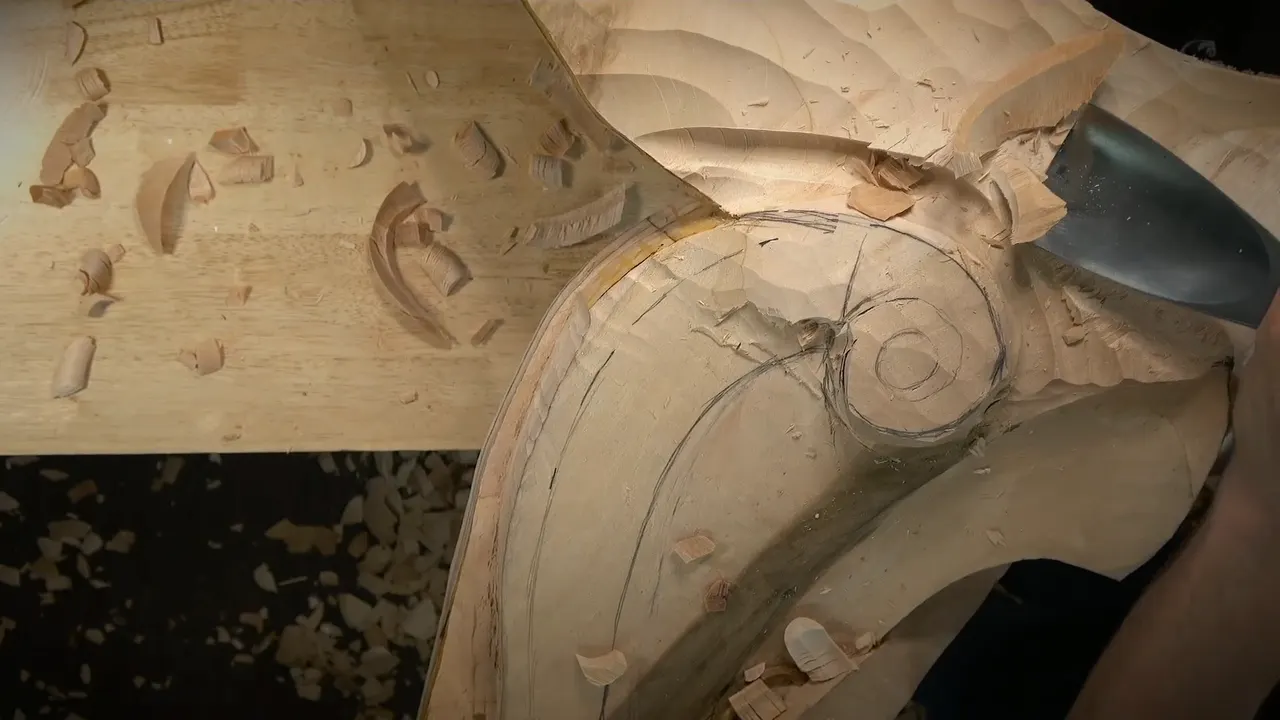

My phrase "sharp point" names the spot where a shape ends on one tip. In Venice Room 87, video 7, I use it right after a miss and a note about position. Other lessons use the phrase for a Corinthian leaf, a line that fades to nothing, a calipers tip, and a spot where I do not want one.
Have you ever pushed a gouge toward a corner and wondered how the corner ends up so clean? This page follows that question. Video 7 comes first, line by line. After it come my lines from other lessons, grouped by what I say about the tip: where I want one, where I leave it out, and where the tip belongs to a tool.
What does video 7 say before the tip?
It opens on a tool: "Now take bigger one again, 3 inch." That is 76 mm. Then 86 seconds pass before the next caption line, and it is a need: "I need to reestablish this movement." I say it twice, and a check goes with it: "let me double-check where it's supposed to end."
The end is a place on the piece: "somewhere right here, the intersection point." A few seconds later I add "to this spot." The shape has a name, "a crown, which is a cove, concave," and a direction, "sloping downhill." So the line needs work: "take this line somehow nicer, just to slope it and clean it."

Why does the ridge matter?
I look from another side: "I'm looking from this side how it looks." My verdict has a hedge, "that is the movement approximately," and a second hedge, "I can always double-check, but it looks logical." The tool is number three, and it is a plan.
Then comes the reason, about the ridge: "I need that ridge." It will "give me sharp shadow." I call it "a really important spot," and a moment later "a really, really, really important spot."
What goes wrong before the tip, and how do I fix it?
The miss is plain: "See, that's no good." The fix is said as a need, "I have to attack from the right position." A second try is planned, "let me attack that again, this side," and then I change my mind: "I can clean it first again."

And now the phrase. "Here you go. Everything goes to the same point. It's a really sharp point." My tool for it is a plan, "take probably with the number seven. Fifteen millimeters," which is 0.59 inch. The position is "toward myself," and the line runs "all the way to that point."
After the tip, what is left to do?
The work goes on. "For now, it is really good," I say, and still "I have to excavate much deeper concave in this spot." One region stays shallow on purpose, with "a small detail going that direction" planned beside it.
A question to myself follows: "maybe I can actually do it right now. Why not?" There is no drawing for it: "I don't have a drawing." My plan is "some kind of movement" from the opposite side that will "lay right on top of that crown molding." The video ends with two apologies, "I'm sorry for babbling" and "I apologize for my babbling today."

Where is the finished ridge in the same workshop?
Later in workshop 87, in video 10, the tool is "Number three and 20 millimeters" (0.79 inch), and I add "I'll get right to the line." Next comes a question for you: "Can you see that ridge?" Then the answer, "It just creates a beautiful, sharp point." One more step: "I can refine it."

Where does a line stop in Venice Room 101?
Over in Venice Room 101, video 1, a tool is named: "number seven and 14 millimeters" (0.55 inch). A measure follows: "that line, which is approximately 10 millimeters from this line to this line," or "about three-eighths of an inch." Ten millimeters is 0.39 inch.
The line has a fate: "that's going to go to nothing, to this sharp point." It travels, "wrap all around." My start is named, "my starting point," and a choice stays open: "I can later decide" about "this section."

Do ridge and sharp point mean one thing in the Roman leaf lesson?
They meet in Roman Acanthus 16, video 5. I call a step "an extra step" and add "I think it's going to give me extra light and shadow play." About the leaf, I say it is "kind of angled," and then "so that is a sharp point." Next I name what I mean: "I'm talking about this ridge."
The size is small, "about 1/16 of an inch," which is 1.6 mm. A hedge sits beside it: "Of course, I exaggerate that."

Where does a knife meet an intersection?
Grape Onlay 3, video 2, ties an intersection to the angle of a knife: "make sure you get that intersection." Then comes the angle: "you don't hold that knife 90 degrees just to get that point really sharp and inside."

How does a thin wall change the plan in Hashemi 47?
I mark the spot in Hashemi Flowers 47, video 5: "I marked it with the red marker, and that is the wall." It is "a micro wall," only "about a millimeter-thick wall" (0.04 inch). Some carvers, I say, "actually leave that wall on purpose," and their reason is "That makes it more stylish." My way is different: "I like to bring two points, actually," and then "completely to the sharp point."
Two ways are named: "attack from outside or I can attack that from inside." The plan is "try first from inside, how deep I can get with the knife."

How much time does a nicer tip get when no client waits?
Furniture Panel 19, video 8, starts with no client: "this panel is not for a client, no deadline, so I really don't have to rush it." So "I can probably create much nicer project." The aim is "really nice and sharp point."
The verdict is "looks like I achieved that," and a plan is next, "slightly undercut underneath of this side." A limit rides along. "I'm not sure," I say, about using "my half a millimeter" because "I don't have enough space." That is 0.02 inch.

Which acanthus edges end that way?
For the Corinthian type, in Corinthian Acanthus Leaf 1, video 2, the answer is in my words: "every edge is going to be really kind of sharp point." I add "You always find the sharp point on Corinthian type," and the tip runs "all the way to the center line." The leaf is divided "into five separate leaves," so "five points altogether."

What is lost when a leaf loses its tip?
A few lines in Furniture Panel 16, video 6, tell the story. A check comes first: "Double check." A verdict on the tool follows, "a little too aggressive with the tool," so "I need to chop a little deeper with just the gouge." Then I say "I don't want to lose the sharp point of this leaf."

Which pass gives the Greek leaf its tip?
In Greek Acanthus Leaf 7, video 2, I use "one more pass from opposite, so it just snaps out." It goes on with "kind of refine that cut until I get really nice and sharp point." After it I "separate this detail from that one."

Can a scroll saw make one too?
The second video of Carving Lily Box 1 is about a scroll saw, and it has a loop: "I'll make a loop cut." The blade goes out and returns, "go back to the same position," and I expect the result to be "really sharp."
The same video has the other side: "in this case, I really don't need that sharp point." Later in the same video I say "the right way would be actually attack," and 48 seconds later, "That way it's going to be clean."

Can a petal edge have one too?
Lily Box 10, video 11, says it near an edge: "I'm really at the sharp point right here." A hedge follows, "Not sure it's even visible or not." Then the view that matters: "that's going to give us a really nice look once you're going to look from the side."
When do I say I do not want one?
A shape in Venice Room 42, video 11, is "a bit too pointy, so I need to make a transition." Three degrees follow: "that is really pointy," then "less pointy," then "absolutely no pointy." The tenth video of that workshop gives a tool, "number 11," and a reason: "too sharp point." I still want "some curliness."

Did old Italian acanthus work have them?
About the original Italian work, in Venice Room 8, I say: "on those acanthus points, they never had the sharp points." Then "They had more like a roundy," and "not every acanthus design has a sharp point."
In the fifth video of Venice Room 18 I say I need to chip a point so leaves are not "too pointy," and I give a reason, "trying to be authentic." I add "There is certain designs of acanthus- Where you see those sharp points." On the old work: "I know why they actually don't have those points. That wasn't on purpose." After that the talk turns to stone carvers and marble: "You have to make it smooth, otherwise it doesn't look good."

Do paint and gold leaf change what I want?
The first video of workshop 8 has me saying an angled tool would leave a hard tip inside, "which I don't want to see." It is "hard for paint." Then gold leaf: "you really want to avoid those sharp lines because gold is not going to stick to it."
A cleanup in Venice Room 12, video 4, goes "with 2 millimeters" (0.08 inch), and the reason is "because of the paint I'm going to use."

Is a softer undercut better for shadow?
Floral and Molding 11, video 3: I like "a number 11 or a number nine that creates smoother transition underneath." Then: "I don't like to see always just a sharp undercut or sharp point, so I think smoother gives better shadow."

Is a tip ever wrong on a drawing?
It can be, in Furniture Panel 14, video 5, while a drawing is still on paper: "I kind of don't like that" tip. A fix is offered: "sometimes what they would do, they would just place some kind of bump, if you wish. Not a bump, but small detail like this."
In Furniture Panel 29, video 3, the test is logic: "I don't wanna see any sharp points because it's gonna be not logical."
And it can wait. In Grinling Gibbons Maine 4 I talk about outlining a flower and say "You don't have to create" a tip, and the next word is "yet," then "you will have a chance."

Can the tip sit on the tool instead?
Sometimes. In Venetian Flowers Rosette 5, video 3, it is the tip of a calipers: "I sharpen my points." The aim is "for I can just place it right on a small dot. So that is really important for me." And "you really don't need to, but I think it's a good idea."
Butterflies 1 shows the other side, a quick release: "I really like it, but I don't have really really a sharp point on those. And I think it's gonna be okay that way." A knife has a tip too. And in Hashemi Flowers 23, video 4: "Just because of that sharp point of the knife," I can "follow any line, pretty much any sweep."
I hold a small tool "upside down" in the first video of Grinling Gibbons Maine 10, and "you can see my sharp point."

How do the sizes and tools line up?
| Where | Tool or size named close to the phrase | What the tip is |
|---|---|---|
| 87.7 | a bigger one at 3 inch (76 mm), then number seven at 15 millimeters (0.59 inch) | where the lines meet |
| 87.10 | number three at 20 millimeters (0.79 inch) | a ridge I point out to you |
| 101.1 | 14 millimeters (0.55 inch) in number seven, plus a line near 10 millimeters (0.39 inch) | the end of a line that fades |
| Roman 16.5 | a line near 1/16 of an inch (1.6 mm) | an angled leaf and its ridge |
| Grape 3.2 | knife held off 90 degrees | an intersection, reached with a knife |
| Hashemi 47.5 | a knife, from the inside first, and a wall near a millimeter (0.04 inch) | two points brought to the sharp point |
| Panel 19.8 | half a millimeter (0.02 inch) | a tip with little room around it |
| Venice 12.4 | 2 millimeters (0.08 inch) | a tip I avoid because of paint |
When do I want one, and when not?
I want a tip where lines end on a spot I have named: a ridge, the end of a line, a Corinthian edge, an intersection. I leave it out on leaf tips I chip, inside a spot that paint or gold leaf must cover, or on a drawing where I do not like it yet.
Where would a clean tip help your own wood carving? Workshop 87 waits inside one tuition plan with the rest of the Part 8 workshops.
How it's done
- The need. The first line after the tool is a need, "reestablish this movement."
- The check on the end. A check goes with it, "double-check where it's supposed to end."
- The position. The fix for a miss is a position, "attack from the right position."
- The tool, as a plan. A plan, "probably," for number seven, with the size said next.
- The reason. The ridge matters because it will "give me sharp shadow."
Frequently asked questions
Right before the phrase in video 7, what is said?
A miss: "See, that's no good."
Which gouge is named in video 7?
A plan for number seven, with "probably" in front of it, and a size said right after.
Does video 7 end the work at the tip?
No. A deeper concave is still needed in that spot, and one region stays shallow on purpose.
Which tool shows the ridge in video 10?
What to carve next