

Alexander Grabovetskiy, woodcarver, School of Woodcarving · Published 2020
What does a wood carver mean by "originally"?
Quick answer: Part 8 of workshop 87 has me use "originally" for a slope I did not plan, and near the end for a slope I wanted to leave. In other lessons I say it about lines, ridges, pieces of wood and a stain.
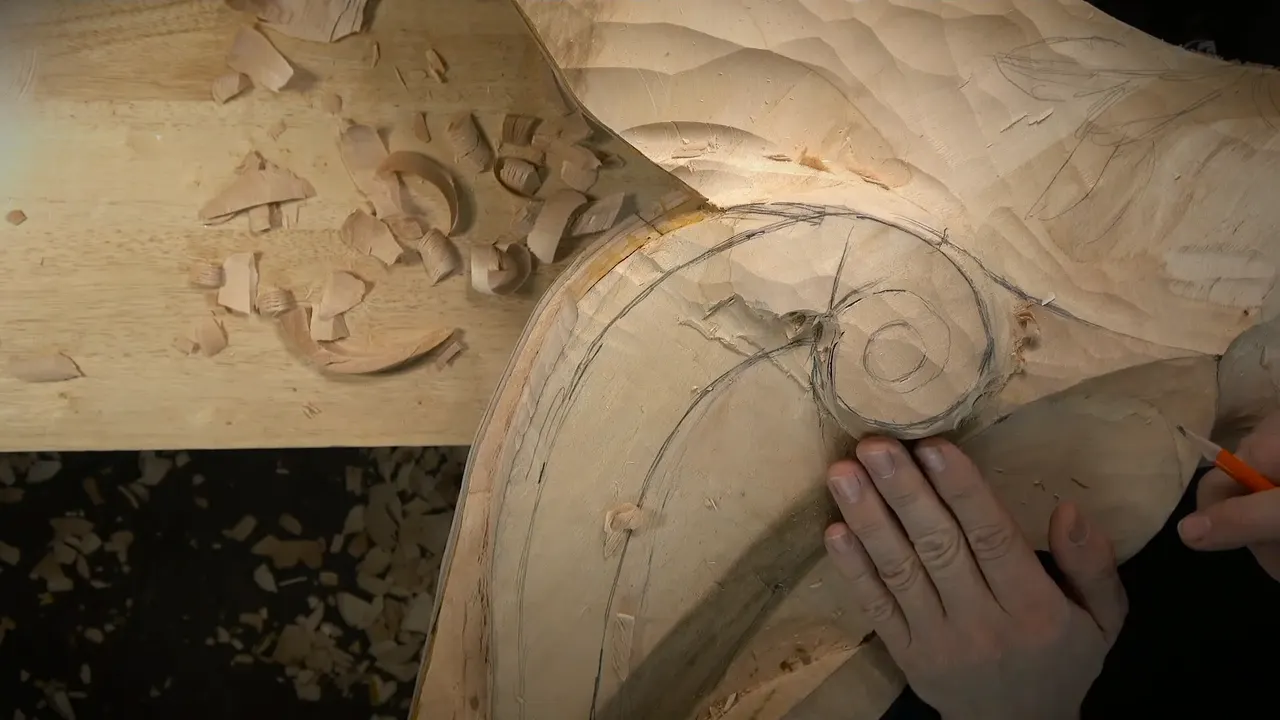

In part 8 of workshop 87, I say "Originally, I didn't plan to have that slope," and then I say I will leave it. Near the end I use the word again on that same slope. In other lessons I say it about lines, ridges, pieces of wood and a stain.
Have you ever planned a spot on a wood carving and then looked at the wood and thought again? This page follows one word through one short video. After that come lessons from other courses where a plan starts with the same word.
How does part 8 begin?
Mistakes come first. I say "I just don't want to make any mistakes," and add that I am at the point where "every mistake is going to make consequences."
The slope enters next. I think I will leave it, and the word follows: I think that slope will bring "really nice movement, a really beautiful transition."

Two plans sit together here: keep the slope, and "let me just clean it."
Is the slope really 45 degrees?
By my own words, not exactly. It is "approximately, I don't know, it's not exactly 45 degrees, but it's still angled."
The look I expect is "a really beautiful movement." A small plan for the design follows, "I'll change that design a little bit."

Why does the slope get a second look so soon?
A second thought arrives: "it's too early because I still have to go around, and that part is going to be much lower." A hedge goes with it, "Maybe it's a little too early with the slope."
The plan moves to a gouge, number 11, "around this movement." For a size I say "maybe seven millimeters will work" (0.28 inch), and I add that I need to find my mallet.
The mallet gets a thought of its own: "a smaller mallet. Or not. Maybe bigger." Then it moves on: "Yeah, I'll get a bigger mallet again."

What happens once the gouge is working?
My verdict is "that is absolutely okay." My reason has a because in it: that part will be lower anyway. Then a tool is named, "I can take, right now, number 9."
Next up are "Let me just push cut," and "I'll go with this side also. And yes, I do know."

Which lines get drawn and measured again?
A need opens it. About a line I say "somewhere right here," and the job is "I need to redraw that." Another line is planned too, "right there."
The next need has a measure in it: "this one I need to redraw again, and I have to measure it. I have to measure it again."
A verdict follows, with a hedge on one side. "Here you go." And then "That is the movement, except this part I'm not too happy about, this side. It's okay. I'll leave it at that."

What are the last words of part 8?
Number nine comes back: "I'll take number nine again, and three-quarters of an inch" (19 millimeters). Then comes a doubt: "You know what? I actually could go... I'm not sure if I should or not. Maybe I shouldn't."
It returns on the slope: "Originally, I wanted to leave that slope, but I don't think I need it."

What do parts 7 and 9 of workshop 87 say about a slope?
The workshop 87 lesson holds two more videos about one. Video 7 names a shape, "a crown, which is a cove, concave." Of it I say "sloping downhill." The same video holds "I need to reestablish this movement."
Video 9 brings a plan of its own: "So my idea is to create another slope." About its look I say "also a concave movement." Plus "I need to get the illusion of 3D in this spot. So that's why I'm excavating much deeper."
Doubt shows in video 9 as well: "maybe it's too early because I still probably have to move this line. I don't know if I'm going to do it or not." My next words are "Let me clean first." After "let me double check" comes a result, "right on the money, very surprisingly."
A boundary plan follows: "I need to create a separation cut," with "the number 11" and "seven millimeters" (0.28 inch). My note on the part is that the whole part will be "a little lower," and on depth: "how deep am I going to go? Well, I could go quite deep," maybe "about even half an inch or so" (13 millimeters).

Where else does a plan of mine begin with that word?
Other courses have them too, and I name each lesson below with a link to its page.
Which side stays the highest spot?
Lily Box 4, part 10, has the look I want: "that is the movement what I want to see. Really nice and smooth transition."
The word opens a plan about the highest spot, "Originally," and then "I wanted to make this as a highest spot, but now I think" and "leave that side as the highest spot." Another line says "And blend that together." A size is named too, "I left approximately 5 millimeters, I'd say" (0.20 inch).

What if a part does not look nice underneath?
Over in part 13 of that workshop a section will be "a little higher than that." My tool is a plan, "Use number three."
Next the word: "Originally, I said this part is going to go underneath, but I don't think it looks too nice." A line follows: "It has to work in three dimensions, and as of now, it isn't." Plus a note about a "concave cut."

What happens to a line planned for the middle?
Lily Box 5 has one in part 11: "Originally, I have a line right in the middle of this one, and I don't think I really like that line, okay? I'd rather place a line in between those two separations."
Next is my verdict, which is that it will look better, "I think." The move is stated again: "move it to that." For that line I name "the 1.0 millimeter" (0.04 inch).

A middle line runs through Lily Box 8, part 6, as well: "Well, originally, I was planning to use a middle line going all the way down like this." I add that maybe it is "a little too much."
I do not think it will look "too good," at least "what I think right now." And "Maybe later on, I'll go back and see."

Workshop 8, part 10, has the word too: "I could stop it, like originally I drew just above and get all the separations." Then "I think it would be really nice," with a motion "inward and inside, underneath of the first layer." And "you really don't have to do that, or I should say I don't have to do it."

Why move a ridge?
In part 11 of that workshop a knot appears: "I really want to hide that small knot behind this ridge." Then "Okay. Originally, my ridge is right here." I probably have to "move it this way because of wood movements."
The shape gets a plan, to "bring that downhill, just like that." And a check: "I need to make sure that I like overall movement, how it looks."

Can a leftover part help?
I ask about a part in Lily Box 9, part 2: "See this part right here?" Then "Originally, it was supposed to go below, but it's good that I left that to the last moment, and I didn't do anything to it."
A use for it follows: "I can actually utilize that as a part of this upper movement." Another idea comes too, "let me see how I can finish this part," and a doubt: "I'm not sure if I'll be able or not."

Does a line have to run beside a diagonal?
Furniture Panel, workshop 17, part 1, has this line: "Like I said, we're going to make some changes on the go." Then "Probably originally" and "I wanted to get parallel to this diagonal, but that doesn't look organic."
I go on: "I still have that diagonal somewhere right here." Also "I don't need to carry that all the way." I think that will look much better, "just a stopping point right there."

How does wood movement fit into a plan?
Venice Room 148, part 1, says it will be "right behind." The next sentence opens with the word and breaks off. After the break: "I didn't want to see any gap between that section and the crown molding."
Next, I thought it would probably look much better right behind it, and that it would allow me "the movement." On wood I say "wood is wood, and it's going to expand, it's going to shrink, depending on whatever is the moisture in the air and the humidity and so on."
Without a solid connection to the crown molding, "it would be a lot easier for the wood movement." Next comes "So that is not going to be connected at all." And "I'm okay" if it moves slightly.

How did a design look on the computer?
Workshop 92 has this in part 12: "I had to change a little bit design because on the computer, when I designed that, when I place those small elements, they looked okay. But in real life, they were a little too small."
Here is the word: "and originally I supposed to get four pieces," and now it will be "kind of hard for me to carve in some of the sections." Next I say "I don't want to leave those sections flat."

Do two narrow pieces stay narrow?
The word sits right after "that's a really interesting detail I have to develop," in part 9 of workshop 65. Here it comes: "So originally, I had those two pieces kind of tiny. I'm talking about how wide they are. And I'm not 100% like it, okay?"
My idea is "maybe I can actually move this section." I add that it is "three-dimensional movement," and that I think it will give me "a lot better movement overall." Earlier in the same video I say "some people would call it bracket, but it's a corbel."

Does a longer leaf fit the space?
Another leaf plan sits in part 6 of workshop 74: "And like I said, originally, I want to do like a leaf, what you saw previously at the ends. That is not the leaf I'm talking about."
Then comes my problem: "that leaf right here, it's much longer leaf than what I have right now right in this area." I am not sure how nice it will look, and I hope it looks okay. My worry is how it will interact with this movement: "Pretty much the only fear I have."

How much extra wood did I plan to leave?
Two sizes sit in workshop 24, part 10: "Originally, I want to leave like a half an inch extra material" (13 millimeters). Next comes "It looks like I have about 3/8 of an inch, the max, 10 millimeters."
The plan changes to match it: "just leave a 10 millimeters" (0.39 inch). Another note is about the part, "a much bigger shell."

What does the word point back at?
Part 1 of workshop 53 has this: "I just want to do something different in every area." The flow will be the same, but the development "a little different."
The video goes on: "So now I need to make sure I do understand what I decided to do right here." From that point I will make my development. "Okay. Originally, I do have a movement like that," running to "that line right here."

Can a plan stay a plan?
It can in the final assessment of my plate with butterflies: "For me, I think it's enough. It looks good for me as of now." And "But I'm going to leave it like that."
Next the stain: "Originally," and "I wanted to put some stain on it, and that would look really nice." It is a stain, and I point to another project, the "bird of paradise, a cutting board," which "I did with the knife." And "I do have some stain. You can apply some stain."

Which lessons use the word, and what follows it?
| Plan | My words after the word |
|---|---|
| slope | really nice movement, a really beautiful transition |
| the same slope | a doubt that I need it |
| highest spot | leave that side as the highest spot |
| underneath | I don't think it looks too nice |
| middle line | I'd rather place a line in between those two separations |
| ridge | move it this way because of wood movements |
| extra wood | just leave a 10 millimeters (0.39 inch) |
| stain | I wanted to put some stain on it, and that would look really nice |
Which spot on your own carving gets a second look?
In the lines above, the word comes first and a spot comes next: slope, highest spot, line, ridge, leaf. Then I say what I think of the spot. Keep it, move it, or look at it later.
You can watch it inside one tuition plan with the rest of the Part 8 workshops, if you want to watch the slope for yourself. See also the Lily Box, Furniture Panel and Butterflies courses, and the late Venice Room workshops in Part 13.
How it's done
- A worry. Mistakes are on my mind.
- A plan for the slope. The slope may stay, and cleaning it is next.
- Gouge and size. Number 11, a size guess, and a mallet still to find.
- A measure. A line to redraw, and a measure to take again.
- The last doubt. Last of all, a doubt about needing the slope.
Frequently asked questions
What comes right before the word in part 8?
Mistakes are on my mind, and the slope may stay, with the clean-up still to come.
Do I give the angle of the slope?
I call it "approximately, I don't know," and not exactly 45 degrees.
Which gouge is planned for going around the movement?
Number 11.
What are the last words of part 8?
What to carve next