

Alexander Grabovetskiy, woodcarver, School of Woodcarving · Published 2020
What does a wood carver mean by "a little lower"?
Quick answer: In part 9 of Venice Room workshop 87, I plan to leave one line where it is, and "this whole part" is to be "little lower." In other lessons I use the words about pipes, sides, middle lines and a part beside a volute.
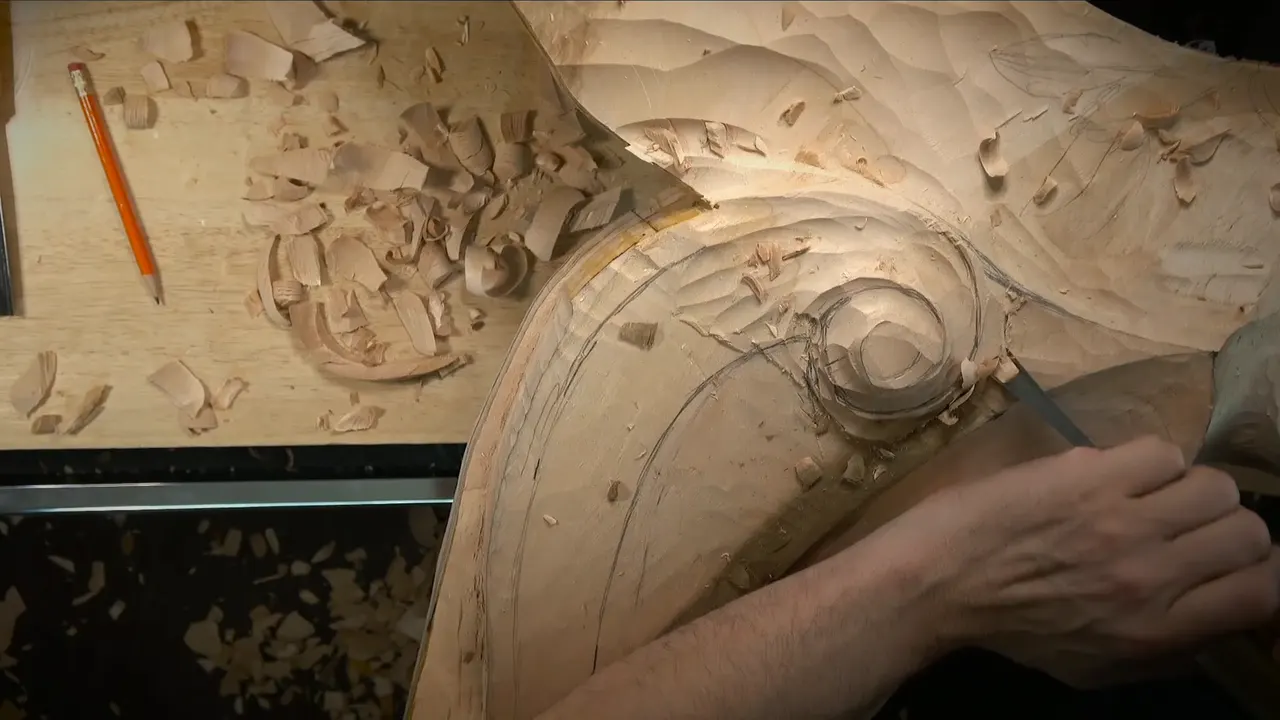

Part 9 of workshop 87 has a line to leave in place, and a whole part that is to be "concave" but "little lower." Other lessons use the same words about pipes, sides, middle lines and a part beside a volute.
Ever looked at two neighbors on a wood carving and known one has to sit below the other? This page stays with that short phrase inside one video of mine, and then it follows the phrase into lessons from several other courses.
How does part 9 begin?
It opens with a tool and a size: "we're going to take number seven and 14 millimeters, and I'll just go in just like that." That is 14 millimeters (0.55 inch).
Then the spot gets an idea. "My idea is to create another slope," and "also a concave movement." Next comes "I need to get the illusion of 3D in this spot," and behind it a reason: "So that's why I'm excavating much deeper."

Which gouges go in before the line is set?
The words for number nine are "just chop straight down with the number nine first, right on the line." Another tool follows: "Number three and three-quarter of an inch" (19 mm). Then "That's what I'm using right now."
Number seven returns, and the words are "And get that excavation even deeper."

Why does a small concave matter?
The reason is in the video: "Again, why I'm doing what I'm doing, just after beautiful shadow casting, okay?" The plan for the spot is "some concave," with "number nine and maybe quarter inch, six millimeters or so."
Here is the plan: "Going to start that concave all the way here."
The concave is "not deep," and the word for it is "detectable." Also "able to see it."
Then "Of course, it's all about shadow. Nobody's going to measure here, but the shadow is really important."

Is it too early to move a line?
"Oh, by the way, maybe it's too early because I still probably have to move this line. I don't know if I'm going to do it or not," and then "Let me clean first."
The wood gets a look next: "see this line?" And "higher than the central part." Next, "let me double check." The answer is "very surprisingly," then "actually right there. Perfect."

Where are the words in part 9?
Right after that check comes the plan: "So what I have to do, I need to create a separation cut. So I'm going to leave that line right here, and this whole part is going to be a little lower. So it's going to be concave, but it's a little lower."
That line holds two things. One is a line that is to stay where it is. The other is the whole part, which is to be concave and lower.

What sets the boundary?
"Let me do a separation cut with the number 11," and for it "seven millimeters" (0.28 inch).
Next: "And carefully going to just establish my boundary." Then "Going to change the position," and "I don't need the mallet."

How deep can the part go?
The video ends on a question: "And that's the question, how deep am I going to go?" The answer reads "Well, I could go quite deep because I need to create that idea that is also sloping this way. Okay? So which means maybe about even half an inch or so" (13 mm).

What does part 10 add?
It begins with "before I go deeper, I need to clean that area." Then "Actually, I can go deeper." The words that follow are "a shadow in this area," and "a really good shadow."
More depth is named: "all the way to a whole inch if I wanted to" (25 mm), and then "Well, an inch right here, and a lot less the closer I get toward my future drop."
Next, the look: "You should already see, or detect I should say, the movement." And "It's going this direction versus that direction," and then "a really good ridge" follows.

Tools named: "let me get a bigger one." Also "numbers seven and 14 millimeters," "I can actually do it with the spoon" and "the spoon gouge, maybe number six or so." The last is "Number three and 20 millimeters" (0.79 inch), and "I'll get right to the line." The ridge gets its own words: "Can you see that ridge? It just creates a beautiful, sharp point."
Does the word lower carry a size?
Inside part 8 the words are "go around," and then "much lower." Further on: "that is absolutely okay." Later, "lower anyway," and "So pretty much I can take, right now, number 9."
Inside part 1 the words are "Okay, so that is approximately... Well, actually," and then "little lower." Also in part 8: "let me take number 11" plus "go around this movement," with "maybe seven millimeters will work" (about 0.3 inch).

None of these gives a depth, so I copy only the words.

Could a concave simply sit lower?
Workshop 16, part 1, has a mistake: "So what happened here, it's not good," and the plan is "Let me use number nine and recreate that concave." Then "the same concave, just little lower."
Next, "let me do little separation right there." Number nine is the gouge. The separation is small.

Does a lower spot help you see a pipe?
Same workshop, part 7, gives a reason for "little lower": "because I really want to see this future pipe."
With a "probably," the plan is to "exaggerate that pipe even more." The light matters too, with "from the ceiling" and then "that exaggeration, that shadow right here."
The pipe gets a shape plan: "that is a pipe," then "somewhat rounded, okay?" And "attack that from the right position," with "number three."

How smooth can a lower spot look?
Also in workshop 16, part 6, "little lower right here." Right behind it comes "But don't want to break it also," and then "now I have really nice and smooth transition right here."

Can a part sit lower than a volute?
Furniture Panel 17, part 8, has "going underneath of this leaf, and we really need to keep that leaf the high spot." And "a little higher, so I hope it makes sense."
The rest of it follows: the volute higher, and "little lower" for that part. Then "hopefully you understand what I mean by that."

Does a side go lower on purpose?
Over in Furniture Panel 23, part 2, I say "and make this side little lower because it's supposed to be lower." Before it: "start undercut a little bit on inside." One more line: "I could wait until later, but it's okay."
After it: "But not much because part of it just going on top of this molding." The tool named there is "the one millimeter number 11" (0.04 inch).

Which side gets the number 11?
Venice Room 36, part 12, has "let me also touch little bit this upper part of this movement." Next, "make it this side little lower, too." Then "I have to grab again number 11 and maybe 10 millimeters" (0.39 inch).

How much is not much?
In workshop 113, part 2, the words are "like a frame." Next comes "Not much, but a little lower," with "As of now, I can probably just indicate that." The depth is "about three millimeters deep" (0.12 inch), with "that feel that's really architectural." Then "Okay," and "So I think it's enough."

Is a lower middle section a problem?
Venice Room 62, part 5, has "so I need to lower down the middle section." Then "Otherwise, it's not going to look as nice," at "seven millimeters" (about 9/32 inch) as the size, and "kind of wrong way of doing it" as another line.
Later: "I've got two pipes exaggerated. I can reestablish my middle line with no problem."

How can a movement's upper part stay lower?
Over in workshop 69, part 9: "I did not take too much material down below, although I still have to establish my concaves on that upper part of a movement, and it still has to be a little lower."

Can a flower spot sit below its neighbor?
Hashemi Flowers 27, part 3, has "I can lower that side a little bit," then "my higher spot," and then "little lower spot and smaller flowers."
One more: "I indicated the direction of those flowers, how they're supposed to look, the centers of the flowers."

What if lower means removing a part?
In workshop 116, part 2: "a shell movement." And "remove that part and make it little lower, otherwise it's not going to look as nice. And then recreate the drawing."

Which is better, a bit lower or too high?
The Tray of Blessing, workshop 3, part 3, is an undercutting video: "Don't get too high. It's better to get little lower than too high." Also "see how high it was?"
Right after: "curvature of that not to get high," and "I don't wanna get right on the line right there." Also "I'm presenting at 45 approximately," "for the slicing motion."

How does a lower part blend?
Byzantine Acanthus 6, part 3: "See, I follow that arc." And "little lower." Then "It just going to make better sense because I really need to blend everything."

Is a slightly lower side still good?
In the Hazelnuts course, part 1 of lesson 6: "Lower down slightly this way," with "number 11, 12 millimeters" (0.47 inch). Next: "Just lower down slightly this side. I think it's still good." And "a little lower than this one," with "probably better."

Do rosettes get a lower part too?
Carving Flower Rosette 4, part 2: "I am somewhat happy, although I need to make this one a little lower." Plus "Just clean around."

Where does extra shadow come in?
Within Furniture Panel 22, part 5, the words are "Even if you don't see exactly what I'm after, but you'll get it." And "let me make this part little lower." Next: "It's not like going really, really deep underneath, but still it does." And "it's going to create beautiful detail." Also "extra shadow, I should say."
For tools: "let me undercut with the half a millimeter number 11" (0.02 inch).

What about the movement on the inside?
Furniture Panel 19, part 4, has "But what I could do, I could actually make that lower now, too." Next, "I have another movement on inside," and "little lower, even lower." Then "lower than the main design." Before that, "I really don't have to, because we still have to work on details"

Could lowering help a flow line?
A movement in Furniture Panel 20, part 3, "just doesn't give me really nice flow line." An idea follows: "Maybe I have to make it little lower."

What tool lowers a part?
Part 3 of Furniture Panel 21 has "make this part a little lower," then "to do that, I could probably use just a knife." A knife is named in that line, and "indicate my movement first" comes before it.
Which piece is smaller, and which goes lower?
Lily Box 13, part 1: "this one is a little smaller than this one." Next, "I want to make this one a little lower." Also "this distance is actually almost equal to this distance." Later: "let's make it a little lower. I need to take approximately maybe a 16th of an inch down to this green line" (1.6 mm).
What if a leaf looks too high?
Carving Roman Acanthus 9, part 5: "Maybe that looks a little too high," and "Let me make it a little lower." A "number 3 sweep," at "12 millimeters" (0.47 inch), is the tool plan.
Is lower always a plan?
Workshop 42, part 6, has the line before: "And that needs to be blended." Then "Actually, I could go little lower." A could stays a could.
Which lessons use the words, and about what?
| Said about | A line from the lesson |
|---|---|
| concave | "the same concave, just little lower" |
| pipe | "exaggerate that pipe" |
| volute | "hopefully you understand what I mean by that" |
| movement | "another movement on inside" |
| middle | "I can reestablish my middle line with no problem" |
| detail | "extra shadow, I should say" |
| side | "part of it just going on top of this molding" |
| undercut | "Don't get too high" |
| flowers | "little lower spot and smaller flowers" |
| arc | "that arc" |
| rosette | "I am somewhat happy, although" |
Which spot on your carving sits below its neighbor?
The lines above point at a pipe, a flower spot, a middle line and a side. Two reasons are named: a pipe to see, and a side "supposed to be lower."
Watch it inside one tuition plan with the rest of the Part 8 workshops, and in workshop 87. The Furniture Panel, Hashemi Flowers and Tray courses carry other lines.
How it's done
- Tool and size. "number seven" with "14 millimeters" (0.55 inch), and "I'll just go in just like that."
- A slope. "my idea is to create another slope," and "also a concave movement."
- Line. That line is to stay "right here."
- Whole part. Both "concave" and "little lower" are planned for the whole part.
- Tool for the boundary. "Number 11" at "seven millimeters" (about 9/32 inch), to "establish my boundary."
Frequently asked questions
Which tool is planned for the boundary in part 9, and what size?
Number 11 is the plan, with seven millimeters (0.28 inch).
How deep could part 9 go?
"maybe about even half an inch or so" (13 mm).
Which line stays?
It is the one I plan to leave "right here" in part 9.
How much deeper does part 10 go?
What to carve next