

Alexander Grabovetskiy, woodcarver, School of Woodcarving · Published 2020
What does a wood carver mean by "if I wanted to"?
Quick answer: Venice Room workshop 87, part 10, has me name "a whole inch" (25 mm) as a depth I can reach, and in part 11 a part I can take "even lower." Both lines end on "wanted to." Lessons from other courses use the same words about hollows, walls, a movement and shadows.
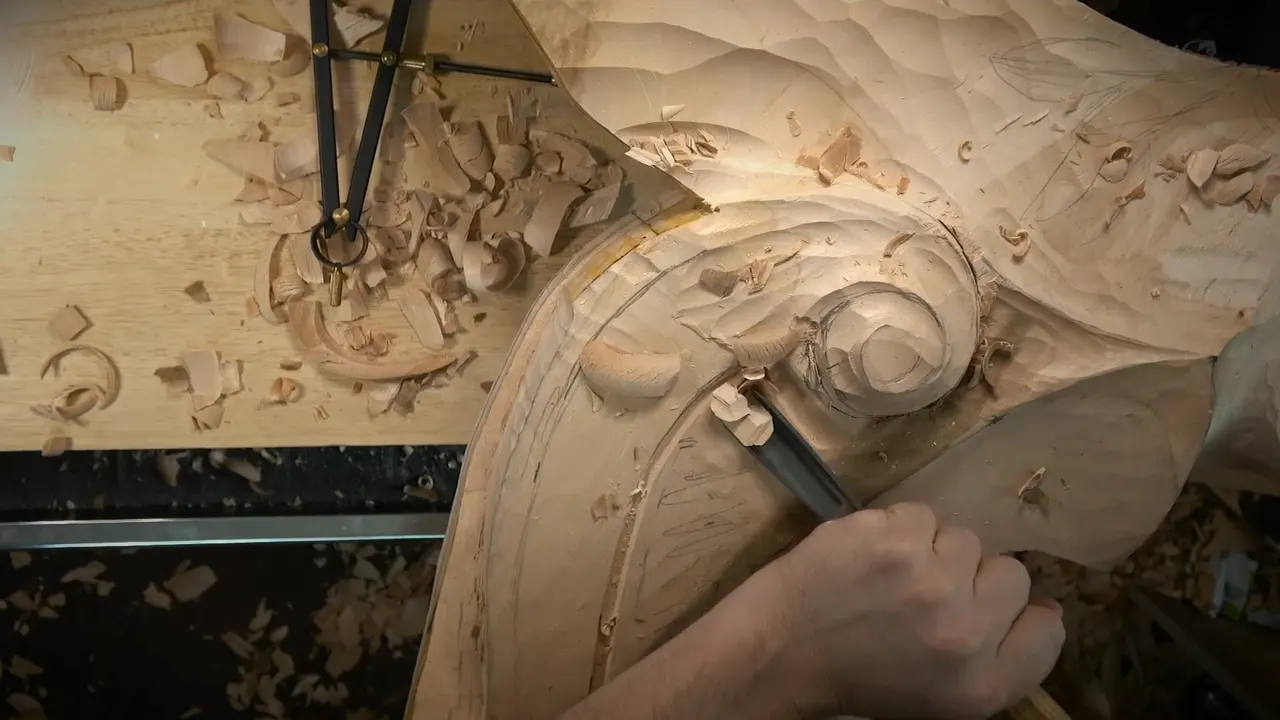

In part 10 of Venice Room workshop 87 the depth I name is "a whole inch" (25 mm), and in part 11 a part can go "even lower." The words "wanted to" end both lines, and lines about a hollow, a wall and a shadow in other courses carry them too.
Ever held a gouge in a hollow and known the wood had more depth in it? Ever left it where it was? This page calls those two words the tail. It stays inside my own part first, and then it follows the tail through lessons from other courses.
How does part 10 begin?
Two plans open the part, with a gouge number right behind them. "So now before I go deeper, I need to clean that area." The second plan reads "Then I'll be able to get deeper, and maybe I'll just use number nine."
The first depth is a number: "Actually, I can go deeper than half an inch" (13 mm). The need comes right behind it: "I need a shadow in this area." And again: "I need a really good shadow."

How far does the hollow go?
Here is the line this page is named for: "I can go all the way to a whole inch if I wanted to, the whole inch deep" (25 mm).
A result sits in the lines right after: "even more shadow if the light is going to shoot from this side." Then: "Well, an inch right here, and a lot less the closer I get toward my future drop."

Which tools work the hollow in part 10?
Number nine comes first, and a bigger gouge is next: "let me get a bigger one." Behind that line sits "And I'll clean it this way." One more line names number nine again: "I'll use number nine."

The sizes change at one point: "let me get numbers seven and 14 millimeters, and establish the form a little nicer that way" (0.55 inch).
A spoon idea arrives with a small word, "Oh." Then the idea itself: "I can actually do it with the spoon." My plan for it is longer: "I need to get the spoon gouge, maybe number six or so, and excavate this way."
The last tool of the part is a number three: "Number three and 20 millimeters" (0.79 inch), and "I'll get right to the line."

How sharp is the ridge?
One look at the ridge reads: "You should already see, or detect I should say, the movement. It's going this direction versus that direction." My verdict is short: "So it's a really good ridge." The name comes with it: "division ridge."
The end of the part asks you a question: "Can you see that ridge? It just creates a beautiful, sharp point." Close to the end: "of course, I can refine it."

What waits for later in part 10?
One spot is not in a hurry: "Not your convenient spot the closer I get right here, but I'll worry about it a little later."
Which sizes open part 9?
Part 9 opens on a size, "we're going to take number seven and 14 millimeters" (0.55 inch).
The idea is a slope, in my words "So my idea is to create another slope." The look is "the illusion of 3D in this spot." And a reason is given: "So that's why I'm excavating much deeper."
Now the chopping starts as a plan: "And now I'm going to just chop straight down with the number nine first, right on the line." A bigger gouge is next: "Number three and three-quarter of an inch" (19 mm).
The number seven returns: "And I'll grab again number seven." A little later: "And get that excavation even deeper." Another tool is named after that: "I need to get number nine and maybe quarter inch, six millimeters or so" (0.24 inch).
The shadow gets its own line: "Of course, it's all about shadow. Nobody's going to measure here, but the shadow is really important."

How does part 9 ask the same question?
The end of part 9 holds the question and a number: "And that's the question, how deep am I going to go?" What comes next is "Well, I could go quite deep because I need to create that idea that is also sloping this way." The number is last: "maybe about even half an inch or so" (13 mm).
Where does part 11 use the tail?
A different verb carries the tail in part 11: "I can make it even lower, this part," and the words "wanted to, of course" end the line.
Then a gouge: "I can probably use a big number seven." And the move itself: "And go straight down, just like that."

Another line about the look sits in the same part: "it was a common design trick to trick the eye." Another says "some spots, it's a 2D relief carving." The aim is stated too: "we are trying to fake the eye and make it look much deeper than that area really is."
How deep does part 11 end up?
The first number is in part 11: "I've got about an inch deep from this point down." A plain remark comes next: "So, of course, it doesn't look clean, and it's time to clean up little bit."
The check comes later in part 11: "So I am about one inch, I would say. We'll check that way I'll know exactly where I'm at." Then: "And yes, I am exactly one inch right there. Just one inch exactly."
The last line is "So that's going to be my final depth." One inch is 25 mm.

Where else do my lessons use "wanted to"?
Other courses do. The table below lists one line from each, and I read the lines in full first, with the words around them.
What stands beside the tail in Venice Room 73, 71 and 54?
Venice Room 73, part 5, sets the tail next to a plan: "I'm going to create the plug cut and excavate just like that." Later comes a number: "About 10 millimeters or so" (0.39 inch), and "That's what I've got inside, okay?"

"It's going to give me a shadow that I'm after" is a line from Venice Room 71, part 9, near the tail. Later in the part: "And create deep shadow. Beautiful and deep shadow."

In Venice Room 54, part 4, the tail sits close to "And it's going to give me beautiful shadow." Next to that sits "Okay? See that?"

What do Venice Room 51, 60 and 33 add?
"I really like how it goes underneath" is the line before the tail in part 5 of Venice Room 51. My plan follows: "let me excavate that eye a little deeper with the smaller number 11." A size comes with it: "And let me use two millimeters" (0.08 inch).

Take Venice Room 60, part 1. A line follows the tail: "it was a really hard decision how I make that transition to the ceiling." Then comes "That was a little challenging."

In Venice Room 33, part 7, the tail is followed by a limit: "everything is in my way, and I'm not going to be able to get as deep, and I am aware of it."

Which other courses carry the tail?
Hashemi Flowers 33, part 1, quotes "And I have plenty of thickness right here, so I can actually go deeper" ahead of the tail. Later: "Let me turn that this direction and attack that from a different side."

"like I said, I left only about a one millimeter wall" (0.04 inch) is a line from Floral and Molding for the Panel 7, part 3. The tail sits after "I could probably go a little deeper." A plan is next in line: "But let me create a concave right on this side."
Over in Vase with Grape Leaves 2, part 9, the words are "Even more, I've got 4 millimeters" (0.16 inch). The line runs on past the tail: "closer to the center and get an even more pronounced shadow." Close by: "See, it's already casting a shadow."

Acanthus over Moldings 7 has these words in part 1: "And I can just get really clean." The tail sits on the line after, behind "And I can get really deep." See the lesson page.
When does the tail carry a movement?
Look at Venice Room 82, part 10. It sets the tail beside "I could actually create the movement," followed by "I'm not sure." A second idea is "Or I can actually take this one and roll it a little more." A plan comes after that: "Let me try it, and if I like it, I'll leave it like that, okay?"

"And it looks good, except I could actually give an extra concave" starts a line in Venice Room 90, part 1, that ends on the tail. The line goes on: "but I don't really need it."

"Even make it little deeper" and the tail sit in Venice Room 85, part 1. A need is stated after them: "I also have to lower that down somehow."
Where does the tail sit beside a shadow?
In part 2 of Venice Room 93 a shadow line opens on the tail and goes on "exaggerate that and to create a deeper shadow in this section." The tool is "half a millimeter veiner #11" (0.02 inch). Later: "I hope you see it."
A second shadow line is in Venice Room 131, part 2, and it opens on the tail too, with "exaggerate the shadow on this side." The size is close by: "I could take number 11, let's say 30 millimeters" (1.18 inch). Later still: "Like almost undercutting, but it's really, really slight undercutting."
Is the tail only about depth?
No. A clamp is named in Venice Room 77, part 7: "Again, I could just clamp it," and the tail follows. The other option comes next: "It would give me a solid point holding, but in this case, I could probably just hold it by finger."
Another small move is in Venice Room 78, part 10: "I could actually move it a little bit that direction." A thought about glue comes before it. "I could actually glue at this point also just to connect to that movement."
Right after "But I also could drill multiple holes" sits the tail, in Venice Room 80, part 3. Behind the tail comes "but I don't think I need it," and later "I can take it down as much as I want to."
A rasp is named in Venice Room 163, part 2: "By the way, I could just rasp it," and the tail follows. It sits again after "But I can do that little later." Between them: "Like I said, that's just paint grade."
In Grape Onlay 3, part 3, the line is "and this, I could use actually a knife." The next line says "but that's how you get in inside of those areas." Later: "I'll use just a skew knife to clean slightly inside."
Venetian Flowers Rosette 4, part 1, quotes "I can always measure" and ends on "with the calipers." Later: "Now, with the calipers, you can actually replicate pretty much any picture." See the lesson page.
Furniture Panel 30, part 3, ties the tail to "I can drop." Next to the tail: "Not all the way, but, you know, kinda lower."
Where do I leave the extra depth alone?
At Venice Room 56, part 5, the words are "I could go really deep," then the tail, and then "but I really didn't wanted to because I still have to finish it, get with my brush somehow." A later line is "Really deep shadow."

From Venice Room 94, part 11, comes "about 10 millimeters down, the final depth right now, I've got about six millimeters." Those are 10 mm (0.39 inch) and 6 mm (0.24 inch). Next is "actually can dig a little deeper" and the tail, and a later line: "But as of now, it's just straight down."
One more is Venice Room 151, part 2, with the tail just ahead of "I don't think I need to, but I can go deeper."
Which line comes from which lesson?
Each line below is quoted from one of the lessons named above.
| Said about | A line from the lesson |
|---|---|
| depth | "Well, an inch right here" |
| plug | "really deep" |
| hollow | "I can go even deeper" |
| eye | "get a little deeper" |
| excavation | "And I can excavate a little deeper" |
| leaf | "excavate even deeper" |
| thickness | "And I have plenty of thickness right here" |
| wall | "probably go a little deeper" |
| pipes | "casting a shadow" |
| movement | "I could actually create the movement" |
| concave | "an extra concave" |
| shadow | "exaggerate the shadow on this side" |
Watch part 10 and the lessons above inside one tuition plan, together with the Part 8 workshops and workshop 87. The Hashemi Flowers, Acanthus over Moldings and Vase with Grape Leaves courses carry the other lines.
How it's done
- Clean the area. "before I go deeper, I need to clean that area" is the plan for part 10.
- Name the depth. "a whole inch," and 25 mm.
- Name the shadow. "I need a really good shadow."
- Pick the tools. First "number nine," then "maybe number six or so," and a "number three" near the end.
- Spot the ridge. "It just creates a beautiful, sharp point."
Frequently asked questions
How far does the hollow go in part 10?
"the whole inch deep" (25 mm) is the limit in part 10.
Which depth is checked at the end of part 11?
"exactly one inch right there" (25 mm), after "I am about one inch, I would say."
Which gouge ends part 10?
Number three, at 20 millimeters (0.79 inch): "I'll get right to the line."
What does part 9 say about shadow?
What to carve next