

Alexander Grabovetskiy, woodcarver, School of Woodcarving · Published 2020
What does a wood carver mean by "go around"?
Quick answer: In my lessons "go around" is followed by things like "the eye," "the flower" and "thorns." In Venice Room 87, video 6, it is a plan with no object named, and a check sits next to it: "I still have to check."
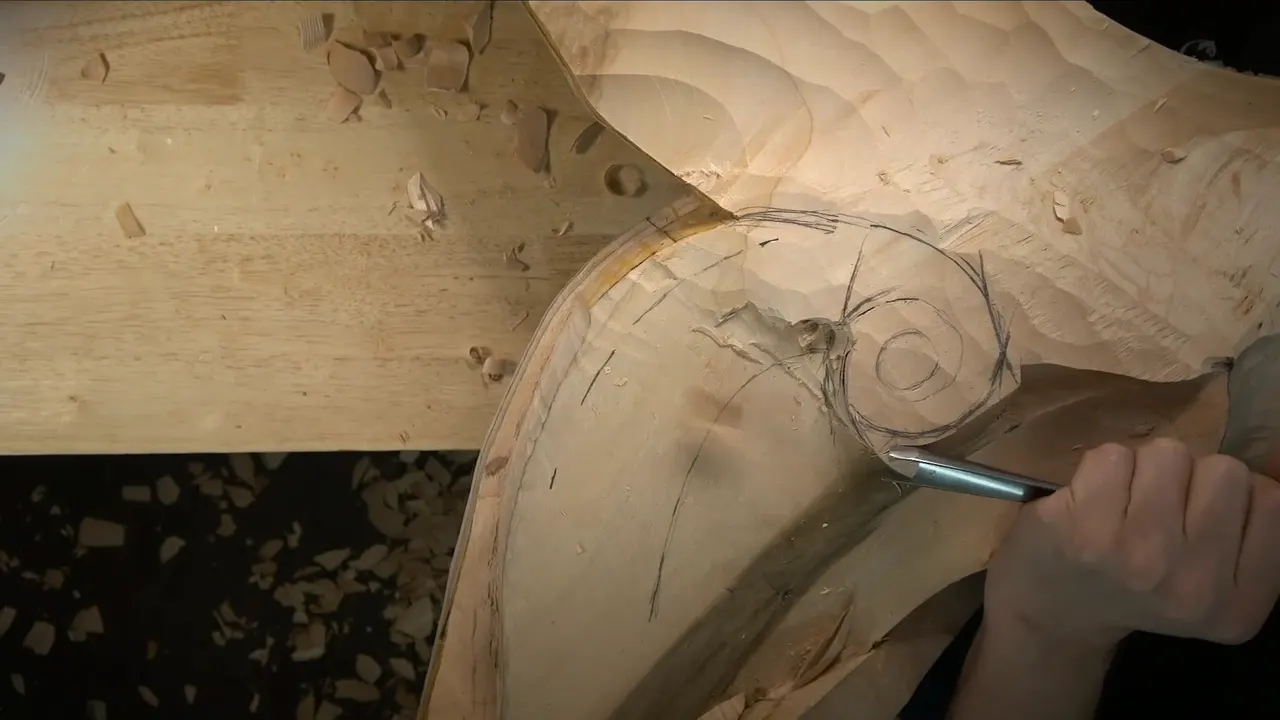

"Go around" is a phrase I use with a tool in my hand. In my lessons it is followed by things like "the eye," "the flower" and "thorns." In Venice Room 87, video 6, it is a plan with no object named, right after the tool: "Number nine and 20 millimeters, and I'll go around." Video 6 comes first. After it come my lines from other lessons, each one linked.
Ever heard a carver say that and wondered what goes around what? The numbers in these lines, like nine and 11, are gouge numbers, which is how I name the tool. Below are the numbers, tools and warnings that sit beside the phrase, first in this video and then in the others on this page.
What does video 6 say before the phrase?
It opens on a measurement: "approximate height." Half a minute later it adds "that is the highest spot." Then a doubt shows up twice in new words, "a kind of problem I have to solve" and "a problem that needs to be solved." The next line is "Maybe yes, maybe no. Maybe there is a problem, maybe there is no problem."
The position gets named, "the right position," and is corrected two seconds later: "Well, actually not, I have to measure from both sides." The new spot is "somewhere right here."

How worried is the center part?
The words are "All I'm worried about the center part," followed by "this is going to be lower anyway, so I am okay." Then "I'm okay with that. Not big mistake."
Next the video says "I've got a little closer to the idea, so I'm pretty close." One part is the exception, "just this part." A figure arrives with it, "about three millimeters off this way" (0.12 inch), and the sentence closes on "so I chopped that a little too early."
Two more lines name a part and a check. The part is "the part I have to work around right now," and it is "a waste." The check is "for some reason, I need to check the distance."

Is the line fixed?
One line moves: "this line right here, it's going to move slightly, okay? But it's okay." The second one gets a plan: it is "a lot easier, so I can just measure off this one." On how strict it is, "there is some flexibility, I should say." And "As long as I'm pretty close, I should be okay."
Which gouge goes with that plan?
The gouge is a number nine at 20 millimeters (0.79 inch). Both lines are plans: "I'll take number nine," then "I will go around." No object follows them.
A check sits right after: "By the way, I still have to check. Maybe it's a little too early what I'm doing." And then "I got to check with my idea first." Short verdict: "I think I'm really close."

What comes after the check?
Next comes a need: "I need to go around and make this part much lower. So I really need to stick this part out." Then "with the same tool," and another need, "I have to change the position."
Further into the video a hump is named, "this hump is a little too big anyway, so I need to take this out." A counterpoint sits right beside it, "I still want to keep this spot." And "right here, it has to be deeper. So let me do little by little."
The last cues are about a line: "I do have a line right here, so I cannot go too much with this area." Then a plan to "take care of this hump."

Where does the phrase turn up in videos 8 and 12?
Back in video 8 of the same workshop the phrase returns with a smaller size, "Seven millimeters" (0.28 inch), and a plan: "I'll just go right around that picture, but I need to find my mallet." The mallet takes a few lines of back and forth, "a smaller mallet. Or not. Maybe bigger." Then "Yeah, I'll get a bigger mallet again," and "around here."
The twelfth video has "the same tool around here" and later "Number three, and little by little." The last line has no object.

How far does the knife dig in Furniture Panel 15?
In Furniture Panel 15, video 2, the first words are about the wood and a knife: "that is walnut, and that's little harder wood than basswood, my knife is not digging too deep." That helps: "So it's actually advantage for me." Then "Go around that," and a plan for "a little extra thickness to this section." One slip is named too, "I just slipped a little bit with the knife."

How deep is the second pass in Lily Box 2?
In the first video of Lily Box 2 the tool and the size are named: "the number 11 veiner and 3 millimeters, which is one-eighth of an inch." Its aim is "just set everything in place." The target named is "all of my thorns," and the next line is "I started from almost nothing."
The second pass is a plan, "a little deeper," and its depth is a hedge: "approximately maybe 3/32 of an inch, maybe 1/8 of an inch," or 2.4 mm and 3 mm. Later the hedge narrows to "No more than" that, and one verdict is "sufficient." The same video has the phrase with "everywhere."


Why the care around the eye in Venice Room 60?
The warning comes ahead of the phrase in Venice Room 60, video 6: "So got to be careful." Size is the question, "a little too big for me," and "either two millimeters, or maybe let me try four millimeters first. Four millimeters, number 11." Those are 0.08 inch and 0.16 inch. A backup is a plan, "if it doesn't work, I'm going to do it with something else."
Then the phrase: "I'm going to go around the eye carefully. Carefully." Seeing gets the last line. "It's impossible for me to see sometimes, that's why I have to stick my head."

How accurate is the line in Floral and Molding 10?
Two tries name the tool in the second video of Floral and Molding 10: "I'll take maybe, let's say, number 11 and 7 millimeters. A little bigger than quarter of an inch." That is 0.28 in. The plan is "I'll just go around the line, okay? I'll just create the outline pretty much." And "Doesn't have to be really, really accurate."
Depth is a hedge, "maybe couple millimeters deep, I would say," and it depends on the spot: "it could be much lower than two millimeters" on one side, the side that gets "much lower." Space is short right there. "I don't have too much space because I do have a lower acanthus movement."

Which angle goes with the knife in Butterflies 12?
Carving Plate with Butterflies 12, video 3, builds its plan on an angle: "start from inside," "exactly the same angle," and "go around whatever the outline I have of that design." Next the video says "I hope it makes sense." The view gets a line: "Let me try this camera." One more line is about the blade, "my knife going to change the direction."

How much comes off in Grape Onlay 3?
In Grape Onlay 3, video 1, the line just before it is "clean it with the same tool." After the phrase the plan is "taking approximately maybe one eighth of an inch at a time, and I'm gonna go deeper." That is 3 mm. The hedge words "approximately maybe" belong to the size of each step, and no object follows the phrase.

Is there a way to skip the walk in Venice Room 151?
Not every passage ends in a walk around the piece. Video 1 of Venice Room 151 has the grain in it: "some spots I am working against the grain," and "There is no supporting grain." The look of it is "choppy," with "this side" cleaner. The option is named, "attack that from opposite side," and the next words are "but I really don't want to walk around and waste my time." A closing line adds "be careful, that's it."

How does undercutting sound in Hashemi 33?
The fourth video of Hashemi Flowers 33 gives a plan: "And now what we're going to do, just go around and undercut everywhere." A verdict follows, "Doesn't look too good," and a tool thought: "Looks like I need the bigger number seven to make it smoother."

Does everywhere mean the same depth in Roman Acanthus 16?
Not exactly. In Roman Acanthus 16, video 3, the talk starts with sizes: "it doesn't have to be exactly the same everywhere. Some spots could be just 1/32 of an inch, somewhere 1/16 of an inch." Those are 0.8 mm and 1.6 mm. It goes on, "get an idea," and "one millimeter, two millimeters, if you like more millimeters," which is 0.04 inch and 0.08 inch.
Then the phrase: "go around everywhere." A warning is beside it, "And be careful," and then "Don't force it." A last line is "Just refine that edge."

How is the corner of a number seven used in Venice Room 134?
A size comes first in Venice Room 134, video 3: "quite deep undercut," about "five millimeters, I'd say" (0.2 inch). Then "Apologize you don't see it." With "the number seven" the plan is to "hit just with the corner." A line later, "I'm just hitting with one of the corners, just like that."
A sentence then opens with the phrase and goes on, "remove excess material, and see how deep shadow it casts?" The verdict is "It's really, really deep and beautiful." A hedge follows: "Some of that stuff I could probably remove with one millimeter" (0.04 inch).
What goes under the cluster in Lily Box 13?
The setup in Lily Box 13, video 6, is "a cluster right at this area" and "I need to go underneath and make some separation where you would see that much better." Then "those darker spots," and the line "around and around and around, and I'll just get that also inside." After it, "Make it a little darker."
After that, "one of the techniques actually really good for the furniture makers who really like to make some embellishment on the furniture." And the video goes on with "So before applying the main color, the main stain."
What limit sits next to the flower in Venice Room 136?
Venice Room 136, video 3, ends the phrase on "the flower." Four seconds later the limit arrives: "I cannot be too deep in this section because you've got the high spot."

How little comes out in the Maine class?
Tools are named in video 1 of the Grinling Gibbons class in Maine 15: "I can use number 11. You could use number 10, number 9. It's up to you." The pick is "number 11 and 5 millimeters" (0.20 inch). The amount comes next: "I don't have to take a lot out. But just a little bit." And on depth, "I also want to make sure I'm not gonna go all the way underneath." Then "just preliminary."

What comes before the pipe in Venice Room 45?
Venice Room 45 opens its third video on "go around this pipe and that pipe." A first step is attached, "I have to clean it first. I need cleanup job." A caution follows: "I do not want to force it, but this will be undercut underneath of this."

What size goes with the line in Venice Room 69?
The plan in the fifth video of Venice Room 69 is "I will go around this line, okay, and I need to remove some of that material." A reason follows: "I want to make sure that the overall shape is also looking good." A number comes first, "a number 11." Then comes a size, "20 millimeters again, three-quarters of an inch," which is 0.79 inch or 19 mm. A correction ends it: "this is actually not number 11. I apologize. This is number 17."

Does a movement go around as well?
Furniture Panel 29, video 1, uses the phrase for flow, not the tool. "The center line going to die somewhere right here where those two petals meet." Then "my movements supposed to go around that center, which invisible, which is gonna be invisible inside."
How do the tools and sizes line up?
| Where | Which tool or size is named in the video | What follows the phrase |
|---|---|---|
| Video six of 87 | number nine, 20 mm (0.79 in), no object after it | none |
| Eighth video of 87 | seven millimeters (0.28 in), then a mallet to find | "that picture" and "here" |
| Lily 2, video 1 | the number 11 veiner, 3 millimeters (one-eighth), then a second pass of about 3/32 or 1/8 in (2.4 or 3 mm) | "all of my thorns," then "everywhere" |
| Video six of 60 | four millimeters (0.16 in) in number 11, as a first try | "the eye," carefully |
| Floral 10, video 2 | number 11 at 7 mm (0.28 inches), depth "maybe couple millimeters" | "the line" |
| Maine 15, video 1 | number 11 at five mm (0.20 in), "just a little bit" | nothing after it |
| Fifth video of 69 | 20 mm (0.79 in), also three-quarters of an inch (19 mm), and number 17 in the end | "this line" |
| Grape 3, video 1 | 1/8 in (3 mm) at a time | nothing named |
| Third video of 134 | the corner of a number seven; undercut of about five millimeters (0.2 in) | "remove excess material," then "see how deep shadow it casts" |
| Lily 13, the sixth video | no tool named, only a cluster to go under | "just get that also inside" |
| Roman 16, video 3 | 1/32 in (0.8 mm) to 1/16 in (1.6 mm) | "everywhere" |
Which things follow the words?
Some passages name a thing after them: a picture, thorns, an eye, the line, everywhere. Six name none: videos 6 and 12 of workshop 87, a Maine video, a Grape Onlay video, a Lily Box video and a video of workshop 134.
Warnings turn up next to the words in three lessons: "carefully" in one Venice Room video, "be careful" and "Don't force it" in a Roman Acanthus video, and a last "careful" in another Venice Room one.
Which part of your own wood carving would you go around first? Workshop 87 waits inside one tuition plan with the rest of the Part 8 workshops.
How it's done
- The gouge number named in this video, nine. "I'll take number nine."
- The idea to check. "I got to check with my idea first."
- Seeing, said plainly. "It's impossible for me to see sometimes."
- Taking only a little. "I don't have to take a lot out."
- Another tool, another size. "Looks like I need the bigger number seven to make it smoother."
Frequently asked questions
What is beside the phrase in the sixth video of workshop 87?
Number nine as the tool, then a check. The video names no object.
Which object is named in video 6?
None. The next line says what it is for, "make this part much lower."
What sizes go with the phrase in other lessons?
Number 11 with 3 mm (0.12 inch) in the Lily Box lesson, four millimeters (0.16 inch) as a first try in a Venice Room lesson, 5 mm (0.20 inch) in the Maine class and 7 mm (0.28 inch) in a Floral lesson. Another Venice Room lesson begins at number 11, then ends at number 17.
What depth does a second pass have in the Lily Box lesson?
What to carve next