

Alexander Grabovetskiy, woodcarver, School of Woodcarving · Published 2020
What does a wood carver mean by "another shadow"?
Quick answer: The phrase "another shadow" is, in Venice Room 89.10, the reason for a little undercutting underneath of a small acanthus movement. In my other lessons the same words follow a concave, a spot and a line with a part below it, in Hashemi, Venetian Flowers, the Lily Box and other Venice Room workshops.
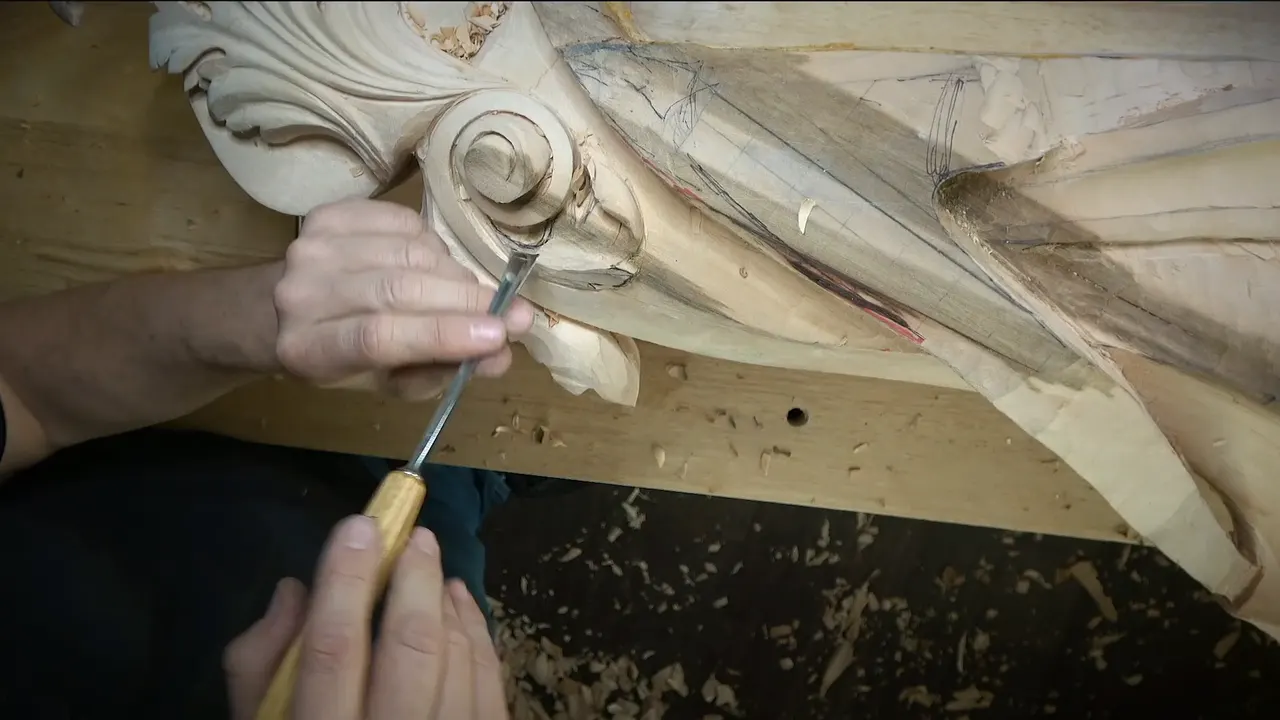

In Venice Room 89.10, "another shadow" is the reason I give for a little undercutting underneath of a small acanthus movement: "Reason why, I want to see another shadow." In my other lessons the same words follow a concave, a spot with a lot of material and a line with a part below it.
Ever moved a lamp just to find one more dark patch on a carving? Did a small undercut ever change the whole look of a piece? Then walk through part 10 with me, and through the lessons where I use the same words.
What happens before part 10 reaches the shadow?
The part opens on a separation to refine. A second side is next: "Let me knock down this side also because it doesn't look too good." A section goes after that, and "I can probably do majority of it with the same number seven. At least I can begin."

Depth has a limit, "I can't do too deep." The clean-up that follows is a small one, "Just clean it little bit."
The next tool is a number 11 with "it would be good idea to use again two millimeters" (about 0.08 in). An edge rule goes with it, "I don't want to see a sharp line," and then "Not on that project." The same tool is planned for "right on this line."

Which line in part 10 asks for the shadow?
It sits right behind a plan for an undercut and a hedge about the light. The light may move: "get the light little closer to me." The undercut is a plan for that small movement, "a little bit undercutting, almost, underneath of" it. My reason follows right behind. Those last two words come back as a line of their own.

A limit follows the undercut: "Not as deep undercut, but still, I need that shadow." Its reason is "Otherwise, it's not going to look as nice." Next the light is up for a change, with a correction of my own words in the middle: "get rid of this light. Not get rid, but move it somewhere else."
This spot gets an idea of its own. One small piece is "laying pretty much on top of that surface," in my words, and it is "Just a small detail, okay?"

How deep does the undercut go?
Deeper, by plan: "I could go even deeper undercut. And I think I should." One millimeter (about 0.04 in) is the size, in the same number 11, and "I can excavate even deeper." My own forecast is brief: "beautiful shadow."

The light gets another move, "this way again," and a second direction waits for the one millimeter. An apology for the camera comes in the middle of the work: "My apologies if my head is going to be in the camera. But see what I'm doing, right?" And then: "You should be able to see it."

Two lines judge the shadow, "It gives me really nice shadow," and later "See how nice shadow it gives me? Beautiful." A doubt about the view sits between them, and the answer is a plan: "Maybe you don't see it, but let me play with the light and you'll see it."
What are the last words of part 10?
A reminder about volute carving: "I said many times that volute carving is pretty much all about light and the shadow, not just the form." The form gets its due right after that: "Of course, it is about the form." And then "3D form is only one thing."

The last sentences name the surroundings of the volute: "you still have to utilize or use natural environment around, like light." The closing line ends on a shadow.
What else sits in parts 9 and 11?
Part 11 starts with the same subject: "It's all about the shadows." One line is about the undercut: "nobody's going to see how deep I got my undercut." A turn follows with a "But": "a lot more pleasant to the eye."

The plan next names one millimeter (about 1/25 in), with "a really nice marriage line between that volute and the background," maybe "slightly undercut."
After the marriage line, part 11 asks for "a spoon, a small spoon," a "Spoon gouge, like number three maybe, and three millimeters or so" (0.12 in). It needs a better strop first: "I changed a little bit bevel because it's already too rounded. So I gave a better bevel on the backside, and that took care of it." After that: "I can actually attack that even against the grain." "Even if it's mushy like this," it is "removed really cleanly."
A half millimeter veiner, number 11, is planned for "a channel cut" (about 0.02 in), and a sixteenth of an inch grounding tool (about 1.6 mm) is planned "between those two cuts." It "gives me really clean and nice transition point."
A limit ends part 11, "I cannot go deeper than that," and a reason to be careful with tiny tools sits right beside it.
Part 9 carries a chisel that is "a really handy chisel" with "whatever the angle I want to use," and a strop with mirror paste. A number seven at "about half an inch" (about 13 mm) is an option "right on top of those facets," with a roll: "see how I'm rolling my tool? Really important. Slicing it." The finish is "absolutely gorgeous finish."
How does the Hashemi Flowers course use the same words?
In Hashemi Flowers 26, part 2, the words belong to something that will be "applied either to the wall or background, whatever a customer is going to decide," and "raised above the background." My words about the shadow are in the table below.

A shadow underneath is expected, and "supposedly" it will "look beautiful." Next to that sit a plan to bring "this down this direction," a remark that it is "much easier to refine the final flow," and a short line, "Just don't force it." The whole course sits on its pillar page.
What does the shadow have to do with a petal?
In Venetian Flowers Rosette 3, part 1, one line is about the view: "If you look from above, so you don't see that movement." From the side, my words are "beautiful spot, beautiful look." A part is described, "this part is naturally just raises up," and an option follows: "I can create extra shadow on the side of the petal."

A small pencil gets mentioned ("little smaller pencil"), along with "a small concave like that." The tool sizes are "like number 11, of course, but much smaller, maybe like a two millimeters" (0.079 in). A warning about the concave: "It does not have to go all the way to the center."
A dull tool needs a buff, and then "That's much better." After that the shadow shows, and the words are "You can already see the shadow casting. So that extra shadow makes a big difference." Two more plans follow, "Let me also excavate on inside right here" and "I can probably undercut," which is "just a preliminary undercut." A deeper pass is planned for later, "go much deeper," and a line adds "Attack it from two sides." The course page is the Venetian Flowers Rosette pillar.

Does a lily box need one more dark spot?
In Lily Box 12, part 6, the words come at a spot on a flower: "Double-check." Then: "a lot of material, and if I'll just hit that with the gouge, I can cast even deeper shadow." A hint at a smaller tool follows, then a summing line: "Every little thing helps."

About doing it at all: "if you don't feel like doing it, just don't do it. Okay? It's still going to look good. But there is a huge difference between look good and look excellent or look great."
Later, a check: "I really don't want to make it paper thin." Then "I love to do paper thin" if it is "just on the wall. Don't get me wrong," and the edge has a limit too: "I still have to have some thickness at the edge." The course sits on its Lily Box pillar.
Where else in the Venice Room do the same words appear?
In Venice Room 15, part 1, they arrive in the middle of a movement. A check comes first, "Double check if I'm going to like it or not," and the hedge on its heels reads "Let me see if I'll be able to do that or not." And a remark: "There is a trick, actually, they used back then to create that extra shadow."

The number nine is up next: "let me outline a little better now with the number nine." Another job: "remove some of the waste I don't need." Later in the same stretch: "I can start removing on the side." And "Chop a little more."
In workshop 119, part 3, a pace comes first: "Really important for me not to rush it." Wood is already gone underneath, and the opening is "actually going all the way through." One caution: "careful, I have to remove little by little."

A short job list follows: "Now what I have to do, just clean up. And that's it. The main movement is done." Then "Just lots of cleanup and undercut, which is nothing exciting." A number 11 is planned to "attack from different points of view and get my excavation deep."
A flatter gauge is planned, "like number three," to clear some marks. A bigger veiner is planned later for concaves and convexes. One more caution: "it's not the main details, so I don't need to spend too much time here, but we'll see."
When does the plan about a shadow change in workshop 109?
In part 2 a plan changes on the spot. The separation will look "awesome," and a part could go under a line. A doubt follows: "Maybe I should."

The turn follows: "Why don't I? Okay." The change of plan reads "Let me change what I just explained to you. I'll do absolutely different." And a correction: "that is not right."
A tool: "for that, I'll take seven millimeters" (about 0.28 in). "And yes, number 11," and "a little bigger than a quarter inch" (over 6.4 mm). The pace is "little by little, without creating lots of pressure," and the tool is a number 11 again.
Does extra shadow ever hurt?
In part 3 of workshop 109, a plan names 2 millimeters (about 5/64 in), a number 11. "It all depends how light going to hit, by the way, but still, extra shadow spot never hurts." A verdict follows, "always good idea." Right after it, a follow-up with 1 millimeter (0.039 in) is planned.

The shadow shows and the surface needs work: "I already can see how it casts shadow. So now I need to take care of the surface, make it look good." Number seven "not going to work," and the tool wanted is "something like number eight," at "about 5/8 of an inch" (about 16 mm).
For the edge: "I can probably use big number two," with a reason, "fit perfectly to the edge." Then: "Now I'm happy. Nice and sharp edge."
Later in part 3, an undercut is planned under a line, "from that direction. From this direction." My reason is a three-dimensional look: "the more shadows I create on outside, more three-dimensional it will look, which is I'm after." And: "So that's why I'm doing what I'm doing."
A tool and its size: "probably 10 millimeters will work" (0.39 in), and "3/8 of an inch" (about 9.5 mm), number 11. The grain has its say: "I have to change the position because I see what grain direction." And: "sometimes it just doesn't work because the grain against me, so it doesn't want to do a good job for me." One slip: "I wasn't too careful and made little chip, which is okay, but you don't see that."
Where does another shadow sit across the lessons?
Each row below names a lesson, so you can find the line on its page.
| Lesson | Words | Beside |
|---|---|---|
| Hashemi 26.2 | raised above the background, so it's going to create another shadow casting. | Raised above |
| Rosette 3.1 | another shadow casting in this section. | Small concave |
| Lily Box 12.6 | This spot, I can actually create another shadow spot. | Much material |
| Room 15.1 | another shadow point somewhere right here. | A movement |
| Workshop 119.3 | another darker spot, another shadow spot. | Underneath |
| Lesson 109.2 | It's going to give me another shadow. | A line |
| Venice 109.3 | there's going to be another shadow point. | Same line |

How is your lighting set right now, and which spot on your carving still reads flat? Part 10 waits inside one tuition plan, with the rest of Part 8 of the Venice Room, and the rest of workshop 89.
How it's done
- Pick the size. The number 11, two millimeters (5/64 in), for the next stretch of part 10.
- Plan the undercut. A little undercutting beneath that small movement, with a limit on how deep it goes.
- Place the light. Closer to me first, then somewhere else.
- Plan a deeper pass. One millimeter in the same number 11, to go deeper (about 1/25 in).
- Show the shadow. The lamp gets a try so the shadow shows.
Frequently asked questions
Which line in part 10 gives the reason for the undercut?
It sits right after my plan for the undercut and right before a limit on its depth. The reason comes first, and then its last two words return as a short line of their own.
How deep is the part 10 undercut?
The first pass is not as deep, and I say so. A later pass is planned with a number 11, one millimeter (0.04 in), and my plan is to go deeper still.
Why does the lamp move in part 10?
These lines carry it: a plan to bring the light closer, a plan to move it somewhere else, and a plan to play with it. In this part only the last gives a reason, which is so that you see the shadow.
What to carve next