

Alexander Grabovetskiy, woodcarver, School of Woodcarving · Published 2020
What does a wood carver mean by "if you noticed"?
Quick answer: In the Venice Room lesson filed as 89.8, I pointed at the number 11 I was using. Lessons in other courses hold a remark of the same kind, followed each time by a detail of how I work, such as the gouge I pick or the spot where I stop.
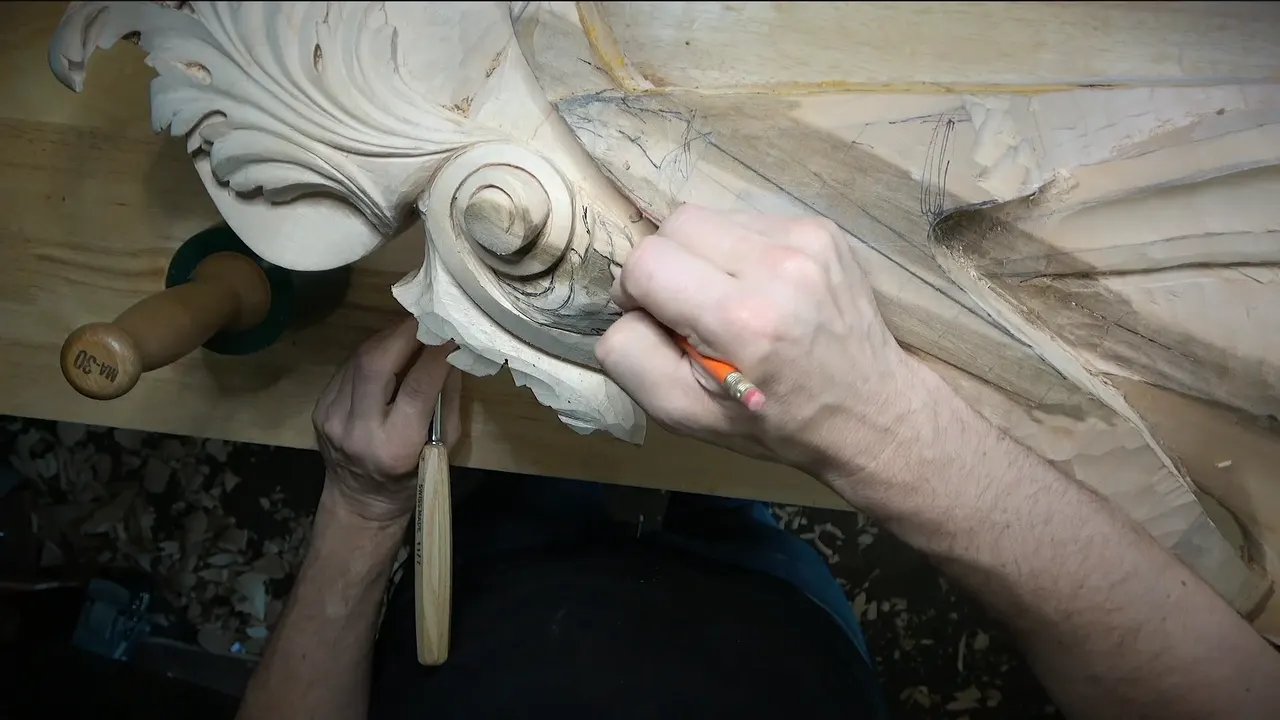

In workshop 89, part 8, I said "If you noticed, in this project, I use a lot number 11." Other lessons of mine carry a remark like it, and what follows is a detail of how I work. A gouge I reach for, a line I stay back from, a direction I work in.
Have you ever watched a carver and wondered why one gouge keeps coming back to the hand? This page starts in workshop 89, then follows that kind of remark through other lessons of mine, each with its own link.
Seven things in part 8
- A planned concave on "this side", running "closer to this surface".
- As a plan, a number 9, "maybe even bigger one", at three-quarter of an inch, 20 millimeters.
- Number 11 once more, planned for an undercut on the left-hand side.
- Two millimeters (0.08 in) as the next try, after a smaller tool.
- Each time I grab a tool, a check of the edge, and a small burr I could feel.
- The "water mark", with basswood or lime wood in the same breath.
- One remark to you, with number 11 in it, about this project.
What does part 8 say around that remark?
Earlier in the part there is a plan with a size: "I'm going to take the same number 11 and 7 millimeters, and I'm going to undercut this way" (0.28 in).
The line right before the remark is another size, and another plan. "I need to switch to a smaller tool, maybe four millimeters" (0.16 in). Next: "Of course, that's still number 11." The remark quoted at the top is the next line.

After it, a note on depth: "Here you go. That is the same depth. I don't want to overdo it." Then another plan: "Maybe I need to use smaller tool. Two millimeters. Let me try two millimeters" (0.08 in).

The edge gets its own words: "every time when I'm grabbing my tool, I'm actually trying to check if the edge is sharp or not." I also said "I can feel there is a small burr developed", and "burr is not the best idea."
Near the end, even that small size was "a little too big for that section." Then came a plan for that same size "right here", which "would be really nice area to use it."

What do the parts next door say about the same tool?
In 89.7 I said "Let me take number 11, and I'll take seven millimeters" (0.28 in). In part 9, I said "with the same tool, I can actually clean right away pretty much that background."
That part has one more line on the tool in hand: "It is almost like if I would use a small number three, but if I have the tool in my hands, why not use it?"

Where else does number 11 show?
In Vase with grape leaves 2, part 10, I said I would need a smaller number 11. Next came a remark on the project, "I'm using a lot of number 11's on this project", and a size: "I'll use 1 millimeter, by the way" (0.04 in).

Workshop 32 gives that kind of remark a reason. "Because I want to feel like those guys who did originally, what they felt. They had pretty much gouges and veiners, and they did a lot of work with those."
Of the V tool I said "I not even once touched V tool, because they didn't have it back then." And then: "I still could, but I don't think I need it." My list ends with "And a knife and a chisel. That's it."

Workshop 57, part 7, has the same remark. I said "One millimeter. Of course, that's a number 11" (0.04 in). In the section of the room I was working on, number 11 was "just a really universal tool, like I mentioned before."

Why would number seven or number five keep showing?
Lesson 3, part 1, of the first Venice Room course says why a tool can show up so much. "If you have that question", I said, "the reason is when I was designing it, I had in mind the tool I have."
And a note for your own design: "if you do have a tool which fits perfectly to the job, you can really expedite the process."

Hashemi Flowers 33, part 2, is about number five. Just before, I said "More I carve, more I catching myself just grabbing the right tool for the job." Then: "I'm using number five a lot in this carving." I added "And maybe some of you already think this is my favorite tool, but it's not necessarily."
Then: "It can become favorite tool today with this carving". And of the next project: "it will be absolutely different tool". And: "But as of today, yes, I'm using it a lot, this number five, and also number 16, a V tool." Then: "I'm using the same tool just for undercutting. I flip that upside down and continue to carve."

The Grinling Gibbons class in Maine adds two remarks of its own, one on number 16 and one on three tools. In class 17 I said "I'm using mostly just the number 16". Over in class 4, a question: "Did you notice that we used only three tools on that project yet?"
What about a tool I do not pick up?
In Lily Box workshop 10, part 9, the remark goes the other way, and I name the tool I am not using in that project. "I'm not using a V tool at all. Although, sometimes it's a good idea. With the V tool, you can get to those areas sometimes much easier." Then a plan to try one: "Let me use, for example, just to try at the beginning, number 16."

Two reasons follow. "Reason number one, it's much easier to break a tool such as a V tool in areas like that with a wood like this." And the other: "a V tool creates a sharp V on the inside, and I really don't want to see that sharp V on inside. I really want to see more like a U shape on inside."
Then I said "Nothing wrong if you would use a V tool. I use a V tool all the time." The end of that thought: "I'll use just number 11s."
What if the tool stays the same?
In Corinthian Acanthus 3, part 4, on an acanthus leaf, I said "I'm still using the same gouge. I'm just carefully utilizing just the certain parts of my gouge."

The Grape Onlay, part 2 of lesson 2, has a close cousin: "I'm still using, uh, the same number five, exactly the same tool." On the same thought: "Number six, still gonna work. Or even number four and three, I will do the job."

Where do I stay back from the line?
Part 10 of that first course has "I did not go all the way to the line here. Because it's easier for me just to go around like that."
In Furniture Panel 27, part 1, I said "I am not pushing all the way". Next: "I'm taking little by little what I'm after."

The third part of that lesson has "I'm not taking out Some of the high spots", and I said "I'm leaving because later on I will need to undercut just like that." My plan was a different tool: "Number three and 12 millimeters" (0.47 in), "little less than half an inch."

In Floral and Molding 1, part 3, I said "I'm not pushing." Next came "I'm always creating a slicing cut, even if it's going to be a short cut."
In Hazelnuts 4, part 3, on a hazelnut carving: "I'm using only corner of the tool".
Does it point at my position, or at my hold on the piece?
Furniture Panel 17, part 3: "I am changing position of my cut. I'm cutting away from myself as of now."

Over at the Dining Table Apron, workshop 11, I said "I changed the direction how I did it. First, I started from this side. And then I switched direction of my v-tool, and I worked from this side."
Flower Rosette 2, part 1, opens with "how I hold that piece". The next words: "I can rotate that easily."
Then Hashemi Flowers 5, part 5: "I'm always placing my tools toward myself with the blade." It is "much easier to grab it like this and use it." Another line there: "I know exactly what sweep it is and what size."

Does it point at the wood?
Apron workshop 15 is about grain, on oak. "I told you not to carve against the grain, but just because I'm filming everything, just limits it all." Then: "in this case, that is oak and it's crunchy."
Next, from me: "My tool is not digging in, so it makes it a little easier to break that rule. But not every wood is that forgivable as oak."

Apron workshop 9 is about sharpening, and it sets oak beside basswood. "I don't go to my sharpening station as often as I do when I'm carving on basswood. And that's kind of a paradox, I guess." Then: "the basswood is a much softer wood", and "for some reason, my tools getting dull a lot quicker on basswood than on oak."
Is every remark about the carving?
No. In Hashemi Flowers 49, part 4, I said "I know you probably noticed that when I'm doing my carving and I'm filming my lessons, and I said many times" the words "That's it. I like it, so let's leave it like that." Then: "But next time when you tune up again, and you're watching the next lesson, so the carving looks actually much cleaner and more finished."
In Greek Acanthus 5, part 2, I pointed at a tool I had named many times, a knife. I put it this way: "at least for myself, you can do much quicker some of the details with the knife than even with some gouges."

Two more are about the site, not the wood. In Lily Box workshop 10, part 8: "I fixed my comments field." Then, in apron workshop 9: "there's a forum on the website."
Which lesson points at what, in one table?
The table lists each place, with a short note on what the remark pointed at. It starts with workshop 89, part 8, and the parts around it.
| Where | What I pointed at |
|---|---|
| Seen here, in 89.8 | A number 11 used a lot in this project, as I told you |
| Picked up in 89.7 | A number 11 taken up, and a strop it seemed to need |
| Heard in 89.9 | The tool I already hold, and the question why not use it |
| Named in Vase 2.10 | A smaller number 11 that I would need, and the idea of owning good veiners |
| Told in Venice Room 32.5 | Gouges, veiners, a knife, a chisel, no V tool touched, and a reason about the old carvers |
| Repeated in Venice Room 57.7 | A really universal tool, as I mentioned before |
| Explained in Venice Room 3.1 | Number seven, and the tool I had in mind while I was designing |
| Admitted in Hashemi 33.2 | Number five, a tool that is not necessarily my favorite |
| Counted in Maine 17.2 | Mostly just the number 16, out of all of the V tools |
| Asked in Maine 4.1 | Three tools so far on that project, and a question about it for you |
| Weighed in Lily Box 10.9 | No V tool at all on that project, with two reasons to explain it |
| Shown in Corinthian 3.4 | One gouge in my hand, and only certain parts of it at work |
| Said in Grape Onlay 2.2 | Number five once more, with other numbers that would do the job |
| Marked in Venice Room 3.10 | A line I did not reach, because going around was easier |
| Stated in Furniture 27.1 | Taking little by little what I am after, and pushing only part of the way |
| Spoken in Furniture 27.3 | High spots left in place, for an undercut I will need later |
| Recorded in Floral 1.3 | A slicing pass, even when the pass is a short one |
| Noted in Hazelnuts 4.3 | Only the corner of the tool, used close to the meeting point |
| Told in Furniture 17.3 | A new position for my pass, cutting away from myself |
| Given in Apron 11 | A V tool switched around, so that I worked from the other side |
| Offered in Flower Rosette 2.1 | A hold on the piece that lets me rotate it easily |
| Voiced in Hashemi 5.5 | Tools placed toward myself with the blade, and the sweep and size I know at a glance |
| Sounded in Apron 15 | A grain rule that I bent while filming, on crunchy oak |
| Put in Apron 9 | Trips to the sharpening station, fewer on oak than on basswood |
| Written in Hashemi 49.4 | A carving that looks cleaner and more finished by the next lesson |
| Raised in Lily Box 10.8 | A comments field that I fixed, and a thank you after it |
Is there a tool you keep reaching for at the bench? Venice Room Part 8, with workshop 89 in it, waits inside one tuition plan, and the rest of Part 8 is listed in the open.
How it's done
- Name the tool in my hand. At 89.8 I stayed on number 11 after a smaller size, and told you so.
- Check the edge. Every time I grab a tool, I try to check if the edge is sharp.
- Keep the depth. Keep the same depth, and do not overdo it.
- Go smaller when the spot asks. Say it when a size looks a little too big for one section.
- Point at what you see. Watch which gouge I pick and where I stop.
Frequently asked questions
Which part holds the number 11 remark?
Venice Room 89.8. Right before it, my plan was a smaller tool, "maybe four millimeters" (0.16 in), and then "Of course, that's still number 11."
Does number 11 show in other lessons?
Yes: Vase with grape leaves 2, Venice Room 32 and Venice Room 57 each carry a remark about it, with their own words about the tool.
Is the tool I use a lot my favorite?
In Hashemi Flowers 33 I said "maybe some of you already think this is my favorite tool, but it's not necessarily."
Is the remark only a note on a gouge?
What to carve next