

Alexander Grabovetskiy, woodcarver, School of Woodcarving · Published 2020
What does a wood carver mean by "needs to be sharpened"?
Quick answer: Venice Room 89.4 starts on that line, and "All right." comes behind it. A smaller one is planned for later. In my other lessons the same line sits next to a buff, stropping, a smaller tool, or more work, and each case has its own words below.
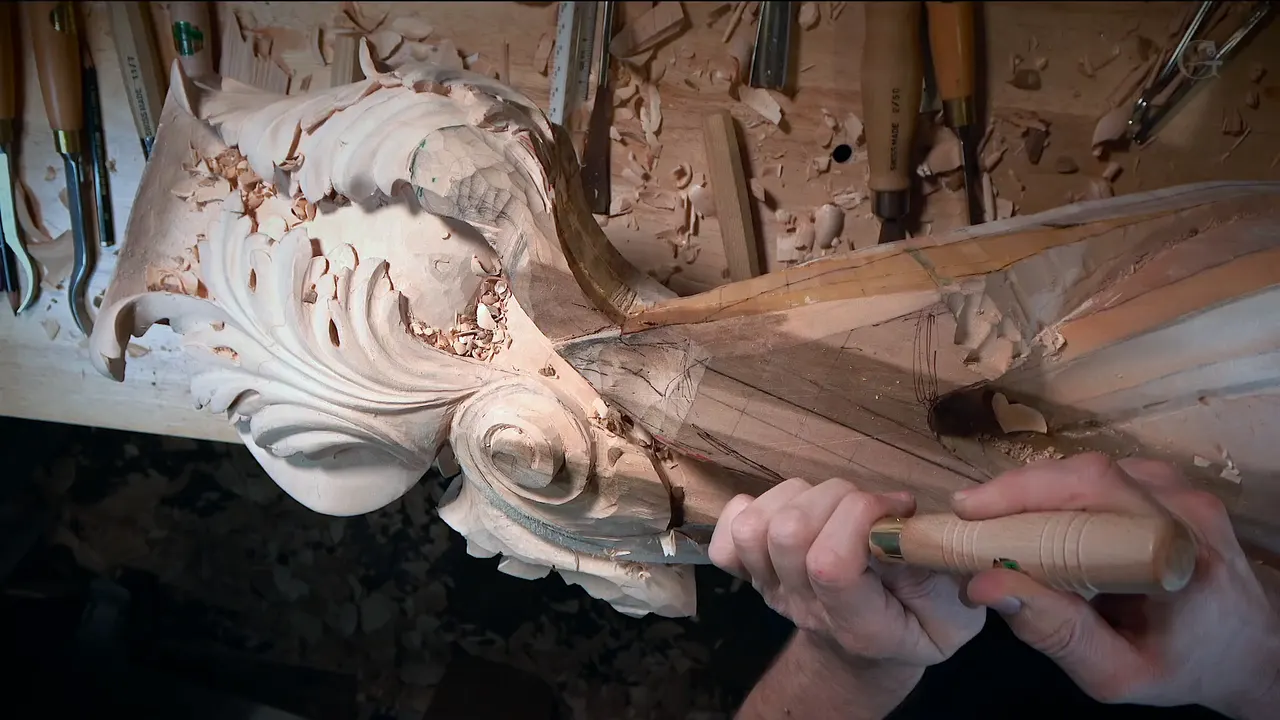

"That needs to be sharpened." Those are the first words of Venice Room 89.4. Other lessons of mine carry the same line about a dull tool, and the ones below each have their own words beside it.
Have you ever felt a gouge drag in the wood and wondered whether to stop? Did you keep going anyway? Then you know the spot this page is about. It starts in part 4 of workshop 89, and then follows the line through lessons from my other wood carving courses, each with its own link.
Six things in part 4
- First comes the line.
- Planned for later: a smaller tool, to blend the area.
- A "preliminary cut" is planned for one spot, and a "first cut" is named with number 11.
- Number three is planned next, with a blend.
- A doubt stays open about what shows right there.
- A groove is needed, and a figure in millimeters for the lowest spot closes the part.
What came next in part 4?
"All right." comes behind it. Next, the plan: "switch to a smaller one a little later and blend this area really nicely."

Close by, there is "I hit a little bit the side of this detail." And "And undercut it a little bit. Not much, because I still have to develop the idea little later, but just clean a little bit."

Which tool goes with the "first cut"?
Plans come first: to "leave it for now", and to "develop this section" later on. Then a need: "I have to make a preliminary cut right here." Close behind, about that part: "much lower underneath. Not much lower, but lower."

The tool is named at once: "Number 11 and 3 millimeters" (0.12 in). "That would be my first cut. And in this section, I don't want to go too deep. I want to make sure it just feels like just barely overlapping it."

Another plan comes in plain words, "Now I'm going to take number three and cut it toward my previous cut. And blend it." After the blend plan a check follows, and the words are "All right. That is good."

What did I still doubt?
"Again, I'm not sure if I like what I see right here, but I think I can try, and if I don't like it, I can always take it out." What follows turns to another idea: "But on the other hand, what I could do--"

"First I need to create a deeper cut in this section. So I need to make sure it feels like it's going from underneath." Then a need that has a name: "I need to excavate some kind of groove right here." One more need is "separated from this movement."

Doubt shows up in part 5 of the same workshop, with different words: "I still have big doubts if I'm doing that thing right." And a limit: "Deep but not too deep because I can't lose this line."
Also in that part: "I really don't need to go like a true undercut because it's going to be visible only from the bottom." And "This cut, I'm only doing it for shadow's sake."
How far down is the lowest spot?
"Still not what I want to see yet. But pretty close." A distance follows: "I've got about 5 millimeters down" (0.2 in). "Okay, so that is the distance between this line and the lowest spot." Part 4 ends on "Let me get another cut. This cut."

In part 3 there is a size to compare: "Same number 11, what I used before, seven millimeters" (0.28 in). "A little bigger than a quarter inch" (6.4 mm). The plan beside it is "And yes, I could actually undercut a little more this area. That way, it's going to give me that shadow."
Part 5 holds a plan of its own: "Let me create a first cut." That part also has "And I need to spend a little more time cleaning up everything, and I can do that off-camera." The Part 8 workshops hold more notes like these.

Which lessons put a buff beside that line?
In Venice Room 36.6 the words are "I think I need to sharpen this tool. It feels like it leaves some of the marks." Then: "Now it cuts perfectly." That is followed by "I just sharpened that off camera." More about the buff follows, and it comes with a take-back inside it: "Buffed, actually. I didn't sharpen it, actually. All I did is just buffing."

A veiner is the tool in Furniture Panel 18.12, and "again" sits in the line. Then "Let me just buff it, and I'll be back." Words return with "Try it." and "Yep, that's much better." And "And yes, I did my sharpening off camera." One reason sits in these words: "because I really didn't need to sharpen it. All I needed is just some stropping done."

Hashemi Flowers 35.2 ends the line with "or just buffed." Not long after: "Okay, it's much better." Further on, "It can let me excavate deeper right between them." And "This number nine is just a quarter inch" (6.4 mm). The lesson is here.
A number nine shows up in Venice Room 91.3 with the line. Right after: "All right. That's much better. And again, reason why, because the color of the wood is dark, which means it's really mushy. So tool must be super sharp to work in an area like that."

A skew has its turn in Venice Room 53.2. Then: "Oh, yes. I just sharpened that off camera and it always helps to work with the sharp tools, obviously."
Why sharpen without filming it? The words for it sit in Venice Room 42.9: "And yes, I'm not filming my sharpening when I'm going and sharpen it, because the camera position, I don't want to spend my time and reposition everything. Please forgive me for that."
A file is in the line in Roman Acanthus 16.4, and "And buff it." comes next. Later, "Much nicer."
Do any lessons reach for a smaller tool?
The plan in 89.4 is a smaller one. Workshop 88, part 12, starts the line with "It feels like my number 11." Further on come the words "a smaller number 11."
In workshop 32, part 5, there is "now it's a little too big of a tool. I need to change my tool and use a smaller one, and I'll use a five millimeters now" (under 1/4 in). It has the line, then "So deep, but not too deep, okay?"
A bigger tool is named in 42.9: "That is probably too big of a tool at this point, and that was 7 millimeters" (0.28 in). Next, "maybe even just 3 millimeters right away, pretty much" (about 1/8 in).
The words in Venice Room 18.3 are "this tool became little too big, and I need to switch that to probably smaller number seven, maybe 10 millimeters or so" (0.39 in). Next comes the line, with "first" in it.
The size comes first in Furniture Panel 15.5: "number eight, and it's at 12 millimeters, half an inch. Almost half an inch, I should say" (12.7 mm). Behind the line sit "3 millimeters" (about 1/8 in) and "Let me just use number 11." The advice from that part is "I would probably encourage you to use those smaller tools on details like that, okay?" And on the bevel: "I would change probably the bevel. Bevel is a little too high."
What happens in the lessons that keep the work going?
A try is in Venice Room 64.5: "And maybe let me see if I'm going to be able to use number five, eight millimeters" (0.31 in). "A little bigger than a quarter inch." The line about it comes, and then "Number 11, one and a half millimeters" (0.06 in). "And carefully go in and excavate underneath."
A reason from the light follows: "I don't have to do a lot again because the light is going to hit from this point from above like this, so it's not going to cast too much shadow."

Lesson 40, part 10, ends the line with the words "I think." Right behind it comes "Oh, I don't think." And, a line later, "I feel it."
Number 11 comes back "again, and create little better movement" in workshop 85, part 2. It is in the line, too, and "the preliminary form." comes later in the part.

Venice Room 70.1: the line trails off in "or something." Behind it comes "again, later on, I will fix overall movement how it feels. But now I need a really good pronounced convex."

Furniture Panel 23.3 has "I can right away pretty much make this side a little lower." The line comes next, with "Just like that. And I can undercut pretty much right away." behind it.
In Vase with Grape Leaves 3.5, "Although" sits in front of the line. Before it: "I'll take number 11 and 1 millimeter" (0.04 in) "and I can prolong that." Then: "I can do it with half a millimeter" (0.02 in). And "Make it just slightly longer."

Part 7 of workshop 38 opens the way 89.4 does, on the line itself. Next: "I could probably take care of this movement a little bit more."
Before the line in Venice Room 101.1 come a number nine and "about 10 millimeters" (0.39 in). Close after it: "Let me get another one."
Two more from the Venice Room: "sharpened a little better," says workshop 29, and workshop 34 has "I think. Okay, and now I can blend a little bit this and make it more like a convex."
What does a dull tool feel like in my hands?
"It feels like it leaves some of the marks" comes from workshop 36. In Floral and Molding 3.1 the subject is end grain, and the "difference of the color" between a super sharp tool and a dull one. Then comes "It's okay yet, but I probably really soon have to buff it. And I can feel that resistance of the tool. So that is not good."
The sign in Venice Room 23.4 is mush: "Whenever I see the mushiness, there's mushy stuff left after cut."
Workshop 87, part 12, is plain. My number nine is named, and then "It is quite dull already. Yeah, it still cuts, but I have to create a lot of force to create my cut. And that is time to buff it or sharpen it."
And in Venice Room 20.2: "Now it's just not as sharp."
Where did I say it, lesson by lesson?
The table lists each place, with the words that sit beside the sharpening line.
| Place and tool | Next to the line |
|---|---|
| Opening of 89.4, a smaller one for later | just a short "All right." |
| Excavating an angle near the inner wall, Venice Room 36.6 | buffing, and "Now it cuts perfectly." |
| Veiner, Furniture Panel 18.12 | a buff, and "I did my sharpening off camera." |
| Hashemi Flowers 35.2, a deep excavation planned with a number nine | "or just buffed" |
| Dark wood, Venice Room 91.3 | "So tool must be super sharp to work in an area like that." |
| Tangent movement, Venice Room 53.2 | a skew, then "it always helps to work with the sharp tools, obviously" |
| Sharpening that is not filmed, Venice Room 42.9 | "Please forgive me for that." |
| Trying number five, Venice Room 64.5 | "one and a half millimeters" (0.06 in), then "carefully go in and excavate underneath" |
| A number nine near the lowest spot, Venice Room 87.12 | "time to buff it or sharpen it" |
| Eight at 12 millimeters (0.47 in) and a bevel, Furniture Panel 15.5 | a bevel that is "a little too high" |
| Number five or something like that, and a pipe, Venice Room 40.10 | "I feel it." |
| Again number 11, Venice Room 85.2 | "the preliminary form" |
| Maybe six, and a pipe, Venice Room 70.1 | "a really good pronounced convex" |
| A part planned to go straight down, Venice Room 88.12 | words for "a smaller number 11" |
| Grape Leaves 3.5, a 1 millimeter (0.04 in) tool | half a millimeter (0.02 in), then "Make it just slightly longer." |
| Lower side, Furniture Panel 23.3 | "undercut pretty much right away" |
| First line of a part, Venice Room 38.7 | "I could probably take care of this movement a little bit more." |
| Mushiness, Venice Room 23.4 | "Whenever I see the mushiness, there's mushy stuff left after cut." |
| A back bend and a plan to excavate little by little, Venice Room 20.2 | "Now it's just not as sharp." |
| Number nine, Venice Room 101.1 | another one |
Does one of your hand tools drag in the wood right now? Could you stop and feel it, the way "I feel it" goes in one Venice Room lesson? Workshop 89 waits inside one tuition plan with the rest of the Part 8 workshops.
How it's done
- At the start. Part 4 of workshop 89 starts on a dull tool, and a smaller one is meant for a little later.
- A buff. Workshop 36, part 6, names a buff, and so does a veiner lesson in the Furniture Panel course, with stropping too.
- Reaching for a smaller tool. Workshop 88, part 12, names a smaller tool. Part 5 of workshop 32 names a five millimeters tool, under 1/4 in.
- More work. Workshop 70, part 1, turns to a need for a pronounced convex, and workshop 85, part 2, has the preliminary form.
- The feel of a dull tool. Marks left on the wood, resistance felt by hand, and force: the lessons name each one.
- The lowest spot. A distance in millimeters closes part 4.
Frequently asked questions
What comes next in part 4?
A short "All right." A plan for a smaller tool at a later point, to blend the area, follows.
Which tool goes with the "first cut" in part 4?
Number 11, at 3 millimeters (0.12 in).
Which lessons put a buff beside the line?
Workshop 36 does, and so does a veiner lesson in the Furniture Panel course, and a Hashemi Flowers lesson with a number nine.
How does a dull tool feel in my lessons?
What to carve next