

Alexander Grabovetskiy, woodcarver, School of Woodcarving · Published 2020
What does a wood carver mean by "mushy" wood?
Quick answer: In workshop 89, part 7, the word "mushy" follows the color of one patch: "you can see the color of wood. It's green." Other lessons of mine put "mushy" beside dark spots, rough edges, and the leftovers of a dull tool, each with its own words below.
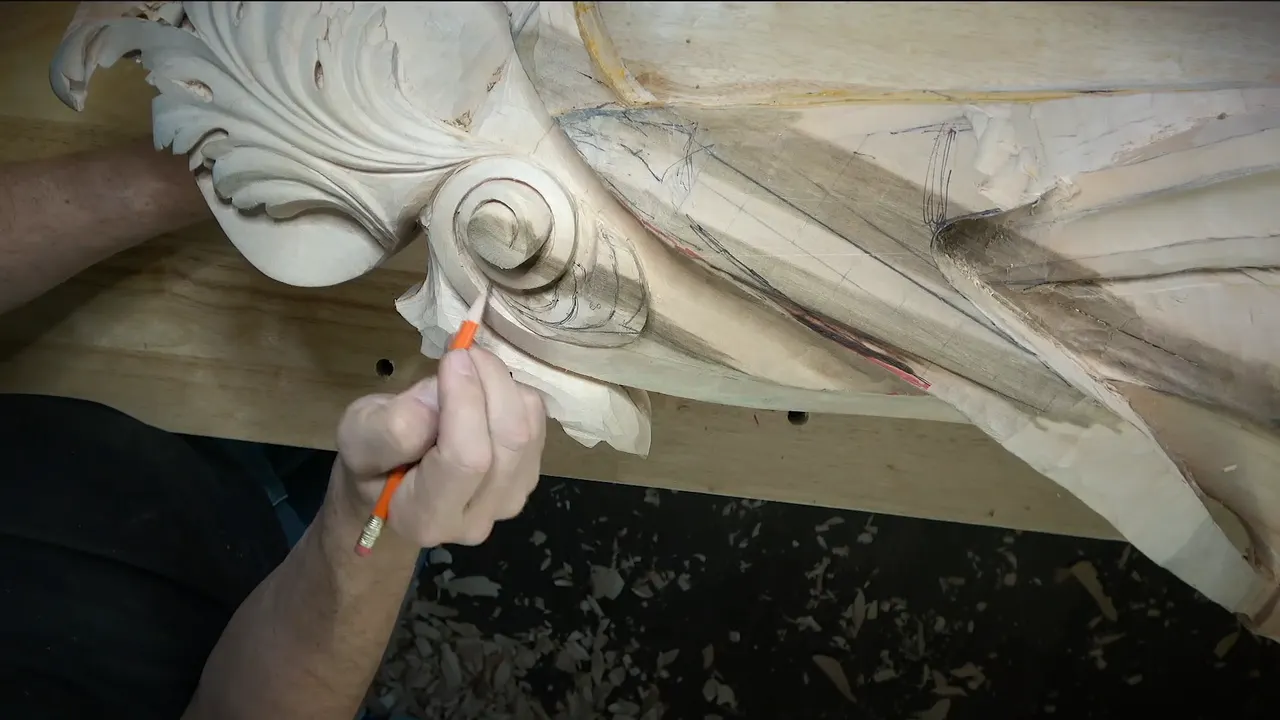

Part 7 of Venice Room workshop 89 uses the word "mushy" on a green patch of wood: "every cut is going to be really not clean." My other lessons put the same word beside dark spots, rough edges, and what a dull tool leaves behind.
Have you ever pushed a gouge into a dark spot on a board and felt the wood give way? This page starts in workshop 89. From there it follows the word through other courses, each with its own link, and in one of them "mushy" points at my tool.
Seven things in part 7
- A second division, then a main division, with secondary ones still to come.
- No space for the eyes.
- A flip backward, and a letter S curve.
- A number 11 at 7 mm (0.28 in), with leather and Mirror Paste.
- The inside first.
- Green wood, water damage, and a spot where rot has started.
- A word I am not sure is a word, though it is exactly what the wood feels like.
How does part 7 start?
Right on the divisions. The first words are "Somewhere right here. So that would be the second division." The main division comes next, along with a plan: "I'm still going to have some secondary divisions."
Then "let me open up this section." I said there would be "also a secondary division right here, and I hope you see it", and I mentioned a marker: "I could probably use a marker for you to see what I'm doing."

What about the eyes and the flip?
There is no room for the eyes. "I have absolutely no space for the eyes, and I really don't need it." A second idea, hedged: "I could actually create some kind of flipping, just a flip backward."
The plan is a letter S curve, "going this direction", and my opinion of it fits in one line: "So simple, but beautiful movement, in my opinion, of course."
What goes on the gouge before it touches the wood?
Leather and paste. "Let me take number 11, and I'll take seven millimeters" (0.28 in), I said, and "looks like I need to strop a little bit." Then: "I'll use just a piece of leather and mirror paste."

The paste is "one of my favorite pastes as of now, at least", and I gave its name, Mirror Paste. It "just gives me quick stropping."
Why strop the inside first?
Stropping rolls the edge, and these are my words for it: "every time when you strop, you're actually rolling the edge, and it's better to roll it from inside out more than from outside in."
The strop itself starts with leather that is "a little too thick", and "I have to just change the leather." I also said "But anyway, let me do an outside." After it: "I always wipe it. Okay. Because I don't want to get that stuff in wood."

Then: "take a look, see how shiny it gives me the surface. It's really beautiful." Next: "Actually, I don't even need to do anything inside. It's already got it. But inside, it's always a good idea to start first."

Next comes "a little thinner piece", with "Let me do a little more on inside." Then: "you can't eliminate that problem with the stropping. Just don't press too hard. Start with inside. It's much better to do that." My leather is "a normal small piece", cow leather.
And again, inside, with a note: "it's better not to do that over the work surface, of course. But I wanted to show you." Last, "wipe it really good", and "you can probably already hear the sound of it even better."

What does part 7 say about the green patch?
It names the color and the damage. My words: "Especially it's important for me in this section because this area, you can see the color of wood. It's green, which means it's water damage, and that's already starting to rot."

Right behind it: "So sharp tools must, otherwise, this area is a little too mushy, and every cut is going to be really not clean", and "even with the sharp tools, sometimes it's challenging."
Next, a question and its answer: "Why is it challenging? Like I said, it's just a much softer area", and then "the structure of fibers is different."
The last lines of the part are about the word itself. "It's like I say, it's just really mushy. I don't even know if there is a word. Maybe I made that word myself, but it's exactly what it feels like."
What do the parts next door say about the same wood?
In part 8 the plan is a concave: "I'll go almost all the way to the bottom, closer to this surface. Otherwise, it's not going to look nice." "I know there's a tendency to start somewhere right here and go along that line, but it's not going to look good." A number nine is better, I said, "maybe even bigger one number nine, like three-quarter of an inch, 20 millimeters", and I said I had to be careful on that section "because the grain, number one, and again, that green stuff."
Later in that part I asked "why do I check especially right now?" and answered "Because of the area I'm working." Then once more: "See that mark, the water mark? So that is really, if you know a little about basswood or lime wood, and if you carved for a while, so you know what I'm talking about."

Part 11 has a plan for a spoon, "like number three maybe, and three millimeters or so" (0.12 in), and a strop that was "not enough." Then: "I just took it to my machine, stropping. And I changed a little bit bevel because it's already too rounded." After that: "Now I can actually attack that even against the grain. Even if it's mushy like this", and I said it will be "removed really cleanly."

Where else is a dark spot called mushy?
Workshop 83 belongs to the Venice Room's Part 7, and in its part 10 the words are: "kind of mushy. You can tell it by the color." On a dark spot, "the material is a little mushy, which is absolutely okay." One of my favorite tools, I said, "in this case would be a skew."

Workshop 91 has sharpening in its words, "this number nine needs to be sharpened", and then a reason: "the color of the wood is dark, which means it's really mushy. So tool must be super sharp to work in an area like that."
And workshop 86, in part 11: "when you have a spot like this, a darker spot, watermark, your tools must be really sharp because this is the spot, a little mushy." I don't really worry about it, I said, and for a problem with a spot like that, "you should know it's just because it's already starting to rot." Later: "A little more mushy."

The livestreams of October 2020 use other words. On lime wood, "a dark wood" is "a damaged wood", "it started to rot", and a dark spot there is "a lot softer wood", so "you really have to be careful what tools you're using."
Another day of that October: "whenever you see the green stuff like this, the color of the wood, it's already like watermarks." Then: "So the tools, they must be super sharp."
Does mushy mean the wood is ruined?
Workshop 88, in its part 12, has a size and then the word. I'll take "probably three millimeters" (0.12 in), I said, "and I'll start." Then: "This area is slightly mushy, which is okay."

The Rosette course says it in part 2: "You could say it's a little mushy, but it's all right." Later in that part, with small tools coming, I said the area was "a little bit mushy, so I need to make sure my tools are really sharp."

Rosette, lesson 4.1 weighs a size: "Maybe about six millimeters or so" (0.24 in). Then: "I've got some kind of mushy area, which is okay."
In a livestream, on a spot right under an eye, I said "that area is mushy because it's a green color." Then came "But that's okay. It'll survive."
Over in workshop 92, part 9, which is in Part 8 of the Venice Room too, I said "I'm using four millimeters as of now" (0.16 in), "and that's probably the only spot I can work with the four millimeters." The reason follows: "there's some green stuff in the wood, so material is a little mushy."

Can mushy mean my tool?
Part 4 of workshop 23 lives in Part 2 of the Venice Room, and there the word can point at my tool. "It looks like this one needs to be sharpened also", I said. "Whenever I see the mushiness, there's mushy stuff left after cut." Then: "That means it's not the wood." And in the same sentence: "it's my tool."

Right after those lines: "Just carefully create a really smooth cut."
What is a mushy edge?
Part 1 of workshop 16, also in Part 2 of the Venice Room, says "It's becoming mushy. It's not good." Then: "Going to use number five. Kind of small number five. Maybe just knock little bit out of that mushiness." After it, a plan with a number 11: "create a little deeper cut at the side. But not too close to the edge because I don't want to see that mushy thing."

Part 11 of that workshop carries the same worry: "I can't go really close to this edge, or else you're going to create some mushy look."
And workshop 34, part 5, in Part 3 of the Venice Room, on setting in the main movement, has "It's just mushy." Then: "That's not a big deal. So it's not like I lost and I can't fix it. I'm talking about this rough edge, okay?"

Is the wood bad when it turns mushy?
Roman Acanthus 16, lesson 1, has a story, and it comes with a line from my teacher. Some of you wrote me an email, and my teacher said "there is no such a thing as not good wood. So knives are not sharp or gouges not sharp."
Then: "Sometimes the same piece of wood, one day, it carves normally, and the second day, it just becomes like mushy, and the third day, it could feel absolutely different, like it's not even basswood anymore."

My reason: "wood is alive, and it's a living thing. So it actually sucks the water in and swallows and then shrinks. It could be more water inside of the fibers, less water inside of the fibers." The outcome, I said, is "more dense or more softer, more mushy." A couple of days later, or a month later, it "could be absolutely different."
What is a wood hardener for?
In the Q and A lesson A simple tip for back cutting the job is stabilizing: "In my case, I use a wood hardener. Doesn't have to be that brand. I'm not selling anything." It is "made for the, you'd be surprised, for the rotten wood, for the outside pretty much."
It "penetrates really deeply on inside and dries really quickly." Nothing in part 7 mentions a hardener, and that lesson is about back cutting, so I keep the two apart.
Which lesson says what, in one table?
Across these lessons the word sits beside colors, sharpness, edges that are rough, and what a pass leaves behind. The table lists each place, with a short note on the spot next to the word.
| Where | The spot |
|---|---|
| This part | A green patch, sharp tools, and a word I doubt |
| Seen in 89.8 | The grain, green stuff, and the water mark |
| Heard in 89.11 | A rebuilt bevel, then the grain, and a clean pass to come |
| Found in 83.10 | Dark spot, color, and a skew |
| Said in 91.3 | Dark wood, a number nine that needed sharpening, and a super sharp tool |
| Noted in 86.11 | A darker spot, a watermark, and really sharp tools |
| Spoken in 88.12 | An area that is slightly mushy |
| Marked in 92.9 | Green stuff in the wood, with a 4 mm (0.16 in) tool |
| Stated in 23.4 | Leftovers after a pass, and my tool |
| Shown in 16.1 | An edge that is becoming mushy |
| Repeated in 16.11 | A weak edge, and a mushy look to avoid |
| Used in 34.5 | A rough edge while setting in |
| Roman Acanthus 16.1 | One piece of basswood that changes from day to day |
| Rosette course 2.2 | Mushy a little, but all right |
| Rosette course 4.1 | A mushy area that is okay, and a 6 mm (0.24 in) size in mind |
| The livestreams of October 2020 | Green color, a watermark, and survival |
Is there a dark patch on the board in front of you? The rest of Part 8, workshop 89 included, wait inside one tuition plan.
How it's done
- Read the color. The wood is green, and the words are about damage.
- Sharp tools. Sharp tools, otherwise the area is a little too mushy.
- Inside first. Every strop rolls the edge, and it is better to roll it from inside out.
- Wipe it. A wipe keeps that stuff out of the wood.
- A softer area. A much softer area, and a different fiber structure.
Frequently asked questions
Which part holds the word with the green patch?
Workshop 89, part 7. The words right behind the color are about sharp tools, and about a softer area.
Do sharp tools matter in a mushy spot?
The lesson with the number nine ties a dark color to sharpening. The lessons with the darker spot and the Rosette flowers say really sharp.
Is a mushy spot a reason to stop?
The lesson with the skew calls the material "absolutely okay", and the Rosette course says "it's all right." In a livestream of October 2020, my line was "It'll survive."
Can mushy point at the tool?
What to carve next