

Alexander Grabovetskiy, woodcarver, School of Woodcarving · Published 2020
What does a wood carver mean by "change the direction"?
Quick answer: I said them in Venice Room 89.2 right after I talked about my slope, and a little concave came next as a plan. In my other videos they sit beside the order of two parts, the grain, and the side I attack from.
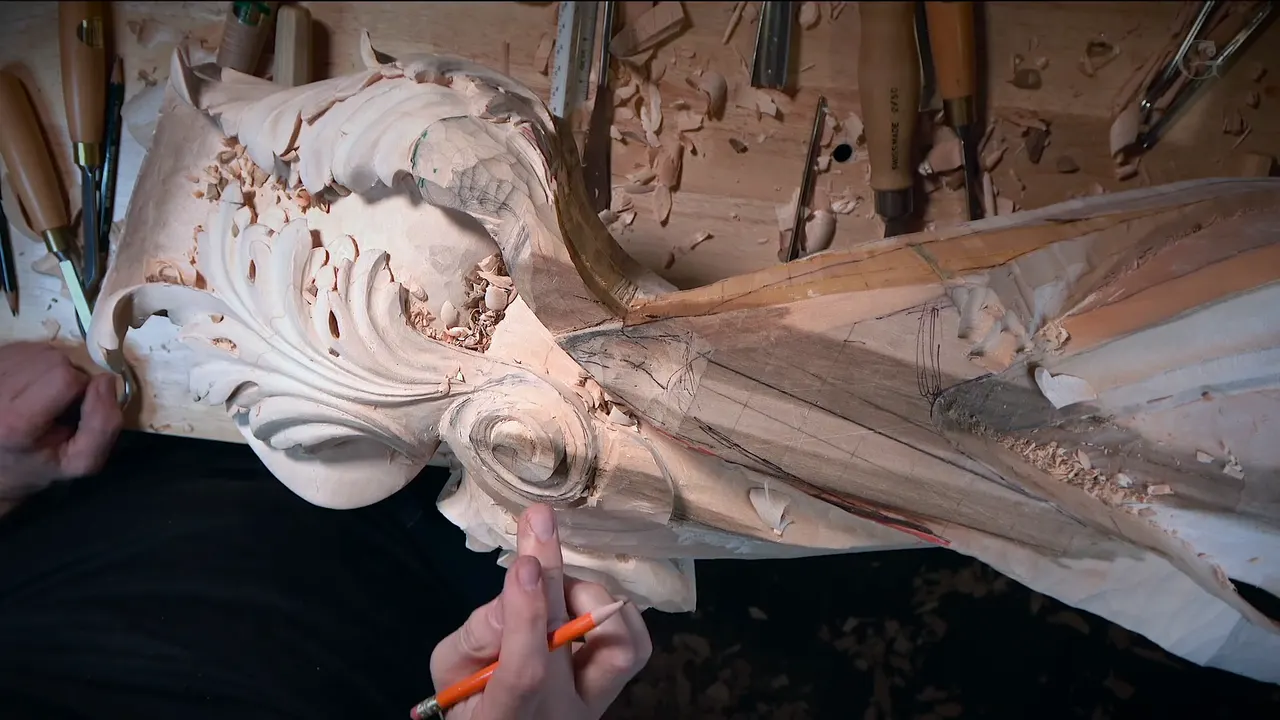

"But on the other hand, it could change the direction. Why not?" That is what I said in Venice Room 89.2, right after I talked about a slope. My other videos use the same words, and they do not always sit beside the same thing.
Have you ever stood over a slope in a piece of wood and wondered if one more cut was worth it? Did you ask "why not?" and reach for a gouge? Then you know the spot where I stood in workshop 89. This page starts at that spot in part 2, steps over to parts 1 and 3, and then follows the same words through lessons from my other courses, each with its own link.
Six things in part 2
- Keeping it wide, with it going all around, opens the part.
- Trying a cleaning pass was a plan.
- It did not look too bad, I said, and the cleaning was set for later.
- A slope was in place, and I was not too happy.
- Planned: a little concave, and my tool needed sharpening.
- I named a blending spot, where everything is going to blend together.
What did I say just before the words?
Here is the whole run: "I'm still not too happy, but I do have that slope. I do have that slope, and I really don't need an extra one."

Before that I had said "let me take out some of the mess with the number 11." That was a plan, and "All right" came after it. Earlier still I had said "yes, I will clean a little later, make it a really clean look."
What came after the words?
Next came "Why not?" and then "So let me actually get this as a same movement." A plan followed: "But I'm going to have that one as a little concave."

Next I said "I need to sharpen my tool." Then, "And here you go," and the blending spot, "where everything is going to blend together."

What else is in part 2?
It opens with "And then we'll be able to keep it wide just like this, and then it's going to just go all around and create a really nice movement." "So let me try to clean this way" follows. Further on comes "Okay. So that actually doesn't look too bad at all."

A detail on the inside is coming, I said. I wanted to make sure I had "a nice movement" there, going all the way in that direction.
Then: "And what I want to do, I don't know. So maybe this is going to be part of it, but how do I transition to it?" What I want, I said, is "just like growing from underneath."

More plans follow in part 2: "let me blend this," "let me redraw the line," and "let me outline it with the number 11."
Where else in workshop 89 did a direction turn?
Part 1 has this line: "And here it's going to be changing the direction." It was the spot where undercutting meets a slope in the opposite direction, I said, and "I can go even deeper" there, and "let me do this direction the same way." A flatter gouge came up too, to go straight down.

In part 3 I named "my outer movement" and "my inner movement right there." "I don't know yet if the distance I'm going to change or not," I added. For now it was "about half an inch" (12.7 mm) in that spot, "which I guess is okay."
A shadow was on my mind there too. "I could actually undercut a little more this area," I said. That way, it gives me "that shadow." The tool I named was "Same number 11, what I used before, seven millimeters" (0.28 in), "A little bigger than a quarter inch."
What if it means the order of two parts?
In Curly Kitchen Cutting Board 12, video 3, I explained the words myself, right after saying them. "What I mean by that, so we could do this one under that one, and that one under that one, and so on." Then, "Or we can do exactly the same what we did right here, so this one can go underneath of that one." My pick: "Let's stick to that."

The eyes were "a little too close" in Venice Room 75, video 10, and moving them farther was "number one change I want to do," "just to give more movement." Then I said which part would overlap which: "So originally, I had this one, this part of acanthus overlapping that part. But I want to change it. So now this one going to go right underneath."

I was going to start with number three in Furniture Panel 21, video 3, though I did not think I would be able to, "because it has to go up, but at least partially." The same words came just before "this part's going to go underneath," and the next part going under another one.

Video 4 of the same lesson has a shadow I had already exaggerated. "Now it has to move downhill" and go underneath another part, I said. Half a millimeter (0.02 in) was the size I would grab again, "and now we're going to undercut underneath of that."

Or does it follow the way a movement runs?
An S curve is the setting in Venice Room 94, video 1. It would be "like almost like an S curvature," I said, not "just a single arc," and I have to make the decision where the movement goes the other way: "So one arc going this direction and another one in this direction."
The calipers could measure from the right hand side "all the way to the end," and it looks like the logical point for that direction of movement. "I am almost there."

Video 6 of Venice Room 44 has "I want to create another eye," and I needed "a bigger, I should say number 11, like 15 millimeters, about five-eighths of an inch" (0.59 in). Then: "there is another eye, so which means I have to make the rotation with my tool somehow, and go around," and turn the movement "like that." I added "maybe I can actually exaggerate this movement a little more," with a plan for "a little inward cut. Not too much."

Could it be the grain?
After "let me chop a little bit this direction, too," in Venice Room 59, video 4, I said I needed to switch "because it is against the grain, and I need to change it and work with the grain." A back bend, I said, helps me a lot, even with that molding in the way.

The words in Venice Room 21, video 7, come with "because I see my grain of wood is starting to split, and I don't really want to see that." Another separation, I said, is coming right there, and "I don't want to lose it."

Toward the center in Greek Acanthus Leaf 9, video 1, I said "I have to keep an eye on my grain, in this case, and just nicely blend it to the center." At one spot, "if I going to continue to cut, I going to make a split to that direction, and it's not right." The plan was to go at it from the opposite side with my cleaning cut.

The grain is the reason in Lily Box 13, video 2. "Because of the grain," I said, and a few lines on, "We're almost getting done with this project. I'm happy."
My words in Venice Room 9, video 4, were "a little tough area because of the grain," and "still doable." At a spot where "it's catching right there," I said to switch, and then "Let me push those fibers in."

In Hashemi Flowers 47, video 9, I said "that's against the grain," and then that maybe I had to switch how I make my cut. Then, "so maybe I have to just chop off this edge."

Over in Venetian Flowers Rosette 6, video 1, the grain turns as you work around, I said, "and sometimes you have to attack from the opposite directions," so that you do not try "to hit everything in one cut." I added "Really important not to rush it."

Maybe a line, or a side?
"Maybe number 11 and 10 millimeters" (0.39 in) was my guess in Venice Room 102, video 3, for "a blending almost cut" from "deep to almost nothing, to shallow." The switch follows: "Right here it's a marriage line, so I need to cut this direction."

In video 3 of Venice Room 55 I said I had to switch, and to "outline my head of acanthus," in "this direction now."

Over in Venice Room 83, video 5, I said "Let me use 7 millimeters" (0.28 inch) "and clean little bit this side." The cut needed a switch, I said, and then "what I need to do just to create that convex, just exactly the same like on the opposite side."

I could probably create "another concave with the five millimeters" (0.20 in) "just right on the side," I said in Venice Room 91, video 2. Next, I said I have to switch and "cut one more time this direction." Further on I said it again, to "create a shallow concave," and if you ask why I need it, "just for the shadow's sake."

A plain case is in Venice Room 28, video 3: "Again, that is wrong direction." Switching was the need, and then to attack "that from this side," and "create little deeper concave on the side of that pipe." Before that I had said "Number 11 and 7 millimeters" (7 mm is 0.28 in) "and I'll create my preliminary cut."

Sweep number five comes up in Venice Room 21, video 12: it "would be sweep number five, and I'll use just a 2 mm" (0.08 in) and "knock a little bit that ridge out." I would probably need to switch there too, I said, and "just knock down a little bit."
Venice Room 12, video 8, has "attack that from that side," and later "It should be good." A pipe in Venice Room 30, video 12, also went "that way," "but it's not as nice as I want to see it, but I can probably fix it with no problem." The switch follows, and "maybe even deeper, little cut."


A spot was "a little mushy" in Venice Room 86, video 11, and I said it was "already starting to rot." Then came "this way, though I really have to attack from this side."

In video 3 of Venice Room 139, if you need to turn, you just turn, I said. "That's it." Then, "Essentially, it is a V cut."
Where did I say it, lesson by lesson?
| Lesson and spot | A cue next to it |
|---|---|
| Over the slope and the extra one (workshop 89, video 2) | Why not? |
| Two parts, one under the other: Curly Kitchen Cutting Board 12, video 3 | Let's stick to that. |
| An S curve with two arcs: Venice Room 94, video 1 | I am almost there. |
| Which part of acanthus overlaps: Venice Room 75, video 10 | But I want to change it. |
| Another eye to go around: Venice Room 44, video 6 | Not too much. |
| A shadow and the number three, Furniture Panel 21, videos 3 and 4 | Just part of it. |
| A molding in the way: Venice Room 59, video 4 | work with the grain |
| Beside a separation (workshop 21, video 7) | I don't want to lose it. |
| The center of a leaf: Greek Acanthus Leaf 9, video 1 | it's not right |
| Around the olives, Lily Box 13, video 2 | I'm happy. |
| A tough area: Venice Room 9, video 4 | still doable |
| A second concave: Hashemi Flowers 47, video 9 | chop off this edge |
| Working around a rosette: Venetian Flowers Rosette 6, video 1 | Really important not to rush it. |
| A blending cut: Venice Room 102, video 3 | blending almost cut |
| An outline: Venice Room 55, video 3 | this direction now |
| With 7 millimeters in Venice Room 83, video 5 | the opposite side |
| On a concave: Venice Room 91, video 2 | a shallow concave |
| Beside a pipe: Venice Room 28, video 3 | preliminary cut |
| A pipe that went that way: Venice Room 30, video 12 | no problem |
| A mushy spot: Venice Room 86, video 11 | A little more mushy. |
| A V cut: Venice Room 139, video 3 | Essentially, it is a V cut. |
Is there a slope in your wood carving where one more cut feels like too much? Could you set your hand tools and your mallet down, and ask "why not?" the way I did in workshop 89? Workshop 89 waits inside one tuition plan with the rest of the Part 8 workshops, and this page starts at the slope in part 2.
How it's done
- Stay wide. In part 2 of workshop 89 I said it would stay wide and go all around.
- Try cleaning this way. I would try to clean this way, I said.
- Weigh the extra one. The slope was there and an extra one was not needed. I said it could shift how it goes, and I asked why not.
- Plan the little concave. I planned the same movement with a concave, a little one.
- Sharpen the tool. "I need to sharpen my tool," I said.
- Name the blending spot. I called it the blending spot, in part 2 of workshop 89.
Frequently asked questions
How did I weigh the slope in 89.2?
I had that slope already, and an extra one was not needed, I said, but it could shift how it goes.
Which tool did I name for the mess in 89.2?
Number 11 came up for taking out some of the mess, and again at the end for an outline. Both were plans.
Which part did I plan to clean later?
Cleaning a little later, for a really clean look, and then it transitions this direction.
What was the blending spot?
What to carve next