

Alexander Grabovetskiy, woodcarver, School of Woodcarving · Published 2020
What does a wood carver mean by "my challenge"?
Quick answer: In Venice Room 89.5 the word "challenge" comes right after "how wide it is", in a thought about undercutting underneath. Other lessons put the same word beside position, ceilings, cameras, flow and the final look, and each case has its own words below.
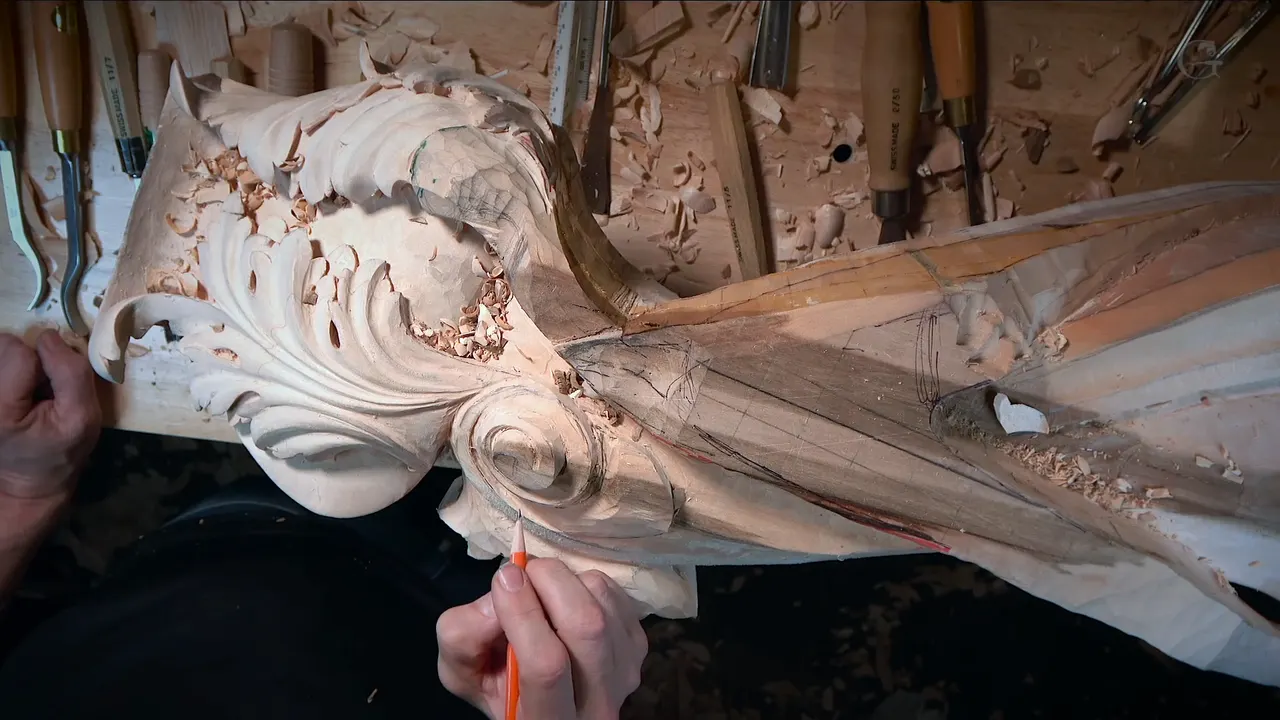

Venice Room 89, part 5, uses the word "challenge" right after the width of one spot. Other lessons carry the word beside other spots, and each one has its own words.
Have you ever looked at a spot on a wood carving piece and disliked it, with no clear next step? Then you know the place this page is about. It starts in workshop 89, part 5, and then follows the word through lessons from my other courses, each with its own link.
Six things in part 5
- Depth, in one area.
- A limit on how deep, because of one line.
- "Huge doubts", and a thought to "lower it down a little more".
- One spot to "leave it alone for now".
- "Completely undercut underneath", and the width of one spot.
- The line with the word itself.
What comes before the word in part 5?
The part opens on a plan: "So which means actually, you know what I can do? I'm going to undercut this way. Not undercut, but go much deeper in this area."

Behind it comes a reason: "I really don't need to go like a true undercut", with the words "visible only from the bottom" behind them. Then: "It's never going to be visible." A second line: "This cut, I'm only doing it for shadow's sake." Next, a need: "Okay, this needs to be shaped a little deeper."

What limit does part 5 set?
One limit is named: "Deep but not too deep because I can't lose this line." The next words: "That would be a big mistake."
What happens when the doubts come?
"I still have big doubts if I'm doing that thing right." And again: "Huge doubts. Let me see how it's supposed to look." A thought closes the moment: "So I think I need to lower it down a little more."

Cleanup gets a note: "And I need to spend a little more time cleaning up everything, and I can do that off-camera." Right behind it: "Or maybe not." And once more: "Maybe off-camera, maybe not."
A hedged plan follows: "what I probably want to do, I want to excavate a concave right here on this side and see what's going to happen."

How does a carver walk away from a spot?
Here is the line: "You know what? The problem for me, it's better just to leave it alone for now because at this point, that is the part I don't really like it and it bugs me, okay? And the more I take the material out, the more chance I'm going to make the mistake."
Right after, a plan: "So I need to walk away for a couple of days or so from this area and come back and just see what I'm able to do."

More doubt shows up in plain words: "I kind of don't like, honestly, how it looks." Maybe some of it happens off-camera, to "play around." Also: "I don't like it, but I have to figure out what I should do."
What is the challenge in 89.5?
"I think what I should do, I should actually completely undercut underneath of here. Right? Just like I did right here. But I don't want to lose the overall feel. I mean, how wide it is. So that is my challenge."

A hedge comes with it: "But I probably should undercut."
How far does the plan slope?
"Well, I want to see some of the sloping right here, but not as much. So this could be a little more straight down like this."

A plan to start undercutting in comes next: "Same idea right here." Later: "Then it's going to slope a little bit." The plan is for "most of it" to be "undercut like I did under the barrel."
Near the end: "Like I said, sometimes it's a good idea just to walk away. Let me create a first cut." One more line closes the part: "And now I can actually undercut this way."

Where else does the word challenge come up?
The word turns up in many of my lessons, mostly in plain words, next to a spot. These lessons are grouped by what the challenge is about.
What makes position a challenge?
Part 2 of workshop 5 has it: "But I do have a challenge because I have to attack that with the right position." And: "Let me get number 11 and half an inch and a long bend." That half inch is 12.7 millimeters.
In 47.8 a size is named: "Approximately 3/16 of an inch" (4.8 mm). Then: "And I have a challenging area because this part is also somewhat on my way. That's not easy to attack area." And: "It's not impossible area, but it's not the easiest also."
Workshop 60, part 5, gives a reason: "But I have a challenging area because grain. Again, the area is challenging because, I hope you understand why, my carving goes to the ceiling." Further on: "I kind of like it, but I don't." And: "I've got too much of a spooning. I think this concave is just too much of a spooning."

The same ceiling shows up in workshop 61, part 2: "But the challenge is just because it transitions to the ceiling. That is the challenge."
How does a camera get in the way?
Venice Room 8.4 has a plan, "And I'll follow with the 1 millimeter cut" (0.04 in). Next come the words "Challenge because everything is in my way." And: "And gradually move up."

Not long after: "I should probably use a spoon on number 11 and 1 millimeter, but it's okay." And: "It's just not too appealing." The 1 millimeter in this part, and in the plan at its start, is 0.04 in.
In workshop 67, part 4, the camera is the challenge: "But the challenge I have, it's a camera. A camera on my way. It is challenge. Because I'm kind of looking at that detail from the point of view which is not too convenient for me. But I really wanted to show it to you. I could get it done off camera, of course, but I really wanted to show it to you what the development is and how I approach it."

Workshop 72, part 2, has two: "And in this area, there's a double challenge for me. One of the challenges, I don't want to stick my head in the camera." The next words: "You know what? I can do this way. It's almost impossible because that's in my way, and I really can't do that against the grain in this case."
Just before, the tool comes in: "Also number five sweep, the curvature". Then a size: "half an inch, 13 millimeters or so." That is 12.7 mm and 0.51 in. A solution follows, ending "Just little by little."

In the plural, Venice Room 70.7 has this: "Couple challenges I have right here." Then comes a need, which sits beside a slope: "I have to position a little farther away from myself, the carving itself. Plus, it is a slope area."
How do depth and flow turn into a challenge?
In 38.2 there is a size question: "Maybe this is a little too big, 5 millimeters. I should use 4 millimeters or 3 millimeters." For reference, 5 mm comes to 0.2 in, 4 mm to 0.16 in, and 3 mm to 0.12 in. Close behind: "It looks like 4 millimeters works fine."
"And I can excavate. The challenge I have right now is this. Okay? Really high and I can't get too deep. But the way to do that, I can probably go with the flatter tool and continue my excavation higher, and then take back bend again." Next, a plan: "probably smaller back bend this time and cut a little deeper." Right behind it: "Let me use a mallet."

Part 7 of workshop 45 has a need: "So now I need to solve for one of the challenges. It looks somewhat fine in this area, but I kind of don't like that this is sticking on the same line, and it does not create the flow."
Width comes up there too, as in 89.5: "Also, I need to make it slightly wider, okay? So how wide that is?"

A smaller one sits in workshop 66, part 2: "But then I have a little challenge because I cannot go too low on this side. That could create a little problem." After that: "I need to think."
Over in 57.4 the word comes back: "But now I have another challenge." Next: "I have a T-stop almost. But it's not really T-stop because you can just follow, and it's still going to go somewhere underneath like that."
Spacing is next: "But the other thing is what I don't like, the space between this point and that point. That I don't like. It's almost equal everywhere, and it should not be that." Later: "But I still have doubts."

Can the overall feel be the challenge?
From workshop 59, part 5: "Again, it looks easy on the screen, but this area is challenging. Really challenging because I'm working right on a transition. Okay? The challenging part is not to carve, the challenging part not to mess up its overall feel. Okay? Overall movement, that's the challenging part."

That part names 10 millimeters (0.39 in) and "another concave." Then: "Don't pay attention to overall design. I will fix it." And: "All I need right now is just a concave-convex movement."
Furniture Panel 14.4 puts the word somewhere else: "I still want to draw eye to this section also." And: "That is why I do have a little challenge what I want to put in this area."

What if two parts have to join?
Hazelnuts 3.1 brings it to a hazelnut lesson: "husk and husk on both sides. So the challenging going to be the part where I can connect two of those." Next: "So let me think how I can do that. Well, first of all, I need to probably excavate a little more."
The gouge is named: "Number seven gauge." On the size, the words are: "It could be quarter inch." Then: "I'm using about seven millimeters or so." Then, a comparison: "Little bigger than a quarter." A quarter inch is 6.4 mm, and 7 mm is 0.28 in.

Last comes a maybe: "or maybe I have to just chop the whole thing and just glue new piece on top and just redo that. But let me try first saving it."
Which part of a flower is the most challenging?
Hashemi Flowers 49.2 gives the word a different weight: "The only challenging part of those flowers, I would say the only challenging, at least for me." And: "But for me, the most challenging part is how nice I want to see my final look."

Next: "So you will always find some imperfections." My teacher's words are in that part too: "That's the last day of your artistry. So you're not an artist anymore."
The close: "So that's probably, for me, the most challenging part. To what point I want to take it." Behind it: "And sometimes just the business side of me just kicks in, and I have to say, 'That's enough. I have to feed my family. I got to buy food.'"
Where does the word sit, lesson by lesson?
The table lists each place, with a short note on what sits beside "challenge".
| Where | What the challenge is about |
|---|---|
| This part, 89.5 | The width of a spot, with a thought about a complete undercut and a wish to keep the overall feel |
| 5.2 in the Venice Room | Position |
| 8.4 | Everything in the way, and a ridge, not too appealing |
| 38.2 | High spot with a limit on depth |
| 45.7, a Venice Room lesson | One line that does not create the flow |
| 57.4 | T-stop, and a space that is almost equal everywhere, which should not be |
| 59.5 | The overall feel, and the overall movement |
| 60.5 | Grain, and a carving that goes to the ceiling |
| 61.2 | Transition to the ceiling |
| 67.4 | Camera in the way, and a detail seen from an inconvenient point of view |
| 72.2 | Double challenge: a head near the camera, and the grain |
| 47.8, a part on the way | Area not easy to attack, and not impossible, with one part in the way |
| 66.2 | One side, with a limit on how low it can go |
| Hashemi Flowers 49.2 | The final look, and to what point to take it |
| Furniture Panel 14.4 | What to put in one area |
| 3.1 in Hazelnuts | Connecting a husk on one side with a husk on the other |
Is there a spot on your own carving that you do not like yet and cannot fix right away? The rest of the Part 8 workshops, workshop 89 included, wait inside one tuition plan.
How it's done
- Going deeper. The part opens on a plan to go "much deeper".
- Doubts. "Huge doubts" are voiced, and a thought follows to lower it a little more.
- Leaving a spot for now. A return to the area after time away is the plan.
- One word, in part 5. It comes after an idea to undercut underneath completely, and after the width.
- Many spots, one word. Position, ceilings, cameras, flow and the final look each get their own words in other lessons.
- Plans at the close. Near the end of part 5: "Let me create a first cut."
Frequently asked questions
What comes right before the word "challenge" in part 5?
An idea to undercut underneath completely, with the overall feel and the width named next.
What limit is named in part 5?
Depth has a limit, because a line cannot be lost.
What does part 5 plan for the area?
"So I need to walk away for a couple of days or so from this area and come back and just see what I'm able to do."
Which lessons put a camera beside the word?
What to carve next