

Alexander Grabovetskiy, woodcarver, School of Woodcarving · Published 2020
What does a wood carver mean by a continuous line?
Quick answer: In part 6 of workshop 89, the phrase "continuous line" is followed by "it ends right there". Other lessons put "continuous" beside stems, ridges, grooves, shells, shadows and waves, and each place has its own words further down the page.
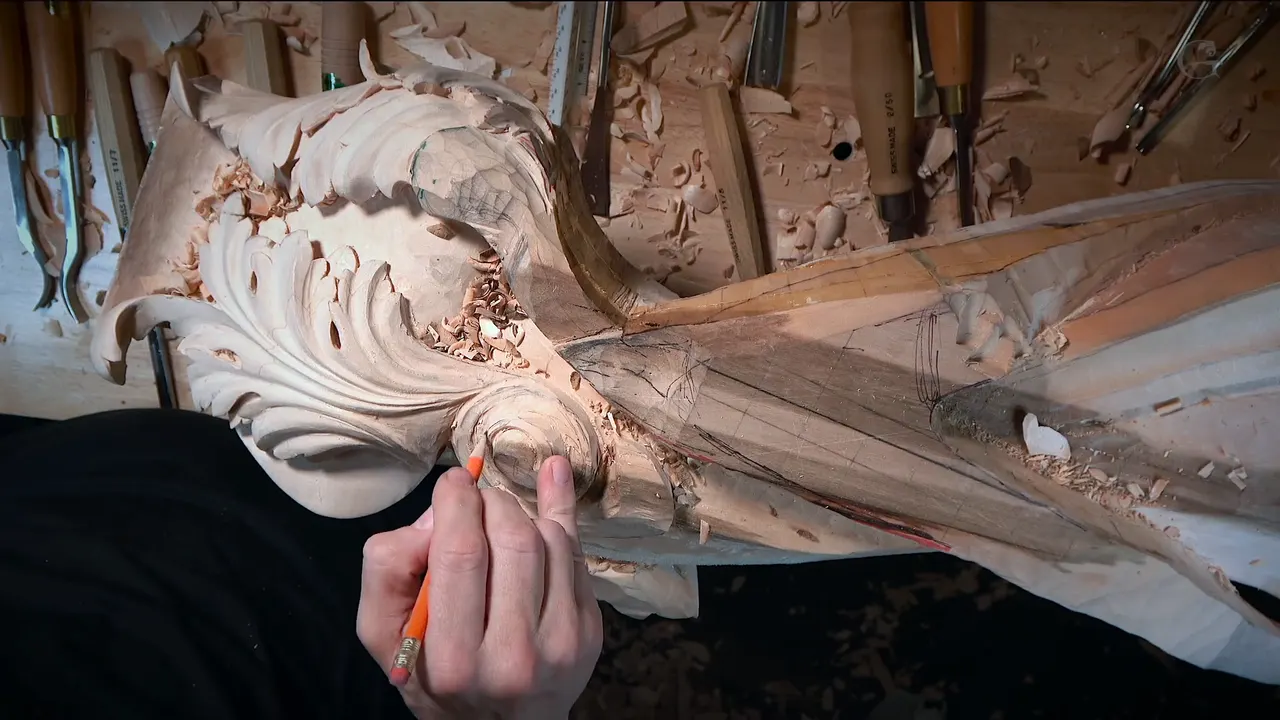

Part 6 of Venice Room 89 has the words "continuous line" after "somewhat the shape I'm after" and before a plan for a concave on the side. Other lessons put the same two words next to ridges and stems, and next to waves and shadows.
Have you ever looked at a wood carving piece and wondered where a line should end? This page starts in workshop 89, part 6, and then follows the words through lessons from my other courses, each with its own link.
Six things in part 6
- Somewhat close, but not completely.
- One area that bugs me, and the words "Now I'm close."
- The line, and where it stops.
- A position from which I don't see the true shape.
- Middle line, and how I determine it.
- One movement that will hit a line, and a second one after it.
What are the first words of part 6?
The first words are: "Yep, this is somewhat close what I want to see. Not completely, but at least closer."

A little later: "This area bugs me, okay?" Then: "Here you go. Now I'm close." A plan follows: "I'm just going to clean everything, but like I said, I can clean it off camera."
Then: "Make it look nice, smooth. And yes, that is what I was looking for." The closing words of that stretch: "That is somewhat the shape I'm after."
Where is the line itself?
Here they are: "So I've got that continuous line, and that goes, goes, goes, goes, goes, and it ends right there." The next words: "So it's not going to be from underneath."

Then: "the same line. Okay?"
After the line, what comes first on the list?
"So what I have to do now, just refine everything and create a concave cut right on the side. But I need to stick my head in the camera too because I need to make sure I see exactly what is going on."
A reason follows: "I need to change the position because right now I'm looking from a position when I don't see the true shape of it." Next: "I don't want to make mistake."

What about the volute?
"I kind of like it. So, I probably going to do exactly the same idea what I've done on this volute." Then a look at a detail: "there's a channel, goes all the way around, and then ends right at the end of the volute right here."
Two more lines: "And here I don't have any channels. I apologize." The plan is: "I will do exactly the same idea what I've done on the other side. But that could be done off camera. I don't really want to spend time on it."

Which spots are named next?
"So now I'm going to work on this acanthus movement, and we're going to continue to develop the whole idea." After it: "Hopefully, really soon we're going to jump on the upper part." The plan for that spot includes "some oak leaves."
Then: "I also have to do some leaves right here and some leaves in this section." Also: "I don't yet know if I like it or not." A word about the lights: "Let me move my lights to the right position. And by the way, I still love those lights. I can adjust the color, whatever I feel the best."

Where does the middle line come from?
"I've got the middle line somewhere right here." Then: "how I determine my middle line, again, by the golden ratio."
Then the calipers: "If you do have a golden ratio calipers, it would be much easier. It's a three-leg calipers." Then: "You can see this leg falls on about 60% out of this distance. So 60/40." Next: "So that is a easy way to establish it."

And more: "And of course, I can just do whatever. And you can see without even calipers, I am able to get that line."

Why is the golden ratio important?
The part asks: "Why is it important, if you would ask me?" The answer: "That golden ratio thing, especially in the Renaissance era, 15, 16th century, 17th century also, it was a big deal and they checked everything pretty much by the golden ratio."
What happens where movements meet?
"So that would be the main central line." Then: "one of them is going to go this direction and I'm going to hit that line." And: "It's going to look visually like it is a continuation of the lines."
Part 7 of the same workshop opens with: "Somewhere right here. So that would be the second division." It also has: "let me open up this section." Also: "I hope you see it. I could probably use a marker for you to see what I'm doing."

Where else is the phrase used?
The phrase is in many of my lessons, beside a spot. The lessons below are grouped by that spot.
Which ridge or stem has the phrase?
In Lily Box 5.9 a ridge is named: "I really would like to keep this ridge right here." Next: "just like a continuous line from this ridge going on inside." Then: "So you're just visually going to just create the same line, same curvature."

A stem sits in Lily Box 3.5: "Here's my stem. Okay? And my stem, it's just a continuous line to the middle section." Then: "I need to make sure I create a concave cut just like that downhill." And: "Let me get a little bigger gouge. I will use 1/8 of an inch." That makes 3.2 mm.

Which words does the Lily Box use?
Over in Lily Box 8.6 the words are: "So let me see from above. Yeah, looks like I need to chop out a little more right here. Just a little more to make a continuous line. Invisible, of course."

The same lesson, in 8.9, has a check: "Let me make sure it has a continuous line, okay? And as of now, it doesn't." Then: "Can't even get my pencil in it." A need follows: "I need to chop this one a little bit and blend this movement with that one." A size sits just before: "I need to use the number five, but only about eighth of an inch." Converted, 3.2 mm.
A bump sits in 7.10: "I need to blend both directions underneath here and also that way, because this movement has to have a continuous line." Then: "when you go from this direction, go uphill, there is a bump. Okay? So a hill I need to take care of." Later: "Okay. And now there is no hill anymore."
Two parts of Lily Box 6 have the words. Part 9: "still want to make sure this line is really nice and continuous. Not wiggly." Part 6: "it actually curves nicely and smoothly. Really nice and continuous." Then: "So that's why it's really important to sometimes stop and look."
Does the cutting board lesson have the phrase?
Beginner workshop 14, part 4, on the curly kitchen cutting board, has: "you can see this line should flow continuously, but I do have some spot right here which is not that nice. What I'll do, later on, I'll check everything, and I'll just recut with a single pass until I'll make this like a same continuous flow line."
Next: "Now let's reestablish this flow line. I call it flow, F-L-O-W, because it's like a flowing all together. Okay? Everything has to go to the same line."

Does a curvature stay continuous?
In workshop 57, part 8 the words are: "But don't be fooled, because it's just the eye how it's catching. It is actually a continuous line. This curvature continues on this side, even if it looks kind of a little too straight, but it's not. It just looks like because of this groove I just cut at some spots deeper, some spots not as deep."

Then: "Even if it looks on your camera like a straight line, it's not. It actually curves." And a plan: "I will be able to check again and fix it if I need to, move right to left and so on."
How do tangent and continuous go together?
In Venice Room 53.1 the words are: "it has to be tangent, continuous tangency to the overall movement."
In Furniture Panel 20.5 the pair is the same: "if you look at that line right here, invisibly, this line supposed to be going all the way that direction right here. Again, it's like a tangency, continuous line. Okay? Just like that."

46.2 has: "I got to get a little closer to my line, what I just created with the number seven, big one. And that's going to give me really beautiful and tangent, continuous movement."
Next, 58.4 gives a goal: "the goal is to make a really tangent or really continuous movement even in 3D. Okay? Even in 3D." Then: "really important for me not to break the movement." It ends with "visible from all over."

And in 58.10: "Really gradual, continuous movement." Right behind it: "Yeah, now I can push probably a little harder and get closer to the center."
What about shells, waves and shadows?
Workshop 73, part 3 has a shell: "you can see the line goes underneath, and it's pretty much continuous right here, and then invisibly just going and continuous on this side."
A wave sits in 61.1: "it has to be a wave, continuous." Then: "See this movement right here? It just goes up, then goes down, then goes up, then goes down. So it's actually like a wave." And: "that is what I'm after."
A short one sits in 54.4, with a shadow: "And my shadow is continuous. Now I need to excavate."
In workshop 70, part 1 the words are "that feel of a continuous convex", and Furniture Panel 7.2 has: "I want to create the illusion that this molding", and later in that sentence, "it's continuous."
In Venice Room 63.5 the words are: "Let me also use a long bent and approach that line in the same matter. That way, it's going to be really continuous line. Continuous and clean."

Behind it: "All I'm after is just that line." Then, after "Maybe I should use a little smaller tool", a size: "Like three-eighths of an inch. About 10 millimeters." Three-eighths of an inch is 9.5 mm. Then: "That is really good line. Really good line."
Which other courses use the phrase?
Roman Acanthus 8.4 has: "that is not the final cuts yet." Then, about the undercut to come: "make my lines even more continuous and nice and clean."
Plate with Butterflies 4.1 has a plan, "So let me get this preliminary movement", and then: "This way that way it's just continuous from here."
In Furniture Panel 15.7 the words are: "And I'm constantly checking the line because I don't want to be off." Then: "And got this line continuous right here."
Which lesson says what, in one table?
The table lists each place, with a short note on the spot next to it.
| Where | The spot |
|---|---|
| This part, 89.6 | One line that goes and goes, then stops, with the words the same line later on |
| Venice Room 63.5 | Clean, and a really sharp edge |
| Furniture Panel 20.5 | Invisibly, like a tangency, with a middle part and flowers next in the plan |
| Workshop 57, part 8 | Curvature that continues, even when it looks a little too straight |
| Lily Box 5.9 | Ridge, seen from the side, going on inside and underneath |
| Lily Box 3.5 | Stem running to the middle section, plus a need for a concave downhill |
| Lily lessons 8.6 and 8.9 | More chopping for the line is a need, then a check that it has one |
| The 7.10 part of Lily Box | Movement that has to have the line, one bump, and then no hill |
| 6.6 and 6.9, Lily Box | Curves nicely and smoothly, and a line that is not wiggly |
| Cutting board 14.4 | Flow, and a plan to "recut with a single pass" |
| Roman Acanthus 8.4 | Not final yet, then lines that can be even more continuous |
| Butterflies plate 4.1 | Preliminary movement, and a stretch that is continuous from here |
| Furniture Panel 15.7 | Checking the line constantly, so as not to be off |
| Designing Furniture Panel 7.2 | Molding, and an illusion that it is continuous |
| 70.1 in the Venice Room | Shell to come, and the feel of a continuous convex |
| 46.2, Venice Room | Made with the big number seven, with a tangent, continuous movement |
| 58.4 and 58.10 (Venice Room) | Movement to keep in 3D, and a really gradual one |
| 73.3, Venice Room | Under a shell, a line going underneath that is continuous |
| 61.1, Venice Room | Wave that goes up, down, up, down |
| 53.1, Venice Room | Tangent, with a continuous tangency to the overall movement |
| Venice Room 54.4 | Shadow, then the need to excavate |
Is there a line on your own carving that you cannot see end to end yet? The rest of the Part 8 workshops, workshop 89 included, wait inside one tuition plan.
How it's done
- Close, but not complete. The first words are "somewhat close".
- The line. The phrase "continuous line" is in 89.6, and the next sentence says it will not be from underneath.
- The true shape. A need to change the position.
- The middle line. A three-leg tool, and 60/40.
- Movements out. One of them is planned to hit that line.
- Many spots, one phrase. In other lessons shadows, grooves, shells and waves each sit beside it.
Frequently asked questions
What are the first words in part 6?
"Yep, this is somewhat close what I want to see."
Which plan covers the side?
A plan to refine everything and make a concave on the side, and a need to stick my head in the camera to see exactly what is going on.
How does part 6 determine the middle line?
With the golden ratio: with calipers, "this leg falls on about 60%", and without even calipers, "I am able to get that line."
What is expected where one movement hits a line?
What to carve next