

Alexander Grabovetskiy, woodcarver, School of Woodcarving · Published 2020
What does a wood carver mean by "catch the idea"?
Quick answer: In Venice Room 89.3 the line comes when a smooth transition was already in, and "Maybe" follows it. In my other lessons the same hope sits beside a camera, other people looking, light in the room, a stopper, or a hand on the grain.
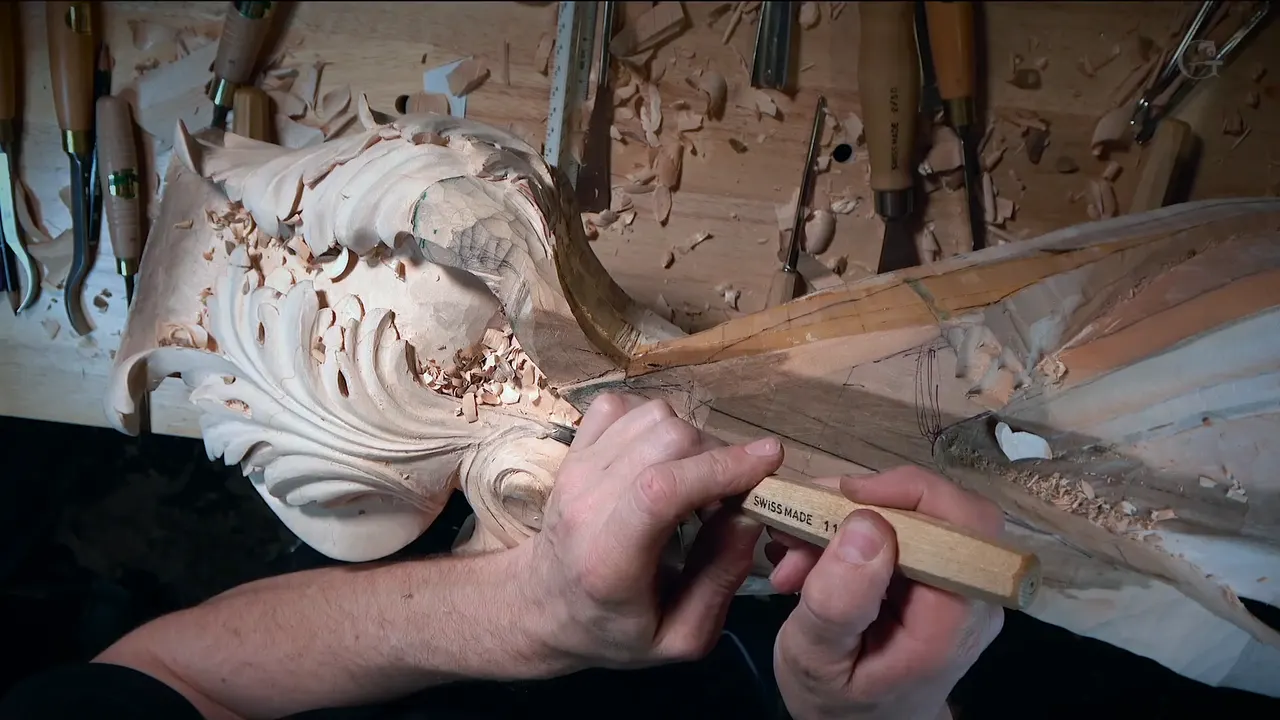

"I hope you can already catch the idea." I said that in Venice Room 89.3, after "I still have to go all around with the smaller one." Other lessons of mine carry nearly the same line, and each one sits beside something different.
Have you ever held a carved piece toward the camera and wondered if anyone could see the shape you were after? Did you lean your head out of the way so the view stayed clear? Then you know the spot I was in. This page begins in part 3 of workshop 89, and then follows the words through lessons from my other courses, each with its own link.
Six things in part 3
- The transition was smooth, and a smaller tool still had a trip around the piece ahead of it.
- The idea came first, and then the hope that you would catch it.
- Cleaning a little more, off camera, was my plan.
- A small hump showed under my finger, not on the camera.
- A brand-new rasp took the high spots out.
- A distance in one spot kept a maybe attached to it.
What did I say before the hope?
Part 3 opens with "All right," and then "That is a really nice and smooth transition," with the smaller tool in the same sentence. Then "So, that is the idea."

One word follows the hope: "Maybe." Following that comes "And of course, like I said, I'm going to clean it a little more right now. It's just developing the main idea."
Why did I plan to clean it off camera?
The plan was to clean it off camera, and the reason sits in these words: "because it's so inconvenient for me sometimes just to not stick my head, that's the goal, inside of the view."

Next is "I really like it." Soon after, "Its blending point, all of those movements going from the same movement." And a short order: "Clean that."
Next comes a plan. "And maybe I can actually somewhat undercut right away. But I want to make sure it looks really good in 3D. I'm talking about that slope."
Which spot did my finger find, and the camera miss?
"Looks like I do have a little hump I need to take out. I know on the camera it doesn't show, but when you move it like this, you can feel it."
After that: "And you know what? I could actually do something else. I never use, pretty much, rasps, but this year, I bought some of them. This is a brand-new one I didn't use yet. So I want to try it." The hope for the rasp: it would "help me to establish" a smooth movement, and then "I'll clean it again with the gouge."

"See, it takes out, right away, pretty much the high spots. And that is exactly what I said. So on the camera, you don't see that high spot, but I can feel it with the finger." The rasp "helped me actually establish a really nice and smooth transition downhill." Later, "And it's quite fast also."

"All right. That's enough." Next, "So at least I know exactly where I am." The names come after: "my outer movement" and "my inner movement right there."
What distance stood in that spot?
"I don't know yet if the distance I'm going to change or not, but for now, I've got about half an inch" (12.7 mm) "right in this spot, which I guess is okay. But maybe it's going to change." And "I do have that little small movement right here, which, in this case, actually helps me a lot."

For the shadow, a plan came next: "And yes, I could actually undercut a little more this area." Then "Beautiful shadow. With number 11, of course. Same number 11, what I used before, seven millimeters" (0.28 in), "A little bigger than a quarter inch" (6.4 mm).

"See? I got that shadow that I'm after." Then "Except right here, I need to use a smaller one again, maybe three millimeters" (0.12 in).
What do the other parts of workshop 89 say about the idea?
In part 2 comes "So that is going to be my idea." It also asks "how do I transition to it?" Part 4 has "Not much, because I still have to develop the idea little later, but just clean a little bit."

Where does the same line show up in other lessons?
A curl comes first in Hashemi Flowers 12.1: "from underneath, growing uphill, and then curl backward." Then "kind of confusing right now, but hopefully, you'll catch what I'm trying to reach." One more line: "let me attack that from this side."

In Hashemi Flowers 48.5, "let me remove this" comes before the catch line. Behind it sit "I'm doing actually really big curl, just like that. Big movement." Then "that is my excavation point." The line "But hopefully, you know what I mean." comes after that.

In Hashemi Flowers 20.1, "I need the V tool. Same V tool, number 16." comes first. Then "I really hope you can catch" goes on to "my idea about what I'm doing."
Over in Hashemi Flowers 13.2, "Make a really deep excavation" leads into "Hopefully, you can catch what I do." The gouge was "a 10 millimeters, #9 gouge" (0.39 in).

The shadow is the subject in Venice Room 64.3: First the words "Beautiful shadow casting," then "Can you see it?" and "kind of a little far." Next: "Hopefully, you will catch it." Later, "So I've got the camera a little closer to you, so hopefully, you can see how deep shadow it casts."

In Modern Acanthus 8.3, comes "look at my piece." The catch line comes next, and then "I did that already on this side, but I didn't touch yet that side." "Is it a good picture?" comes later, and after it "that would be number 11."

A pierced spot is in Vase with Grape Leaves 3.5: "really have to be careful not to pierce it through because it's much deeper right now." Then "But it is airborne, so you can see," and the catch line is next, followed by "It's all the way through."

Hazelnuts 2.1 has "All I need is just a preliminary movement," and the catch line right behind it ends "but just going downhill."

A handle is in Venice Room 71.10. "And why back bend?" The answer includes "I'm hitting with the handle on the main body." After that comes the catch line, and next "And I'm really limited what tools I can use."
Mid-sentence, Venice Room 80.2, holds it: "that distance between my stopper" and then "it's about one-eighth of an inch" (3.2 mm). Next, "Maybe a little less, maybe three-32nds of an inch" (2.4 mm).
Does the light change what you catch?
Light is the topic in Venice Room 90.1: "Just that you don't probably see, but I just created a small ridge." Then "Let me play with the light, and you can see that." It is "almost invisible when you just shoot the floodlight," and at the end "But at night, it's going to make a big difference."

In Roman Acanthus 16.3: "I could use an even smaller, really small gouge, like a one-eighth of an inch gouge" (3.2 mm), and "create extra notch in inside, just like that." Next, "And in the full light, you're not going to be able to catch it." Evening and side light show every little detail. Later: "And again, that depends how you cast your light."

Extra concaves are the plan in Venice Room 10.3: "Just two, three, maybe right there, and give that extra feel." The tool plan is "probably number 7." And "but still, you're going to catch it when you're going to look at it. Depends how the light going to hit."

A far point of the room is the setting in Venice Room 56.10: "I was thinking I could bring one of the movements actually pretty much this direction." The prediction is "invisible if you look from the bottom." But "like a far point of the room" brings the catch line.

Light is the subject in Venetian Flowers Rosette 4.3, where "need the long bend, number seven" comes first. Then "too much lights going on." And "It's kind of bright," with the catch line right after those words.

Floral and Molding 10.3 has "a secondary movement on inside." It "creates extra shadow." Before "it casts extra shadow, like I said" comes the catch line. Next: "Totally don't have to do it, okay?" And "But I like that stuff."
What if the idea is the thing to catch?
Roundness is the plan in Furniture Panel 36.3: "number five and this, one eight of an inch" (3.18 mm), "Now use it upside down." The plan is "some kind of roundness all around," and "And I still wanna keep my high spot" opens a sentence that holds the catch line.

In Venetian Flowers Rosette 5.2, the words are "another cut, like on the side." Then "I have a lot of stuff to clean up" opens another such sentence, and it ends "once I've done it."

A tool is named in Venice Room 88.12: "Number 3, that's what I'm using." Then "you should be able to see I'm establishing that sloping movement on this side," and the catch line follows.

A lower concave is the job in Floral and Molding 3.3: "Now somehow I have to create the lower concave." Then "number nine and 1/8 of an inch" (3.18 mm). Next, "And yes, most likely going to cover with my hand, the view," and the catch line. After it, "It doesn't have to be really deep concave, by the way. Just establish the idea, and that is enough for me."
Who else would catch it?
In Venice Room 41.6, "by the law of design, you have to repeat." Then "And most of the people are not going to catch it," followed by "some professional people looking at it." And "architects and designers who are involved in the project."
In Furniture Panel 38.2 come "some kinda little too deep cut in this section," and "that is the mistake, mistake of the design." Next: "But please, you're the only one who knows that nobody's gonna catch it." And "Maybe it was on purpose."
A design rule is in Design Principles 2.1: "It's a rule of diagonal movement. Catch it?" Then "each space, every design has a diagonal and usually two main ones."
Does catch mean something else near the grain?
Grain is the subject in Tray of Blessing 7.1: "be careful what the grain does. You feel, what the grain does because you could catch it." Then "approach from different positions."

In Furniture Panel 18.5: "you can actually catch the edge and split, and it can create a problem." Then "if you really have sharp tools, you should not catch it."

A third meaning shows in Venice Room 4.5: "I can see the problem I don't like." Then "if I can catch it right away, I can always fix it right away."
Where did I say it, lesson by lesson?
| Lesson and place | Next to it |
|---|---|
| The smaller tool that still had a trip around the piece, workshop 89.3 | a smooth transition |
| A curl in Hashemi Flowers 12.1 | growing uphill and then backward, kind of confusing right now |
| A big movement and a spot I named, in Hashemi Flowers 48.5 | excavation point |
| The V tool, Hashemi Flowers 20.1 | number 16, then my idea about what I'm doing |
| A really deep excavation with a gouge, Hashemi Flowers 13.2 | 10 millimeters (0.39 in) |
| A deep shadow, Venice Room 64.3 | the camera a little closer to you, so you can see how deep |
| The words look at my piece, in Modern Acanthus 8.3 | a good picture |
| Vase with Grape Leaves 3.5 | careful not to pierce it through, because it is much deeper |
| Going downhill, in Hazelnuts 2.1 | preliminary movement |
| A handle against the main body, Venice Room 71.10 | a back bend, and really limited tools |
| A stopper and about an eighth of an inch (3.175 mm), Venice Room 80.2 | maybe three-32nds of an inch (2.4 mm) |
| A ridge under the floodlight, Venice Room 90.1 | almost invisible |
| An extra notch inside, in full light and evening light, Roman Acanthus 16.3 | the light you cast |
| A few extra concaves, Venice Room 10.3 | number 7 |
| Another part of the room, Venice Room 56.10 | invisible from the bottom |
| The long bend and too much light going on, Rosette 4.3 | kind of bright |
| A secondary movement on the inside, Molding 10.3 | extra shadow |
| A high spot to keep, in Furniture Panel 36.3 | roundness all around |
| Rosette 5.2, a lot of stuff to clean up | "another cut, like on the side" |
| Venice Room 88.12 | a sloping movement on this side, then the same right here |
| A lower concave and my hand most likely over the view, Molding 3.3 | number nine |
| Who looks at the work, Venice Room 41.6 | architects and designers |
| A mistake of the design that nobody will see, Furniture Panel 38.2 | maybe on purpose |
| A rule in Design Principles 2.1 | diagonal movement |
| The grain and the words you could catch it, Tray of Blessing 7.1 | approach from different positions |
| Sharp tools and the edge that can split, Furniture Panel 18.5 | if you really have sharp tools |
| A problem seen early enough to fix, Venice Room 4.5 | right away |
Is there a spot on your wood carving that the camera cannot show? Could you put your hand tools down, and feel it with a finger the way I did in part 3? Workshop 89 waits inside one tuition plan with the rest of the Part 8 workshops, and this page starts at that hump.
How it's done
- Smooth transition. Part 3 of workshop 89 opens on a smooth transition, with a smaller tool still to come.
- The idea first. "Maybe" followed the hope. Then came the plan to clean a little more.
- Feel the hump. The hump did not show on the camera. A finger on the piece found it.
- Try the new rasp. I wanted to try a brand-new rasp. It took out the high spots right away.
- Name the movements. Two names came: an outer movement and an inner movement. I did not know yet if the distance would change.
- Plan the shadow. More undercut was possible, with the same number 11, seven millimeters (0.28 in). Smaller again, maybe three millimeters (0.118 in).
Frequently asked questions
What came before the hope in this part?
A smooth transition, and the smaller one still to go around.
Which hump did the camera miss?
The hump was little, I said, and it did not show on the camera.
How did the rasp help in part 3?
It took out the high spots right away, I said, and it helped me establish a smooth transition downhill. It was quite fast.
What distance did I name for that spot?
What to carve next